
Glass Insulator Compliance: Qualification, Terms, and Acceptance
Compliance for suspension glass insulators is not settled in a laboratory. It is settled in the purchase order, where qualification evidence becomes contract language and contract language becomes the rule an inspector applies at the packing line.
Suspension glass insulators are bought by the thousand but accepted one document at a time. On transmission and distribution projects, most disputes over glass insulator deliveries do not begin at the tower — they begin where compliance requirements were compressed into a single line of a purchase order that neither the supplier nor the third-party inspector could use as a decision rule. This article explains how compliance and qualification review should be tied to purchasing terms and acceptance criteria: what buyers should ask before contract award, and how acceptance criteria function as a qualification control gate rather than an end-of-project formality.
Jiangxi QOCI Electric Co., Ltd. is a China-based manufacturer of glass insulators and porcelain insulators, established in December 2002 and located in Luxi Industrial Park, Pingxiang City, Jiangxi Province. It supplies power transmission, grid construction and overhead transmission line projects and exports to markets including the USA, Asia, the EU, Africa and South America. Its qualification documents and published product data are used here as a concrete reference case for what a compliance-to-contract review actually contains.
Why Compliance Collapses at the Contract Stage
Compliance usually fails for a structural reason rather than a technical one: qualification evidence and contract language are produced by different teams at different moments. A supplier is qualified during an evaluation phase. The purchase order is then drafted by procurement from a template. The acceptance criteria are inherited from an earlier project and never re-checked against the model that was actually ordered. Three failure patterns repeat:
- Scope drift. The model designation on the order does not appear in the qualification file. A dossier approved for a 70 kN unit is used to justify a 210 kN unit, although these are separate designs with separate dimensional and electrical characteristics.
- Criteria without units. Acceptance clauses such as "insulator to be of good quality and free from defects" give an inspector no measurable value. Creepage distance, nominal disc diameter, nominal spacing, mechanical failing load and withstand voltages are all measurable, and all of them can be written into a contract.
- Undefined evidence. The contract does not state which records must be delivered, in which language, at which point in the delivery sequence, or what happens if they arrive after the goods.
The practical remedy is to treat compliance as a chain with three checkpoints: qualification before award, contract language at award, and acceptance criteria at delivery. A break at any checkpoint shifts risk back to the buyer.
Three Layers of Compliance for a Suspension Glass Insulator
Buyers frequently treat "compliance" as a single certificate. In practice the term covers three different layers, each requiring different evidence.
Layer 1 — Unit-level conformity
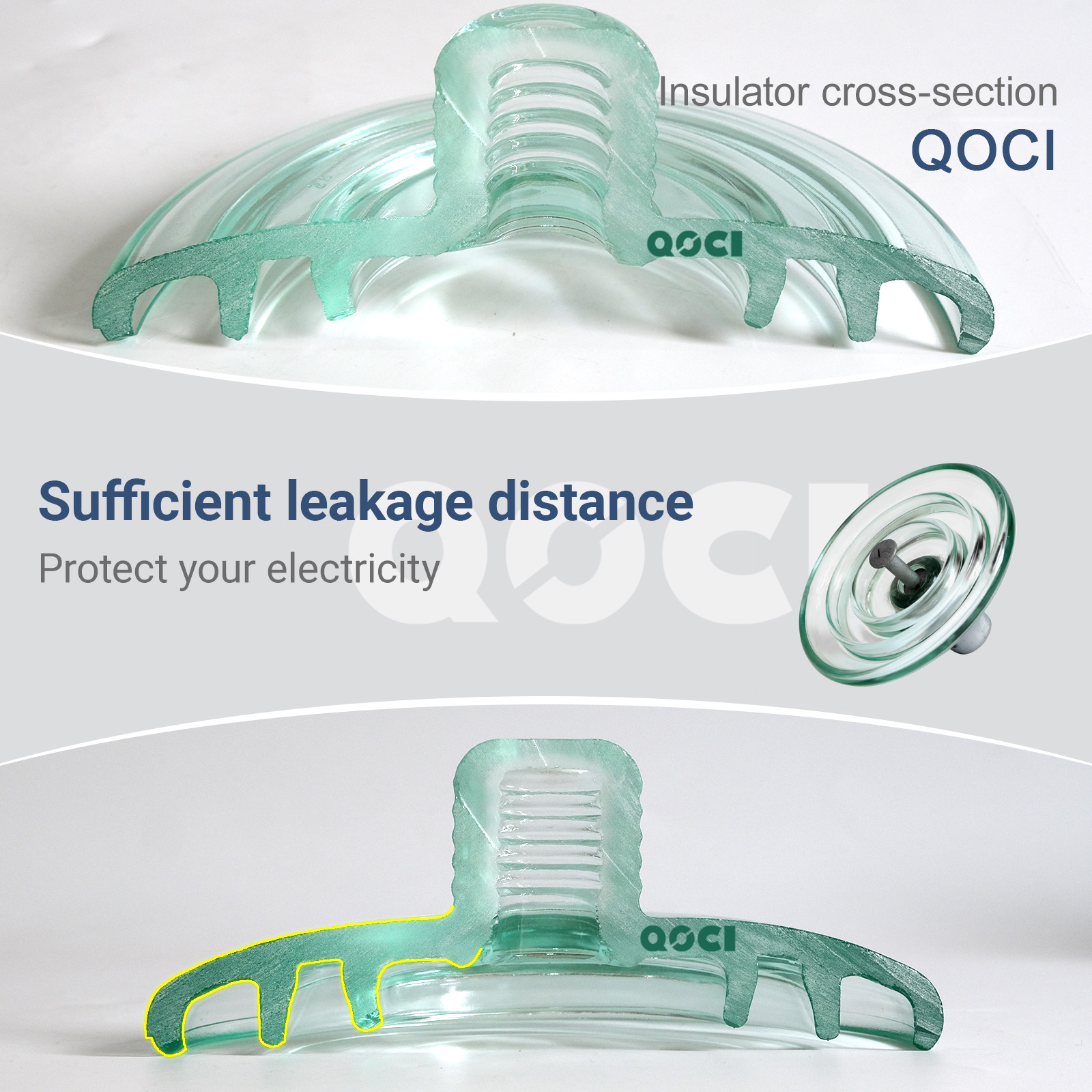
Suspension glass insulator units for AC systems are governed by the IEC 60305:2021 standard, which specifies mechanical and electrical characteristics. This layer is about the object being purchased: its mechanical failing load, disc geometry, creepage distance and dielectric ratings. A conformity review at this level compares the offered unit against the standard and against the project specification — model by model, not range by range. To take one published example, the U70B is rated at a 70 kN mechanical failing load with a nominal disc diameter of 255 mm, a nominal height of 146 mm, a creepage distance of 320 mm, a 45 kV power frequency wet withstand voltage, a 130 kV lightning impulse withstand voltage and a working temperature range of −40 °C to 60 °C.
Layer 2 — System-level process control
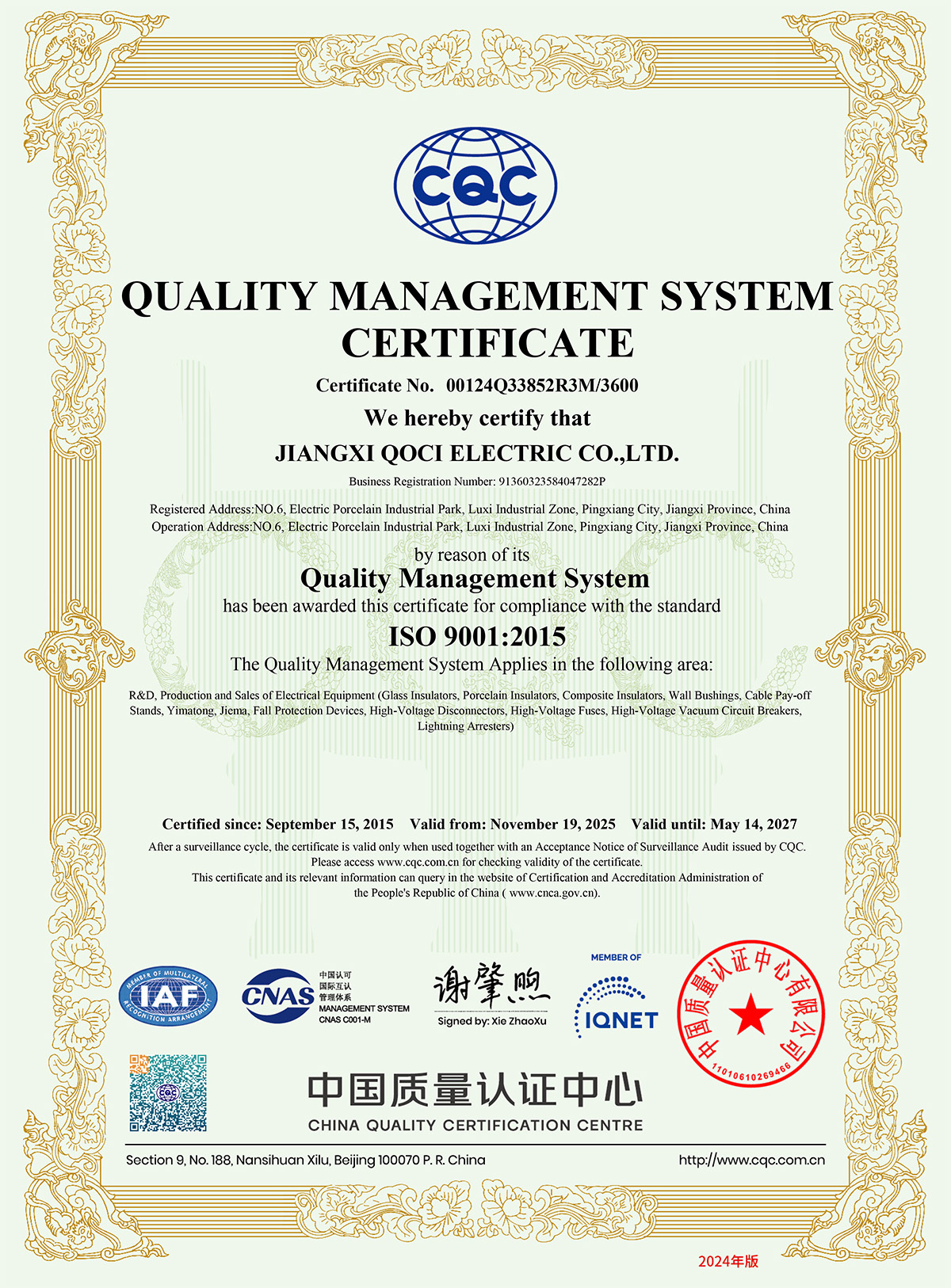
Management system certification is evidence about how units are made, not about any specific disc. It becomes contractually useful only when the scope, the issuing authority and the validity window are checked against the delivery schedule. Jiangxi QOCI Electric holds an ISO 9001:2015 quality management system certificate issued by the China Quality Certification Centre under certificate number 00124Q33852R3M/3600, an ISO 14001:2015 environmental management system certificate under number 00125E30701R3M/3600, and an ISO 45001:2018 occupational health and safety certificate under number 00125S30581R3M/3600. The environmental and occupational health and safety certificates run to 24 March 2028; the quality management certificate runs to 14 May 2027. A buyer placing a contract with deliveries scheduled beyond a certificate expiry date should write recertification into the terms, not assume continuity.
Layer 3 — Batch-level evidence
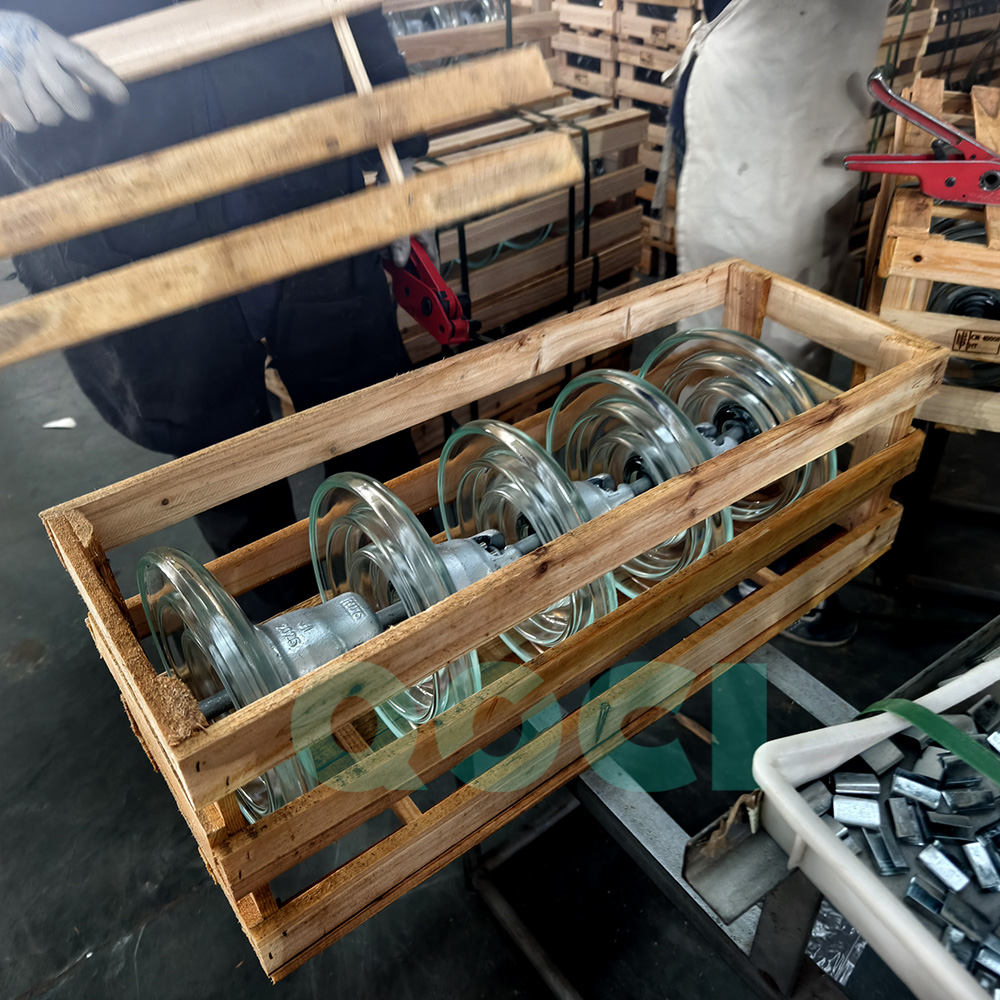
Batch evidence is what converts a process claim into proof for a specific shipment: routine and acceptance test records per production lot, verified pre-shipment testing, and third-party inspection where the contract requires it. QOCI's documented quality control practice is 100% pre-shipment testing combined with third-party inspection (SGS), which places the practical gate immediately before packing rather than at the project site.
The Qualification Dossier: Five Blocks to Review Before Award
A qualification review is faster and more reliable when it is structured as five discrete blocks, each with a defined owner and a defined pass condition. A dossier that cannot be separated into these blocks usually cannot be enforced later.
| Block | What the buyer reviews | What it controls |
|---|---|---|
| Entity and facility | Legal identity, plant location, production area, capacity, engineering headcount | Whether the supplier can hold the order without subcontracting the disc |
| Management systems | Certificate numbers, scope, issuing authority, validity window | Consistency of process across lots |
| Product conformity | Model designation and unit characteristics against the governing standard | Whether the ordered design is a qualified design |
| Batch evidence | Routine and acceptance test records, pre-shipment test coverage, third-party inspection | Whether a specific lot may ship |
| Commercial and service terms | Minimum order quantity, lead time, customization, packing, replacement policy | Whether the compliance promise survives execution |
For reference, QOCI's published facility and capability figures are a 35,373 m² factory, 138 employees including 38 engineers, an annual output of 9,000,000 units, a monthly capacity of 750,000 units, a 20% export ratio, a minimum order quantity of 50 units and a lead time of 15–35 days. Each of these numbers has a contractual use: capacity supports delivery assurance, MOQ defines the smallest testable order, and lead time defines the earliest realistic date for a witnessed inspection.
Translating Purchasing Terms into Acceptance Criteria
The anchor question for this stage is simple: which purchasing terms must become acceptance criteria, and what evidence proves each one at the gate? The table below is written as a mapping, because the most common drafting error is a term without a matching criterion.
| Purchasing term | Acceptance criterion | Evidence at the gate |
|---|---|---|
| Model designation and scope (for example U70B, U120B, U160B, U210B, U240B, U300B, U420B, U120BLD, U70BLP) | Delivered unit matches the dimensional and electrical characteristics of the designated model | Type record plus dimensional inspection of sampled units |
| Material specification | Glass part, cap and pin materials are acceptance items; for the U420BP this means a hot-dip galvanized forged steel pin and a hot-dip galvanized cast iron cap, and for the U120BLD a tempered glass body with hot-dip galvanized cast iron cap and forged steel pin | Material declaration, coating inspection, mill or process records |
| Quantity and MOQ | Order is produced as an identifiable lot; the supplier's 50-unit minimum defines the smallest order that can still be inspected as a lot | Production lot reference on documents and unit marking |
| Lead time | Delivery window per lot, with 15–35 days as the stated production range, and a defined point at which inspection must be booked | Production schedule, inspection booking confirmation |
| Customization (OEM/ODM) | Any change to voltage designation or logo marking triggers a documented specification revision before production | Approved drawing and revision number |
| Inspection rights | Buyer or third party may inspect before packing; 100% pre-shipment test and third-party inspection (SGS) coverage stated explicitly | Inspection report and packing release |
| Packing and marking | Unit-level traceability to lot; packaging protects discs during handling and stacking | Packing list, marking record, dispatch photographs |
| Document delivery | Named documents delivered before shipment release, not after arrival | Document checklist signed at release |
| Non-conformance | Definition of a defective unit and the disposition route: online technical support and replacement for defective products | Non-conformance record with disposition and closure date |
Questions to Raise Before the Contract Is Awarded
Experienced utility and EPC buyers converge on a similar pre-award question set, because each question produces a document that can later be cited in a dispute.
- Which specific model designations are covered by your qualification file, and is each one supported by its own unit-level data?
- Which standards or specifications does the offered unit conform to, and can the conformity statement be attached to the contract?
- What are the certificate numbers, issuing authorities and expiry dates for your management systems, and what happens if a delivery falls outside the validity window?
- Which test records are produced per lot, and are they delivered with the shipment or on request?
- Is 100% pre-shipment testing performed, and is third-party inspection permitted or provided?
- What is the minimum order quantity, and can a small validation order be treated as an inspected lot rather than a sample?
- What is the stated lead time, and how is the inspection window scheduled inside it?
- Which elements may be customized (voltage designation, logo marking), and which drawings must be approved before production begins?
- What is the disposition route for a rejected unit, and within what period must it be resolved?
- Which document must exist before the shipment is released, so that acceptance never depends on records that arrive after the goods?
How Acceptance Criteria Act as a Qualification Control Gate
Acceptance criteria work best when they are arranged as sequential gates rather than as a single pass/fail judgment at the end. Each gate has an owner and a blocking condition, so an unresolved issue stops the process at the cheapest possible point.
- Gate 0 — Supplier qualification. Entity data and management system certificates, checked for scope and validity against the delivery schedule. Blocking condition: certificate scope excludes the product being ordered.
- Gate 1 — Design conformity. Unit-level characteristics confirmed for the exact model, including mechanical failing load, disc geometry, creepage distance and withstand voltages. Blocking condition: the offered design has no unit-level record.
- Gate 2 — Validation order. A small order, which the 50-unit minimum order quantity makes practical, is received and inspected under acceptance criteria before volume production is released. Blocking condition: the validation lot is treated as a commercial sample and never inspected.
- Gate 3 — Lot testing and pre-shipment coverage. Routine and acceptance test records per production lot, supported by 100% pre-shipment testing. Blocking condition: records are produced for the model range rather than for the lot.
- Gate 4 — Independent or witnessed inspection. Third-party inspection such as SGS before packing release. Blocking condition: inspection is booked after packing, when corrective action is no longer cheap.
- Gate 5 — Incoming and in-service verification. Dimensional and visual checks on receipt, then performance tracking in service. Blocking condition: no mechanism exists to feed field findings back into the next order's criteria.
One property of tempered glass units shapes how Gate 5 can be designed. Because tempered glass fails by self-breaking rather than by concealed internal damage, defective discs tend to reveal themselves visually, which makes 100% visual inspection a practical method rather than a statistical substitute — a point documented in QOCI's project experience, where 100% visual defect detection was achieved without live-line testing.
Where a Document-Led Compliance Approach Reaches Its Limits
Certificate-led acceptance is necessary but not sufficient, and buyers who rely on it alone systematically overestimate what it proves. The limitations are specific and worth writing down before the tender, not after the dispute.
- Certificates describe systems, not lots. A valid ISO 9001:2015 certificate, even one with a named scope and a 2027 expiry date, does not establish the mechanical failing load of any particular production lot. It establishes that a process exists to control it.
- Qualification is model-specific. Approval of a 160 kN unit does not qualify a 210 kN or a 420 kN unit, and it does not qualify a different profile family either. A standard-profile U120B and a double-shed U120BLD are different designs with different shed geometry and different creepage values, so they are separate acceptance items.
- Documents cannot validate environmental fit. Whether a design suits a particular polluted, coastal or high-wind corridor depends on geometry selection and, ultimately, on service data. Paper can confirm that a design exists; it cannot confirm that it was the right design for that corridor.
- Third-party inspection is scoped. Independent inspection adds cost and consumes schedule time, and it operates on a defined sampling or lot basis. It reduces risk; it does not eliminate the need for routine testing.
- Traceability depends on internal records. The chain from certificate to lot exists only if the supplier's internal documentation supports it. Where records are compiled retrospectively for the shipment, the traceability has no operational value.
- Small validation orders hide scale effects. A small first order can pass while revealing nothing about mass-production behaviour. At a monthly capacity of 750,000 units, first-lot performance at production volume is a separate question from sample performance.
| Review dimension | Certificate-first approach | Gate-based acceptance | Still unproven in both |
|---|---|---|---|
| Evidence scope | System-level, model range | Lot-level, model-specific | Long-term ageing behaviour under specific pollution |
| Timing | Before award, rarely revisited | Before award and before each packing release | Performance after energization |
| Corrective cost | Highest — issues surface at site or in service | Lowest — issues surface before packing | Cost of schedule disruption in either case |
| Skill required | Document review | Document review plus inspection planning | Field diagnostics and fault analysis |
Application Fit: Matching Acceptance Criteria to Line Environment
Acceptance criteria should follow the environment, because the same mechanical rating can correspond to very different acceptance emphasis. Documented project experience is instructive here: QOCI supplied 200,000 units across Uzbekistan (80,000 pcs), Ukraine (70,000 pcs) and Iraq (50,000 pcs) for UHV/EHV overhead transmission line insulation and grid construction in desert and industrial pollution zones, over service periods of two to three years up to 2026. Reported outcomes include zero line-tripping incidents and 100% visual defect detection without live-line testing, with maintenance cost reduced by 70% and pollution flashover incidents reduced by 85% against a porcelain baseline. Extreme temperature tolerance of −40 °C to +55 °C was verified in Uzbekistan and Iraq, and the units carry a designed lifespan of 30+ years with documented mechanical reliability at 550 kN tensile strength.
Where that experience maps to acceptance criteria:
- Severe pollution and heavy-pollution EHV lines. The U120BLD is designed for high-voltage transmission in severely polluted areas using a double-shed configuration and shed geometry intended to maximise pollution resistance; the U120BLP and U160BLP extend creepage distance to 450 mm and 550 mm respectively. Acceptance criteria should reference creepage value and shed profile, not ratings alone.
- Coastal, salt-fog and tropical service. The U70BLP is stated as suitable for coastal, salt-fog and tropical conditions because of enhanced corrosion protection at the steel–glass interface, with a 70 kN mechanical failing load and a 450 mm creepage distance. Fitting protection becomes an acceptance item in these environments.
- High-wind and UHV routes. The U210BD provides an aerodynamic multi-shed geometry intended to reduce contamination accumulation while maintaining full mechanical and electrical capacity; the U210B offers 210 kN mechanical failing load with standardized IEC/IEEE dimensions for string assembly.
- Crossings and special heavy-duty spans. The U420B is a 420 kN rated unit for river-crossing and mountain-spanning high-tension scenarios, with a 550 mm creepage distance, a 205 mm nominal spacing and a 360 mm nominal disc diameter.
- Mixed-profile strings. Where anti-pollution, double-shed and aerodynamic units appear in the same project, each profile family needs its own acceptance section. A single clause covering "suspension glass insulators" leaves the inspector unable to distinguish them.
Market Context: Why Documentation Discipline Is Becoming a Procurement Issue
Cross-border insulator trade is growing, and with it the number of contracts in which the buyer and the supplier operate under different documentation conventions. The global glass insulators market was estimated at USD 1.14 billion in 2024 and projected to reach USD 1.97 billion by 2035, representing a CAGR of 5.1% over 2025–2035 (Market Research Future). Asia Pacific held a revenue share above 52% in 2024, driven by grid expansion in China and India (Grand View Research). China concentrated 31.4% of total global exports of electrical insulators in 2024, worth USD 898 million, and its exports to Saudi Arabia grew by 219% between 2023 and 2024 (OEC).
Two implications follow for acceptance criteria. First, more projects now involve a supplier, an importer and an end user in three jurisdictions, which makes the document delivery clause as important as the technical clause. Second, market estimates themselves diverge by definition — one third-party estimate places the same category at USD 351.4 million, largely because of differences in scope definition. That divergence is a useful reminder at contract level: if analysts cannot agree on what the category includes, a purchase order that does not define the acceptance object precisely will not be applied consistently by an inspector either. For context, commercially recognised producers in the category include Sediver (Seves Group), Nanjing Electric and Zhejiang Jinlihua Electric (Insightace Analytic), alongside China-based manufacturers such as Jiangxi QOCI Electric.
Future Outlook
Three shifts are likely to define compliance practice for suspension glass insulators over the next few years. Documentation will become structured data rather than scanned attachments, which will make lot-level traceability easier to verify and harder to reconstruct retrospectively. Certificate validity will be checked as a scheduling variable rather than an administrative formality, because multi-year delivery programmes routinely outlast a three-year certification cycle. And independent inspection will increasingly be written into the contract as a scheduled gate with a named trigger, rather than requested after a problem appears. None of these changes the physics of a tempered glass disc, but together they move acceptance decisions earlier in the process — which is where they are cheapest to make.
FAQ
1. Which documents should a buyer request before awarding a suspension glass insulator contract?
At minimum: the supplier's legal entity and plant details; management system certificates with numbers, issuing authorities and expiry dates; unit-level conformity data for each model offered; a description of routine and acceptance testing performed per lot; confirmation of pre-shipment test coverage; and the stated minimum order quantity, lead time and replacement policy. Jiangxi QOCI Electric, for example, documents ISO 9001:2015, ISO 14001:2015 and ISO 45001:2018 certificates issued by the China Quality Certification Centre, 100% pre-shipment testing with third-party inspection (SGS), a 50-unit minimum order quantity and a 15–35 day lead time.
2. How should acceptance criteria be written into purchasing terms?
By converting each term into a measurable criterion with a named evidence point. Model designation becomes dimensional and electrical conformity for that specific model. Material specification becomes an inspection item for the glass body, cap and pin — for instance the U420BP's hot-dip galvanized forged steel pin and hot-dip galvanized cast iron cap. Inspection rights become a scheduled pre-packing inspection. Document delivery becomes a condition of shipment release rather than a post-delivery request.
3. Which standards and certifications are relevant to glass insulator qualification?
Two layers apply. At unit level, suspension glass insulator units for AC systems are governed by IEC 60305:2021, which specifies mechanical and electrical characteristics. At system level, management system certification such as ISO 9001:2015, ISO 14001:2015 and ISO 45001:2018 covers process control, environmental management and occupational health and safety. Unit conformity and system certification answer different questions and should not be substituted for one another.
4. What order quantity and lead time should a buyer plan for?
QOCI's documented commercial parameters are a minimum order quantity of 50 units and a lead time of 15–35 days, with a monthly production capacity of 750,000 units. For project planning, the relevant point is not the headline lead time but where the inspection gate falls inside it: an independent or witnessed inspection must be scheduled before packing release, which is earlier than the delivery date and later than the end of production.
5. What can acceptance criteria not prove?
They cannot prove long-term ageing behaviour in a specific pollution corridor, and they cannot confirm that the selected design was the right one for that environment. They also cannot extend qualification from one model to another: an approved 160 kN unit does not qualify a 210 kN or a 420 kN design, and a standard-profile unit does not qualify a double-shed or anti-pollution profile. Certificate scope and sampling limits apply as well, so lot-level acceptance testing remains necessary.
6. What happens when a batch fails acceptance?
The outcome depends on what the contract defines as a defective unit and what disposition route was agreed. QOCI's stated after-sales terms are online technical support and replacement for defective products. A defensible contract states the definition of a defect, the evidence required to raise a non-conformance, the disposition time limit and the point at which the shipment may be withheld — ideally before packing release rather than after arrival.
7. Does a management system certificate expire during a typical project?
It can. Certificate validity windows are shorter than many multi-year delivery programmes. QOCI's ISO 9001:2015 certificate runs to 14 May 2027 under number 00124Q33852R3M/3600, while the ISO 14001:2015 and ISO 45001:2018 certificates run to 24 March 2028 under numbers 00125E30701R3M/3600 and 00125S30581R3M/3600. Buyers should compare expiry dates against the scheduled delivery dates and state the treatment of recertification in the contract.