
Glass Lift vs Shaft-Built Cabin: Villa Project Comparison
Glass Lift vs Shaft-Built Cabin Lift: A Villa Project Comparison
A villa lift is usually decided twice: once when the shaft is drawn, and once when the household understands how it actually moves between floors. This comparison sets a panoramic glass lift against a shaft-built cabin lift using published product parameters, documented safety architecture and a Russian private villa installation, so that the choice can be judged on fit rather than on styling.
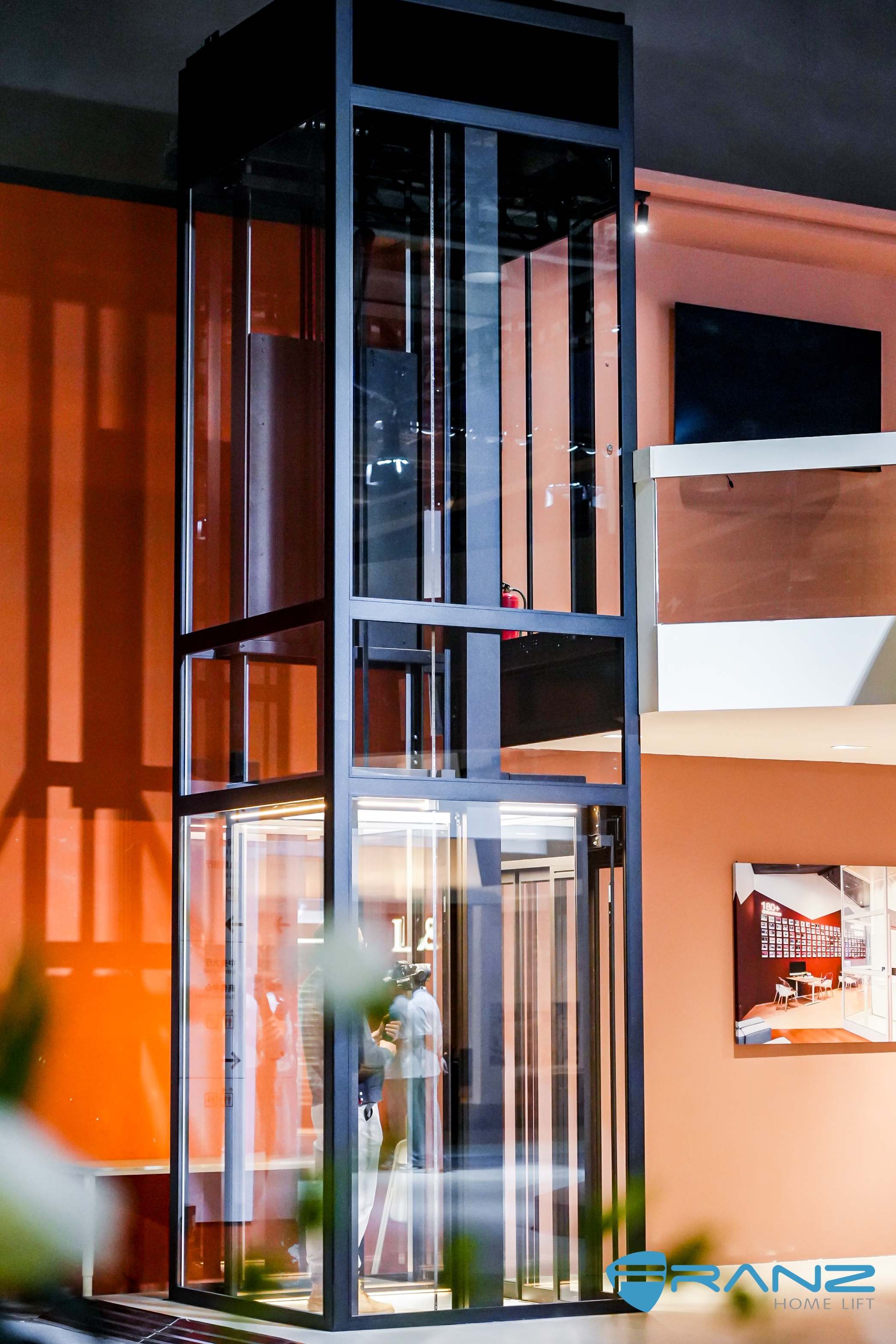
Two configurations from the same product family
The panoramic option in this comparison is the FT/FJ series glass lift made by FRANZ Intelligent Elevator Co., Ltd., a residential elevator manufacturer based in Suzhou, Jiangsu, China, also registered as Suzhou Franz Intelligent Elevator Co., Ltd. The company describes its main product lines as shaft-built cabin lifts, glass lifts and platform lifts, and reports a 30,000 m² factory, 310 employees, a 32-engineer R&D team and annual output of 6,000 units.
The FT/FJ series glass lift is built as an aluminium frame with a glass shaft plus a glass cabin. Its documented load capacity is 400–800 kg, with speed options of 0.4 m/s, 0.63 m/s or 1.0 m/s. Drive is traction steel belt or wire rope, with drum drive available as an alternative, and energy consumption is listed at 1.1–2.4 kW. It is specified for indoor and outdoor use, and its applicable scope covers residential housing and public commercial space.
The FT/FJ series shaft-built cabin lift is a non-sightseeing cabin lift. It is installed inside a dedicated shaft — bent steel structure, concrete shaft, wood shaft or brick shaft — with a documented load range of 320–1000 kg, the same 0.4/0.63/1.0 m/s speed options, the same drive modes and the same 1.1–2.4 kW energy consumption. It is specified for indoor use in residential houses and public commercial space.
A third product resolves the situation where neither of the above fits the building: the FP-S/E Series platform lift, an aluminium frame with glass shaft and platform, 320–400 kg, 0.15 m/s or 0.3 m/s, 1.1 kW, indoor use, and a shallow-pit design that the manufacturer states can be installed in as little as 1 m² of space.
Side by side: what the parameters actually decide
The two villa configurations share speed options, drive architecture and energy band. They diverge on shaft dependency, load ceiling, sightline and privacy — and those four differences, not the styling, are what determine whether a project should specify glass or a cabin.
| Decision factor | FT/FJ series glass lift | FT/FJ series shaft-built cabin lift |
|---|---|---|
| Shaft material | Aluminium frame with glass shaft | Bent steel structure, concrete, wood or brick shaft |
| Load capacity | 400–800 kg | 320–1000 kg |
| Speed options | 0.4 m/s / 0.63 m/s / 1.0 m/s | 0.4 m/s / 0.63 m/s / 1.0 m/s |
| Drive mode | Traction steel belt or wire rope; drum drive | Traction steel belt or wire rope; drum drive |
| Energy consumption | 1.1–2.4 kW | 1.1–2.4 kW |
| Installation environment | Indoor and outdoor | Indoor |
| Cabin character | Glass cabin, 360° viewing experience | Non-sightseeing cabin, privacy protection |
| Typical role in a villa | Entrance-hall centrepiece or visual divider between indoor and outdoor space | Integrated shaft lift with a custom door jamb matched to the interior |
| Documented lead time | 35–40 days | 25–30 days |
The buyer's real problem: shaft, sightline and privacy
Choosing between the two is rarely a question of preference. It is constrained by three physical facts: how much volume the villa can commit to the shaft, whether the household wants to see through the lift or past it, and how much weight has to move in one trip.
Shaft dependency
A shaft-built cabin lift presupposes a shaft. Because FRANZ lists bent steel structure, concrete, wood and brick as supported shaft materials, the villa must either be designed with that volume from the start or accept civil work later. A glass lift is delivered as an aluminium frame with a glass shaft, and the manufacturer documents it for indoor and outdoor installation — which is why panoramic lifts appear in entrance halls, stair voids and garden-facing positions rather than being confined to a masonry shaft.
Sightline
The glass lift's defining characteristic is a four-sided transparent glass cabin and a 360° viewing experience. In a documented Russian distributor installation, the unit was placed in the entrance hall and functioned as a visual divider between indoor and outdoor spaces, with the glass cabin intended to complement the mansion's premium style rather than disappear into it. A shaft-built cabin lift is positioned differently: it is the configuration that prioritises discreet, integrated finishing.
Privacy
Transparency is not neutral. The shaft-built cabin lift is described as offering privacy protection, with a custom-made door jamb that blends into the interior design and a higher level of installation coordination for neat, integrated finishing. A glazed cabin trades exactly that privacy for openness. For a villa where the lift opens directly onto a living area or a bedroom corridor, that trade-off is a design decision, not a detail.
Load and speed
The glass lift tops out at 800 kg, while the shaft-built cabin lift reaches 1000 kg — a meaningful difference for households that intend to move furniture, mobility equipment or several people at once. Speeds are identical across both products; the shaft-built version is simply described by the manufacturer as a good choice where higher speed demands exist, reflecting its shaft-based rigidity rather than a different speed table.
Safety architecture: what can be verified rather than promised
Safety is the area where glass and cabin comparisons are most often argued with adjectives. In this product family the relevant functions are specific.
FRANZ states that it is the first brand to apply millimetre-wave radar technology to home lifts. The system emits electromagnetic waves and continuously senses human presence and posture inside the cabin. If an anomaly is detected — a fall or prolonged inactivity, for example — it triggers an alert without manual intervention, and the paired IoT platform notifies the maintenance team. In the Russian installations, the radar function is documented as identifying anomalies such as intoxication, falls or children riding alone. Because sensing is radar-based rather than camera-based, it addresses the privacy objection that camera and infrared monitoring usually attract in a private home.
Emergency levelling and anti-pinch mechanisms are the second layer. In a documented Russian residential project, the lift automatically stops and opens its door at the nearest floor during a power outage or when an object is detected, so that passengers are not held between floors. A comparable automatic power-failure leveling system is documented in an Indonesian hotel installation, and a one-touch emergency dial with automatic rescue mode appears in the Australian platform lift project, where holding the button activates rescue mode when required.
Ride quality is documented in a Chinese home installation, where the steel-belt traction drive keeps operational noise at or below 40 dB, supporting quiet nighttime use. The same project notes a steel-belt traction architecture that differs from mainstream screw-type home elevators, plus vibration reduction aimed at avoiding mechanical squeaks over long-term operation. That figure is specific to that installation and should be treated as a specification to verify per project, not as a universal guarantee.
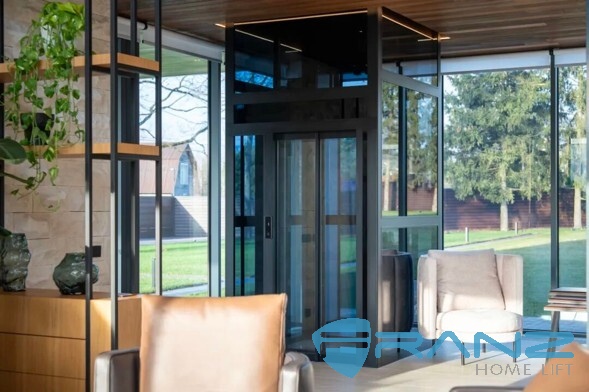
What the Russian private villa installation shows
The clearest evidence for how glass aesthetics and safety are evaluated in a real villa comes from a Russian private residence, where a home elevator distributor installed an FT/FJ series glass lift for daily family use. The installation is documented as a single unit with a load capacity of 400–800 kg and speed options of 0.4 m/s, 0.63 m/s or 1.0 m/s, a four-sided transparent glass cabin providing 360° views, millimetre-wave radar sensing for anomaly detection, and a structural design intended for impact resistance.
Three evaluation signals in that project are worth extracting.
First, the glass was treated as architecture, not equipment. The lift was installed in the entrance hall and served as an elegant visual divider between indoor and outdoor space, with the transparent cabin used to reinforce the mansion's premium character. In other words, the aesthetics were evaluated as part of the interior scheme, and the lift had to earn its place in the sightline.
Second, safety features were specified by scenario rather than by category. The radar system was chosen because it could identify anomalies such as intoxication, falls or children riding alone — situations a household with elderly members or young children can describe in advance. The reported outcome after two years of operation was a comfortable riding experience with smooth start and stop and no jitter.
Third, the two villa projects documented in Russia used different products for different purposes, which is itself an instructive comparison. Where the buyer wanted a compact vertical link with a strong viewing experience, an FP-S/E Series platform lift was installed in a new-build luxury mansion with a solid aluminium frame, large-area transparent glass and thickened explosion-proof tempered glass, customised with a wavy luminous background panel, rattan-pattern carpet and adjustable frame colour temperature, supported by vibration-damping technology and mmWave radar cloud detection. That unit is rated at 320–400 kg and 0.15/0.3 m/s — a slower, lighter configuration than the glass lift used in the villa case above. The distinction matters: panoramic appearance is available across more than one product, but load and speed follow the product chosen, not the design intent.
Where each option reaches its limit
An honest comparison has to state boundaries, and both configurations have them.
Glass lift limits. The 400–800 kg range is lower at the top end than the shaft-built cabin lift's 1000 kg. Transparency reduces privacy, so a lift opening onto private living space requires a deliberate decision about placement. The manufacturer positions this configuration for spacious shafts where views matter — which means its advantage narrows in a tight shaft where there is little to see. Documented lead time is also longer: 35–40 days for the glass lift against 25–30 days for the shaft-built cabin lift, with the platform lift at 45–50 days.
Shaft-built cabin lift limits. It depends on a dedicated shaft. A villa without that volume cannot use it without civil work, and this is the point at which buyers typically move to a glass configuration or to a pit-free platform lift. As a non-sightseeing design it delivers no panoramic value; if the panorama is the objective, this product will not provide it. In some floor plans the shaft also consumes area that could serve another function.
What neither option resolves. Both products list the same maximum speed of 1.0 m/s, so a project requiring higher travel speed falls outside the documented range. In addition, this article found no third-party laboratory benchmark — decibel levels or vibration measurements — comparing FRANZ products against European specialist manufacturers, so noise and ride-quality claims should be validated per project against a stated test method rather than accepted as a category-level fact.
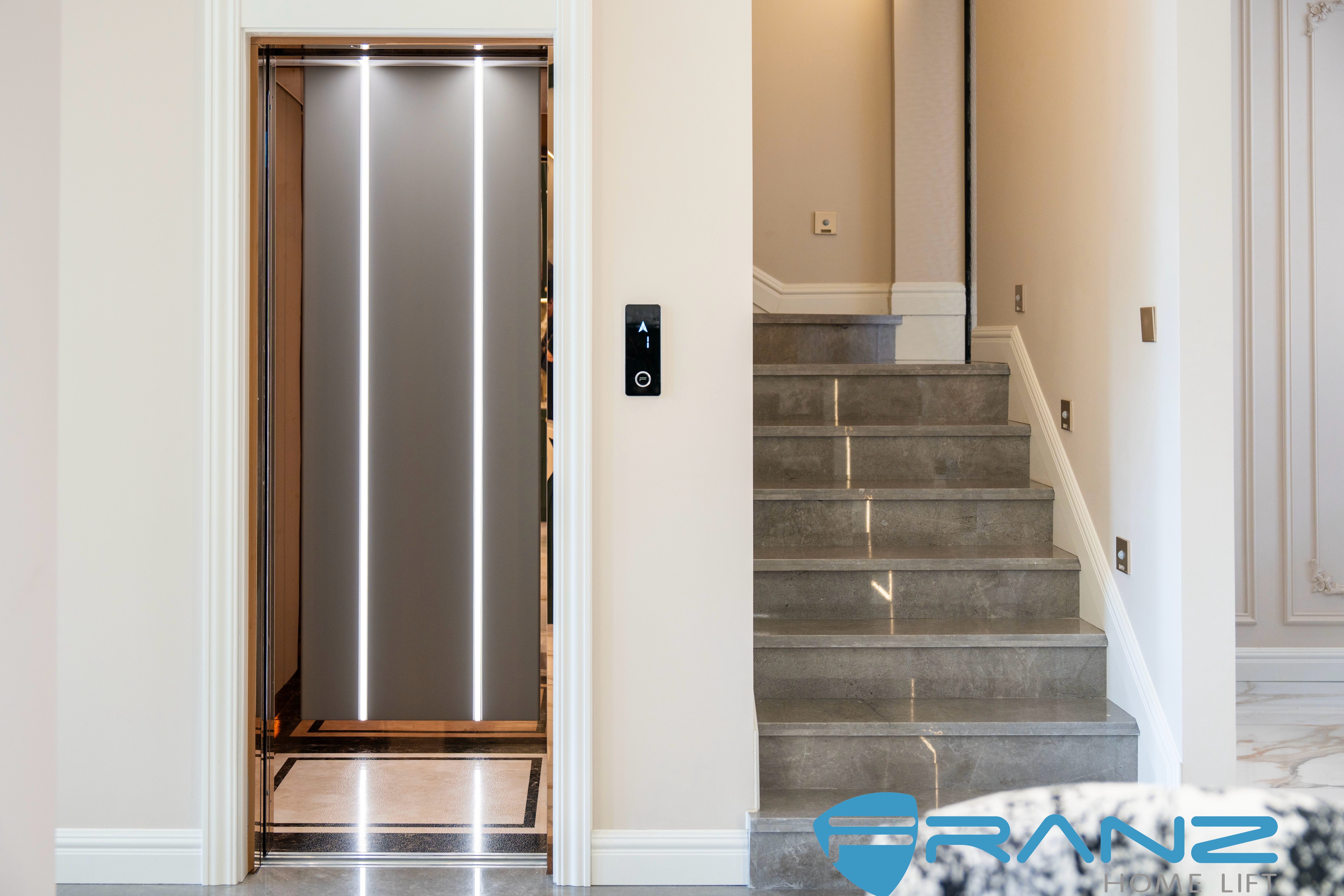
Market context: why this comparison is being asked more often
The residential elevator segment is large enough that configuration choices now carry real budget consequences. Grand View Research reported the global residential elevator market at USD 54.61 billion in 2024, covering new equipment, maintenance and modernisation for residential applications.
Regulation is converging at the same time. TÜV SÜD has documented the transition from EN 81-20/50 to ISO 8100-1 and ISO 8100-2, which harmonises global elevator safety standards, with the change noted as active and transitioning and an effective date of 1 March 2026. For villa buyers, this means compliance questions increasingly have an international reference point instead of a purely national one.
Retrofit demand is the other structural driver. Roland Berger projects the modernisation segment of the elevator market to grow at a CAGR of 7% through 2030, which aligns with the villa problem this comparison addresses: many houses were built without a shaft volume, and the retrofit route is often a glass or platform configuration rather than a full cabin installation.
Forecast figures should be read with care. Straits Research reports a lower residential elevator CAGR of 4.58%, while Grand View Research and Fortune Business Insights cite higher figures. The published conflict analysis attributes the gap to scope: broader definitions that include wheelchair lifts and stairlifts produce lower growth rates than narrower vertical-platform and elevator-only definitions. Buyers comparing market narratives should therefore check what each study counts before drawing conclusions.
Supply scale is also worth knowing. Aritco Lift AB produced approximately 3,000 elevators per year as of late 2025 and operates in 60 countries, which gives a useful reference point when assessing whether a supplier's capacity matches a project timeline. For context, FRANZ reports a monthly capacity of 500 units, a one-unit minimum order, 100% testing, and export markets including Southeast Asia, Russia, Australia, the Middle East and Africa, with an export ratio of 15%. In 2025, the company states that its commercial platform elevators received the TÜV Rheinland EU EC Whole-Machine Safety Certification.
Procurement checklist for villa projects
The following checks convert the comparison above into questions a buyer can put to any supplier, including this one.
- Shaft reality first. Confirm whether the villa has, or can create, a dedicated shaft for a cabin lift, or whether the frame-and-glass route is the only practical option.
- Match load to the household. Verify the product's documented load range against the actual requirement — 400–800 kg for the glass lift, 320–1000 kg for the shaft-built cabin lift, 320–400 kg for the platform lift.
- Confirm speed against the building. All three product lines list different speed sets; the required travel speed must appear in the quotation rather than in the brochure.
- Name the safety functions. Millimetre-wave radar sensing, emergency levelling, anti-pinch protection and one-touch emergency call should each be listed explicitly.
- Ask for the noise figure. The documented figure of ≤40 dB comes from a specific steel-belt traction installation; a project should specify its own target and test method.
- Check the environmental rating. Only the glass lift is documented for indoor and outdoor installation; the cabin and platform lifts are listed for indoor use.
- Plan the installation window. With site conditions ready, installation and commissioning are documented at 7–15 working days, with longer durations if civil work is incomplete.
- Verify support structure. The standard warranty is documented at one year for the whole unit, with remote support, on-site service and factory training, and after-sales normally delivered through the local distributor network. Annual maintenance in China is currently quoted at RMB 3,000–5,000 per year, with local variations.
- Ask about remote monitoring. A lift IoT (LOT) system allows distributors to check lift status remotely.
- Confirm which certification applies. The TÜV Rheinland EU EC Whole-Machine Safety Certification obtained in 2025 relates to the company's commercial platform elevators, so buyers should confirm the certified scope for the specific product being purchased.
Future outlook
Two directions look durable. The first is that active sensing becomes an expectation rather than a differentiator: radar-based presence and posture detection that works without cameras addresses both safety and privacy, and the IoT layer that follows it converts a lift from a mechanical asset into a monitored one. The second is the retrofit market. With modernisation projected to grow at 7% CAGR through 2030, configurations that minimise civil work — pit-free platform lifts and frame-and-glass shafts — are likely to carry a growing share of villa and existing-house projects.
For the glass-versus-cabin question, that suggests convergence rather than a winner. Glass will keep winning where sightline, light and architecture are the brief. Shaft-built cabins will keep winning where privacy, higher load and faster delivery are the brief. The useful skill for a buyer is knowing which of those briefs the project actually has before the shaft is drawn.
Frequently asked questions
What load capacity and speed should a villa specify for a glass home lift?
The FT/FJ series glass lift is documented at 400–800 kg with speeds of 0.4 m/s, 0.63 m/s or 1.0 m/s. The FT/FJ series shaft-built cabin lift is documented at 320–1000 kg at the same speeds, and the FP-S/E Series platform lift at 320–400 kg with 0.15 m/s or 0.3 m/s. The specification therefore depends on which product line fits the building, not on a single villa standard.
When is a shaft-built cabin lift more suitable than a glass lift in a villa?
It is the more suitable choice when the villa has or can build a dedicated shaft in bent steel structure, concrete, wood or brick; when the household requires up to 1000 kg rather than 800 kg; when privacy and interior-matched door jambs are preferred over panoramic views; or when the shorter documented lead time of 25–30 days matters to the schedule.
How do millimetre-wave radar sensing, emergency levelling and anti-pinch functions work in practice?
Millimetre-wave radar emits electromagnetic waves and continuously senses human presence and posture inside the cabin. When an anomaly such as a fall or prolonged inactivity is detected, it triggers an alert without manual intervention, and a connected IoT platform notifies the maintenance team. Emergency levelling and anti-pinch mechanisms act independently: during a power outage or when an object is detected, the lift stops and opens its door at the nearest floor so passengers can exit safely.
What did the Russian private villa installation demonstrate about glass lifts?
A home elevator distributor installed one FT/FJ series glass lift for daily family use in a Russian private residence, documented at 400–800 kg, 0.4/0.63/1.0 m/s, with a four-sided transparent glass cabin providing 360° views and millimetre-wave radar sensing for anomaly detection. The unit was placed in the entrance hall as a visual divider between indoor and outdoor space. The reported result after two years of operation was a comfortable ride with smooth start and stop and no jitter.
What installation, warranty and maintenance commitments should buyers verify before ordering?
With site conditions ready, installation and commissioning are documented at 7–15 working days, extending if civil work is incomplete. The standard warranty is documented as one year for the whole unit. After-sales is normally provided through the local distributor network, with 24/7 remote support and on-site technical guidance available, and annual maintenance in China is currently quoted at RMB 3,000–5,000 per year, varying by country. A lift IoT system allows distributors to monitor lift status remotely.
Which standards or certifications should a villa lift project be checked against?
The international reference point is the transition from EN 81-20/50 to ISO 8100-1 and ISO 8100-2, documented by TÜV SÜD as harmonising global elevator safety standards, with an effective date of 1 March 2026. At company level, FRANZ states that its commercial platform elevators received the TÜV Rheinland EU EC Whole-Machine Safety Certification in 2025. Because certification is scope-specific, buyers should confirm exactly which product and which function the certificate covers before treating it as evidence for a particular villa installation.
Product reference: the glass lift and shaft-built cabin lift parameters in this article are drawn from the FT/FJ series documentation, and the platform lift parameters from the FP-S/E Series. A consolidated technical brochure covering the civil and glass lift ranges is available here: Franz civil and glass lift brochure (PDF).