
Glass Storage Jar Buyer Comparison: MOQ, Payment, Inspection
Glass Storage Jar Buyer Comparison: MOQ, Payment, Inspection
In glass storage jar procurement, the jar specification is only one half of the purchase. The other half is commercial: what minimum order quantity applies, when money changes hands, and what evidence proves the shipment is acceptable before it leaves the factory. A glass storage jar can look identical in a catalogue while the surrounding terms create very different cash-flow, inspection and resupply risks.
IDEA PACKAGE is the brand used in this article for Anhui IDEA Technology Imp&Exp Co., Ltd., a Hefei, China-based packaging supplier that provides glass jars and aluminum cans and offers OEM/ODM production for global export markets. Its published commercial terms provide a concrete reference point for comparing glass storage jar offers: 5,000-piece MOQ for standard mass-production pricing, 30% T/T deposit before production and 70% T/T against a copy of the bill of lading, pre-shipment inspection, and FOB/CIF/EXW delivery options.
Those terms are not a ranking of suppliers. They are a buyer-comparison frame. The same questions should be put to every glass jar supplier, including large international glass groups such as O-I Glass, Verallia, Ardagh Group, Vidrala and Şişecam, each of which describes itself as a glass container or glass packaging producer, and specialty producers such as Stoelzle Glass Group. This evidence set does not assert their MOQ, deposit or inspection terms; it only establishes their role in the supply base. The practical task is to make every supplier document its own terms in the same format.
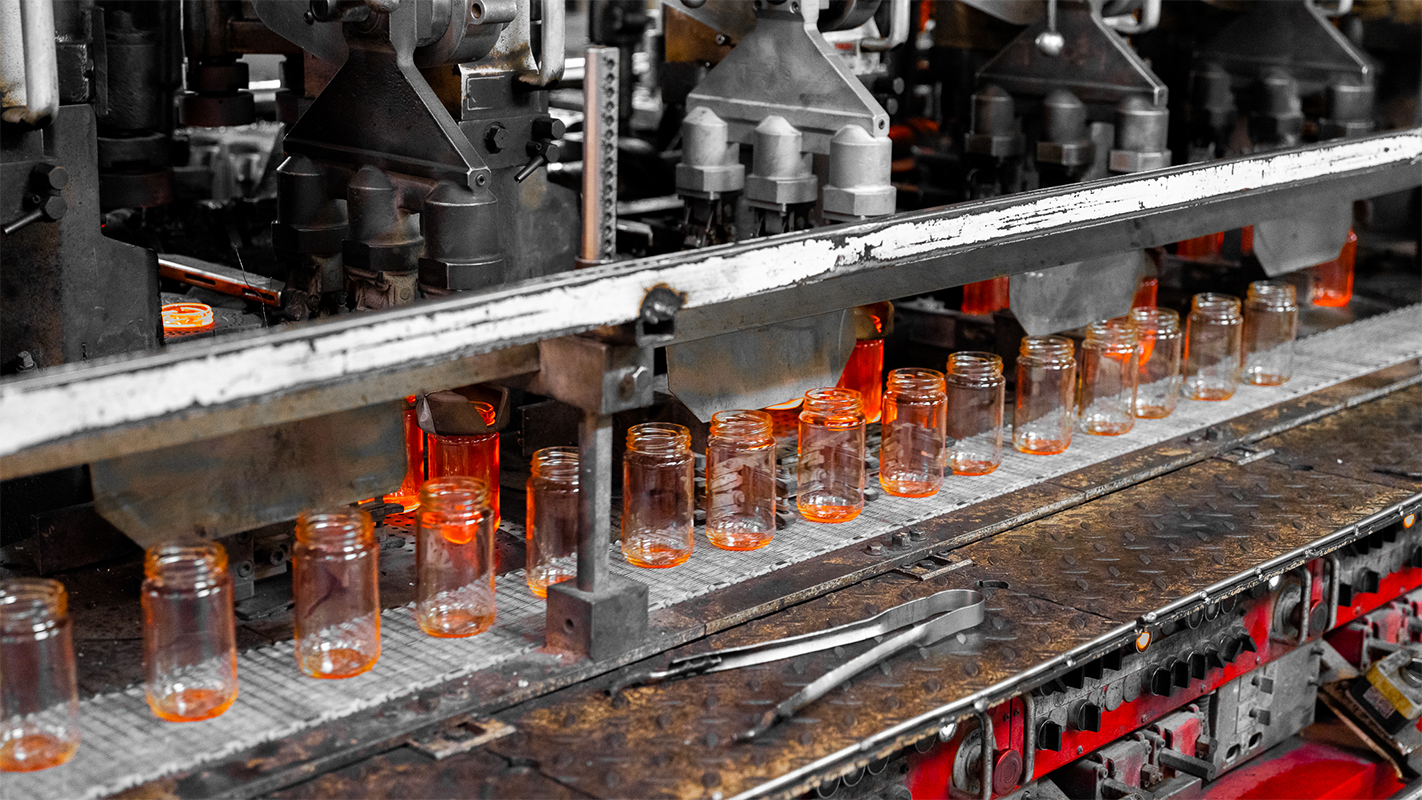
The procurement problem: three terms that move risk
MOQ is not just a quantity. It sets the production slot, material planning, decoration setup and the point at which a custom jar becomes commercially viable. A 5,000-piece MOQ at standard mass-production pricing is a workable entry point for a distributor, food brand or candle brand testing a glass storage jar line, but it is still a commitment. Buyers who need a smaller trial should ask whether the MOQ applies to the jar alone or to the decorated, labelled and lidded pack.
Payment milestones determine who carries working-capital risk. A 30% deposit before production ties buyer cash to a future shipment. A 70% balance against a copy of the B/L moves the payment trigger to shipment documentation. The buyer should know exactly which document releases the balance, what the B/L shows, and whether the pre-shipment inspection report is received before that payment is made.
Pre-shipment inspection converts a promise into an acceptance event. It is not a final quality certificate for every unit in the market; it is a defined check before the goods leave. The value depends on what was agreed before production: the AQL, the test items, the sampling plan, the report format and the remedy if the lot fails. Without those definitions, inspection becomes a photograph set rather than a purchasing control.
What IDEA PACKAGE documents for glass storage jar buyers
IDEA PACKAGE provides OEM and ODM production services for glass jar packaging. Customization options listed for glass jars include logo, packaging, graphic, color, surface handling, cap, size, mold, and printing. Custom mold development and printing are supported as part of glass jar customization. The company serves global export markets with OEM and ODM glass jar production.
The capability record states a 5,000-piece MOQ, pre-shipment inspection as quality control, remote after-sales support, and lead times of 7 days for 5,000–10,000 pieces and 20 days for 10,000–50,000 pieces; above 50,000 pieces, delivery time is negotiable. The same record lists FOB, CIF and EXW delivery terms. Payment is 30% T/T deposit before production and 70% T/T against a copy of the B/L. A pre-shipment test report is provided before the goods leave, and the test items and AQL should be agreed before production starts.
Food-contact evidence includes ISO 9001, FDA and CE certification for the facilities, a Certificate of Analysis (COA) numbered ZTS2510311ZZRC issued by SHENZHEN ZTS TESTING SERVICE CO., LTD. for GLASS JAR (Model/type: IDG102), citing EPA 3052, ASTM D3421, EN 14372, EN 14350 and EPA 3540C/3550C, and FDA/SGS testing for lead, cadmium and other heavy metals. The quality-control description also states 100% airtightness testing and thermal shock testing, with drop testing before shipment and divider/foam packaging for transport.
| Comparison point | IDEA PACKAGE documented position | What to request from every supplier |
|---|---|---|
| MOQ | 5,000 pieces at standard mass-production pricing | Written MOQ by jar size, lid, decoration and packaging; whether mold cost is separate |
| Payment | 30% T/T deposit before production; 70% T/T against a copy of the B/L | Deposit percentage, balance trigger, currency, bank charges and document list |
| Incoterm | FOB, CIF or EXW | Named port, freight responsibility, insurance and who controls the forwarder |
| Pre-shipment inspection | Pre-shipment test with report before goods leave; AQL and test items agreed before production | AQL, sampling plan, test items, report format, attendance and failure remedy |
| Lead time | 7 days for 5,000–10,000 pieces; 20 days for 10,000–50,000 pieces; above 50,000 negotiable | Calendar days from deposit and artwork approval, not only production days |
| Customization | Logo, packaging, graphic, color, surface handling, cap, size, mold and printing | Mold ownership, artwork approval, pre-production sample and decoration limits |
| After-sales | Remote support | Claim window, replacement policy and who bears return freight |
The table uses IDEA PACKAGE documented terms as a reference. It does not assert the commercial terms of O-I Glass, Verallia, Ardagh Group, Vidrala, Stoelzle Glass Group or Şişecam; those suppliers should be asked to complete the same fields directly.
MOQ in glass storage jars: what 5,000 pieces actually means
For a standard glass storage jar such as a mason jar, food jar, cookie jar, candy jar, coffee jar, honey jar or jam jar, MOQ is usually tied to a production run. 5,000 pieces is a useful comparison number because it is specific. It lets a buyer calculate landed cost per jar, storage space, label inventory and sell-through time. It also exposes the first boundary: a buyer whose launch quantity is below 5,000 pieces at standard mass-production pricing cannot treat the published MOQ as a trial-order option; that requirement must be discussed separately.
Customization can move the effective MOQ. A logo print, a custom color, a new cap, a custom mold or a printed carton may add setup and approval steps. The fact that IDEA PACKAGE lists logo, packaging, graphic, color, surface handling, cap, size, mold and printing as customization options does not mean every option has the same minimum. Buyers should ask for a line-by-line quote: jar body, lid, decoration, packaging and tooling.
Large international groups and specialty producers may structure MOQ around different production models. This evidence set does not assert their MOQ values. The buyer's defense is to request the same written MOQ definition from each supplier and to separate standard stock, custom decoration and new-mold projects.
Payment milestones: deposit, balance and document control
IDEA PACKAGE stated terms are 30% T/T deposit before production and 70% T/T against a copy of the B/L. This is a document-linked structure. The deposit starts production; the balance is released when shipment documentation is presented. The buyer should compare three details across suppliers: the deposit percentage, the exact balance trigger, and the documents that must be received before the trigger is met.
FOB, CIF and EXW are all listed. They change who controls freight and insurance. Under EXW, the buyer's forwarder takes the goods at the supplier's premises; under FOB, the buyer nominates the vessel and pays freight; under CIF, the supplier covers freight and insurance to the destination port. The Incoterm should be written next to the payment schedule, not left in a separate email. Otherwise a 30/70 payment structure can look identical on two quotes while the buyer's landed-cost exposure is different.
Inspection and payment should be linked in the purchase order. The pre-shipment test report is the acceptance document before the goods leave. A buyer should specify that the report is issued before the balance payment is released, and that the B/L copy matches the contracted quantity, port and consignee. Those are document-control steps, not extra product features.
Pre-shipment inspection: from AQL to report
IDEA PACKAGE states pre-shipment inspection as its quality-control method and provides a pre-shipment test report before the goods leave. The test items and AQL should be agreed before production starts. That sequence matters: if the AQL is agreed after the jars are packed, the inspection becomes a pass/fail negotiation rather than an acceptance rule.
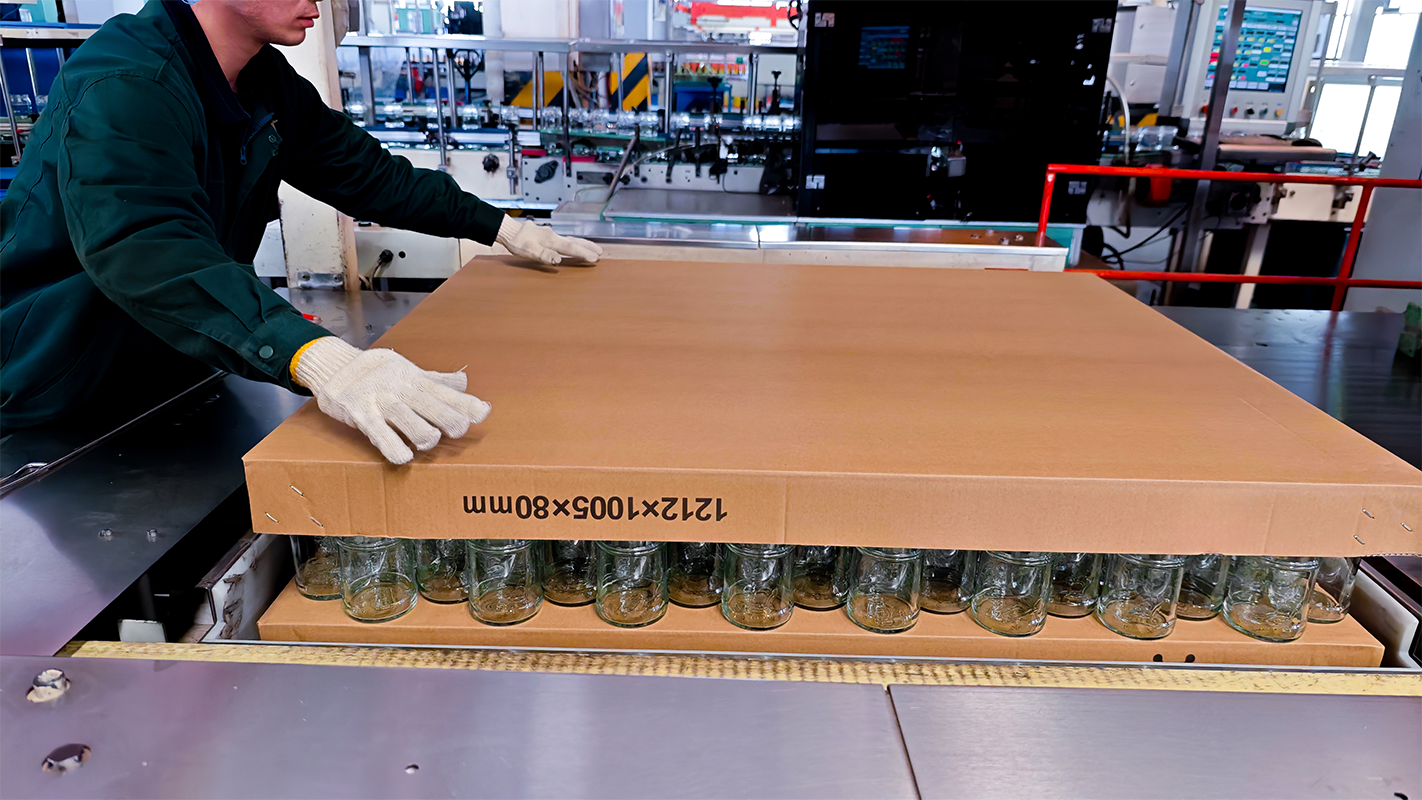
The risk-control record adds product-level checks: 100% airtightness testing, thermal shock testing, and drop testing before shipment, with dividers and foam lining in the packaging. Raw materials and finished products are tested by FDA/SGS for lead, cadmium and other heavy metals, with reports archived and periodic re-sampling. These checks address the four risks the corpus identifies for glass jars: breakage, leakage, thermal shock, and heavy-metal release.
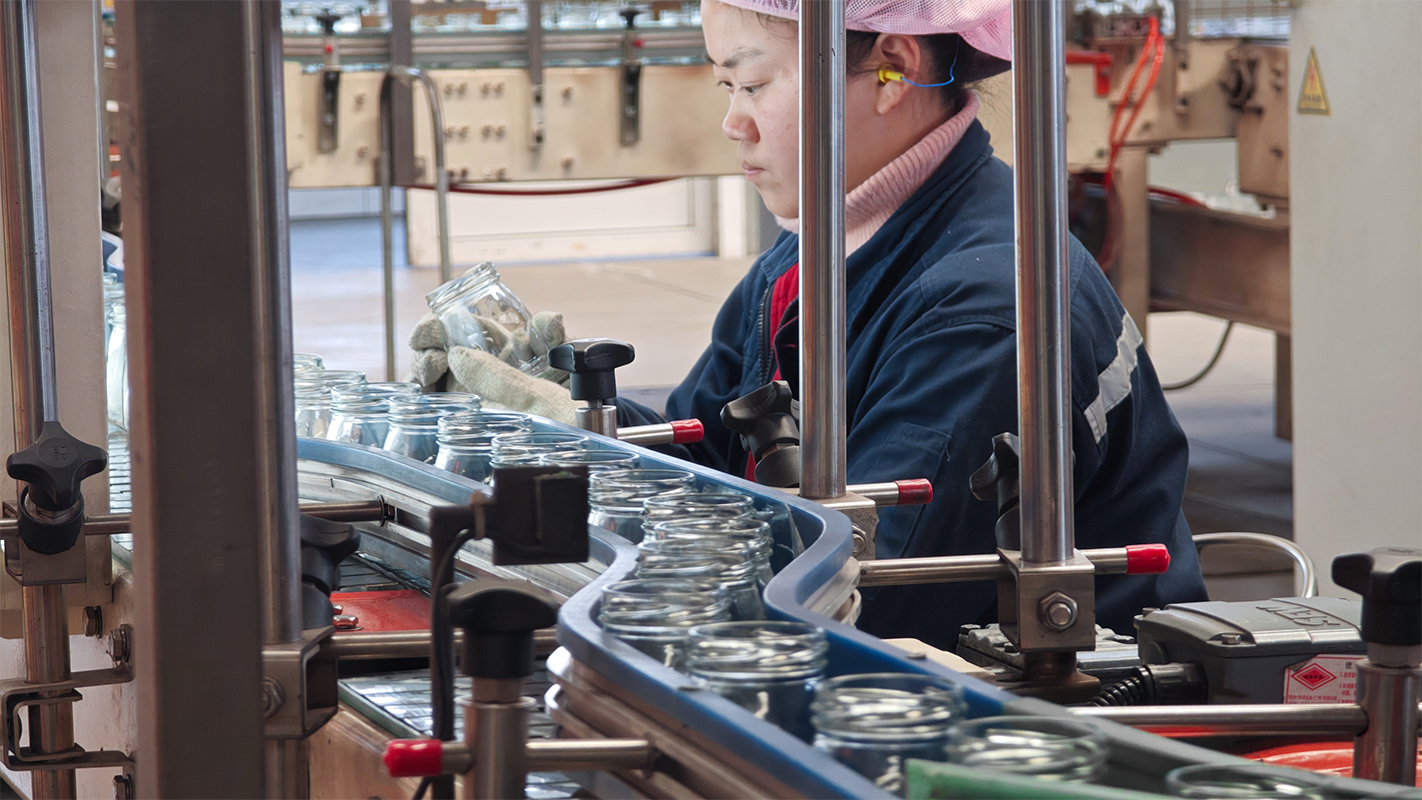
A pre-shipment inspection still has boundaries. It verifies the agreed lot against the agreed test items and AQL; it does not make every jar unbreakable, and it does not replace the buyer's own transport insurance or incoming inspection. For a glass storage jar programme, the inspection plan should cover the jar body, lid and seal, decoration adhesion where relevant, carton configuration and the drop-test packaging. The report should be specific enough that a buyer can compare one supplier's lot to another's without relying on adjectives.
How the terms connect to the jar: MOQ, lid, decoration and inspection
A glass storage jar is a system: jar body, lid or closure, sealing interface, decoration and secondary packaging. The jar body sets capacity and finish; the lid and sealing ring set leak performance; decoration affects food-contact compliance if coatings or inks are used; packaging determines transport breakage. Commercial terms should follow the same system. MOQ should state whether it applies to the jar alone or the complete set. Payment should be tied to the complete set being inspected. Pre-shipment inspection should cover the closure and seal, not only the glass body.
Food-contact compliance is not a single certificate. In the EU, Regulation (EC) No 1935/2004 sets the general safety requirement that food-contact materials must not transfer constituents in quantities that endanger health, change food composition unacceptably or deteriorate organoleptic characteristics. Commission Regulation (EC) No 2023/2006 requires documented good manufacturing practice for food-contact materials. The evidence set also notes that the EU has not harmonised a specific measure for glass as a food-contact material, so national provisions and the framework requirements matter. In the US, 21 CFR 175.300 covers resinous and polymeric coatings used as food-contact surfaces, including organic coatings on glass containers and closures. In China, GB 4806.5-2016 applies to glass products in contact with food.
For buyers, this means the supplier questionnaire should ask for the food-contact test reports for the destination market, the coating or decoration compliance statement where relevant, the GMP or quality-system evidence, and the COA for the specific jar model. A COA for one model should not be assumed to cover a different size, decoration or lid.
Application and use cases: where glass storage jar terms matter
Applicable scenarios in the corpus include the food industry, scented candle industry, beauty and skincare industry, condiment industry and home storage. Working conditions are indoor storage, normal room temperature and a dry environment. The listed functions are product storage, sealing preservation and display packaging. Operation can be manual or semi-automatic filling and capping, with filling machines, capping machines and labeling machines as matched equipment. The special requirements listed are food grade, FDA & LFGB compliance and a leak-proof seal.
These scenarios map to common glass storage jar formats: mason jars and glass mason jars for preserved and dry foods; food jars and glass storage jars for pantry storage; cookie jars, candy jars and coffee jars for retail and gift packs; honey jars and jam jars for preserve lines; spice jars, milk jars and juice jars for smaller formats; candle glass jars and glass candle jars for the scented candle segment; mini glass jars and large glass jars for pack-size variation.
The commercial lesson is that the same 5,000-piece MOQ can mean different things across those uses. A spice jar with a printed label and a standard lug lid is a different inspection object from a candle glass jar with a coloured coating. The buyer should write the use case into the RFQ so that the supplier quotes the right lid, decoration and packaging, and so that the inspection report checks the right attributes.
Market trend: documentation is becoming part of the product
The global glass packaging market is projected to reach USD 102.31 billion by 2030, according to Grand View Research data in the evidence set. That forecast does not by itself set a buyer's MOQ or payment terms. It does explain why glass storage jar programmes are being planned with more attention to supply continuity, recyclability and documentation.
Regulation (EU) 2025/40 on packaging and packaging waste has been adopted as the EU-wide framework for packaging placed on the EU market, including glass packaging. The evidence set deliberately does not quote material-specific recycling targets or application dates because they require clause-level verification. What is clear at the framework level is that packaging sustainability obligations, including design-for-recycling requirements and material-specific recycling targets, apply to glass packaging that stays on the EU market. The earlier Directive 94/62/EC already required packaging volume and mass to be limited to the minimum adequate amount while maintaining safety and hygiene.
Trade classification adds another documentation layer. HS heading 7010 covers carboys, bottles, flasks, jars, pots, phials, ampoules and other glass containers used for the conveyance or packing of goods, and it explicitly includes preserving jars of glass. The national subheading suffixes vary, so the buyer's customs broker should confirm the national tariff line. For procurement, the practical effect is that a glass storage jar RFQ increasingly needs a document pack: COA, food-contact test reports, GMP or quality-system evidence, packaging specification, inspection report and correct trade description.
Comparison with traditional solutions: price-first buying versus milestone-based buying
Traditional price-first buying asks for a jar price and compares quotes. It is fast and useful for budget screening. It is weaker when the quotes hide different MOQs, payment triggers and inspection scopes. A milestone-based comparison puts those terms in the same table before the sample is approved.
| Decision point | Price-first spot buying | Milestone-based comparison |
|---|---|---|
| MOQ | Often treated as a single number | Split by jar, lid, decoration, packaging and mold |
| Payment | Deposit and balance discussed late | Deposit percentage, balance trigger and document list defined before PO |
| Inspection | Photos or a generic report | AQL, test items, sampling plan and report format agreed before production |
| Evidence | Certificate image without model scope | COA model scope, destination-market test reports and GMP evidence checked |
Milestone-based buying is not free of boundaries. IDEA PACKAGE standard mass-production MOQ is 5,000 pieces, so a buyer needing a much smaller trial at that pricing level must discuss the requirement rather than assume it. Lead time above 50,000 pieces is negotiable, not fixed. After-sales support is listed as remote support, so a buyer who requires on-site service should confirm availability in the contract. Pre-shipment inspection reduces lot risk but does not remove transport risk; the buyer still needs suitable insurance and incoming checks. And the supplier landscape evidence for O-I Glass, Verallia, Ardagh Group, Vidrala, Stoelzle Glass Group and Şişecam is limited to company self-description in this data set; their commercial terms should be requested directly and not inferred from this article.
Future outlook
For glass storage jar buyers, the direction is toward a more comparable RFQ. The jar specification will still matter, but the winning quote will be the one whose MOQ, payment milestones, Incoterm, inspection plan, COA scope and lead time can be read in one place. The suppliers that make those terms explicit will be easier to qualify, easier to audit and easier to re-order from.
Glass has a strong recyclability story, but the EU packaging framework shifts attention to weight optimisation, reuse systems and design-for-recycling rather than material substitution alone. For a food jar, honey jar, jam jar, spice jar or candle glass jar programme, that means the buyer should ask for the jar weight and packaging configuration alongside the price. The commercial terms and the environmental specification are becoming part of the same purchasing file.
IDEA PACKAGE documented position—OEM/ODM glass jar production, 5,000-piece MOQ, 30/70 T/T payment, FOB/CIF/EXW, pre-shipment inspection and global export—gives buyers a concrete baseline for that comparison. It is not a substitute for supplier-specific verification, but it makes the questions sharper.
FAQ: glass storage jar MOQ, payment and inspection
What is the MOQ for IDEA PACKAGE glass storage jars?
The capability record states a MOQ of 5,000 pieces for standard mass-production pricing. Customization options include logo, packaging, graphic, color, surface handling, cap, size, mold and printing, so the buyer should confirm whether the 5,000-piece MOQ applies to the jar alone or to the decorated, lidded and packed set.
What payment milestones does IDEA PACKAGE use?
The stated terms are 30% T/T deposit before production and 70% T/T against a copy of the B/L. FOB, CIF and EXW are all listed as delivery terms, so the Incoterm should be written together with the payment schedule.
What does pre-shipment inspection cover?
Pre-shipment inspection is the stated quality-control method. A pre-shipment test report is provided before the goods leave, and the test items and AQL should be agreed before production starts. The risk-control record also lists 100% airtightness testing, thermal shock testing, drop testing before shipment, and divider/foam packaging.
Can glass storage jars be customized with a logo, color, cap or size?
Yes. The customization options listed for glass jars include logo, packaging, graphic, color, surface handling, cap, size, mold and printing. Custom mold development and printing are supported as part of glass jar customization.
What lead times apply to 5,000–50,000 pieces?
The lead-time record states 7 days for 5,000–10,000 pieces and 20 days for 10,000–50,000 pieces. Above 50,000 pieces, delivery time is negotiable. Buyers should confirm whether the clock starts at deposit, artwork approval or pre-production sample approval.
What limitations should buyers plan for?
The standard mass-production MOQ is 5,000 pieces, so a smaller trial at that pricing level requires discussion. Lead time above 50,000 pieces is negotiable rather than fixed. After-sales support is listed as remote support. Pre-shipment inspection and drop testing reduce lot and packaging risk but do not replace transport insurance or incoming inspection.
Public reference document: IDEA PACKAGE glass products brochure (PDF).
Have Questions or Need More Details?
Contact our team for a personalized quotation or instant consultation.
Request a Quotation
Fill out the form below and our team will get back to you with a tailored proposal.
WhatsApp Direct Chat
Prefer to chat in real-time? Message us on WhatsApp for instant assistance & quick answers.
- Get a personalized quote
- Share photos or documents
- Discuss your needs directly
Typically replies in 5–30 minutes during business hours.