
Glass vs. Porcelain: A Procurement FAQ on 70B and U70BP/146D
Industry Reference · Overhead Line and Substation Insulators
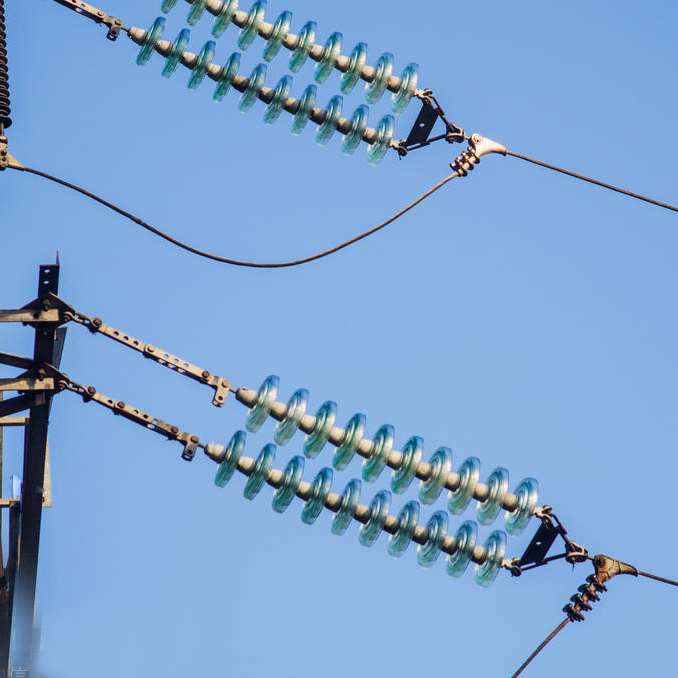
Glass disc insulators on an overhead line: the material choice sits inside a load-case decision, not above it.
Glass or Porcelain: The Answer Usually Comes Down to Load Direction
Most insulator selection arguments are settled before price is discussed. The determining question is mechanical: is the unit suspending a conductor in tension, or is it supporting one as a post? Glass and porcelain disc insulators are both long-established answers in overhead line and substation work, and both remain in active production and export. What a buyer needs is not a general preference for one material, but a reliable way to read two datasheets against the load case in front of them.
This article is organised as a procurement FAQ because that is how the decision is actually taken. A buyer checks the load case first, then creepage and clearance requirements, then the evidence package, and only afterwards the commercial terms. Two catalogue items are used as reference points throughout: the glass insulator model 70B and the porcelain insulator model U70BP/146D. Both are catalogue items of China Energy and Chemical Industry Co.,Ltd, a Zhengzhou-based manufacturer and exporter of polymer insulators, porcelain insulators, glass insulators and metal fittings for insulators, whose catalogue also covers surge arresters, fuse cutouts and end fittings.
The Two Units at a Glance
Putting the two datasheets side by side is useful precisely because so much of what buyers assume to be different turns out to be identical, and so much of what they assume to be comparable turns out not to be.
| Parameter | Glass insulator 70B | Porcelain insulator U70BP/146D |
|---|---|---|
| Insulating material | Glass | Porcelain |
| Catalogue classification | Post line insulator | Porcelain insulator |
| Creepage distance | 255 mm | 255 mm |
| Nominal structural height | Not listed | 146 mm |
| Nominal disc diameter | Not listed | 255 mm |
| Minimum arcing distance | Not listed | 450 mm |
| Cantilever load | 10 kN | Not listed |
| Rated electromechanical failing load | Not listed | 70 kN |
| Power frequency wet withstand voltage | 45 kV | Not listed |
| Power frequency dry withstand voltage | 65 kV | Not listed |
| Power frequency puncture voltage | 135 kV | Not listed |
| Connection structure code | Not listed | 16 |
| Colour | Brown | Not listed |
Comparison based on the published catalogue entries for the two models. Buyers should confirm dimensions against the current drawing and the unit-specific type test report before order release.
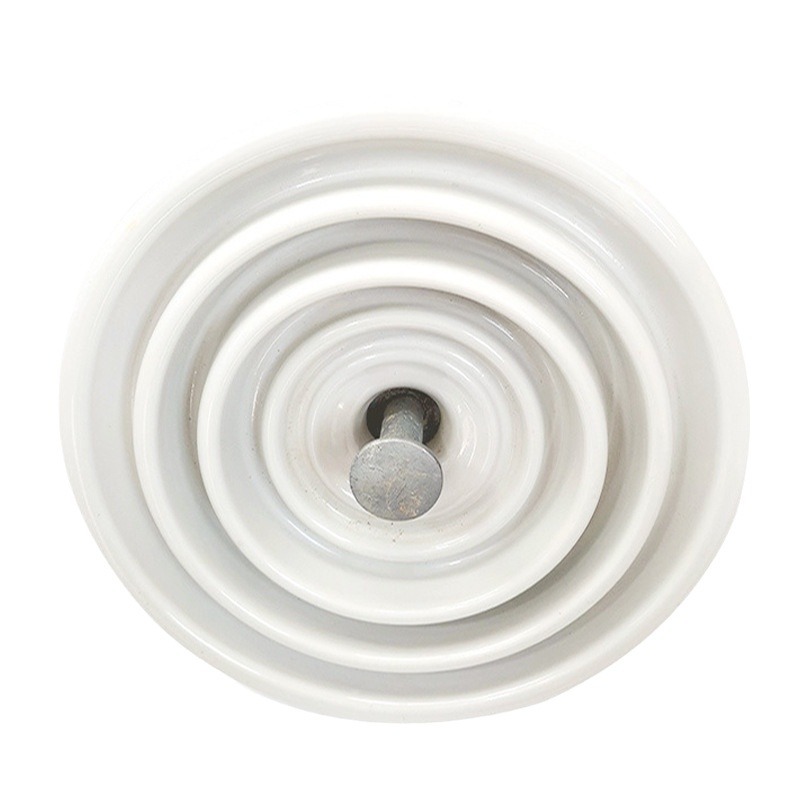
Porcelain insulator U70BP/146D: 146 mm structural height, 255 mm nominal disc diameter, 450 mm minimum arcing distance, 70 kN rated electromechanical failing load.
Two entries in that table deserve attention. Both units list a creepage distance of 255 mm, and both use connection geometry referenced by the number 16. A buyer comparing only creepage would conclude that the two units are equivalent on insulation surface. That conclusion would be premature, because the difference between them is not creepage, it is material behaviour, product classification, the definition of the governing load, and the test evidence that accompanies each model.
What the Material Change Actually Alters
The 70B glass unit lists three voltage figures that describe a progression rather than a single capability. The power frequency wet withstand voltage is 45 kV, the power frequency dry withstand voltage is 65 kV, and the power frequency puncture voltage is 135 kV. The first two define the service envelope under wet and dry conditions. The third describes the voltage at which the insulating body is destroyed rather than merely flashed over. The distance between the wet withstand figure and the puncture figure is the margin a buyer is implicitly purchasing, and it is the figure that matters when a line is exposed to moisture, contamination and transient overvoltage together.
Failure behaviour is the second material-level difference that affects maintenance planning. Glass disc units are widely described in field practice as failing visibly: when a disc breaks, the loss of a unit is obvious to a line patrol without climbing or testing. Porcelain units can puncture internally while the shed profile remains visually intact, so detection often depends on voltage measurement or infrared inspection rather than sight alone. Neither behaviour is a free benefit. A shattered glass disc leaves debris and loses mechanical continuity; a punctured porcelain disc may remain in service at reduced dielectric strength until inspection finds it. In both cases, scheduled inspection remains part of the maintenance plan.
Ten Kilonewtons and Seventy Kilonewtons Are Different Measurements
The most common misreading in quotations for these two models is to place 10 kN and 70 kN side by side and conclude that the porcelain unit is seven times stronger. The two figures are not the same load case. For the 70B glass insulator, 10 kN is the cantilever load. For the U70BP/146D porcelain insulator, 70 kN is the rated electromechanical failing load. One describes a bending force applied to a post-type insulator. The other describes the tensile force along the axis of a suspended unit at which the assembly fails.
A post position and a suspension position are therefore not interchangeable, and neither is the rating that validates them. A structure that requires a post insulator rated for a defined cantilever duty is not qualified by quoting a tensile failing load, and a suspension position that must hold a conductor under tension is not validated by a cantilever figure. The correct procurement sequence is to fix the load case first, compare only those ratings that belong to that case, and only then compare material and price.
Standards and Evidence: What to Request Before Order Release
Two standards appear frequently in insulator specifications and are often cited without their scope. The updated IEC 61109:2025 standard covers composite suspension and tension insulators for AC and DC systems with nominal voltages above 1,000 V. ANSI/NEMA C29.11-2020 defines test methods and performance characteristics for composite insulators used in North American overhead transmission lines. Both are scoped to composite insulators, so neither should be presented as the governing standard for a glass or porcelain disc order without checking the scope statement on the certificate itself.
On documentation practice, certificates already in this supplier's set show the level of traceability that is realistic to request. Type Test Report number 23XJ0089-S was issued on 13 July 2023 by Suzhou Electrical Apparatus Science Research Institute Co., Ltd. together with the China National Center for Quality Inspection and Test of Electrical Apparatus Products, referencing standards IEC 60815, IEC 61109, IEC 62217 and IEC 61466, and covering the 35 kV composite pin insulator model FPQ-35/6 (5). Separately, ISO 9001 certificate number 75425Q0493R053, issued by Zhongjing Certification (Shanghai) Co., Ltd. against GB/T 19001-2016 idt ISO 9001:2015, applies to the Ball-Head Suspension Ring QP-7 and is cited for Europe, the Americas, the Middle East and Central Asia.
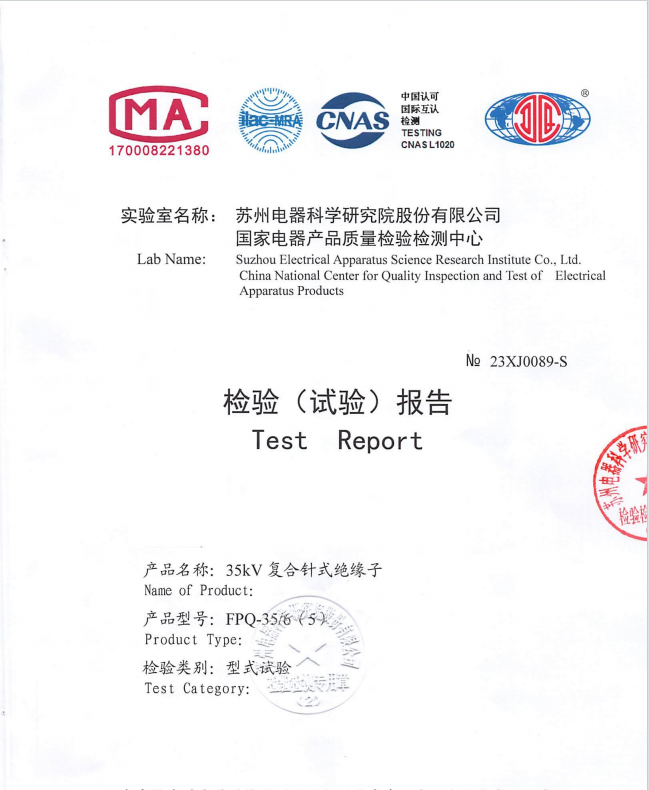
Type Test Report 23XJ0089-S covers the 35 kV composite pin insulator model FPQ-35/6 (5) — a useful example of how narrowly a type test report is scoped.
That narrowness is the point. The published type test report in this set applies to a composite pin insulator model, not to the 70B glass unit and not to the U70BP/146D porcelain unit. Buyers specifying either model should request unit-specific type test evidence and confirm which standard that report was issued against. A supplier-level quality certificate does not automatically transfer to every item in a catalogue.
Where Composite Insulators Fit in the Same Decision
Glass and porcelain are not the only two answers available, and the wider portfolio reflects that reality. Polymer insulators from the same manufacturer, such as model FXB-24-70-785mm, are rated at 35 kV with a lightning impulse withstand voltage above 230 kV, a power frequency one-minute wet withstand voltage above 95 kV, a minimum creepage distance above 1,050 mm and a rated bending load of 5 kN, built from silicone, fiberglass and carbon steel or C45 components. The creepage figure is the comparison that matters here: a minimum of 1,050 mm against the 255 mm listed for both disc units. That gap is one reason polymer units are frequently considered where pollution, salt spray or altitude makes leakage distance the binding constraint rather than mechanical load.
Market structure supports the same reading. The 11 kV to 200 kV rating band accounted for approximately 33% of the composite insulator market in 2025, and suspension insulators represented an estimated 38% of that market in the same year. Composite units are a mainstream part of the specification landscape rather than a niche alternative, which is why a glass-versus-porcelain FAQ should acknowledge them as a third option instead of presenting a binary choice.
Where the 70B and U70BP/146D Fit in Practice
Both units serve the same broad duties. They are used for mechanical support and insulation on transmission lines, for substation insulation, for railway catenary or ground equipment insulation, and in fuse and overvoltage protection applications. The buyer base for these duties is consistent across markets: utility companies, power EPC contractors, railway operators and contractors, distributors and resellers.
A three-year, 10,000-unit programme across Brazil, Italy, Türkiye and Vietnam illustrates how these items are actually consumed. The reported outcome of that programme was enhanced line stability, reduced maintenance intensity and improved pollution resistance, with lightweight design, anti-pollution and ageing resistance, customizable end fittings and FRP rod core supply identified as the deciding factors at tender stage. For a procurement manager, the pattern is worth noting: the technical decision was made on pollution performance and on how much maintenance the asset would demand, while the commercial decision turned on the ability to customize end fittings and supply core components.
Accessory hardware follows the same logic. The Ball-Head Suspension Ring QP-7 is a hot-dip galvanized steel fitting with a designated coupling size of 16, a rated failing load of 70 kN and a net weight of 0.3 kg. Because the U70BP/146D porcelain insulator lists connection structure code 16, the interface between insulator and fitting is defined on the datasheet rather than left to the installer to resolve on site. Buyers assembling suspension strings should confirm coupling size and rated failing load together, so that the weakest element stays inside the intended assembly rather than outside it.
Market Context: Direction of Travel, With a Caveat
The global composite insulator market was valued at approximately USD 6.58 billion in 2024 and is projected to reach USD 9.3 billion by 2035, according to Market Research Future. Asia-Pacific dominated that market in 2024 with a revenue share of approximately 49.5%, according to Mordor Intelligence. The competitive landscape includes Hitachi Energy, NGK Insulators Ltd., Seves Group (Sediver), Siemens Energy and Hubbell Power Systems.
The caveat matters more than the headline. Estimates for the 2024 market size diverge substantially between research houses: Strategic Market Research places the composite insulator market at USD 3.42 billion and Reports and Data at USD 2.35 billion, against the USD 6.58 billion figure quoted above. Different scope definitions and methodologies produce materially different totals. Buyers and planners should treat these numbers as directional indicators of growth and regional concentration, not as inputs to a procurement budget or a supplier scorecard.
Boundaries, Trade-offs and Failure Modes
- Cantilever ceiling. The 70B is listed with a 10 kN cantilever load. That figure governs post-type duty and should not be exceeded by substituting a tensile rating from another unit.
- Load-case mismatch. The U70BP/146D is listed at a 70 kN rated electromechanical failing load, which describes axial tensile failure and does not qualify the unit for post duty.
- Detection is not prevention. Visible shattering in glass units and hidden puncture in porcelain units are both failure modes, not protective features. Scheduled inspection remains necessary in either case.
- Creepage is only one input. Both units list 255 mm creepage distance. In heavy contamination, coastal salt spray or high-altitude service, leakage distance and surface behaviour generally need to be assessed against the project pollution study rather than accepted from a standard catalogue value.
- Documentation scope. Type test reports apply to the models named on them. A report for one model does not evidence another model in the same catalogue.
- Market data is not specification data. Divergent third-party estimates cannot substitute for a project-specific technical requirement or a factory acceptance test.
Procurement Checklist for Glass and Porcelain Disc Insulators
| Check before order release | Why it matters |
|---|---|
| Confirm whether the position is in bending or in tension | Determines whether cantilever load or rated electromechanical failing load is the governing figure |
| Confirm creepage distance and minimum arcing distance against the pollution and clearance study | Both reference units list 255 mm creepage; contamination class may require more |
| Confirm the connection interface | U70BP/146D uses connection structure code 16; the QP-7 fitting uses designated coupling size 16 |
| Request unit-specific type test reports and quality certificates | ISO 9001 certificate 75425Q0493R053 covers the QP-7 accessory; report 23XJ0089-S covers a different model |
| Confirm commercial parameters before tender | MOQ 500 units, lead time 30–45 days, monthly capacity 500 tons and 100,000 pieces, 100% test |
| Confirm customization scope if the project differs from catalogue | Voltage, creepage distance, lightning impulse withstand voltage, bending load, colour and logo can be customized under OEM/ODM, with remote after-sales support |
What to Watch Over the Next Specification Cycles
Three signals are worth tracking. First, the revision of IEC 61109 to the 2025 edition confirms that composite suspension and tension insulators above 1,000 V remain under active standardisation, which usually precedes tighter documentation expectations from utilities and EPC contractors. Second, the concentration of demand in Asia-Pacific, at approximately 49.5% of 2024 revenue, means manufacturing and testing capacity in the region will continue to shape lead times and evidence packages. Third, the widening use of polymer alternatives in pollution-heavy and coastal corridors will keep pressure on conventional glass and porcelain specifications to justify themselves on load case, inspection practice and lifecycle cost rather than on habit.
For glass and porcelain disc units specifically, the practical expectation is continuity rather than displacement. The 70B and the U70BP/146D answer well-defined positions. The buyer's task is to keep the governing load case, the evidence package and the interface dimensions aligned, and to treat the material choice as the last question rather than the first.
Reference material: dimensional drawings, packing data and model listings for polymer, glass and porcelain insulators are compiled in the 2025 CECI catalogue of polymer insulators and glass insulators.
FAQ: Comparing the 70B Glass Insulator and the U70BP/146D Porcelain Insulator
What is the difference between the 70B glass insulator and the U70BP/146D porcelain insulator?
The 70B is a brown glass insulator classified as a post line type, with a creepage distance of 255 mm, a cantilever load of 10 kN, a power frequency wet withstand voltage of 45 kV, a dry withstand voltage of 65 kV and a puncture voltage of 135 kV. The U70BP/146D is a porcelain insulator with a 146 mm nominal structural height, a 255 mm nominal disc diameter, a 450 mm minimum arcing distance, connection structure code 16 and a rated electromechanical failing load of 70 kN. The two share the same 255 mm creepage distance, but differ in material, product classification, governing load case and available test data.
Can the 10 kN cantilever load of the 70B be compared directly with the 70 kN rating of the U70BP/146D?
No. Cantilever load describes a bending force applied to a post-type insulator, while rated electromechanical failing load describes the axial tensile force at which a suspended unit fails. The two ratings are measured on different load paths and cannot be ranked against each other. Selection should start from the load case of the position, after which only the rating belonging to that case is compared.
What certification and test documents should buyers request for these models?
Buyers should request a unit-specific type test report and the relevant quality management certificate. In this supplier's existing set, Type Test Report 23XJ0089-S was issued on 13 July 2023 by Suzhou Electrical Apparatus Science Research Institute Co., Ltd. and the China National Center for Quality Inspection and Test of Electrical Apparatus Products, referencing IEC 60815, IEC 61109, IEC 62217 and IEC 61466, and covering the 35 kV composite pin insulator model FPQ-35/6 (5). ISO 9001 certificate 75425Q0493R053, issued by Zhongjing Certification (Shanghai) Co., Ltd. against GB/T 19001-2016 idt ISO 9001:2015, applies to the Ball-Head Suspension Ring QP-7. Neither document covers the 70B or the U70BP/146D, so model-specific evidence should be requested separately.
Which unit is easier to inspect once it is in service?
Glass disc units are commonly described as failing visibly, because a broken disc is apparent during a line patrol. Porcelain units can puncture internally while the shed profile remains visually intact, so detection typically relies on voltage measurement or infrared inspection. Visible failure does not remove the need for scheduled inspection, and it also produces debris and a loss of mechanical continuity at the affected position.
What commercial parameters apply when ordering these insulators?
The published capability data for this manufacturer lists a minimum order quantity of 500 units, a lead time of 30–45 days, a monthly capacity of 500 tons or 100,000 pieces, and 100% testing before shipment. Customization under OEM/ODM covers voltage, creepage distance, lightning impulse withstand voltage, bending load, colour and logo, with remote after-sales support. After-sales service is described as remote support rather than on-site service.
Are the 70B and U70BP/146D suitable for polluted, coastal or high-altitude environments?
Both models list a 255 mm creepage distance, so neither carries an elevated leakage distance in its standard catalogue configuration. Where heavy contamination, coastal salt spray or high altitude applies, the pollution study usually drives the requirement, and buyers commonly evaluate higher-creepage or polymer alternatives. In this portfolio, the 35 kV polymer insulator model FXB-24-70-785mm lists a minimum creepage distance above 1,050 mm, which illustrates the order of difference that pollution-driven specifications can require.
Which standards cover glass and porcelain disc insulators as opposed to composite insulators?
The standard references available in this data set are scoped to composite insulators: IEC 61109:2025 covers composite suspension and tension insulators for AC and DC systems above 1,000 V, and ANSI/NEMA C29.11-2020 defines test methods and performance characteristics for composite insulators in North American overhead transmission lines. For a glass or porcelain disc order, the applicable standard should be read directly from the unit-specific type test report rather than inferred from a composite insulator standard.