
Global Diesel Generator Trends 2026: A Shortlist of Regions Reshaping Policy, Capacity and Exports
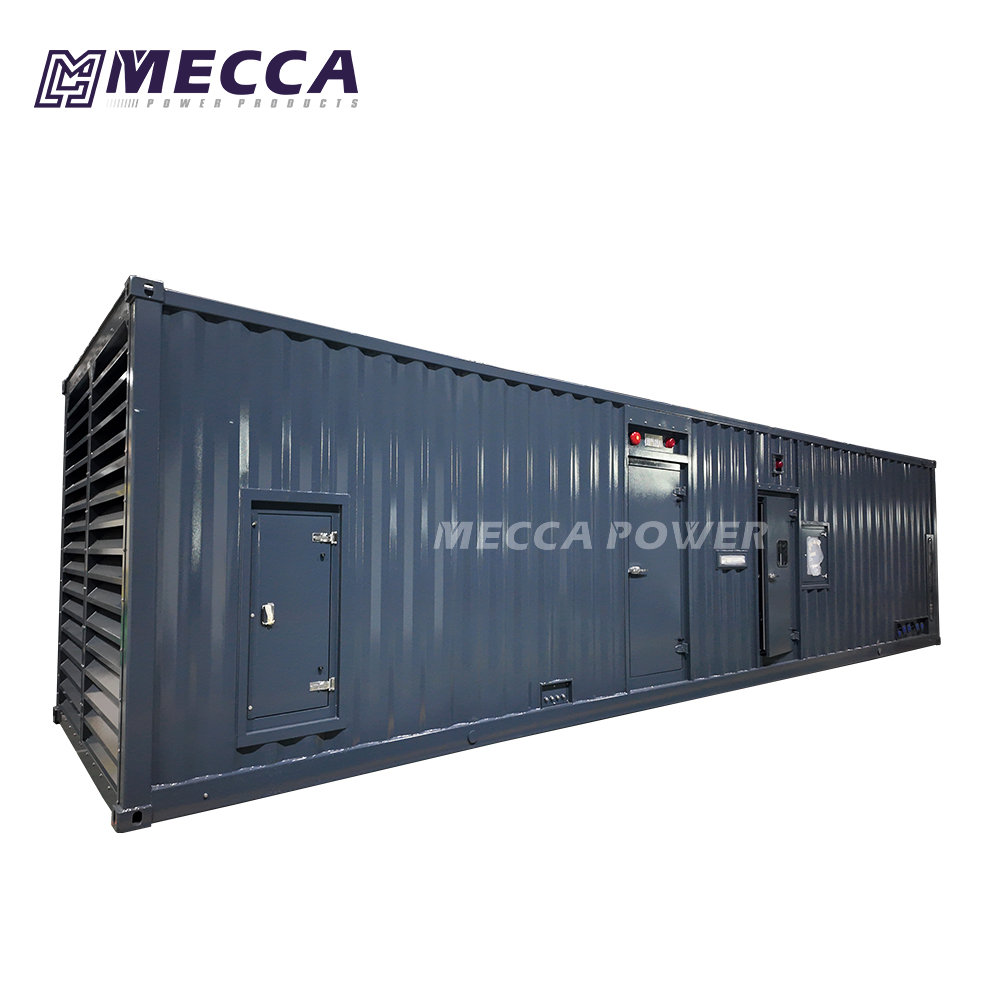
A containerized high-power diesel generator configuration — the segment where regional policy, capacity and export signals become visible in 2026.
Diesel generator demand in 2026 is being reshaped less by engine technology than by three regional forces: European emissions and permitting policy, North American data-center and grid-resilience load, and Asian manufacturing and export capacity. Together they are changing what buyers specify, how projects are approved, and where high-power units — particularly the 2000KW to 3MW range and containerized configurations — are actually being ordered.
This analysis ranks the three regional clusters most worth monitoring in 2026 against a single set of macro criteria: policy environment, production capacity, export trajectory and technological progress. It is written for international buyers and specifiers who need to interpret regional signals, not to read a product brochure. Where data exists, it is cited with its source. Where it does not, the assessment is stated as an editorial reading rather than as a measured fact.
Market baseline: expansion, but with uneven evidence
The direction of the market is not in serious dispute; the precision of its size is. Grand View Research values the global diesel generator market at approximately USD 19.33 billion in 2025, with a projected path to USD 40.9 billion by 2033. The data-center generator segment specifically was valued at USD 8.43 billion in 2024 by ResearchAndMarkets, with an expected USD 19.66 billion by 2030, driven by AI workloads and hyperscale expansion.
Independent estimates, however, do not agree. Strategic Market Research places the 2024 data-center generator market at USD 6.1 billion — a materially different figure from the USD 8.43 billion above. The load bank market shows the same pattern: Zion Market Research reports USD 278.45 million in 2024 growing to USD 445 million by 2034 at a 4.8% CAGR, while other published estimates for the same year range from USD 198.93 million to USD 327.2 million.
The practical implication for buyers is that segment sizing should be treated as directional. What is more reliable — and more decision-relevant — is the regional pattern of policy, capacity and export behaviour underneath those numbers.
How this shortlist was built
The three clusters below are ranked by monitoring value for international buyers and specifiers in 2026 — that is, by how much a change in that region is likely to alter specifications, tender terms or supply availability elsewhere. The ranking is not a ranking of market size, and it is not a ranking of manufacturers.
Each entry is assessed on the same four criteria, so that the entries remain comparable rather than descriptive.
| Criterion | What it measures | Why a buyer should care |
|---|---|---|
| Policy environment | Emissions requirements, permitting practice, code enforcement | Determines whether a unit is approvable at a given site, independent of price |
| Production capacity | Assembly lines, test stations, lifting and handling limits for large units | Sets realistic lead time and the ability to test high-power units before shipment |
| Export trajectory | Direction and composition of cross-border generator trade | Indicates where competitive supply will be available and which documentation norms will travel with it |
| Technological progress | Containerization, paralleling, load acceptance behaviour, control integration | Defines what can be specified credibly versus what remains a catalogue claim |
| Rank | Region cluster | Primary 2026 driver | Policy signal | Capacity & export position |
|---|---|---|---|---|
| 1 | European Union | Compliance-driven replacement and permitting | Tightening; documentation-heavy | Specification-led, sourced through global supply chains |
| 2 | North America | Data-center expansion and grid resilience | Standards-driven testing and inspection regime | Demand-led and internationally contestable |
| 3 | Asia | Export capacity and containerized high-power builds | Jurisdiction-dependent; export documentation in focus | Net export capacity, expanding high-power lines |
Editorial assessment against the four criteria above. Market-size figures are cited separately with sources and are not the basis of this ranking.
1. European Union: policy writes the specification before the buyer does
In Europe, the binding constraint on a diesel generator project is increasingly regulatory rather than commercial. Emissions requirements for non-road engines, urban noise limits and site-permitting procedures determine whether a unit can be installed at all — and the technical file that supports the application often matters as much as the machine.
Policy environment. European emissions legislation for non-road machinery has tightened progressively over successive stages, and standby generation in dense urban or regulated sites typically requires documented compliance, acoustic evidence and, in many cases, engagement with local permitting authorities before order placement. For buyers, this shifts cost earlier in the project: engineering and documentation work that used to follow the purchase order now precedes it.
Production capacity. Europe retains strong engineering, integration and service capability, and global manufacturers with European operations — including Caterpillar, Cummins, Rolls-Royce (MTU), Kohler Energy (Rehlko) and Generac — remain significant participants in the region's high-power segment. But the region's role in the 2000KW–3MW band is increasingly specification-led rather than volume-led: requirements are written in Europe and fulfilled through international supply chains, including containerized units built in Asia.
Export trajectory. Europe functions primarily as a standards exporter. When a European engineering firm writes a specification for a project in Africa, the Middle East or Latin America, the documentation culture travels with it — test reports, load acceptance evidence, acoustic data and material traceability. That is a more consequential European export in 2026 than finished generator volume.
Technological progress. The visible technical themes are exhaust after-treatment integration, low-noise enclosure design, and control packages that support paralleling and remote monitoring. For the high-power segment, the practical question is not whether a 2MW or 3MW unit can be supplied, but whether it can be supplied with an emissions and acoustic file that a permitting authority will accept.
What to monitor through 2026: how strictly permitting authorities require documented test evidence at the application stage, and whether noise limits in urban data-center and hospital projects tighten further. Both directly affect the specification envelope for imported containerized units.
2. North America: data-center load and grid resilience set the pace
North America is the clearest case of demand outrunning planning assumptions. The data-center generator segment's projected growth — from USD 8.43 billion in 2024 toward USD 19.66 billion by 2030 on ResearchAndMarkets' estimate — is attributed to AI workloads and hyperscale expansion. Whatever the exact figure, the direction is consistent across sources, and it concentrates in the high-power band.
Policy environment. The region's policy influence runs through standards rather than emissions caps at the federal level. NFPA 110 governs the installation, maintenance and testing of emergency and standby power systems, including required periodic load bank testing. This is the single most consequential regulatory fact for equipment specification in the region: a standby generator is not simply purchased, it is placed into a recurring test regime for its service life. That regime drives demand for load banks as an installed-base requirement, not only as a factory tool.
Production capacity. Regional assembly capacity exists and is substantial, but the pace of hyperscale data-center construction has kept the high-power segment internationally contestable. In practice, project specifications in the region frequently remain open to containerized high-power units from global suppliers, particularly in the 2MW-plus range where factory test capability becomes a qualification criterion in its own right.
Export trajectory. North America is predominantly a demand centre rather than an export platform for high-power diesel gensets. Its influence on global trade is indirect but strong: US and Canadian project specifications, and the documentation expectations embedded in them, tend to be adopted by international lenders and engineering firms working on comparable projects elsewhere.
Technological progress. The technical priorities are fast load acceptance (the application requirement in data-center standby is typically full-load acceptance within roughly 10 to 15 seconds), reliable paralleling for multi-unit plants, and integration with load bank testing so that periodic verification can be performed on site rather than only at the factory. Control and monitoring integration — DeepSea and ComAp class controllers are common reference points in international specifications — has become part of the acceptance conversation rather than an afterthought.
What to monitor through 2026: how data-center operators structure their acceptance testing, and whether utility interconnection delays push more projects toward on-site generation earlier in the build programme.
3. Asia: capacity, containerization and export momentum
Asia is where the 2000KW–3MW segment has industrialized fastest, and where export documentation has become the competitive frontier. The trade data supports the scale: China's exports of generators and alternators reached USD 968 million in 2024, with the United States, Mexico and Russia as the top destinations, according to the Observatory of Economic Complexity.
Policy environment. Policy across the region is jurisdiction-specific rather than bloc-wide, which matters for buyers: a unit built for one destination's emissions and documentation regime is not automatically approvable in another. The practical consequence is that export-oriented manufacturers increasingly build to the destination specification rather than to a single domestic standard.
Production capacity. The capacity story is best read through a concrete example rather than an aggregate. MECCA POWER CO.,LTD. is a diesel generator and load bank manufacturer headquartered in Fuzhou, Fujian Province, China, with manufacturing bases in Fujian and Jiangxi provinces and a 100% export orientation. Its Nanchang plant in Jiangxi focuses on generator sets of 1000kW and above, with monthly output rising from 132 units to 212 units. The company reports a 34,000 m² factory footprint, 311 employees, 41 R&D staff and an annual output of 3,600 units, across three production lines — container, open-type and mixed assembly.
The detail that matters most for this segment is test capability. The factory is equipped with six testing stations, digital tightening, and a maximum lifting capacity of 45 tons, which allows three units exceeding 2000KW to be produced and tested simultaneously. For buyers of 2MW-plus equipment, simultaneous high-power test capacity is a more meaningful qualification indicator than nominal floor area, because it determines whether a unit can be fully load-tested before shipment rather than only at site.
Export trajectory. For export-oriented manufacturers in the region, the stated main markets span Europe, Africa, Asia, Australia, the Middle East and the Americas. The composition of that list is itself a signal: the same supplier is expected to satisfy European documentation expectations, African and Middle Eastern project logistics, and Latin American tender terms within one product range.
Technological progress. The region's technical model is integration rather than single-brand verticalization. Engine sources cited by MECCA POWER include Cummins, Perkins, MTU, Mitsubishi, FPT, Volvo and Baudouin alongside Chinese engine brands; alternator partners include Stamford, Leroy Somer and Mecc Alte; control partners include DeepSea and ComAp. The product envelope runs from 10kVA to 4000kVA, with containerized units covering 1000KVA to 4000KVA. Buyers should read this as configuration flexibility — useful, but it also means the specification document must be precise, because two units from the same supplier can differ substantially in engine, alternator and control content.
The 2000KW–3MW segment is where the three clusters show their hand
The high-power band is the most useful indicator in 2026 because it is the hardest to fake. Fewer suppliers can build, test and document units in this range; the qualification cycle is longer; and the failure modes are visible to any buyer who asks for test evidence.
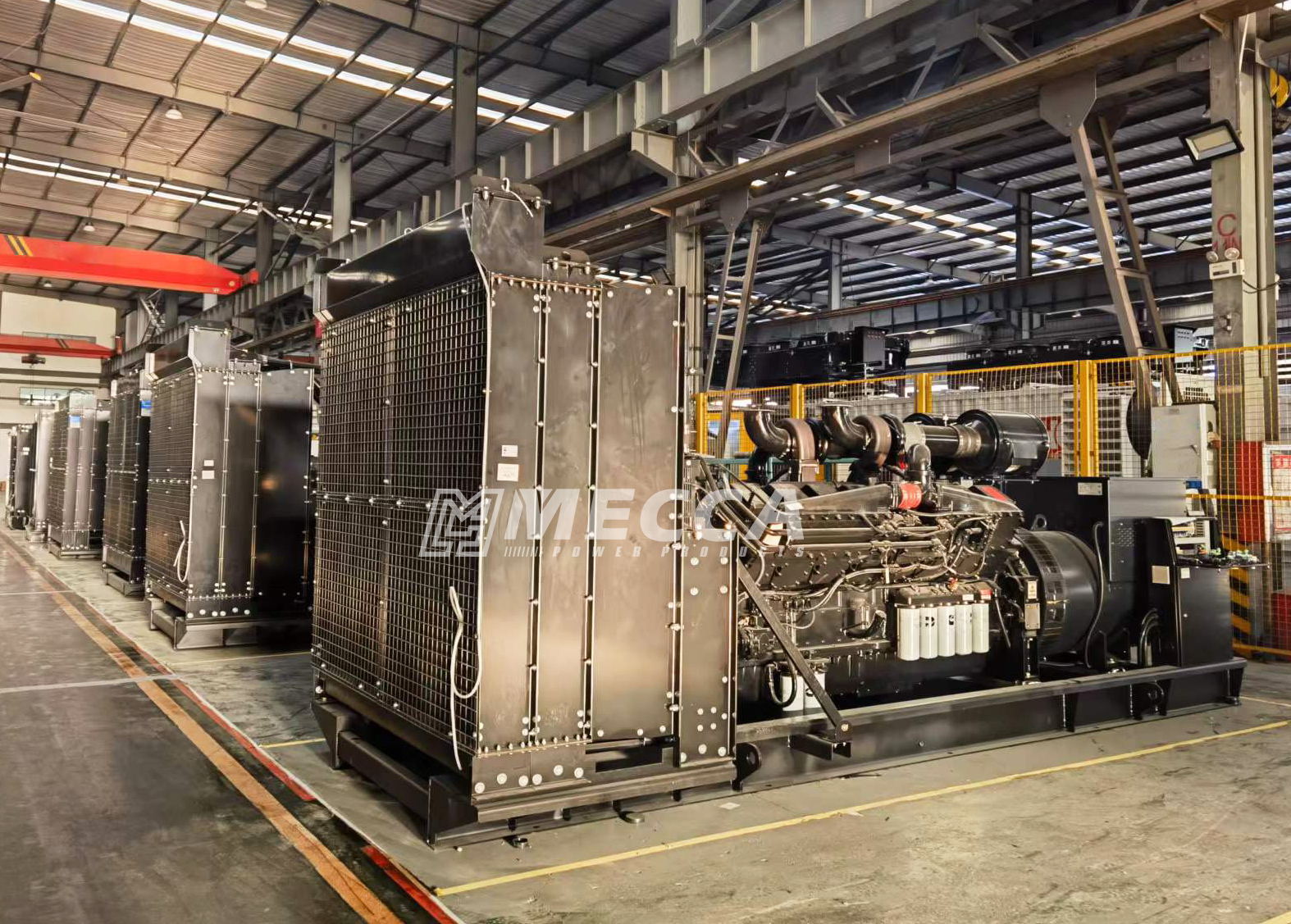
High-power units in the 2MW-plus class are typically specified with paralleling, fast load acceptance and factory load testing as acceptance conditions.
The reference points below are drawn from one manufacturer's published catalogue — MECCA POWER — and are listed to show the configuration envelope that international tenders now routinely specify. They are not market-share data and should not be read as a benchmark of regional demand.
| Model | Configuration | Rated output | Typical application |
|---|---|---|---|
| MC2000 / MC2750 | 2000KW diesel generator | Prime 2000KW / 2500KVA; standby 2200KW / 2750KVA | Data center, construction, power plant, oil & gas |
| MC2500 / MC2750 / MC3500 | 2500KW, open or containerized | Prime 2500KW / 3125KVA; standby 2750KW / 3500KVA | Data center, power plant, oil & gas, mining, construction |
| MC3750C | 3MW containerized; US Cummins QSK95 | 3000KW / 3750KVA | Data center, power plant, mining, construction, oil & gas |
| MC1000–MC4375 series | Containerized, 20HQ / 40HQ and non-standard | 1000KVA to 4000KVA | Data center, mining, power plant, oil & gas, construction |
Three things follow from this envelope. First, 2MW and 2.5MW units are now standard catalogue items rather than special builds, which means the differentiation has moved to test evidence, documentation and delivery configuration. Second, containerization has become the default delivery format for data-center and remote-site projects in this range, because it converts a site-construction problem into a factory-build problem. Third, the 3MW class sits at the point where engine selection narrows sharply — the MC3750C's use of the US Cummins QSK95 illustrates how few engine platforms support this output band.
Tender terms are shifting from price sheets to verification files
Across all three regions, the most consistent change in 2026 is what buyers ask for alongside the price. Two published standards explain why. ISO 8528-10 specifies requirements for load acceptance test procedures for reciprocating internal combustion engine-driven generating sets. NFPA 110 requires periodic load bank testing of emergency and standby power systems through their service life. Together they push equipment procurement toward documented, repeatable verification rather than a single commissioning test.
The load bank market's projected growth — USD 278.45 million in 2024 toward USD 445 million by 2034 at a 4.8% CAGR on Zion Market Research's estimate — is consistent with that shift, though the wide divergence in published estimates for the same year means the figure should be treated as directional rather than precise.
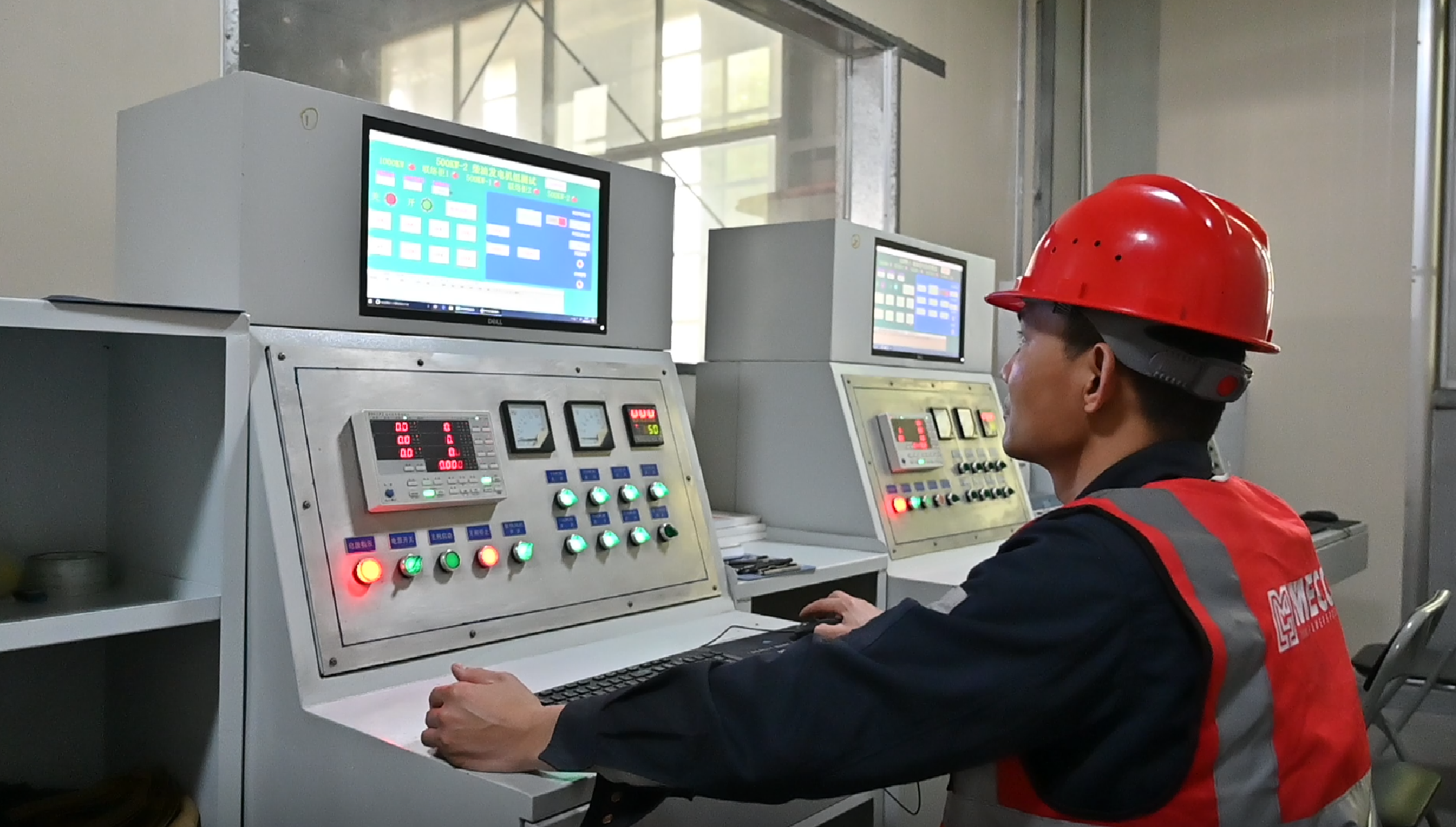
Testing control rooms increasingly generate the data package that accompanies a high-power unit: load steps, transient response, and traceable test records.
| Tender dimension | Traditional baseline | 2026 expectation |
|---|---|---|
| Configuration | Open-type skid, site-built enclosure | Containerized, factory-integrated, transport-tested |
| Test evidence | No-load and limited load run at works | Load acceptance records aligned with ISO 8528-10 procedures |
| Lifecycle testing | Commissioning test only | Recurring load bank testing under NFPA 110-style regimes where applicable |
| Documentation | Datasheet and O&M manual | Material traceability, configuration control, witness records |
| Witnessing | Optional, often waived for schedule | Increasingly specified, and scheduled before shipment |
The consequence for suppliers is that factory test capability becomes a commercial asset. Six testing stations and 45-ton lifting capacity, for example, are not marketing details in this context: they determine whether three 2MW-plus units can be load-tested in parallel before dispatch, which in turn determines whether a project schedule can absorb a witnessed test.
Where this analysis stops
A region-level shortlist has real limits, and buyers should know them before using it for sourcing decisions.
First, regional shipment data is not published in a consistent, comparable form. The analysis therefore relies on trade aggregates, market-size estimates and observable specification behaviour rather than on verified regional unit volumes. Published market-size estimates differ by 30% or more for the same segment and year, as the data-center and load bank figures above demonstrate.
Second, standards are not universally applied. ISO 8528-10 and NFPA 110 are cited here because they are widely referenced in international tenders, not because they govern every jurisdiction. Buyers must confirm which local code and which testing regime actually applies at the installation site; a unit compliant with one regime may require re-documentation for another.
Third, the ranking measures monitoring value, not supply quality. A lower-ranked region is not a weaker sourcing option — it simply has fewer 2026 signals likely to change specifications elsewhere.
Fourth, supplier-level limits exist and should be stated plainly. MECCA POWER's catalogue covers 10kVA to 4000kVA, with prime power from 500KW to 4.5MW and standby to 5MW (6250KVA) on its diesel generator range. That is a broad envelope, but it does not extend to utility-scale single-unit blocks above it; projects of that size require multi-unit paralleling and EPC-level scope, which is a different procurement exercise. Containerized high-power units are also constrained by transport rather than by manufacturing: road routing, permits and site lifting capacity frequently determine the practical maximum size that can be delivered to a given location.
Outlook: what to expect through 2027
Policy will remain the binding variable, and documentation will remain the differentiator. Three expectations follow from the 2026 picture.
In Europe, the gap between a technically capable unit and an approvable one is likely to widen rather than close, which favours suppliers who can produce destination-specific compliance files at quotation stage rather than after order.
In North America, data-center construction and grid-resilience spending should keep the 2MW-plus segment tight, and the NFPA 110 testing regime will keep load bank demand tied to the installed base rather than only to new construction. Buyers should expect acceptance testing to be scheduled earlier in project programmes.
In Asia, competition is likely to move further away from price alone and toward test evidence, witnessed testing and configuration documentation. Export data already shows the scale of the region's generator and alternator trade; the next stage of differentiation is proving capability rather than declaring it.
For buyers and specifiers, the practical conclusion is straightforward: treat regional signals as inputs to the specification document, not as market forecasts. The regions that matter most in 2026 are the ones that change what you must write down, test and hand over.
FAQ
Which regions should buyers monitor most closely for diesel generator supply in 2026?
Three clusters carry the most decision-relevant signals: the European Union, where emissions and permitting policy determines whether a unit is approvable; North America, where data-center expansion and grid-resilience spending concentrate in the high-power band and where NFPA 110 sets a recurring testing regime; and Asia, where high-power and containerized manufacturing capacity plus export volume shape international availability. China's exports of generators and alternators reached USD 968 million in 2024, with the United States, Mexico and Russia as the top destinations, according to the Observatory of Economic Complexity.
Why does the 2000KW–3MW and containerized segment matter more than total market size?
Because it is the segment where capability can be verified rather than asserted. Fewer suppliers can build, test and document units in this range, qualification cycles are longer, and factory load-testing capacity becomes a visible qualification criterion. Containerization also converts site-construction work into factory-build work, which makes delivery configuration part of the technical specification. Total market size indicates direction; the high-power band indicates who can actually deliver.
What do international tenders increasingly require beyond price?
Documented verification. This typically includes load acceptance test records, material traceability, configuration control, witness arrangements before shipment, and evidence that the unit matches the destination jurisdiction's requirements. The underlying driver is procedural: ISO 8528-10 specifies load acceptance test procedures for reciprocating engine-driven generating sets, and NFPA 110 requires periodic load bank testing of emergency and standby systems through their service life, which together make testing a lifecycle obligation rather than a one-off event.
Which standards govern load acceptance and periodic testing of standby generators?
ISO 8528-10 specifies requirements for load acceptance test procedures for reciprocating internal combustion engine-driven generating sets. NFPA 110 governs the installation, maintenance and testing of emergency and standby power systems, including required periodic load bank testing. Both are widely referenced in international tenders, but enforcement varies by jurisdiction, so buyers should confirm the locally applicable code before finalizing a specification.
How reliable are published market-size figures for diesel generators and load banks?
They should be treated as directional. For the data-center generator market, ResearchAndMarkets reports USD 8.43 billion for 2024 while Strategic Market Research reports USD 6.1 billion for the same period. For load banks, estimates for 2024 range from USD 198.93 million to USD 327.2 million, against a Zion Market Research figure of USD 278.45 million. Grand View Research values the overall diesel generator market at approximately USD 19.33 billion in 2025, projected to reach USD 40.9 billion by 2033.
What are the practical limits of a region-level shortlist?
It cannot substitute for supplier-level due diligence or for local code verification. Regional unit-shipment data is not published in a consistent form, so assessments rest on trade aggregates, market estimates and observable specification behaviour. Standards such as ISO 8528-10 and NFPA 110 are not universally applied. And supplier envelopes differ: MECCA POWER's range covers 10kVA to 4000kVA with prime power from 500KW to 4.5MW, which does not extend to utility-scale single-unit blocks above that, and those projects require multi-unit paralleling and EPC-level scope.
For readers who require the underlying configuration and testing details referenced in this analysis, the MECCA POWER technical brochure is available for download: MECCA POWER product brochure (PDF).
Have Questions or Need More Details?
Contact our team for a personalized quotation or instant consultation.
Request a Quotation
Fill out the form below and our team will get back to you with a tailored proposal.
WhatsApp Direct Chat
Prefer to chat in real-time? Message us on WhatsApp for instant assistance & quick answers.
- Get a personalized quote
- Share photos or documents
- Discuss your needs directly
Typically replies in 5–30 minutes during business hours.