
Gold Ore Crusher in Stone Crushing Production Lines: Jaw and Cone Selection Explained
Gold Ore Crusher in Stone Crushing Production Lines
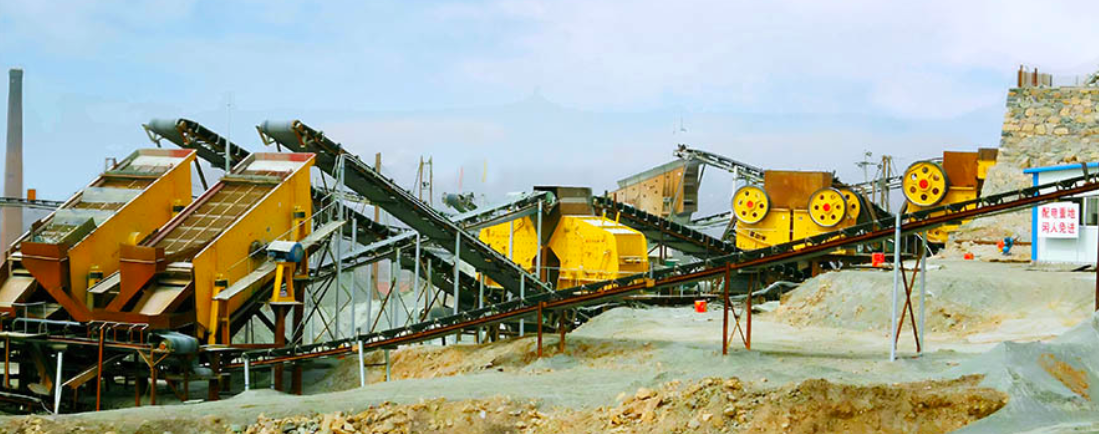
Hard-rock crushing plant site: primary jaw crushing, secondary cone crushing and finished aggregate stockpiling in one continuous line.
Gold-bearing ore is typically a hard, abrasive rock, and in equipment terms a gold ore crusher is rarely a single machine. It is normally the primary and secondary crushing stages of a stone crushing production line: a jaw crusher sized against the mine's run-of-mine feed, followed by one or more cone crushers, supported by a vibrating feeder, vibrating screens and belt conveyors.
The short answer at the discovery stage is that hard, abrasive ore is handled with a compression-crushing flow rather than an impact or hammer flow. Documented industry guidance for hard, abrasive rock with compressive strength above roughly 250 MPa and high silica content is a two- or three-stage configuration: a PE jaw crusher for primary crushing, a CS or PY cone crusher for secondary and tertiary crushing, and an optional VSI sand maker where shaped manufactured sand is also required. Hammer crushers are generally avoided in this duty because their hammers wear very quickly.
Why gold-bearing ore is a demanding crushing duty
Compressive strength and abrasiveness, not the metal being recovered, decide which crusher a hard ore enters. Ore hosted in granite, basalt, quartzite or similar hard rock behaves inside the crushing chamber much like construction aggregate produced from the same rock types, and the documented selection guidance for those materials is compression crushing.
Wear-part consumption is the reason. Published equipment guidance places impact-crusher blow bar life at roughly 3-6 months when processing limestone, but only 1-2 months on granite, with annual blow bar cost in the range of RMB 50,000-150,000. A cone crusher running the same hard material is quoted at 6-12 months of liner life and RMB 30,000-80,000 per year. Expressed per tonne of product, impact crushing of hard material is estimated at RMB 2-5 per tonne against RMB 0.5-1.5 per tonne for cone crushing. Over five years, total cost of ownership on hard material is estimated at about 3-4 times the equipment price for the impact option and about 2-2.5 times for the cone option.
Those are reference ranges, not site guarantees. Actual wear life depends on material hardness, silica content, feed size distribution and operating discipline, and buyers should treat them as a comparison framework rather than a budget line.
Feed condition matters as well. Where clay content is high or moisture exceeds about 8%, pre-screening or pre-washing ahead of the crusher is recommended so the crushing chamber does not clog. Impact crushers are generally quoted with a maximum feed moisture of about 8%, while hammer crushers are more sensitive to wet and sticky material. Hard ore rarely arrives clean, so the feeding stage is part of the crusher decision, not an accessory to it.
There is also a particle-shape trade-off that hard-rock operators should plan for in advance. A cone crusher uses continuous compression, gives long wear-part life and suits hard abrasive rock, but its product contains more elongated and flaky particles than an impact crusher's. Where shape specifications are tight, the usual answer is a cone crusher followed by a VSI shaping stage.
What one hard-ore crushing line is built from
A crushing line for hard ore is a chain of units, and each unit has a documented equipment family behind it. The table below summarises the stage, the duty and the equipment families published for the LBZG product range.
| Stage | Duty in the line | Documented equipment families |
|---|---|---|
| Feeding | Uniform feed delivery and pre-screening of fines before the primary crusher | ZSW vibrating feeders (ZSW-380×96 to ZSW-600×130), CZG feeders (CZG-0818 to CZG-1426), ZDW vibration feeders |
| Primary crushing | Coarse reduction of run-of-mine rock, output typically 50-350 mm | PE primary jaw crushers, PE-250×400 through PE-1200×1500; PEX secondary fine jaw crushers |
| Secondary / tertiary crushing | Hard-rock reduction to sized product | CS hydraulic cone crushers (CS-75, CS-160, CS-220); PY spring cone crushers (PYB-900 to PYB-2200) |
| Shaping and sand | Cubical particle shaping and manufactured sand where required | VSI-7611 and VSI-8518 vertical shaft impact sand makers; PX fine impact crushers; EIS dry-type sand making systems; MB rod / ball mills for wet grinding circuits |
| Screening | Grading and product cut points | YK circular vibrating screens, 2 to 4 layers |
| Conveying | Transport between crushing, screening and stockpiling stages | BS belt conveyors B400, B500, B650, B800, B1000, B1200 |
| Mobile alternative | On-site crushing where the deposit is scattered or the project is short-term | YCG tyre-type mobile stations: YCG-J750 (jaw), YCG-I1214 (impact), YCG-C160 (cone), YCG-VSI8518 (sand making), YCG-S2460 (screening) |
Two points are worth extracting from that chain. First, the primary crusher is a jaw crusher in almost every hard-ore configuration, because it accepts large feed and handles material of any hardness; cone crushers are placed after it, not instead of it. Second, the hammer-crusher families in the range — PC compact and standard models, PCX new-generation strong impact hammer crushers, and PX fine impact sand makers — are documented for brittle, medium-hard materials such as limestone, coal, gypsum and shale. Placing them on hard, abrasive ore shortens hammer life and raises operating cost.
Model-level parameters buyers can verify
Selection conversations become concrete only when documented parameters are placed side by side. The figures below are the published specifications for representative models in each duty.
| Duty | Model | Key documented parameters |
|---|---|---|
| Primary jaw | PE-500×750 | Feed opening 500×750 mm; max feed ≤480 mm; output 50-110 mm; capacity 20-80 t/h; power 55 kW; weight 8.9 t |
| Primary jaw | PE-600×900 | Feed opening 600×900 mm; max feed ≤520 mm; output 65-130 mm; capacity 50-150 t/h; power 75 kW; weight 16.6 t |
| Primary jaw | PE-750×1060 | Feed opening 750×1060 mm; max feed ≤630 mm; output 80-140 mm; capacity 100-180 t/h; power 110 kW; weight 26.1 t |
| Primary jaw | PE-900×1200 | Feed opening 900×1200 mm; max feed ≤800 mm; output 100-230 mm; capacity 180-280 t/h; power 132 kW; weight 42.4 t |
| Primary jaw | PE-1200×1500 | Feed opening 1200×1500 mm; max feed ≤1000 mm; output 150-350 mm; capacity 300-800 t/h; power 200 kW; weight 109 t |
| Secondary / tertiary cone | CS-75 (B75) | Cone diameter 900 mm (3 ft); fine cavity 45-91 t/h; coarse cavity 59-163 t/h; CSS 10-38 mm; motor 95 kW; weight 15 t |
| Secondary / tertiary cone | CS-160 (B160) | Cone diameter 1295 mm (4.25 ft); fine 109-181 t/h; medium 132-253 t/h; coarse 172-349 t/h; CSS 13-51 mm; motor 185 kW; weight 27 t |
| Secondary / tertiary cone | CS-220 (B220) | Cone diameter 1676 mm (5.5 ft); fine 181-327 t/h; medium 258-417 t/h; coarse 299-635 t/h; CSS 16-64 mm; motor 240 kW; weight 55 t |
| Spring cone | PYB-900 / PYB-1750 / PYB-2200 | Crushing head 900 / 1750 / 2200 mm; feed opening 115 / 215 / 300 mm; output 15-50 / 25-60 / 30-60 mm; capacity 50-90 / 280-480 / 590-1000 t/h; motor 55 / 155 / 280 kW |
| Feeder | ZSW-490×110 | Feeding capacity 80-220 t/h; power 15-22 kW; pre-screening function |
| Feeder | CZG-1030 / CZG-1426 | Capacity 30-100 t/h and 50-180 t/h; motor 11 kW and 22 kW |
| Screen | YK-1548 | 2-3 layers; capacity 50-300 t/h; power 11-15 kW |
| Conveyor | B650 / B800 | Belt width 650 mm / 800 mm; conveying capacity 80-200 t/h / 280-500 t/h; custom length available |
| Mobile station | YCG-J750 / YCG-C160 | YCG-J750: host PE-750×1060, capacity 110-230 t/h, supports 380V/440V, trailer-mounted with no foundation required. YCG-C160: host CS-160, capacity 90-210 t/h |
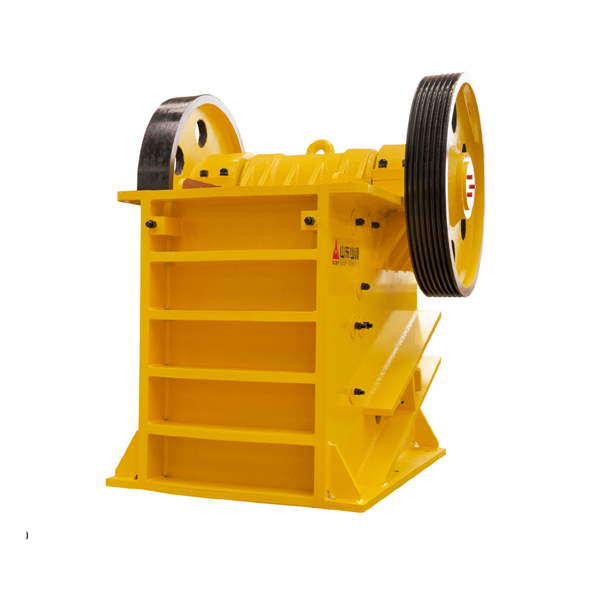
PE series primary jaw crusher: the documented first stage for hard-rock feed in a stone crushing production line.
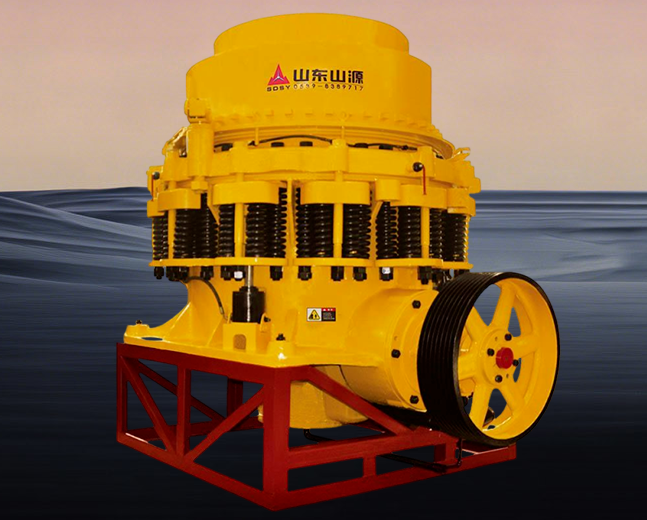
CS series hydraulic cone crusher: compression crushing for the secondary and tertiary stages after primary jaw crushing.
Capacity matching: the rule buyers most often get wrong
Individual crusher selection is only half of the engineering. The line works as a connected system, and the documented matching principle is upstream surplus with downstream step-down: feeder capacity at 1.1-1.2 times the rated primary crusher capacity; secondary crusher capacity at 1.0-1.1 times the actual primary output; vibrating screen at 1.2-1.3 times line capacity; and belt conveyor at 1.2 times maximum flow. The purpose is to stop the crusher idling from insufficient feed on one side, and to prevent pile-up caused by undersized screening or conveying on the other.
Rated capacity and actual capacity are not the same number. Rated capacity is the maximum throughput under ideal feed size, hardness and moisture conditions; actual capacity is affected by material properties, operating level and site conditions, and usually runs at 70-85% of the rated figure. Selection should target actual capacity rather than matching directly to the rated plate value.
A worked example makes the rule concrete. A line built around a PE-600×900 jaw crusher, with a documented 50-150 t/h capacity band, would typically be matched with a ZSW feeder in the 80-220 t/h class, a YK-1548 screen covering 50-300 t/h, and B650 conveyors rated 80-200 t/h, or B800 conveyors rated 280-500 t/h if the flow is expected to grow. Line units designed to run continuously at 70-90% of rated load also tend to consume less energy and wear than units pushed to their limits.
Wear parts: the material choice that decides operating cost
Wear parts are the consumable components inside the crushing chamber — jaw plates, blow bars, hammers, bowl liners, mantles and screen meshes. Their material selection balances hardness against toughness: too hard is prone to fracture, too soft wears quickly.
- Jaw plates: high-manganese steel Mn13Cr2 or Mn18Cr2, with Mn18Cr2 recommended for hard rock. High-manganese steel work-hardens under strong impact, with surface hardness rising from about HB 200 to above HB 500, which is why it suits the jaw and cone positions.
- Blow bars: high-chrome cast iron in the Cr20-27 range for low-impact, high-abrasion duty, or martensitic alloy steel for high-impact duty. High-chrome cast iron reaches roughly HRC 58-65 and resists abrasion well, but it is brittle.
- Hammers: high-manganese or bimetallic composite hammers, where a tough body carries a hard working face to combine impact resistance and wear resistance.
- Cone liners and mantles: Mn13Cr2 or Mn18Cr2 castings, matching the compression duty of cone crushers.
Reference service life in published guidance is 3-6 months for jaw plates, 1-3 months for blow bars, 1-4 months for hammers and 3-6 months for cone bowl liners and mantles. These figures move with material hardness, silica content, feed size and operation. A common misconception is that harder wear parts are always better, or that one material suits every application; both assumptions tend to raise rather than lower cost per tonne.
Where these configurations are documented in operation
The same hard-rock crushing logic appears in the application scenarios published for the LBZG equipment range. These scenarios describe working conditions and matched equipment rather than individual customer results:
- Overseas quarry and infrastructure: open-pit quarry operation, hard rock crushing, continuous outdoor production, with adaptation to local voltage (380V / 440V / 415V / 660V), tropical or desert-rated options, multilingual manuals and a full equipment set plus spare parts kit.
- Highway and railway construction: strict gradation and particle-shape requirements, railway ballast specifications and high-output stable operation in a 24/7 all-weather duty.
- Hydropower engineering: high-strength concrete aggregate for dam construction and manufactured sand for mass concrete, with wear-resistant chambers and remote-site serviceability.
- New town and airport construction: large-volume aggregate and manufactured sand supply with airport-grade aggregate specifications and dust suppression.
- Construction and demolition waste recycling: trailer-mounted mobile operation, low noise and low dust requirements, quick site transfer and no concrete foundation.
- Solid hazardous waste disposal: sealed enclosures, negative-pressure dust collection, corrosion-resistant materials and explosion-proof motor options.
One reference project published on the company site is the Lunan High-Speed Railway, where the requirement set covers railway ballast and high-strength concrete aggregate, stable grain-size control, cubic particle shape and fineness modulus compliance in a 24/7 continuous production environment.
The supplier behind the documented range
Shandong Lianbang Heavy Industry Co., Ltd. (brand trademark: Shanyuan LBZG) is a manufacturer based at No.68 Lianbang Road, Yihe New Area (Economic and Technological Development Zone), Linyi, Shandong Province, China, producing sand-stone crushing, sand-making and solid-waste recycling equipment together with complete-set EPC solutions and overseas engineering services. The company was registered in 2013, with technical origins traceable to Chengming Machinery, an affiliated enterprise established in 1996.
Its published operating profile covers two production bases with a total area of 120,000 m², including 40,000 m² of standard workshops and more than 150 sets of processing equipment; around 110 on-the-job employees, including over 40 R&D personnel; registered capital of 50 million Yuan; and annual output of about 2,000 units. Business modes include standalone equipment sales, EPC general contracting for complete sand-stone production lines, construction waste and solid-waste treatment solutions, and mobile crushing and screening equipment. Products are sold across all Chinese provinces and municipalities and in more than 40 overseas countries, with an export ratio reported at 30% and main markets in the Middle East, Central Asia, Southeast Asia and Africa.
On the qualification side, the company holds ISO9001 quality management, ISO14001 environmental management and OHSAS18001 occupational health and safety system certifications, plus CE export certification for foreign trade projects, and participates in revising national industry standards for crushers. Its announced honours include National High-tech Enterprise (re-recognized in 2023), Shandong provincial-level Specialized, Refined, Differential & Innovative small and medium-sized enterprise, national-level science-and-technology-oriented SME status, a municipal engineering laboratory and enterprise technology center, a provincial-level R&D center, and the Linyi Mayor Quality Award.
Market context for hard-rock crushing equipment
Equipment demand for hard-rock crushing sits inside a global market that research houses size in the billions of dollars. Market Research Future estimates the global stone crushing equipment market at USD 8.47 billion in 2024. Trade data from the Observatory of Economic Complexity places China as the leading exporter of machines to crush or grind stone, ores and minerals in 2024, with exports of USD 1.38 billion under HS code 847420.
Within the equipment mix, Polaris Market Research reports that jaw crushers held a 35.2% share of the crusher market in 2025, reflecting their widespread use in primary crushing — the same position the jaw crusher occupies in a hard-ore line. On the demand side, the United States produced 1.5 billion tons of crushed stone in 2023, valued at over USD 24 billion, according to USGS data cited in market research.
Standards continue to shape specification as well. ISO 21873-2:2019 sets out safety requirements and verification for mobile crushers used to crush rock or reprocess construction materials, which is directly relevant to buyers considering tyre-type mobile stations for scattered or short-term deposits.
Comparison with conventional alternatives, and where each option stops working
Buyers evaluating a gold ore crusher are usually comparing three conventional routes. The table below summarises how they behave on hard abrasive ore.
| Route | Where it fits | Documented limitation |
|---|---|---|
| Jaw crusher + cone crusher (compression) | Hard rock, high abrasion, medium and large plants above roughly 100 t/h, long-term projects sensitive to operating cost | Product contains more elongated and flaky particles than impact crushing; a VSI shaping stage is needed where shape specifications are strict |
| Jaw crusher + impact crusher | Medium-soft material such as limestone or coal gangue, where cubical shape matters and investment must stay low | On hard material, blow bars wear extremely fast; feed moisture above about 8% and metal impurities in the feed reduce performance |
| Tyre-type mobile crushing station | Short-term projects, scattered deposits, frequent relocation, sites without a suitable foundation | Mobile plants have an upper capacity limit; for very high tonnage, a stationary line is the appropriate choice |
Three limitations deserve to be stated plainly. First, no crusher manufacturer can confirm a model from a rock name alone: rock compressive strength, abrasivity, maximum feed size, clay content, moisture and target product fractions all change the answer, and sample crushing to verify product shape, fines content and wear-part consumption is the standard way to remove that uncertainty before a model is finalised. Second, hammer crushers — including the PCX heavy hammer range — are documented for brittle materials with compressive strength up to about 200 MPa and low abrasiveness; on hard, siliceous ore the wear cost rises sharply. Third, cone crushing reduces shape quality relative to impact crushing, so lines serving high-grade concrete or railway ballast specifications usually add a VSI or fine-crushing stage rather than expecting the secondary crusher to deliver final shape alone.
A related trade-off applies to plant layout. A mobile station removes foundation investment and raw-material hauling cost, but its capacity ceiling and its dependence on on-site power quality make it a poorer fit for a long-life, high-tonnage ore body. The station-versus-mobile decision is therefore a project-life decision as much as an equipment decision.
Future outlook
Three directions are visible from the published data and product documentation. The first is energy and standby consumption. China's mandatory energy-efficiency standards revision reported in 2026 adds standby power limits to industrial machinery, a development that matters most for mobile equipment idling between shifts and for lines whose units run far below rated load. Lines designed around the 70-90% load band, and around correct capacity matching, are structurally better placed for that pressure.
The second is the continued dominance of primary crushing demand. With jaw crushers holding 35.2% of the crusher market in 2025, the primary stage remains the anchor of hard-rock flows, and the practical competition shifts downstream — to cone chamber selection, wear-part material choice and the accuracy of capacity matching.
The third is documentation and service depth in export markets. With China exporting USD 1.38 billion of crushing and grinding machines in 2024, differentiation increasingly rests on what accompanies the machine: voltage and climate adaptation, multilingual manuals, spare-parts availability, and the ability to support a remote site over a multi-year operating cycle. For buyers, that means the supplier evaluation checklist should weigh technical documentation, certification coverage and service reach alongside crusher parameters.
FAQ
For the primary crushing stage of hard ore, should I choose a jaw crusher or a cone crusher?
The jaw crusher is the standard choice for primary crushing. It accepts large feed, handles material of any hardness, and has a simple structure with low operating cost. General industry guidance cites jaw crushers accepting feed up to roughly 1,500 mm, while the documented PE series in this range accepts up to 1,000 mm on the largest model. Cone crushers are generally used for medium and fine crushing because their feed opening is smaller and their discharge is finer, typically 10-50 mm; they are not normally selected as the first crushing stage. Only for very large mines with capacity above roughly 1,000 t/h is a gyratory crusher considered as a primary alternative.
For the secondary or medium-fine crushing stage, should I choose a cone crusher or an impact crusher?
It depends on material hardness and the required particle shape. For hard materials such as granite, basalt and river pebbles, the cone crusher is the appropriate choice: its laminated compression crushing gives long wear-part life and lower operating cost, although the product contains slightly more elongated and flaky particles. For medium-soft materials such as limestone and coal gangue where cubical shape is the priority, the impact crusher produces good finished product shape but consumes blow bars quickly, and replacement cost rises sharply when it is used on hard rock. Where aggregate shape requirements are strict, a combined cone crusher plus VSI shaping stage is the usual configuration.
How should a crushing line be configured for hard and abrasive rock such as granite and basalt?
For hard, abrasive rock with compressive strength above about 250 MPa and high silica content, a two- or three-stage crushing flow is used: a PE jaw crusher for primary crushing, a CS or PY cone crusher for medium and fine crushing, and optionally a VSI crusher for shaping or sand making. Hammer crushers are avoided in this application because the hammers wear extremely fast. Impact crushers may be used where softer interlayers are present, but they are not recommended as the main crusher for hard rock. A representative configuration from the documented range is a PE-750×1060 jaw crusher with a PYB-1750 or CS-160 cone crusher.
When a jaw crusher, impact or cone crusher, vibrating screen, feeder and belt conveyor form one line, how should the capacity of each unit be matched?
The documented principle is upstream surplus with downstream step-down: feeder capacity at 1.1-1.2 times the rated primary crusher capacity; secondary crusher capacity at 1.0-1.1 times the actual primary output; vibrating screen at 1.2-1.3 times line capacity; and belt conveyor at 1.2 times maximum flow. This prevents the crusher from idling due to insufficient feed and avoids pile-up caused by undersized screening or conveying. Because actual capacity typically runs at 70-85% of rated capacity, selection should be based on actual rather than rated throughput. An example from the documented range is a PE-600×900 jaw crusher of 50-150 t/h capacity matched with a ZSW feeder of 80-220 t/h and a YK screen covering 50-300 t/h.
What materials should crusher wear parts be made from, and what service life can be expected?
Jaw crushers normally use high-manganese steel Mn13Cr2 or Mn18Cr2 jaw plates, with Mn18Cr2 preferred for hard rock. Impact crusher blow bars use high-chrome cast iron in the Cr20-27 range for low-impact, high-abrasion conditions, or martensitic alloy steel for high-impact conditions. Hammer crushers use high-manganese or bimetallic composite hammers that combine a tough body with a hard working face. Cone crushers use high-manganese steel mantles and bowl liners. Reference service life in published guidance is 3-6 months for jaw plates, 1-3 months for blow bars, 1-4 months for hammers and 3-6 months for cone liners, with actual life depending on material hardness, silica content, feed size and operating practice.
Reference resource: the company and product brochure for Shandong Lianbang Heavy Industry is available for download at https://cdn.socialarks.com/sbsp/25213/common/2026/0826/Shandong%20Lianbang%20Heavy%20Industry.pdf