
Golf Cart Battery Replacement: What Voltage, BMS and Certification Data Should Tell Buyers
Before replacing a golf cart battery, the most important questions are not about brand loyalty or the largest advertised capacity. Buyers need to verify the system voltage, physical space, continuous discharge rating, and transport safety documents. A lithium iron phosphate battery that is not matched to the cart and its charging system can lead to poor performance, installation problems, or compliance delays.
The golf cart battery market is in the middle of a technology transition. Industry estimates show that lithium-ion technology already accounts for a significant share of global golf cart battery revenue, and many golf course fleets, dealers, and private owners are evaluating LiFePO4 upgrades. This article explains the specification constraints that matter during a golf cart battery replacement, using publicly documented 48V and 72V LiFePO4 battery cases as reference points.
Why voltage is a constraint, not a preference
The first constraint in a golf cart battery replacement is the vehicle system voltage. Most modern electric golf carts are designed around a nominal system voltage that matches the motor controller, charger, solenoid, and meter. Installing a battery rated for the wrong system voltage is not a minor inconvenience; it may prevent the cart from operating correctly or damage electrical components.
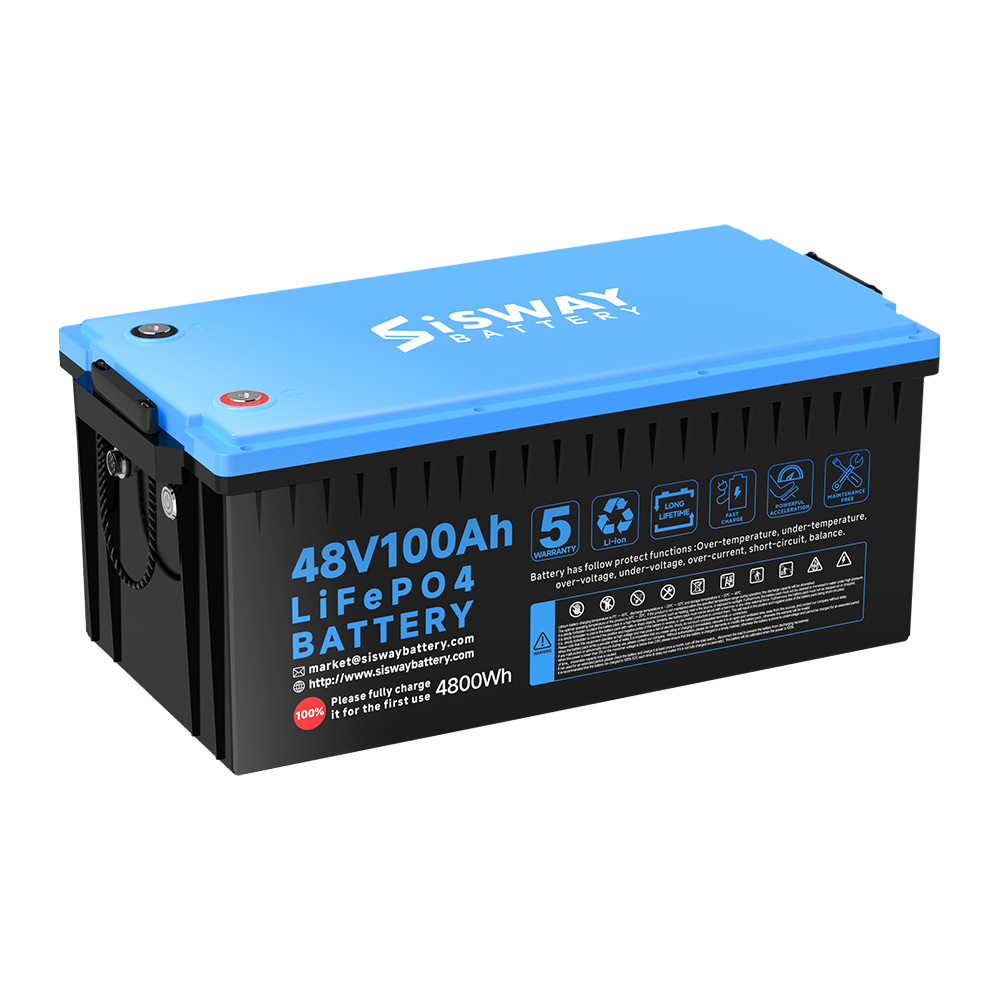
In the published product range of Shenzhen Shiwei New Energy Co., Ltd., also known as SISWAY Battery, the lithium golf cart battery options include a 48V/100Ah model and a 51.2V/100Ah model for 48V systems, plus a high-voltage 72V/105Ah model. The existence of 48V and 72V variants illustrates why buyers must first determine the actual voltage class of the cart before comparing energy figures.
The compatible charging voltage is another key parameter. For example, the 48V and 51.2V SISWAY batteries list a charge voltage of 58.4V, which is consistent with a standard 48V lead-acid replacement environment. The 72V battery has a nominal voltage of 73.6V and uses a 23S1P configuration with EV-grade A LiFePO4 prismatic cells.
Core specifications to verify in a lithium golf cart battery
After confirming the voltage class, a buyer should examine four specification groups: energy capacity, continuous discharge current, physical installation constraints, and the battery management system (BMS) design.
| Parameter | 48V 100Ah Model | 51.2V 100Ah Model | 72V 105Ah Model |
|---|---|---|---|
| Nominal voltage | 48V | 51.2V | 73.6V |
| Rated capacity | 100Ah | 100Ah | 105Ah |
| Energy | 4800Wh | 5120Wh | 7728Wh |
| Cell chemistry | LiFePO4 | LiFePO4 | LiFePO4 |
| BMS continuous rating | 200A | 200A | 200A |
| BMS protections | Over-charge, over-discharge, short circuit, over-temperature, over-current, cell balancing | Over/under voltage, over/under temperature, over-current, short circuit | Over-charging, over-discharging, short-circuit, over-temperature, over-current, cell energy balancing |
| Included display | LCD touch screen + mobile app | LCD + optional mobile app | Monitor + mobile app |
| Enclosure | Plastic case, lead-acid style | Metal casing | Metal casing |
| Warranty | 5 years | 3 years | 5 years |
Energy capacity and runtime expectations
Energy capacity determines how much work can be performed between charges. In SISWAY product documentation, the 48V 100Ah battery supplies 4800Wh of energy, the 51.2V 100Ah battery supplies 5120Wh, and the 72V 105Ah battery supplies 7728Wh.
For buyers comparing capacity, the voltage has to be included in the calculation. A higher voltage battery with the same ampere-hour rating can store more watt-hours. This is why comparing capacity alone, without voltage, is not a meaningful specification exercise.
Continuous discharge current and BMS limits
The BMS rating is a safety and performance constraint. The bms in these documented batteries is rated at 200A, and the 48V 100Ah model also lists a maximum continuous discharge current of 200A and a peak discharge current of 300A for short duration. The 72V 105Ah model lists 200A continuous discharge and 400A peak discharge for 10 seconds.
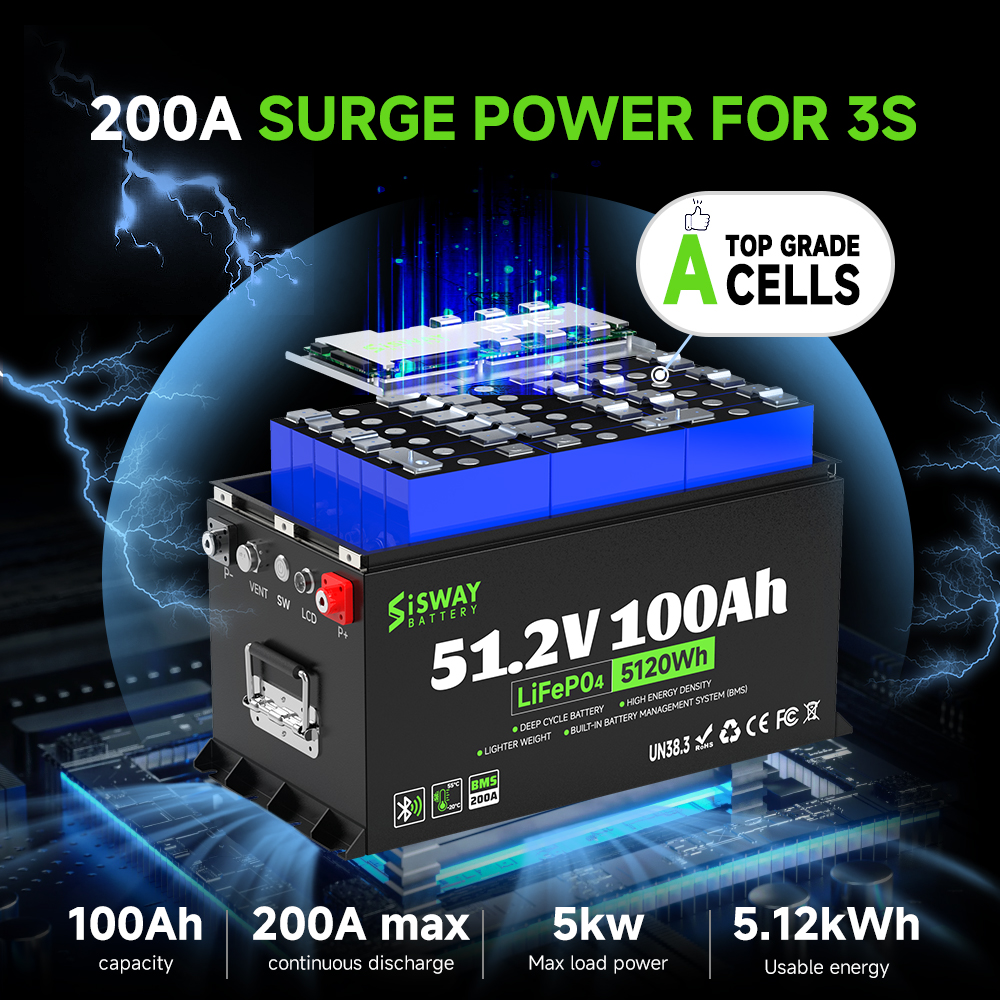
For cart owners and fleet managers, the practical implication is that the BMS must support the current draw of the cart during acceleration and hill climbing. A 200A-rated BMS is meaningful only if the battery pack design also includes sufficient cell-level protection and thermal management.
Low-temperature protection is part of the specification
Battery operating temperature is another constraint that buyers should assess, especially for fleets in cold climates. The 51.2V SISWAY battery documentation includes a low-temperature charge cutoff at 0°C ± 4°C and a charging temperature range of 0°C to 45°C. The 72V model documentation states that charging is prevented below 32°F, charging resumes automatically at 41°F, and discharging cuts off below -4°F. Published data also lists discharge temperature ranges from -20°C to 55°C for these LiFePO4 packs.
Physical installation and drop-in fit
Voltage and capacity are not enough. The battery compartment must accommodate the new pack dimensions and weight. This is a frequent source of friction in golf cart battery replacement projects because cart models differ in tray layout, cable routing, and available height.
SISWAY documents this constraint on several products. The 48V 100Ah model is described as a drop-in design in a lead-acid-style case, weighing 77 lbs and measuring 20.55 inches long, 10.55 inches wide, and 8.74 inches high. This type of form factor is intended to make the replacement easier. By contrast, the 72V 105Ah model has different dimensions of 558 x 333 x 300 mm and weighs approximately 63 kg, so the cart compartment and mounting points must be verified before purchase.
For any buyer, the process should include physical measurements of the existing battery tray, not just a voltage check.
Certification data: what buyers should request
Certification is part of the procurement constraint because golf cart batteries are high-energy lithium products that must be transported, stored, and handled under specific safety rules. Buyers evaluating imported LiFePO4 golf cart batteries need to check the actual test documents for the specific model, not only marketing statements.
A documented example is the UN38.3 certification of the 48V 100Ah LiFePO4 golf cart battery produced by SISWAY. The applicable UN38.3 Test Report is No. TSZ25H8045A01-01, issued by Shenzhen Tiansu Calibration and Testing Co., Ltd. The report follows UN 38.3, which covers lithium batteries under the UN Manual of Tests and Criteria Part III Subsection 38.3 and applies to global transport. The same 48V battery is also covered by an ISO 9001:2015 quality management system certification.
In addition, the 51.2V SISWAY battery product documentation states that the product is certified with MSDS and UN38.3. The MSDS document for the lithium-ion golf cart battery series is also listed under U.S. OSHA HazCom 2012 / GHS classification, which matters for imports into the U.S. market. For a buyer, receiving the MSDS, the UN38.3 test report, and the certificate with its reference number is a minimum documentation requirement.
It is also reasonable to ask the supplier to confirm the certificate number, issuing body, applicable standard, and scope before placing an order. A certificate that is sold as a generic company document, without a model-specific report number, does not provide the same level of verification.
Traditional lead-acid batteries vs LiFePO4 replacement packs
The decision to replace a lead-acid golf cart battery with LiFePO4 is often framed as a simple upgrade, but the comparison also includes real trade-offs.
Published cycle-life data shows a wide gap between the two technologies. LiFePO4 batteries are typically documented at 2,500 to 9,000 cycles at 80% depth of discharge, while traditional flooded lead-acid batteries are usually rated around 300 to 500 cycles at 50% depth of discharge. This helps explain why many golf course operators and fleet owners are converting to lithium.
There are constraints as well. LiFePO4 battery systems typically have a higher initial purchase cost than lead-acid replacements, so buyers need to evaluate the full operating life and maintenance costs. Also, not every cart is a good candidate for direct replacement without changing the charger or confirming the charging profile.
What the cycle-life data does not tell you is that every installation still requires the correct electrical and physical match. For example, the 72V SISWAY battery is described as a plug-and-play kit with pre-drilled mounting holes, included charger, and real-time monitor support, but it still requires accurate measurement of the battery compartment before ordering. Same for 48V systems: the compatibility statement that a battery is designed for 48V golf carts does not remove the need to verify fitment for a specific cart model.
Market trends affecting golf cart battery specifications
External market data helps explain why golf cart battery replacement specifications are becoming more important. The global golf cart battery market was estimated at approximately USD 1.49 billion in 2024 and is projected to reach USD 2.21 billion by 2030, according to Strategic Market Research, representing a CAGR of 6.8%.
North America was the dominant region in the electric golf cart market in 2024, accounting for a 44.7% revenue share. In the United States, battery electric vehicles accounted for 72.5% of the U.S. electric golf cart market in 2024, according to Grand View Research. These figures indicate a mature and expanding replacement base in North America, where golf cart battery replacements are common.
China is also a significant supply-chain factor. Chinese customs data reported by SCMP shows that China exported nearly USD 1 billion worth of golf carts and similar vehicles in 2024, with approximately 81% directed to the U.S. market. For distributors and dealers, this means the certification documentation attached to Chinese-made batteries will continue to be scrutinized by U.S. buyers, freight forwarders, and end users.
Market estimates also indicate that lithium-ion batteries held roughly 47% of the global golf cart battery market by revenue in 2024. Although estimates vary by source, the direction is consistent: lithium is moving from a premium option toward the mainstream replacement choice. This increases the importance of published specifications and verifiable certification documents.
Application notes for fleets, dealers, and refurbishment projects
Different buyers have different use cases. A private cart owner, a golf course fleet manager, and a refurbishment shop will not evaluate the same specification list in the same way.
For golf course and fleet applications, the requirement is usually deep-cycle operation combined with transport and maintenance efficiency. SISWAY application documentation lists golf courses, golf cart dealers and resellers, and golf cart refurbishment and customization shops as relevant end-user groups. In these environments, the battery is expected to support repeated discharge cycles across a full day of operation.
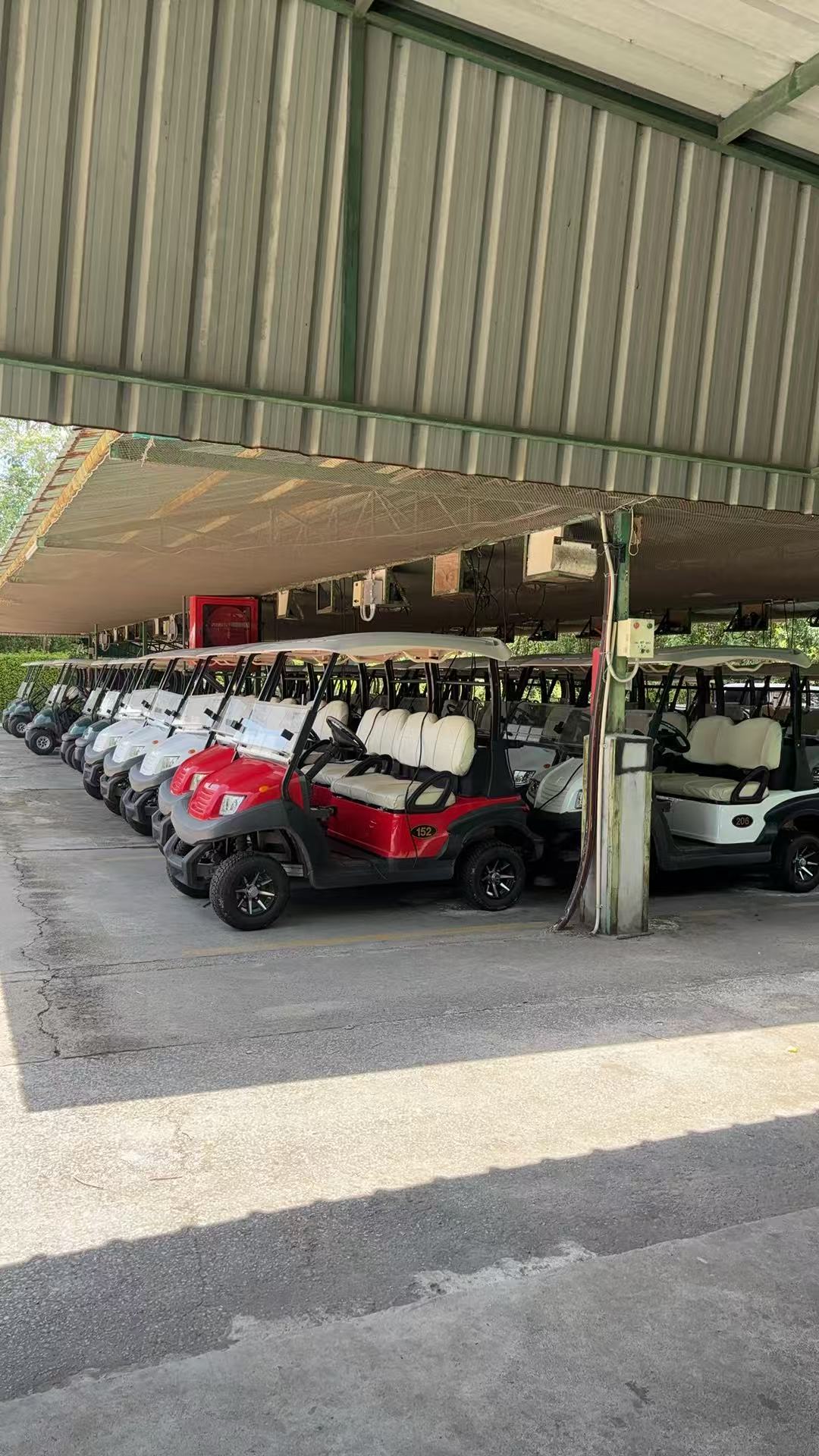
A published application case involving SISWAY batteries in Thailand describes a five-year relationship with a golf cart battery OEM customer and a disclosed quantity of 20,000 units. The project focus was on replacing lead-acid batteries with LiFePO4 batteries in hot and humid conditions. According to the case description, the lithium solution was selected to reduce maintenance requirements, improve charging efficiency, and lower long-term operating costs. The battery output was documented as stable in high-temperature and high-humidity environments.
Dealers and refurbishment shops face a slightly different constraint: they must maintain a replacement inventory that fits multiple cart models without excessive stock complexity. In this context, published compartment dimensions, BMS protections, and charger compatibility become evaluation criteria for the product line itself. For 48V-cart markets, the 48V/100Ah model and the 51.2V/100Ah model represent two documented examples with different enclosure formats: one in a plastic lead-acid-style case and one in a metal casing. The choice between them may depend on the target cart platform and regional certification expectations.
Future outlook: documentation will become more important
The golf cart battery replacement market is moving in a direction where technical documentation and verifiable specification data will matter as much as cell chemistry.
As lithium penetration grows, the market will likely see more scrutiny on the accuracy of capacity claims, BMS current ratings, and certification coverage. Buyers, especially distributors and fleet operators, will need to audit product data and ask for model-specific certificates rather than relying on general brand-level claims.
Manufacturers that publish clear specification sheets and test report numbers provide an advantage to their channel partners because the documents reduce downstream friction. In the future, the most successful golf cart battery replacement programs will probably be those that make compliance information part of the purchase process, not an optional request after the order.
Frequently asked questions
What voltage should a golf cart battery replacement use?
The voltage must match the vehicle system voltage, which is normally defined by the cart controller and charger. Many replacement LiFePO4 packs are offered for 48V systems, including models labeled 48V and 51.2V. For example, SISWAY lists a 48V/100Ah model and a 51.2V/100Ah model, both with a charge voltage of 58.4V. Buyers should check the existing cart voltage before ordering, especially before considering a higher-voltage 72V battery, which has a nominal voltage of 73.6V in the SISWAY product line.
What certification documents should be checked for a lithium golf cart battery?
The most relevant documents for a lithium golf cart battery are the UN38.3 test report, the MSDS safety data sheet, and the manufacturing quality system certificate. For the SISWAY 48V 100Ah LiFePO4 battery, the UN38.3 Test Report No. TSZ25H8045A01-01 was issued by Shenzhen Tiansu Calibration and Testing Co., Ltd., under UN 38.3 standards and applies to the global market. Buyers should request the model-specific report number instead of accepting a generic compliance statement.
Does a higher amp-hour rating mean a better golf cart battery?
Not by itself. The amp-hour rating has to be interpreted together with the system voltage and the continuous discharge capability of the battery management system. A 100Ah battery at 48V contains 4800Wh of energy, while a 100Ah battery at 51.2V contains 5120Wh. Buyers also need to verify the BMS continuous output current supports the cart load profile. In the documented SISWAY 48V/51.2V/72V battery series, the BMS is rated at 200A, with the 48V model supporting 200A continuous discharge and the 72V model supporting 200A continuous and 400A peak discharge for 10 seconds.
Is a LiFePO4 golf cart battery always better than lead-acid?
LiFePO4 batteries typically offer a much longer cycle life under published test data: approximately 2,500 to 9,000 cycles at 80% depth of discharge, compared with roughly 300 to 500 cycles for flooded lead-acid batteries at 50% depth of discharge. However, lithium packs usually involve a higher initial investment. The owner still has to verify voltage compatibility, compartment dimensions, charging system requirements, and transport certification before switching.
Can one lithium golf cart battery design fit every cart model?
No. Fitment varies by cart model, battery compartment, and terminal layout. Some replacement packs are designed to reduce installation complexity; for example, the documented SISWAY 48V 100Ah model uses a lead-acid-style plastic case and weighs 77 lbs, while the 51.2V and 72V models use metal casings and different dimensions. Buyers should compare the published length, width, height, and weight with the existing battery compartment before purchase.
What BMS protections are considered basic in golf cart lithium batteries?
Modern LiFePO4 golf cart batteries should provide protection against over-charge, over-discharge, over-current, over-temperature, short-circuit, and cell imbalance. SISWAY documents these protections across its 48V, 51.2V, and 72V LiFePO4 packs. Some models also add low-temperature charge cutoff, which prevents charging below specified temperatures and helps protect the battery in cold environments.
Shenzhen Shiwei New Energy Co., Ltd. (SISWAY Battery), founded in 2017, is a lithium battery manufacturer headquartered in Bao’an District, Shenzhen, China, and is one example of a supplier publishing golf cart battery specifications and certification references. Public company materials and product brochures are available at https://www.siswaybattery.com and via the official brochure at SISWAY Battery brochure (PDF).
Have Questions or Need More Details?
Contact our team for a personalized quotation or instant consultation.
Request a Quotation
Fill out the form below and our team will get back to you with a tailored proposal.
WhatsApp Direct Chat
Prefer to chat in real-time? Message us on WhatsApp for instant assistance & quick answers.
- Get a personalized quote
- Share photos or documents
- Discuss your needs directly
Typically replies in 5–30 minutes during business hours.