
Grades vs. Gauges: A Structured Framework for Specifying Stainless Steel Baby Coils
A stainless steel baby coil is a narrow, thin cold-rolled coil — generally around 600 mm wide and between 0.1 mm and 1.2 mm thick — supplied as a stock-fed input for tube mills, kitchenware stampers, and building-product fabricators. Buyers rarely struggle to find one. The harder problem is deciding which combination of grade, gauge, width, and finish is genuinely worth paying for, because two coils that look identical on a quotation can behave very differently on a production line.
The framework below separates that decision into two independent axes. The grade axis answers which alloy family fits the end-use environment. The gauge axis answers which thickness, width, finish, and packing will move through the buyer's process with the least waste. Each axis is scored on its own, so the output is a specification decision rather than a price comparison.
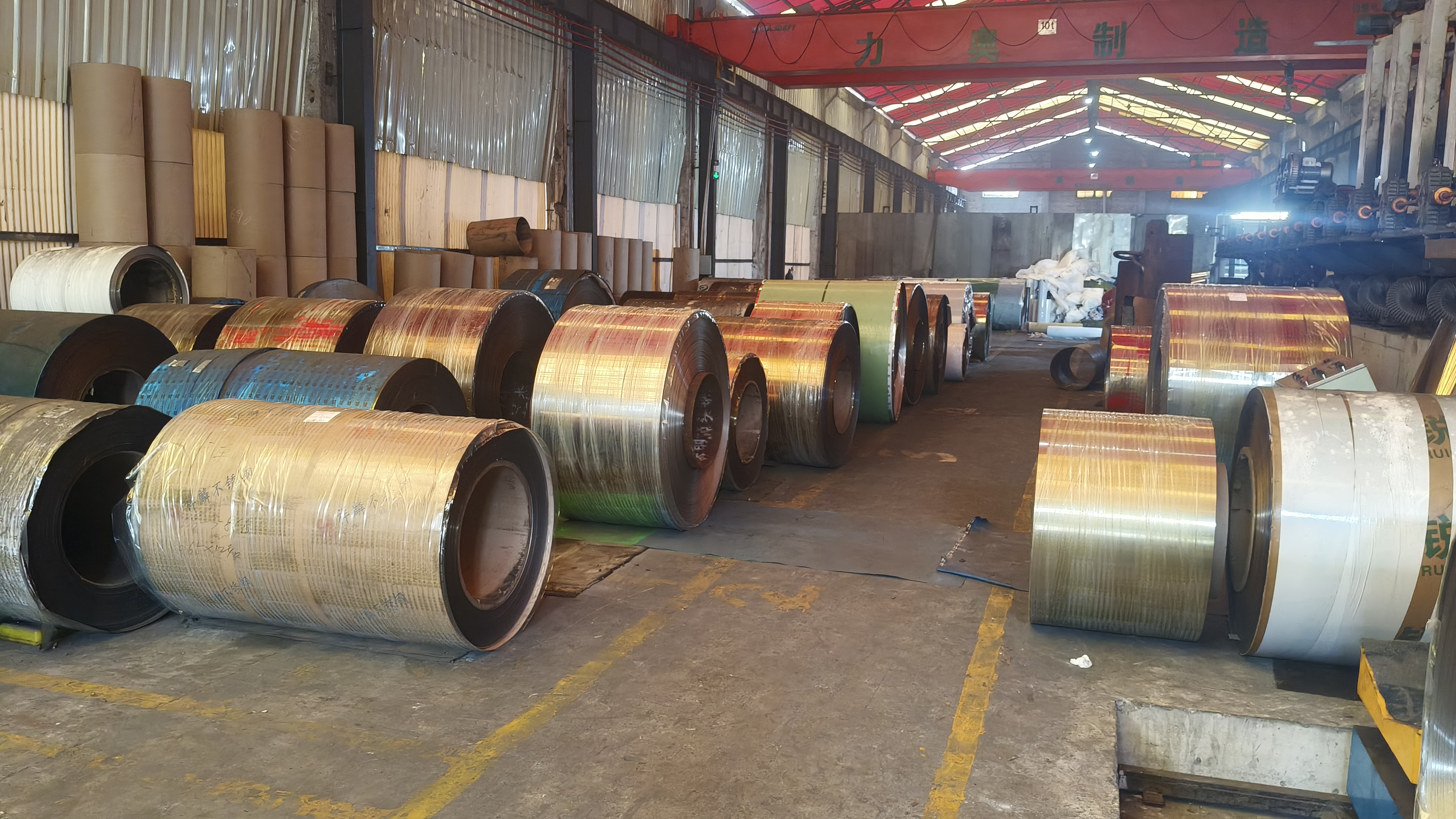
Cold-rolled stainless steel production: the process base behind narrow, thin baby coil supply.
Why Price-Led Comparison Breaks Down
Supply depth is not the constraint. China's accumulated stainless steel exports reached 3.7827 million tons in January–September 2025, up 2.4% year on year, according to China Customs data reported by SunSirs. When a material is available at that scale, the commercial differentiator moves from availability to specification fit — and specification fit never appears on a price sheet.
Three failures recur in narrow coil purchasing, and all three are specification problems rather than negotiation problems:
- Grade substitution treated as an equivalent swap. A 201 J-series or 430 secondary coil is quoted against a requirement originally written around 304, with no review of the mill test certificate that documents what was actually produced.
- Gauge drift inside the coil. The nominal thickness is met on the specification line but not consistently across the strip, which shows up later as forming scrap rather than as an incoming-inspection failure.
- Finish mismatch. The buyer plans for a decorative surface and receives a bright-annealed one, or plans for BA and is offered a surface whose thickness window does not match the drawing.
A scorecard is more useful than a discount because it forces these three variables to be evaluated before price is compared, not after.
The Two-Axis Model: Grade and Gauge
Most baby coil quotations compress two unrelated decisions into a single number. The model below keeps them apart, and gives each axis its own evidence requirement.
| Axis | What it decides | Evidence to request |
|---|---|---|
| Grade | Alloy family, documentation standard, corrosion expectation for the end-use environment | Mill test certificate showing standard, certificate scope, issuing authority, and issue date |
| Gauge | Formability, yield, visible surface appearance, handling and storage requirements | Thickness inspection records, surface inspection report, packing specification, coil width and weight data |
The decision rule is deliberately strict: a low gauge score cannot be rescued by a lower grade price, and a strong grade certificate does not compensate for a width that generates avoidable scrap. Both axes have to clear the buyer's threshold before commercial terms are worth discussing.
The Grade Axis: 201, 304, 410 and 430 in Baby Coil Form
Baby coils are offered in 430, 304, 410 and 201. These are not tiers of one product; they are different alloy families, and in the documentation currently available to buyers they are certified against different standards. That documentation difference is itself a procurement variable, because a certificate answers a narrower question than a grade name does.
| Grade | Format relevance | Documentation in the current evidence file |
|---|---|---|
| 201 (J3 / J2 / J5, 2B and BA) | Narrow form 0.1–2.0 mm across 550 / 600 / 620 / 650 / 690 / 730 / 810 / 830 mm widths; wider form 0.25–3 mm at 1240 mm mill edge | Q/ZQHW 2-2024 — certificate ZQ202512250046, scope: 201 J2 stainless steel strips, issued 2025-12-25 |
| 304 | Narrow form 0.10–2.00 mm at 550 / 600 / 620 / 650 / 690 / 730 mm; wider form 0.3–3 mm at 1240 mm | ASTM A240/A240M — certificate QT20260108631, scope: 304 stainless steel coils & sheets, issued 2026-01-08 |
| 410 | 410 Narrow BA 0.15–1.2 mm at 300–1010 mm; 410 Wider BA 0.25–1.5 mm at 1240 mm / mill edge | Format specification as published in the product data |
| 430 | Supplied largely in secondary coil form, narrow and wider | GB/T3280-2015 — certificate JSPZ20260501804, scope: 430 stainless steel coils & sheets, issued 2026-05-22 |
A practical rule follows from this table. Score a grade by the standard it is certified against, the scope of that certificate, and its fit with the end-use environment — not by the grade number alone. A certificate covering "201 J2 stainless steel strips" under Q/ZQHW 2-2024 answers a different question from one covering "430 stainless steel coils & sheets" under GB/T3280-2015, and neither automatically answers a requirement written for 304 under ASTM A240/A240M.
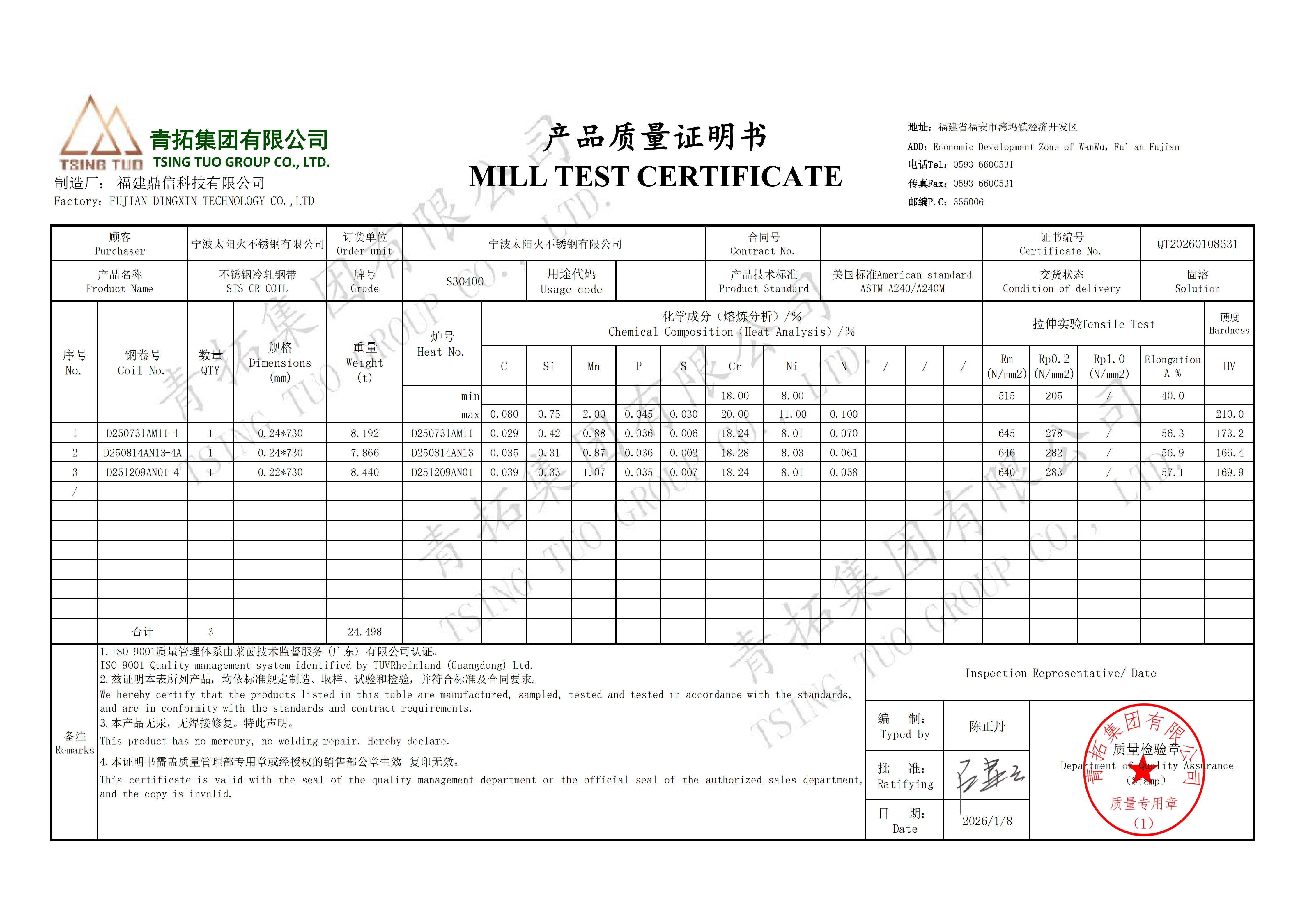
Mill test documentation for 304 stainless steel coils and sheets, certified to ASTM A240/A240M — the evidence layer that makes a grade specification verifiable.
The Gauge Axis: Thickness, Width, Finish and Packing
The baby coil format has a narrow, well-defined envelope, and buyers who work outside it usually discover the boundary after ordering. Published product data describes thickness from 0.1 mm to 1.2 mm, with the 0.3–0.6 mm band accounting for approximately 80% of that window; width anchored around 600 mm; surface predominantly BA finish at roughly 70% of the mix; and packaging as nude packing.
Width flexibility exists at the edges of the format rather than in the middle. 410 Narrow BA is offered from 300 mm to 1010 mm, and secondary wider coils run from around 1000 mm to 1250 mm in 0.25–1.5 mm thickness, mainly BA. For comparison, 304 narrow coil is offered at 550 / 600 / 620 / 650 / 690 / 730 mm widths, and 201 narrow coil spans 550–830 mm. A buyer whose part width sits comfortably inside one of those bands has genuine format choice; a buyer whose part width sits above roughly 600 mm does not.
Finish produces the framework's first hard boundary. Baby coil supply is mainly BA — a bright-annealed surface, which is consistent with the vertical bright annealing furnace reported in the supplier's equipment list. Decorative finishes are produced on a separate line: NO.4, 8K, Gold 8K, Rose Gold 8K and Black 8K are produced on 201 J2 finish material at 1240 mm width, with finish-specific thickness ceilings — 0.28–1.45 mm for NO.4, 0.28–1.95 mm for 8K, and 0.28–1.15 mm for Gold 8K and Rose Gold 8K.
The consequence is easy to state and easy to overlook: when a drawing calls for a mirror or colored surface, the specification generally leaves the baby coil envelope and moves to a 1240 mm decorative line. Treating the two as interchangeable is one of the most common causes of sample rejection in narrow coil projects.
A Reusable Weighted Scorecard
The following scorecard converts the two-axis model into a repeatable comparison. Weights are an editorial framework, not a supplier claim; buyers should adjust them to their own process economics.
| Criterion | Weight | Question it answers | Evidence to attach |
|---|---|---|---|
| End-use environment fit | 25 | Does the alloy family suit the exposure, cleaning regime, and product life expected? | Application description, end-use environment notes, previous material failures |
| Documented grade | 20 | Does a mill test certificate match the ordered grade, standard, and scope? | Mill test certificate with number, standard, issuer, scope, issue date |
| Gauge control | 15 | Is the thickness band and width stable coil to coil? | Thickness inspection records, incoming sample measurements |
| Surface and finish | 15 | Is the supplied surface the one the drawing assumes? | Surface inspection report, finish sample, thickness window for the finish |
| Packing and handling | 10 | Will nude packing or interleaved packing survive the route and the warehouse? | Packing specification, handling photographs, storage conditions |
| Commercial fit | 15 | Does MOQ match consumption rate, and lead time match the production schedule? | Quotation, stock list, delivery schedule |
Score each criterion from 1 to 5 and multiply by its weight. Two criteria should function as stop conditions rather than negotiation points: a documented grade score below 3 and a gauge control score below 3. In both cases the correct next step is a specification conversation, not a discount request.
Applying the Scorecard: Industrial Equipment and Construction
Industrial equipment and tube and pipe manufacturing put the gauge axis first. These processes feed strip continuously, so thickness consistency across the coil matters more than the headline grade; baby coil material in the 0.3–0.6 mm band, which represents the bulk of the format's window, is well matched to light-gauge forming, metal stamping, and deep drawing where a drifting thickness band translates directly into scrap. Width selection follows the same logic: the 600 mm anchor suits narrow tube and hardware parts, while 410 Narrow BA extends the usable range to 1010 mm when the part is wider.
Construction and interior decoration, including elevator decoration, reverse the priority. Here the visible surface carries the specification, so the surface and finish criterion gains weight relative to raw formability. The industries listed as applicable to baby coil supply — kitchenware and cookware, home appliances, elevator decoration, construction and interior decoration, automotive components, industrial equipment, metal stamping and deep drawing, tube and pipe manufacturing, tableware production, and hardware accessories — each sit at a different point on that trade-off, which is precisely why a single fixed weighting does not work across a buyer's full product range.
Cost-sensitive consumer lines form a third pattern. 201 J-series and 430 secondary material are documented against their own standards and are specified where the end-use environment allows them; the scorecard does not treat that as a downgrade, but it does require the certificate scope to be checked against the application rather than assumed.
Matching the Framework to a Real Supply Base
NINGBO SUNFIRE STAINLESS STEEL CO., LTD is a Ningbo-based stainless steel supplier established in 2013, specializing in stainless steel and stainless steel products, with a stated focus on secondary and baby coil material. The company exports its output entirely and serves markets including Pakistan, India, Vietnam, Russia, Turkey, Indonesia, the United Arab Emirates, Thailand, Malaysia, and Bangladesh, as well as the Middle East, South America, and Africa.
For a buyer applying the scorecard, four capability facts matter more than the product list:
- Customization. OEM customisation is offered across thickness, width, surface finish, PVC, and packaging — the four gauge-axis variables a buyer would otherwise have to accept as fixed.
- Quality control. The stated control sequence is mill test plus thickness inspection plus surface inspection, which maps directly onto the documented grade, gauge control, and surface criteria in the scorecard.
- Lead time. Quoted lead time runs 7–45 days depending on grade and stock status. Stocked narrow and wider items are typically quoted at 7–30 days, while circle products are quoted at 25–45 days.
- MOQ behaviour. Minimum order quantities are specification-dependent rather than flat: 201 narrow product is quoted at 27 MT across 3–4 specifications, 304 narrow at 8–9 MT per width, 410 Wider BA at 20 MT per thickness, and stainless steel circles at 3 MT per thickness.
Case-level evidence points in the same direction. Export clients across Indonesia, India, South Africa, Pakistan, Vietnam, and Saudi Arabia have been served at roughly 50 containers per month for more than 10 years, covering kitchenware and home appliances as well as building and construction applications. Reported outcomes from that work are stable material performance, good corrosion resistance, consistent surface quality, and compliance with international standards.
Evidence note: the capability and case figures above are supplier-reported. They qualify a supplier for the next stage of evaluation; they do not replace certificate review, incoming inspection, or sample validation. Buyers should treat every claim in this section as a prompt for verification rather than as a substitute for it.
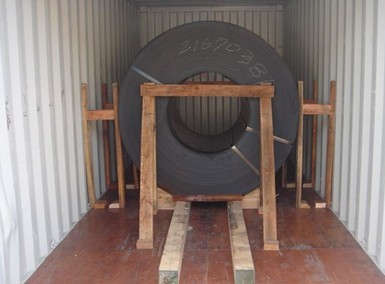
Export loading of stainless steel coils — the delivery stage where specification decisions become inspection points.
Market Trend: Why Specification Discipline Is a Buyer Signal
Three observable data points frame the current sourcing environment, and they point in the same direction.
First, supply remains deep. China's January–September 2025 stainless steel exports reached 3.7827 million tons, up 2.4% year on year — a primary customs-derived figure reported through SunSirs. Deep export supply means buyers are choosing between many compliant-looking offers, which raises the relative value of documentation rather than lowering it.
Second, the underlying market is large but not fast-growing enough to absorb specification errors quietly. Commercial research published by Custom Market Insights valued the global stainless steel market at USD 134 billion in 2025, with a forecast horizon extending to 2034. Estimates of this kind carry medium confidence and are useful for context rather than for procurement decisions.
Third, decorative demand is growing faster than the base. A separate commercial research report on mirror polished stainless steel sheets places that segment on a 5.3% CAGR through 2032. That trend matters to baby coil buyers because it pulls specification attention toward surface quality — and, as the gauge axis showed, decorative finishes generally live on a different product line with different thickness windows.
The practical reading is that the commodity layer of stainless steel is competitive, while the specification layer is where buyer-side competence now shows. A scorecard-based RFQ is a more reliable signal of capability than a larger order size, because it makes the supplier's documentation and process control visible before any volume commitment.
Comparison with Traditional Sourcing Approaches
Baby coil is one of three realistic formats a buyer can choose from, and the comparison is not a hierarchy. Each format wins under different conditions.
| Approach | Best fit | MOQ and lead-time behaviour | Where it fails |
|---|---|---|---|
| Slit a wide 1240 mm coil in-house | Parts that need wide stock, or decorative finishes produced at 1240 mm width | 201 wide: 7–10 MT per thickness; 304 wide: 10 MT per thickness; 410 Wider BA: 20 MT per thickness; lead time generally 7–30 days for stock | Requires slitting capacity and yield planning; small-volume buyers absorb scrap from unused slitting yield |
| Buy baby coil around 600 mm directly | Narrow parts in 0.1–1.2 mm, where the 0.3–0.6 mm band covers the bulk of demand | Grade-dependent; 201 narrow quoted at 27 MT across 3–4 specifications, 304 narrow at 8–9 MT per width | Part width above the coil width forces a format change; BA dominance leaves little finish choice inside the format |
| Buy secondary coil (narrow or wider) | Cost-sensitive applications where the end-use environment and certificate scope both allow it | Narrow secondary around 600 mm at roughly 200 kg per coil; wider secondary 1000–1250 mm at around or above 1 MT | Documentation and quality confidence must be established per order; not a substitute where a specific standard scope is contractually required |
Stating the boundaries plainly matters more than listing the advantages, so the limits deserve equal weight:
- A width ceiling. Baby coil is anchored around 600 mm. Parts wider than that cannot be produced from it, and the practical alternatives are 410 Narrow BA up to 1010 mm or a wider secondary or prime coil.
- A finish ceiling. With roughly 70% of the format supplied in BA, decorative requirements are not a baby coil specification at all. Mirror and colored finishes sit on a 1240 mm line with finish-specific thickness ceilings of 0.28–1.45 mm for NO.4, 0.28–1.95 mm for 8K, and 0.28–1.15 mm for Gold 8K and Rose Gold 8K.
- Grade substitution risk. 201 J-series and 430 secondary material are documented against their own standards and are not interchangeable with 304 under ASTM A240/A240M. Substitution without certificate review and an end-use assessment is a risk transfer, not a cost saving.
- Stock-dependent timing. Because narrow and wider formats are commonly quoted from stock at 7–30 days, and circles at 25–45 days, a specification change late in the project can move the delivery date as much as it moves the price.
- Packing differences. Baby coil is supplied as nude packing, while wider and secondary forms are typically PVC-wrapped or paper-interleaved. Handling, storage, and re-packaging costs differ accordingly and should be scored before order placement.
Future Outlook
Two developments are likely to shape baby coil procurement over the next planning cycle, and both favour buyers who have already built a scoring method.
The first is a shift from grade names to certificate scopes. As export supply remains deep and offers look increasingly similar on paper, the distinguishing question becomes which standard a coil is certified against and whether that scope matches the application. Buyers who ask for the certificate number, standard, scope, and issue date at the quotation stage will spend less time resolving disputes at incoming inspection.
The second is continued pull from decorative and appliance-facing demand, where surface consistency commands a premium and where the thickness windows are narrower. That pressure flows down into the base formats: BA baby coil quality expectations tend to rise as downstream visible-surface applications grow. For narrow, thin coil buyers in Green Energy & New Materials and adjacent categories, the practical response is not a broader supplier list but a stricter one — scored on grade documentation and gauge control first, and on price last.
Frequently Asked Questions
Which stainless steel grades are available in baby coil form?
Baby coils are offered in 430, 304, 410 and 201. The format is defined by thickness from 0.1 mm to 1.2 mm, width around 600 mm, and a surface that is predominantly BA finish, with packaging typically supplied as nude packing. Grade availability should be confirmed against the specific width and thickness combination required, because narrow and wider formats carry different specification ranges.
Is 304 worth specifying instead of 201 for a baby coil project?
The two grades are documented against different standards, which is the more useful comparison than a simple preference ranking. In the current evidence file, 304 coils and sheets are certified to ASTM A240/A240M, while 201 J2 material is certified to Q/ZQHW 2-2024. The selection criterion is therefore the end-use environment and whether the certificate scope matches the application, not the grade number in isolation. Where a project requires a specific standard scope, that requirement determines the grade; where it does not, the decision should be recorded openly in the specification.
What thickness and width should a buyer specify for a baby coil?
The published envelope is 0.1–1.2 mm in thickness, with the 0.3–0.6 mm band accounting for approximately 80% of that range, and a width anchored around 600 mm. Where a wider strip is needed, 410 Narrow BA is offered from 300 mm to 1010 mm and secondary wider coils run from around 1000 mm to 1250 mm. Specifying the narrowest width that still fits the part reduces edge trim and scrap.
Why is BA the dominant baby coil finish, and when should buyers deviate?
Roughly 70% of baby coil supply is BA finish, a bright-annealed surface that is consistent with the vertical bright annealing furnace reported in the supplier's equipment list. Buyers should deviate when the visible surface is decorative rather than functional. NO.4, 8K, Gold 8K, Rose Gold 8K and Black 8K finishes are produced on 201 J2 finish material at 1240 mm width, with thickness ceilings of 0.28–1.45 mm for NO.4, 0.28–1.95 mm for 8K, and 0.28–1.15 mm for Gold 8K and Rose Gold 8K. Those finishes sit outside the baby coil format, so the deviation is a format change rather than a finish option.
How can a buyer verify grade and gauge before accepting delivery?
Verification starts with the mill test certificate. Check the certificate number, the standard it is issued against, its scope, the issuing authority, and the issue date against the ordered grade — for example, certificate ZQ202512250046 covers 201 J2 stainless steel strips under Q/ZQHW 2-2024, certificate JSPZ20260501804 covers 430 stainless steel coils and sheets under GB/T3280-2015, and certificate QT20260108631 covers 304 stainless steel coils and sheets under ASTM A240/A240M. Gauge verification relies on incoming inspection rather than documentation alone, and the stated quality-control sequence of mill test plus thickness inspection plus surface inspection reflects that division.
When is a baby coil the wrong specification?
It is the wrong specification in four identifiable situations: when the part width exceeds the coil width, since the format is anchored around 600 mm; when the required surface is mirror or colored, because those finishes are produced on a 1240 mm line with their own thickness windows; when the end-use or contractual requirement calls for a certificate scope the available grade cannot provide; and when the production schedule cannot absorb a lead time of 7–45 days, including the 25–45 day range quoted for circle products. In each case the correct response is a format or grade re-specification, decided before order placement.
Company reference: NINGBO SUNFIRE STAINLESS STEEL CO., LTD — en.sunfirex.com. Product brochure (PDF) for download: Sunfire stainless steel product brochure.
Have Questions or Need More Details?
Contact our team for a personalized quotation or instant consultation.
Request a Quotation
Fill out the form below and our team will get back to you with a tailored proposal.
WhatsApp Direct Chat
Prefer to chat in real-time? Message us on WhatsApp for instant assistance & quick answers.
- Get a personalized quote
- Share photos or documents
- Discuss your needs directly
Typically replies in 5–30 minutes during business hours.