
Green Building Solutions: Choosing a Long-Term China Supplier in 2026
Sustainable construction is no longer an optional upgrade. For international buyers, green building solutions now sit at the center of project planning, regulatory compliance and long-term asset performance. The challenge is not only finding a product, but choosing a supplier that can deliver consistently over years of collaboration.
Why Long-Term Sourcing Decisions Are Different
At the decision and execution stage, buyers evaluating green building materials from China are typically looking beyond a single order. They are assessing whether a supplier can support repeat projects, maintain consistent quality, respond to after-sales requests, and adapt to changing specifications.
The opportunity is significant. According to IMARC Group, the China green building materials market reached USD 216.3 billion in 2025 and is projected to hit USD 484.9 billion by 2034. Another estimate from Markets and Data values China's green building market at USD 69.13 billion in 2024, growing to USD 147.86 billion by 2032. The difference in these figures reflects different definitions of "green building materials," but both point to a fast-maturing supply base.
Domestic policy has accelerated this maturity. The International Trade Administration notes that China mandated 100% of new urban buildings to meet green building standards by 2025 as part of the 14th Five-Year Plan. That means Chinese manufacturers have had to produce materials that satisfy a large, regulated domestic market before exporting them globally.
What a Credible Green Building Supplier Looks Like
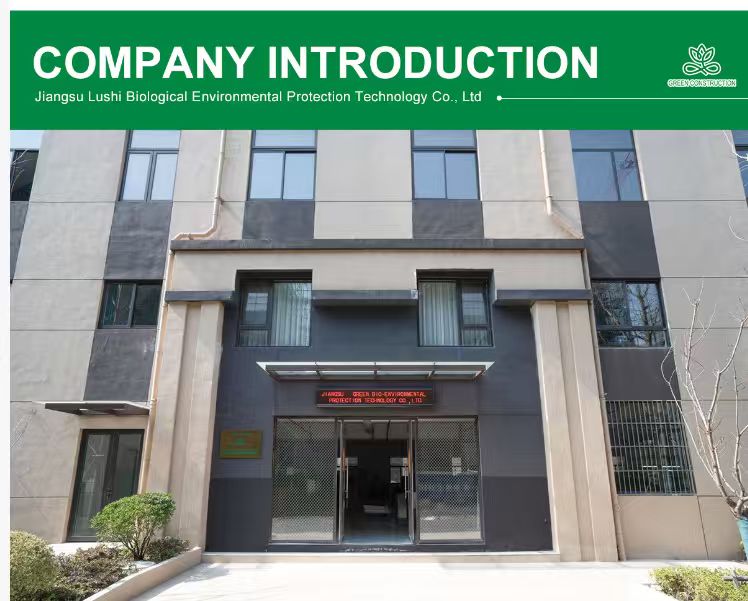
Jiangsu Green Bio-Environmental Protection Technology Co., Ltd. (GREEN BIO) is one example of a China-based manufacturer that has structured its operation around export-facing green building supply. Founded in 2015 and headquartered in Nantong, Jiangsu Province, the company operates a 10,000 m² factory with 50 employees and a research and development team of 25 engineers. It reports an annual output of 120,000 units and a monthly production capacity of 50,000 square meters.
GREEN BIO's main products include PIR sandwich panels, plywood, steel supports, cable brackets and aluminum profiles. Its stated focus covers two areas: insulated building solutions and structural and finishing excellence. The company also provides OEM and ODM production services, which are relevant for buyers who need branded products or customized specifications.
Export markets include Europe, the Middle East, Southeast Asia, South America and Africa, with export business accounting for 70% of total output. That footprint is closely aligned with Belt and Road Initiative markets and other emerging economies.
| Parameter | Detail |
|---|---|
| Founded | 2015 |
| Facility size | 10,000 m² |
| Employees / R&D engineers | 50 / 25 |
| Monthly production capacity | 50,000 m² |
| Annual output | 120,000 units |
| Export ratio | 70% |
| Main export regions | Europe, Middle East, Southeast Asia, South America, Africa |
| OEM / ODM | Available |
Technical Foundation: Energy Efficiency and Compliance
For buyers of green building envelope solutions, the core technical question is whether a product can reduce operational energy consumption without creating compliance risk.
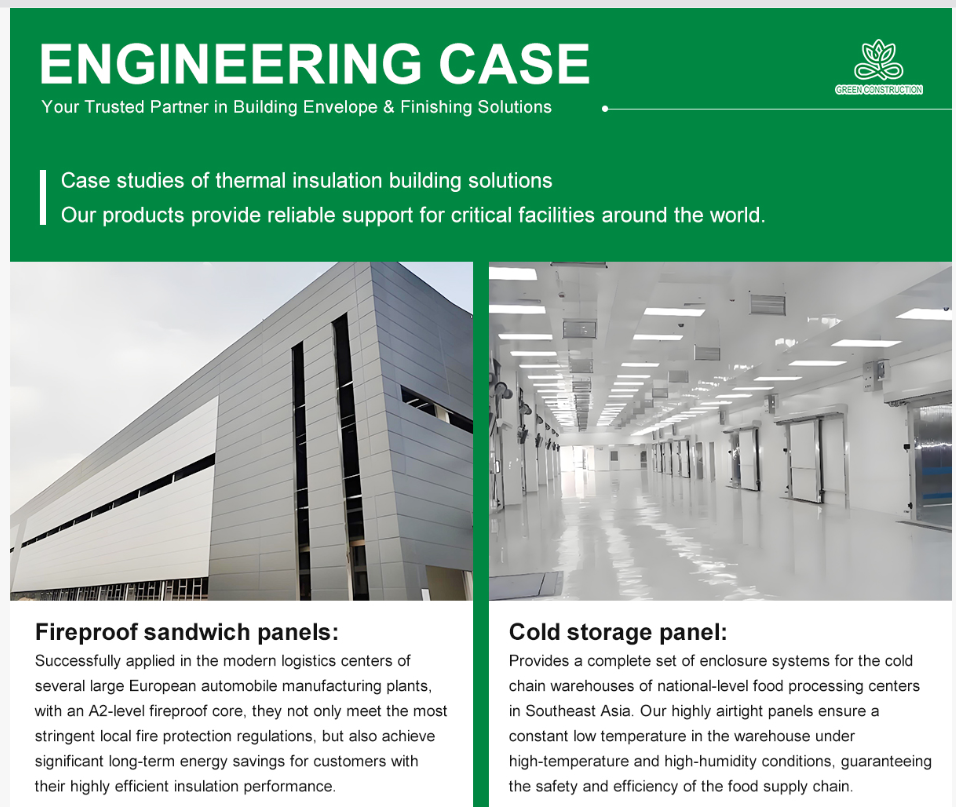
GREEN BIO's PIR sandwich panels use a rigid polyurethane or PIR core. The company specifies thermal conductivity of ≤0.024 W/(m·K) for its cold storage panels, with panel thicknesses of 50 mm and 100 mm and effective widths of 960 mm or 1100 mm. In its supplier comparison material, GREEN BIO states that its high-density PU core can reach a thermal conductivity as low as 0.022 W/(m·K), which it says is roughly 30% more efficient than traditional EPS panels and can lead to long-term electricity savings of 15-20%.
Fire safety is a separate but equally important criterion. According to the company, its panels are strictly tested according to ISO and EN13501 fire safety standards. B1 and B2 grade flame-retardant cores are available, and authoritative third-party test reports are included with shipment to support local fire inspections. This type of documentation matters in projects where the building envelope must meet local code requirements.
The surrounding product range—plywood for formwork and packaging, and galvanized steel supports for temporary or structural use—covers the non-insulation side of a building project. Steel support series include adjustable and telescopic props with heights from 3 m to 5 m, steel grades Q195/Q235, and a minimum order quantity of 500 pieces. For buyers managing full-site construction, having a factory that can coordinate envelope, structure and finishing materials simplifies logistics.
Applications: From Cold Chain to Infrastructure
One practical use of these green building solutions is in cold chain projects. Cold storage panels are widely applied in food and beverage processing, pharmaceutical and vaccine storage, logistics warehousing, chemical raw material storage and agricultural preservation. For exporters building cold-chain infrastructure in tropical or high-temperature climates, the thermal efficiency of the envelope directly affects operating costs and product integrity.
The same product family is also suited to industrial buildings, slab and beam formwork projects, and large-scale construction requiring temporary steel support. Plywood products are used for formwork systems and general building applications, with options such as anti-slip film faced plywood, high-pressure HPL plywood, recyclable core plywood and eco-friendly melamine plywood.
Because GREEN BIO's export footprint includes Southeast Asia, Central Asia, Russia, South America and Africa, its materials already reach projects along the Belt and Road corridor. For buyers with infrastructure or cold-chain programs in those regions, a supplier with existing export documentation and regional logistics experience is an advantage.
Market Trends That Affect Supplier Selection
Several external trends are shaping how buyers evaluate green building material suppliers in 2026.
First, standard-setting is becoming more codified. China's national standard GB/T 50378-2019, the Assessment Standard for Green Building, establishes four certification grades: Basic, 1-Star, 2-Star and 3-Star. While this standard is domestic, it signals a framework that Chinese suppliers understand and can apply to export documentation.
Second, investment in green infrastructure is expanding internationally. The Third Belt and Road Energy Ministerial Conference, held in October 2024, adopted the Green Energy Cooperation Action Plan for 2024-2029. That plan is expected to scale green infrastructure, which increases demand for energy-efficient building products in BRI countries.
Third, bio-based materials are gaining attention. Global Market Insights estimates China's bio-based construction materials market at USD 6.4 billion in 2024, with a 7.2% CAGR forecast through 2034. This reflects a broader shift toward materials with lower carbon footprints, even if the volume remains small relative to the overall construction materials market.
Within the broader industry, buyers are also showing more interest in prefabricated systems, carbon-neutral building materials and smart building technologies. These areas remain part of an evolving supplier landscape rather than fully standardized export categories.
Factory-Direct Supplier vs. Traditional Trading Channel
One of the most common decisions at the execution stage is whether to source from a factory-direct supplier or through a standard trading company.
GREEN BIO's own comparison material highlights several differences it associates with factory-direct sourcing. It points to localized after-sales support via overseas offices, an international staff share of about 80%, and pricing that comes directly from the source factory. According to the company, after-sales response time can be reduced to within 24 hours, communication efficiency improved by 50%, and total procurement costs reduced by 15-20% by eliminating middleman markups. The company also states that overseas offices provide on-site technical guidance, rapid spare parts replacement and localized maintenance services.
These claims are relevant to buyers who have experienced slow communication or remote after-sales with traditional trading companies. They should, however, be verified during negotiation, as the actual service level depends on the specific project location and contractual terms.
| Comparison Criteria | Factory-Direct Model (e.g., GREEN BIO) | Traditional Trading Company |
|---|---|---|
| After-sales response | Within 24 hours (per company data) | Often depends on intermediary |
| Communication | Direct with manufacturer; ~80% international staff | Possible language and time-zone gaps |
| Pricing | Source factory pricing; no middleman markup | Included trading margins |
| Technical support | Overseas offices for on-site guidance | Limited direct technical depth |
| Documentation | Pre-shipment inspection and test reports | Varies by supplier |
What Buyers Should Verify Before Committing
At the execution stage, the decision is less about product brochures and more about verifiable operational facts. A practical checklist includes:
- Production capacity and whether it can support your order frequency and peak season.
- Export experience in your target market, including documentation and logistics.
- Compliance evidence: fire test reports, ISO or EN standards, and product-specific test certificates.
- OEM/ODM capabilities if you need branded or customized products.
- MOQ, lead time, payment terms and delivery terms.
- After-sales support structure, including spare parts and technical guidance.
- Contractual alignment on pre-shipment inspection and quality acceptance.
For example, GREEN BIO states a typical lead time of 15-25 days after deposit, with a minimum order quantity of 100 square meters or one 20-foot container for panels. For steel support products, the minimum order is 500 pieces. Payment terms are 30% advance and 70% before shipment, and delivery options include FOB, EXW, CIF and DDP. Pre-shipment inspection and test reports are part of the acceptance process.
Future Outlook: From Product Supply to Ecosystem Partnership
The long-term direction for successful China-based green building suppliers appears to be moving from discrete product sales toward integrated solution supply. This includes coordinating insulation, structural support, and finishing materials under one process, and eventually aligning with smart green energy system thinking.
For buyers, the practical implication is that supplier selection criteria will likely expand. Price and product quality will remain core, but capacity transparency, compliance documentation, after-sales platform, and the ability to support multiple projects with consistent specifications will become equally important.
As green-building policies and international financing mechanisms mature, suppliers with established export processes and documented product performance are better positioned to become long-term partners rather than one-time vendors.
For a detailed look at the full product range, the company's 2026 professional catalog can be accessed here: GREEN BIO Professional Catalog 2026 (PDF).
Frequently Asked Questions
Does GREEN BIO comply with international fire safety standards?
According to the company, its panels are strictly tested according to ISO and EN13501 fire safety standards. B1 and B2 grade flame-retardant cores are available, and third-party test reports are included with shipment to support local fire inspections.
What is the minimum order quantity for GREEN BIO products?
For panels, the minimum order quantity is 100 square meters or one 20-foot container. For galvanized steel support products, the minimum order is 500 pieces.
What is the typical lead time after placing an order?
GREEN BIO states a typical lead time of 15-25 days after deposit.
Can GREEN BIO provide OEM or ODM production services?
Yes. The manufacturer provides OEM and ODM production services, which allows buyers to customize products or apply their own branding.
Which export markets does GREEN BIO serve?
GREEN BIO exports to Europe, the Middle East, Southeast Asia, South America, and Africa.
What payment and delivery terms are available?
Payment terms are 30% advance and 70% before shipment. Delivery terms include FOB, EXW, CIF, and DDP. Pre-shipment inspection and test reports are part of the acceptance process.