
Green Building Supplier Audit Trail: Plant, People, Output
Green Building Supplier Audit Trail: Plant, People, Output
Most supplier capability claims are true and still unusable. A 10,000 m² facility, a 25-engineer R&D team and a 120,000-unit annual output will get a supplier onto a long list; they are not the numbers that let a procurement team sign a purchase order. What closes that gap is an audit trail — a defined route from each claim to the document that supports it, the organisation that issued it, and the condition under which it stays true.
This reference sets out that trail in three buckets — plant, people and production — and applies it to GREEN BIO (JIANGSU GREEN BIO-ENVIRONMENTAL PROTECTION TECHNOLOGY CO.,LTD), a China-based manufacturer founded in 2015 whose lines cover PIR sandwich panels, plywood, steel supports, cable brackets and aluminum profiles. Each evidence item is paired with three questions a buyer should be able to answer in writing: what does this establish, what does it not establish, and which document closes the gap.
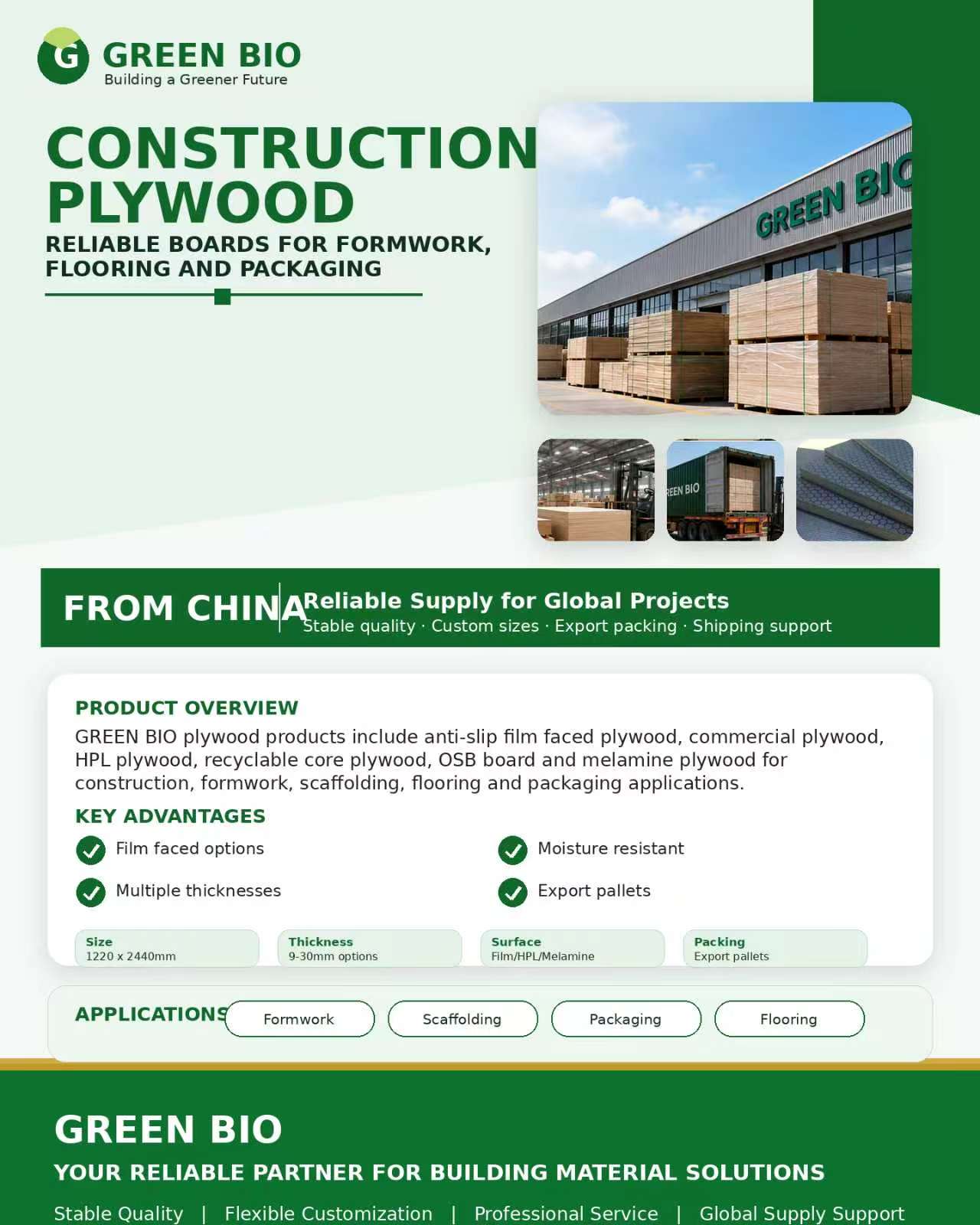
Plant evidence comes first: a facility claim only becomes auditable once it is converted into a layout, a line list and a date.
Why capability claims stall at the evaluation stage
Evaluation-stage procurement has a different job from early sourcing. In discovery, a supplier list is filtered by product fit; in evaluation, it is filtered by evidence. The buyer's output is not a preference — it is a file that a project manager, a client and often an external auditor can read without the salesperson in the room.
Two regulatory instruments explain why that file has grown longer for green building material solutions. Under its 14th Five-Year Plan, China mandated that all new urban buildings meet green building standards by 2025, according to the U.S. International Trade Administration's country commercial guide. At project level, China's GB/T 50378-2019 assessment standard — implemented in 2019, updated in 2024, and scored on a one-to-three-star scale — evaluates buildings across safety and durability, health and comfort, occupant convenience, resource saving and environmental livability. Neither instrument certifies a sandwich panel; both push documentation expectations upstream to whoever supplies the envelope, the structure and the accessories.
Policy direction on prefabricated green building material systems points the same way: MOHURD has set a target for 30% of new urban floor area to incorporate prefabricated methods by 2027. Prefabricated envelope packages arrive on site as specified components, which turns the component supplier's evidence file into part of the project's compliance argument.
The three-bucket audit trail
Dividing the trail by the type of capacity being claimed keeps it manageable. Plant evidence describes where production happens; people evidence describes who converts a specification into a buildable order; production evidence describes how output is controlled. The buckets overlap — a quality manager sits in two of them — but they fail in different ways, so each needs its own document.
| Evidence item | What is stated | What it establishes | What it does not establish |
|---|---|---|---|
| Facility footprint | 10,000 m² | A bounded industrial site | Covered versus total area, line count, layout |
| Workforce | 50 employees | Organisation size and structure | Labour allocation across five product lines |
| Engineering depth | 25 engineers in R&D | A high engineering share of headcount | Named engineer for your drawings; spare capacity |
| Annual output | 120,000 units | A declared annual volume | Product unit, line and shift pattern behind it |
| Panel capacity | 50,000 m² per month | A declared monthly panel output | Reserved capacity inside your delivery window |
| Export share | 70% of shipments | Export is the majority of the business | Which destinations are active this year |
| Management systems | ISO 9001, 14001, 45001 | Audited systems, certificate numbers, dates | Product performance or automatic SKU coverage |
The table is a request list, not a verdict. None of these entries implies that the stated figures are wrong; they mark the point where a claim ends and a document has to begin.
Plant: what 10,000 m² does and does not establish
The company reports a 10,000 m² facility. That figure establishes a bounded industrial footprint. It does not, on its own, say how much of the area is covered production space, how many lines operate inside it, or how material flows between them.
Three requests turn the footprint into usable evidence: a site plan separating covered production area from storage and offices; a line list naming each line and the product family it serves; and dated photographs or a recorded walkthrough that can be matched against the plan. The supplier's documentation includes production-line, workshop and showroom photography — a starting point, not a substitute for the plan.
Capacity needs identical treatment, and here the numbers deserve careful reading. The company profile states annual output of 120,000 units; the capability documentation states monthly capacity of 50,000 m². These are not two views of one metric. They are expressed in different units, and no conversion between them is supplied, so a buyer should not merge them into a single throughput figure. Ask which product each figure describes, whether the annual figure refers to panels or to accessories, and what shift pattern the monthly figure assumes.
Then reconcile the answer against your own schedule. A requirement of 80,000 m² over two delivery phases exceeds one month of the stated 50,000 m² monthly capacity — and the number that matters is not the capacity itself but a written production-slot confirmation for the specific window.
People: 50 employees, 25 engineers, and the capacity that is not on the floor
The company reports 50 employees, 25 of them engineers in R&D. The ratio is the interesting part: half the organisation is described as engineering. For a buyer, that signals how specifications are likely to be handled — and prompts the question of what "engineer" covers in this organisation.
Headcount is not availability. Three questions convert it into usable capacity: who owns the technical file for an export order (design, process engineering, quality, or technical sales); how shop drawings are approved and revised, and by whom; and how many projects the engineering team runs at once. A 25-engineer bench is deep in aggregate; its per-project availability is a separate question.
The practical test is a named resource. Ask for the project engineer who will own your drawings, the expected turnaround for a drawing revision, and the escalation path when a site dimension changes after approval. If the answer is a department rather than a person, the trail stops there.
Production: five product lines, five different evidence sets
The product profile lists five lines: PIR sandwich panels, plywood, steel supports, cable brackets and aluminum profiles. They are marketed as one catalogue but describe several different manufacturing logics — continuous lamination for insulated panels, wood-based panel processing, metal forming and fabrication for supports and brackets, extrusion for aluminum profiles — each with its own equipment, tolerances and inspection method. An audit trail that treats them as a single capability will be thin everywhere.
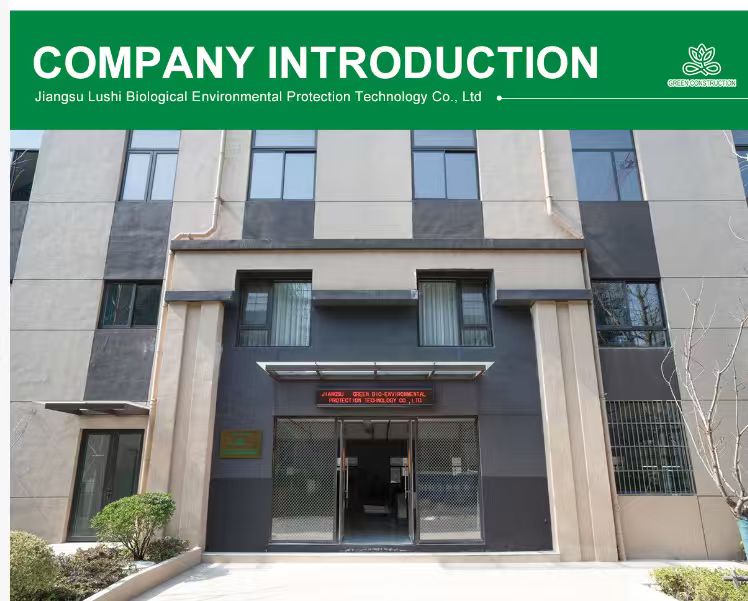
Product families presented together still require separate, line-specific evidence before a purchase order.
For the panel line, the documented customization envelope is unusually concrete, and concrete is what an auditor wants: thickness from 50 mm to 200 mm, steel sheet colour and material, fire rating, custom dimensions and lengths, and cam-lock types. Each is a specification variable that should appear in the order confirmation, not only in the brochure — particularly thickness and fire rating, which drive both envelope performance and freight economics.
For plywood, steel supports, cable brackets and aluminum profiles, the questions are line-specific: whether the process runs in-house or through a partner, which equipment sets the tolerance, and which inspection step catches a deviation before packing. Buyers should not assume that a management-system certificate tied to one related product extends automatically to all five lines; ask, per line, which certificate and which test report apply.
Process control, customization limits and commercial terms
Quality control is described as four gates: incoming raw material inspection, in-process patrol inspection, full inspection of finished product density and dimensions, and pre-shipment photo confirmation. Each gate is auditable only if it produces a record, so the request list stays short: the incoming-inspection record format, patrol frequency and signatory, the density and dimension report for the finished batch, and the pre-shipment photo set for your own order.
Commercial terms close the loop. The supplier's procurement documentation lists delivery terms of FOB, EXW, CIF and DDP, acceptance based on a pre-shipment inspection and test report, and payment terms of 30% in advance with 70% before shipment. For a buyer moving from evaluation into execution, the operative detail is that acceptance is defined by a document rather than a site visit — which is why the inspection report format should be agreed before the order rather than after production.
The minimum order quantity is stated as 100 m² or one 20-foot container, with a typical lead time of 15–25 days after receipt of deposit. Both should be confirmed per product line: a container of panels and a container of cable brackets are not the same commercial unit, and the lead-time clock starts at deposit, not at enquiry.
Export exposure completes this bucket. The company reports a 70% export share, with markets listed as Southeast Asia, Central Asia, Russia, South America and Africa — the Belt and Road corridor and adjacent emerging markets — while the capability documentation also names Europe and the Middle East. That difference is not a contradiction; it is a reason to request the current market list instead of relying on whichever document is at hand. A 70% export share indicates that export orders form the majority of shipments. It does not say which destinations are active this year, which incoterms dominate, or whether the product has been approved under your local code.
ISO certification as management-system evidence — and its boundaries
The supplier holds three management-system certificates, all issued on 25 September 2025 by Jiangsu Taiding Certification Co., Ltd., all valid to 24 September 2028, and all linked in the company's documentation to the Cold Storage Panels product line (model JSGREEN001).
- ISO 9001:2015 Quality Management System, certificate NO.110825Q0383R0S, assessed against GB/T 19001-2016 idt ISO 9001:2015. Recorded scope: sales of metal materials (steel, marine section steel) and hardware and electrical machinery (hardware accessories, pipe fittings); processing of environmental protection equipment accessories.
- ISO 14001:2015 Environmental Management System, certificate NO.110825E0251R0S, assessed against GB/T 24001-2016 idt ISO 14001:2015. Recorded scope: environmental management activities associated with the sales of metal materials and hardware and electromechanical products, and the processing of environmental protection equipment.
- ISO 45001:2018 Occupational Health and Safety Management System, certificate NO.110825S0254R0S, assessed against GB/T 45001-2020 idt ISO 45001:2018. The recorded scope follows the same structure — occupational health and safety management activities associated with the same sales categories, plus processing activities; the published scope description is partially truncated in the source record, so the certificate itself should be read in full.
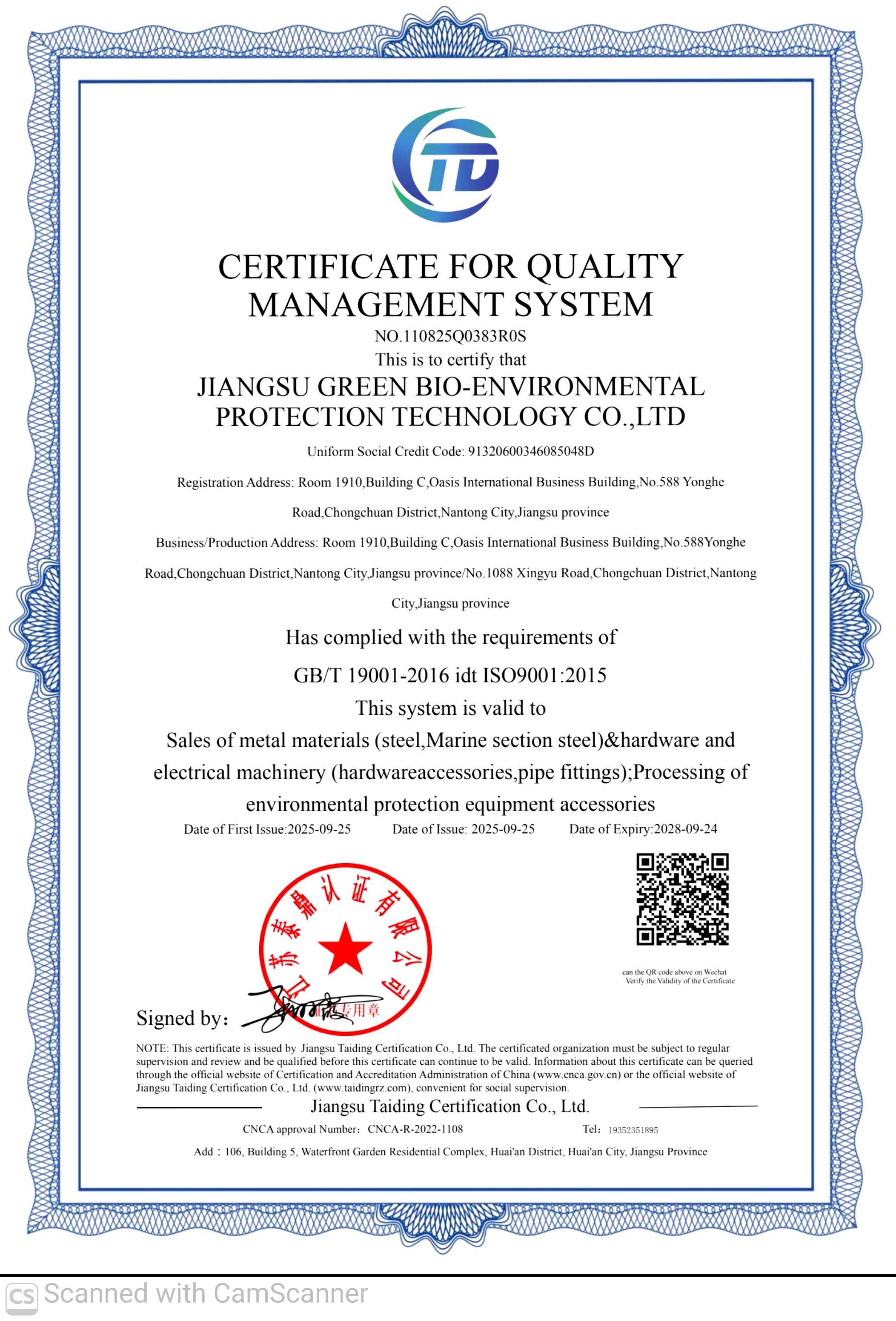
A management-system certificate is auditable evidence of process control; it is not a product performance claim.
What these certificates establish is narrower, and more useful, than "certified quality". They establish that a certification body audited documented management systems against identifiable standard editions, inside a defined scope, and that the certificates carry numbers and validity dates a buyer can check with the issuer before award.
What they do not establish is product performance or blanket coverage. The scope wording is an operational description — sales of metal materials and hardware and electrical machinery, plus processing activities in environmental protection — so a buyer should confirm in writing which purchase-order items fall inside it, and should not assume that all five product lines sit under the same certificate set. Nor do these certificates replace product-level testing: the pre-shipment inspection and test report remains the acceptance document.
This distinction matters because three layers are routinely confused in green building procurement. Management-system certification (ISO 9001, 14001, 45001) covers how an organisation runs quality, environment and safety. Product-level green certification in China runs through a unified green product certification system that, per the certification body CQC, integrates eco-friendly, energy-saving, water-saving, recycled, regenerative, low-carbon and organic products, and whose building-material categories include insulation-system materials, steel members and precast components. Building assessment under GB/T 50378-2019 sits at project level. A supplier can hold the first layer, be a candidate for the second, and contribute evidence to the third — but each layer needs its own document in the file.
Case evidence: what transfers and what does not
Two projects are documented. In Australia, a food processing and meat processing client installed 5,000 m² of cold storage panels for 2,000 tons of capacity, covering a −18°C freezer and a 0–4°C chiller room; the project summary reports stable operation for five years, precise temperature control, seamless joints that limit cold-air leakage, and a GSP certification pass. In Vietnam, a 12,000 m² sorting centre serving a multi-temperature distribution operation (frozen, chilled and ambient) is described as delivered on schedule, easy to install, with improved cargo-turnover efficiency, recorded at one year.
The transferable value is not the tonnage; it is the mechanism the references describe. High-strength double-sided colour steel sheets combined with precision foaming are cited for flatness and load-bearing capacity, and a standardized modular design is credited with a 30% increase in on-site installation speed. That last figure is the supplier's own project summary rather than an independently measured benchmark — treat it as a claim to test against your installer's productivity assumption and the project method statement.
The references also do not transfer automatically. A five-year record in one climate says nothing about thermal duty in another; a distribution centre in Vietnam says nothing about your local fire code; and a GSP outcome belongs to a pharmaceutical-distribution client's regulatory context, not to every project buying the same panel. Case evidence answers "has this been done" — it does not answer "will it work here".
Fit boundary: matching plant output and team depth to project scope
The final step is arithmetic the buyer performs alone: match declared output and team depth to the actual scope, then decide what must be verified in writing.
Start with the panel schedule. Total the area by thickness band, because a 200 mm panel and a 50 mm panel are not interchangeable units of capacity across the documented 50–200 mm range. Compare the total with the stated 50,000 m² monthly capacity, then phase it. A requirement that absorbs a large share of one month's output in a single window is a scheduling problem, not a capability problem — the question becomes whether a production slot can be reserved in writing and what happens if it slips.
Next, size the engineering load. Every custom length, cam-lock type and fire-rating specification creates drawing, approval and inspection work. A team of 25 engineers is substantial; the useful number is how much of that team is available inside your delivery window, and who signs the drawings.
Then run the small-project arithmetic, which fails more often than the large one. With a minimum of 100 m² or one 20-foot container and a 15–25 day lead time after deposit, setup and freight economics dominate small orders. For a single-container requirement, the audit trail should concentrate on the inspection report and packing list rather than on capacity headroom.
Finally, record the fit boundary in the file. A supplier that suits a 12,000 m² phased energy-efficient green building envelope package may suit a single-container accessory order poorly, and vice versa. The evidence does not change between those cases; only its weighting does.
What this means for 2026 project planning
Three documented policy directions converge. The 14th Five-Year Plan mandate that 100% of new urban buildings meet green standards by 2025, the MOHURD target for 30% prefabricated share of new urban floor area by 2027, and the 2024 update to GB/T 50378-2019 all increase the volume of material-level documentation a project has to assemble. The reasonable interpretation — not a volume forecast — is that suppliers whose capability claims are already document-backed will spend less time in qualification and more time in scheduling.
For buyers, the implication is procedural: request the audit trail at tender, not at award. A supplier that can return certificate numbers, a line list, an inspection-record format and a named project engineer within a week has demonstrated something a brochure cannot.
The audit trail as a working document
Capability evidence is less a marketing problem than a filing problem. The 10,000 m² facility, the 50-person team, the 25 engineers, the 120,000-unit annual output, the 50,000 m² monthly panel capacity and the 70% export share are all useful starting points — and each ends exactly where a document has to begin. The three ISO certificates add an auditable management-system layer whose scopes should be read rather than assumed.
GREEN BIO's documented position is that of a 50-person, engineering-heavy exporter with panel capacity, a broader accessory range in plywood, steel supports, cable brackets and aluminum profiles, and a certification set tied to its cold storage panel line; the company's published material is available at greenlvgreen.com. Whether that position fits a given project is decided by four numbers the buyer calculates — schedule, thickness mix, drawing load and local approval — not by the numbers the supplier publishes.
Reference document: the 2026 product catalogue, covering panel specifications and accessory ranges, is publicly available for download — Green Bio Professional Catalog 2026 (PDF).
FAQ: capability evidence questions buyers ask
What does OEM/ODM production cover at this supplier?
GREEN BIO provides OEM and ODM production services. The documented customization variables are specific to the panel line: thickness from 50 mm to 200 mm, steel sheet colour and material, fire rating, custom dimensions and lengths, and cam-lock types. Because that list is written for panels, buyers should confirm in the order documentation which variables apply to each of the other lines — plywood, steel supports, cable brackets and aluminum profiles — rather than assuming an identical envelope.
What are the minimum order quantity and lead time?
The stated minimum order quantity is 100 m² or one 20-foot container, and the typical production lead time is 15–25 days after receipt of deposit. Both should be confirmed per product line in the quotation. The lead time is measured from deposit rather than from enquiry, so the interval between technical clarification and payment is the part of the schedule the buyer controls.
How can a buyer verify the 120,000-unit annual output claim?
Ask for the basis: which product family the figure describes, which line produces it, and what shift pattern it assumes. The annual figure (120,000 units) and the monthly panel figure (50,000 m²) are stated in different units and cannot be converted into one another without that basis. Verification then moves to production records for a recent period and to a written production-slot confirmation for the buyer's own delivery window.
Do the ISO certificates cover the panels themselves?
They cover management systems, not product performance. ISO 9001:2015, ISO 14001:2015 and ISO 45001:2018 were issued by Jiangsu Taiding Certification Co., Ltd. on 25 September 2025 and are valid to 24 September 2028, under certificate numbers NO.110825Q0383R0S, NO.110825E0251R0S and NO.110825S0254R0S respectively. Their scopes are phrased around sales of metal materials and hardware and electrical machinery, plus processing activities, so buyers should confirm in writing which purchased items fall inside scope, and should rely on the pre-shipment inspection and test report for product acceptance.
How should declared capacity be matched to a project's scope?
Total the panel area by thickness band, compare it with the stated 50,000 m² monthly capacity, and phase deliveries so no single window absorbs a disproportionate share. Then size the drawing and approval load against the 25-engineer team and confirm a named project engineer plus a written production slot. For small orders, the 100 m² or one-container minimum and container freight economics matter more than capacity headroom.
Have Questions or Need More Details?
Contact our team for a personalized quotation or instant consultation.
Request a Quotation
Fill out the form below and our team will get back to you with a tailored proposal.
WhatsApp Direct Chat
Prefer to chat in real-time? Message us on WhatsApp for instant assistance & quick answers.
- Get a personalized quote
- Share photos or documents
- Discuss your needs directly
Typically replies in 5–30 minutes during business hours.