
Guangzhou Yongcheng Cosmetics: An Aerosol Cosmetics OEM/ODM Company Review
Cosmetic aerosols such as cooling sunscreen spray, hair-removal mousse, hydrating facial mist and makeup setting spray are a distinct contract-manufacturing category. They require pressure-filling infrastructure, compatible cans and valves, dangerous-goods export documentation and market-specific regulatory files. For global brands and importers researching aerosol cosmetics OEM and ODM suppliers, the first useful question is not only whether a factory can formulate a spray, but whether it is actually equipped to fill, certify and export one.
This company review examines Guangzhou Yongcheng Cosmetics Co., Ltd., an OEM/ODM manufacturer founded in 2018 and based in Huadu District, Guangzhou, China. Guangzhou Yongcheng Cosmetics Co., Ltd. operates a 12,000-square-meter intelligent manufacturing base, employs approximately 150 people and reports an annual production capacity of 100,000,000 aerosol cans. According to company-reported data, its export business accounts for about 50% of total sales, with main markets in ASEAN, Central Asia, the Middle East and Latin America. The company profile also states that it has served more than 100 global beauty brands.
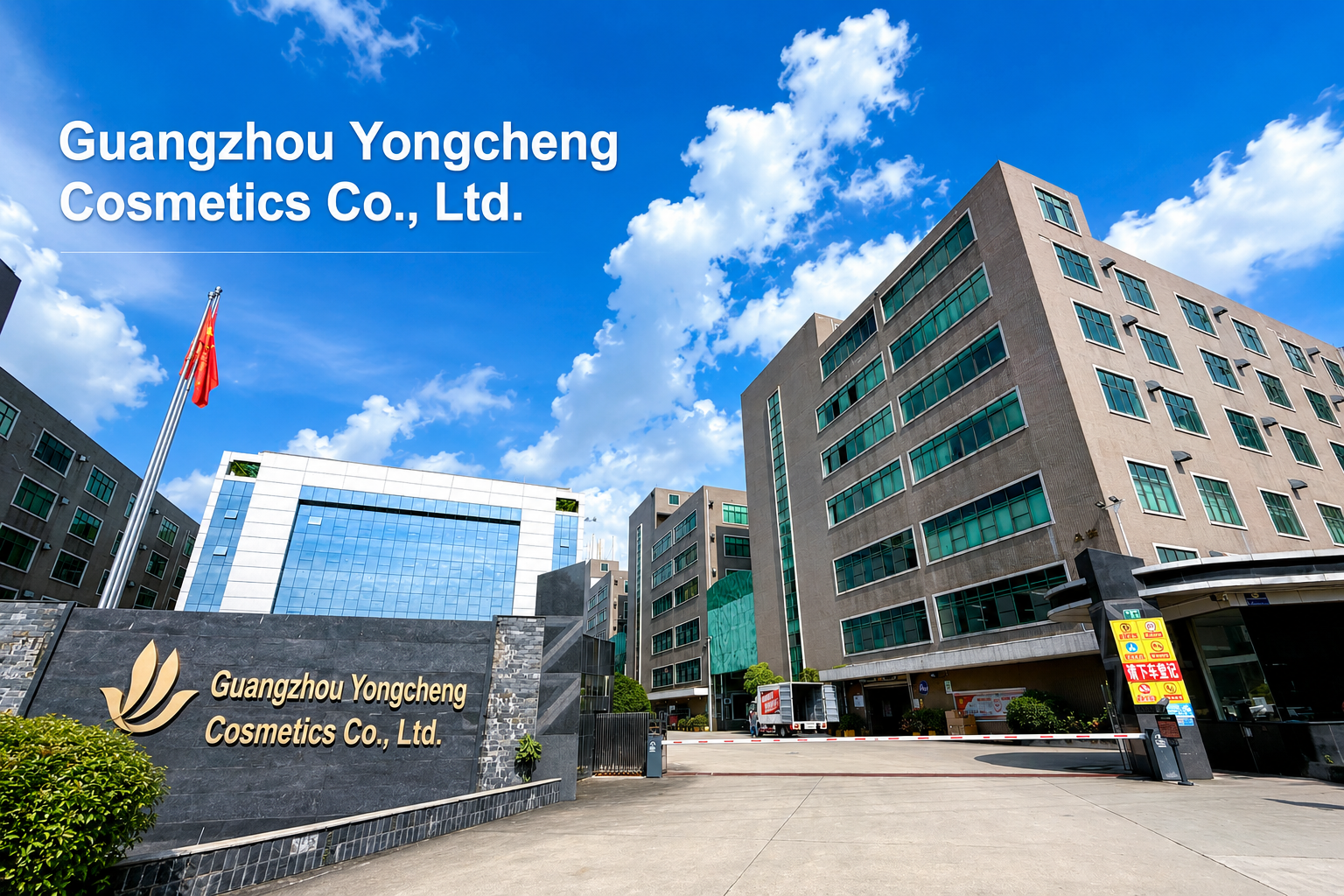
Guangzhou Yongcheng Cosmetics Co., Ltd., Huadu District, Guangzhou.
Why Aerosol Cosmetic OEM Is a Separate Manufacturing Discipline
Cosmetic aerosol manufacturing differs from ordinary cream, lotion and mask production in at least three practical ways. First, the product is filled under pressure with an aerosol filling line, not a standard lotion or cream filling line. Second, the pack is a system of aerosol can, valve and actuator that must be technically compatible with the formulation and with target-market quality expectations. Third, aerosol products are pressurized and are usually handled as dangerous goods during export, which means customs clearance typically requires a UN packaging certificate and SDS/MSDS documentation.
The market consequence is that general cosmetics factories without aerosol qualification may outsource pressure filling to a third party. That creates a separate set of risks around quality control, delivery control and export documentation. A professional aerosol OEM factory, by contrast, is expected to own its aerosol filling capability, control incoming can and valve quality, and provide the documents needed for sea or air shipment. This distinction is central to a supplier review of any aerosol cosmetics contract manufacturer.
Company Profile and Manufacturing Base
Guangzhou Yongcheng Cosmetics Co., Ltd. presents itself as an aerosol cosmetics specialist rather than a general beauty ODM. Its official profile lists a 12,000-square-meter manufacturing base with 6 fully automated production lines and 6 dedicated aerosol lines. The facility is described as ISO 22716 certified and includes a 100,000-class GMP cleanroom. The company also reports a 2,000-square-meter professional R&D laboratory staffed by 15 engineers, with special cosmetics R&D and registration capability.
| Company data point | Reported detail |
|---|---|
| Legal entity | Guangzhou Yongcheng Cosmetics Co., Ltd. |
| Founded | 2018 |
| Location | Huadu District, Guangzhou, China |
| Manufacturing base | 12,000 m² intelligent manufacturing base |
| Staff | Approximately 150 employees |
| Production capacity | 100,000,000 cans per year |
| Production lines | 6 fully automated production lines + 6 dedicated aerosol lines |
| R&D | 2,000 m² research laboratory, 15 engineers |
| Quality standards | ISO 22716; 100,000-class GMP cleanroom |
| Export share | About 50% of total sales |
| Main export markets | ASEAN, Central Asia, Middle East, Latin America |
| Reported client base | 100+ global beauty brands |
Company-reported figures from Guangzhou Yongcheng Cosmetics profile and public content units.
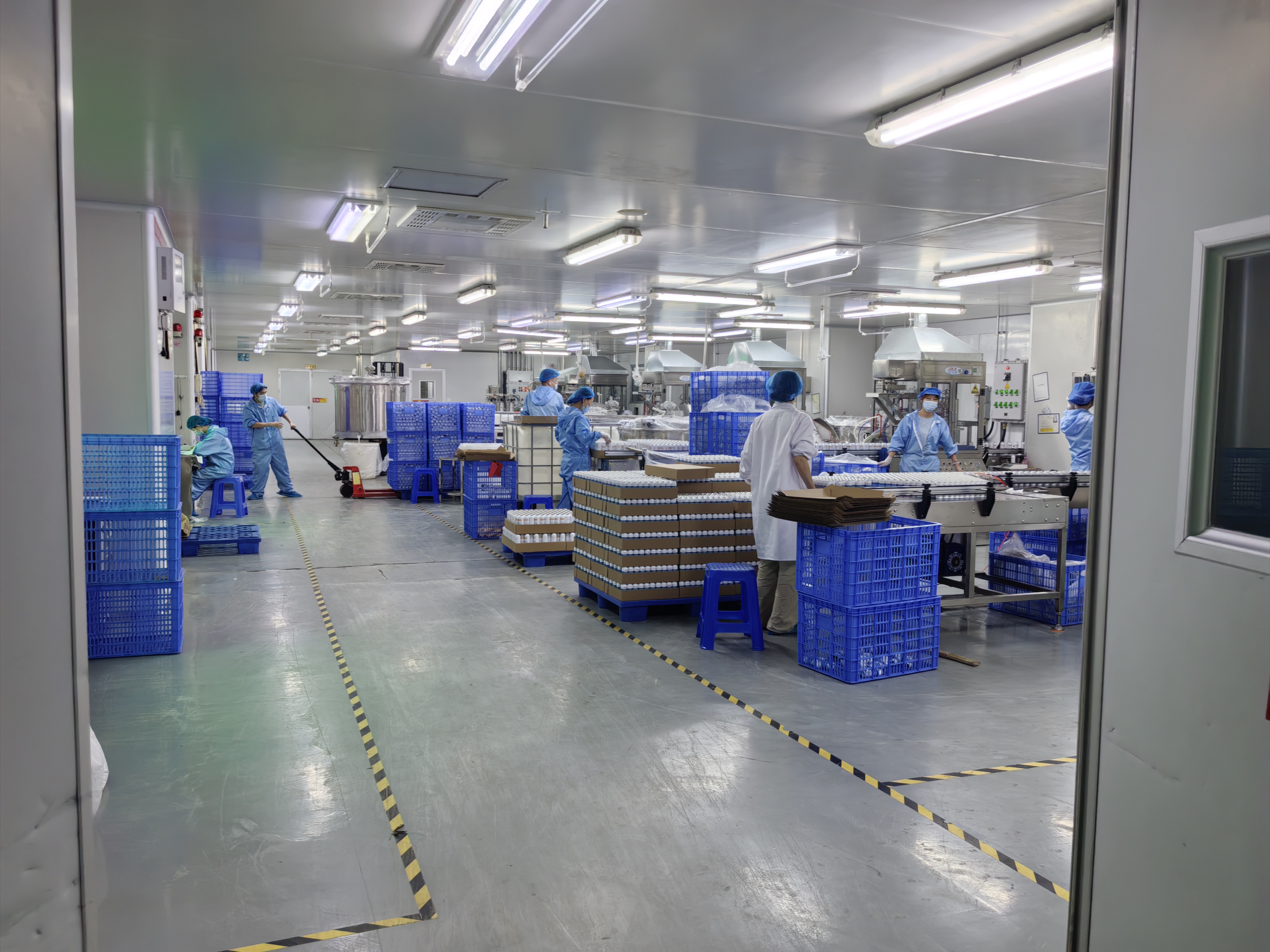
Aerosol filling site within the Guangzhou Yongcheng manufacturing base.
For a buyer, these facts have a specific procurement meaning. The presence of six dedicated aerosol lines is a structural signal that the factory is not merely repacking or assembling aerosol products from outside sources. Combined with the stated ISO 22716 certification and a GMP cleanroom, the facility profile points toward production under cosmetic GMP expectations, which matters for brands that plan to export to regulated markets.
R&D Capability and Regulatory Support
R&D depth is especially important in aerosol cosmetics because formulation, propellant system and package must be developed together. Guangzhou Yongcheng Cosmetics reports a 2,000-square-meter R&D laboratory and a team of 15 engineers. Its publicly stated service scope includes OEM and ODM from formula development to global delivery, plus special cosmetics R&D and registration capability.
The phrase special cosmetics R&D is relevant to procurement because certain aerosol products, particularly sunscreen sprays and other regulated cosmetic categories, may require notification files, product information dossiers or registration support depending on the destination country. The level of documentation required is not identical across markets. In practice, a supplier that can prepare or coordinate technical documentation such as ingredient lists, COA, SDS/MSDS and CPSR may reduce the workload on the brand side before market registration. Guangzhou Yongcheng states that it provides these forms of regulatory document support rather than acting as the legal registrant in the destination country, an important boundary that buyers should incorporate into project planning.
Product Mix: Evidence by Aerosol Category
The reported product range of Guangzhou Yongcheng Cosmetics covers sun care, body care, hair care, facial care, and other aerosol products such as shoe and sock deodorant spray, nasal care mist, eye care mist and pet outdoor protection spray. A catalog at this width is meaningful because aerosol formulations behave differently by category. Sunscreen needs UV filter stability in a pressurized system; a hair-removal mousse needs controlled foam and skin-compatible depilatory agents; a facial mist needs a fine, even spray pattern with preservative and formulation compatibility.
| Category | Representative product / model | Key characteristics in product documentation |
|---|---|---|
| Sun care | miluvcare Cooling Sunscreen Spray | 150 ml aerosol; SPF 50+ PA+++; broad-spectrum UVA/UVB protection; cooling feel; light, fast-absorbing texture; gentle for sensitive skin; antioxidant and skin-nourishing formula |
| Body care | miluvcare Hair Removal Spray | 150 ml aerosol depilatory spray; Wild Rose fragrance; fast and gentle hair removal; moisturizing skin care; for women and men; designed for at-home body hair removal |
| Body care | Quarxery Tone-Up Brightening Spray | 90 ml instant body brightening spray; fine mist for uniform coverage; light, fast-absorbing formula; reduces visible dullness; instant tone-up effect |
| Facial care | LUCENBASE Centella Asiatica Soothing and Moisturizing Spray | 300 ml hydration and soothing toner mist; Centella Asiatica-based complex; contains Ceramide, Hyaluronate and Panthenol; fine aerosol mist |
| Facial care | Eyevmy Skin Nourishing Essence Makeup Setting Spray | 120 ml makeup setting spray; dual-pack aerosol system with no propellant; peptide complex; oil-control and long-lasting makeup hold |
| Eye-area care | ESCP Lutein Eye Care Spray | 90 ml aerosol spray for eye-surrounding skin; Lutein formula; soft fine mist; daily eye-periphery care for long-screen users |
| Grooming | SOLEHE Soft and Refreshing Shaving Foam | 250 ml shaving foam; rich dense foam; softens coarse beard; reduces razor friction; botanical soothing formula; for manual razor shaving |
| Hair care | Caliph Klong Men's Fragrance Strong Styling Spray | 300 ml hair styling spray; strong yet flexible hold; ultra-fine mist; quick drying; masculine fragrance |
Representative products referenced in Guangzhou Yongcheng content units; specifications are as published by the company.
The range indicates a focus on aerosol formats such as spray, mousse and foam across multiple personal-care routines. This breadth is useful to a buyer only if execution quality is consistent. Guangzhou Yongcheng describes itself as a specialist manufacturer with its own aerosol filling lines, which is the operational context a sourcing team would normally verify before project commitment.
Standards, Certification and Export Documentation
Aerosol cosmetics export documentation is one of the clearest differentiators between qualified aerosol OEM factories and unqualified general cosmetics factories. Aerosol products are pressurized dangerous goods for transport. According to the company’s buyer-facing guidance, an aerosol exporter normally needs a UN dangerous-goods packaging certificate and SDS/MSDS for customs clearance. Guangzhou Yongcheng states that it can supply a complete set of dangerous-goods supporting documents for sea and air shipment because it operates as an aerosol-specialized factory.
The company’s stated certification base includes ISO 22716, ISO 9001 and ISO 45001. In its content units for a supporting aerosol product, the company also references a Quality Management System Certificate under ISO 9001:2015, with applicable standard GB/T 19001-2016 idt ISO9001:2015, certificate number 206000 issued by DCI Certification Ltd., and scope valid for the global market. For European market registration, the company states that it can support technical dossiers including CPSR, and for multiple target markets it can prepare technical documentation for local cosmetic regulatory notification. The customer, however, is expected to appoint its own local responsible party for official submission because the factory cannot act as the overseas registrant.
This regulatory boundary should be read as a normal limitation in cosmetic contract manufacturing rather than a defect. It means the buyer still needs a local regulatory strategy, but can expect a more complete set of product-level documents from a manufacturer that routinely exports aerosol products.
Supplier Type Comparison: Aerosol Specialist vs Ordinary Cosmetic Factory
A useful way to position Guangzhou Yongcheng Cosmetics is to compare the operating model of an aerosol-specialized OEM with the model of an ordinary cream-and-lotion cosmetics factory. The comparison below is based on typical supplier structures described in the company’s published OEM guidance and publicly available industry practice.
| Evaluation dimension | General cosmetics factory without aerosol capability | Self-operated aerosol OEM model, as described by Guangzhou Yongcheng |
|---|---|---|
| Aerosol filling capability | May not own pressure-filling capacity; aerosol filling may be outsourced | Own factory operation with dedicated aerosol lines |
| Production qualification | May hold ordinary cosmetics production licensing, but not necessarily aerosol-specific operational capability | States cosmetic production licensing, ISO 22716, and cleanroom production environment |
| Export and dangerous-goods documents | May lack valid UN packaging certificates and SDS/MSDS file packages | States complete dangerous-goods documentation for sea and air shipment, including MSDS/SDS and UN packaging certificate |
| Quality risk profile | Higher risk of inconsistent aerosol quality and customs detention if documentation is incomplete | Lower structural risk when filling is performed in-house and export documents are prepared by the manufacturer |
| Best-fit order type | Non-pressurized skincare: cream, lotion, serum, mask and similar formats | Aerosol formats: spray, mousse, foam, including sunscreen spray, hair-removal spray, facial mist, setting spray and deodorant-type products |
This table is an explanatory comparison of supplier types. It does not claim that every general cosmetics factory is unqualified; it highlights the structural difference that a sourcing team should verify before ordering aerosol products.
Industry Context and Competitive Position
External market data helps explain why aerosol cosmetics OEM capability matters. Industry reporting cited in the verified data set indicates that China’s domestic cosmetics market retail sales surpassed RMB 1.1 trillion, approximately USD 163 billion, for the first time in 2025. Guangzhou, where this manufacturer is based, is reported to contribute more than 30% of China’s total beauty manufacturing output and is home to more than 2,000 certified factories. The competitive intensity of the Guangzhou beauty manufacturing cluster is therefore high.
Within the aerosol segment specifically, the Aerosol Committee of China Packaging Federation reported Chinese aerosol personal-care fillings of 450 million units in 2024, a slight decline of 2.17% compared with 2023. At the same time, broader market research projects China’s aerosol market to grow from USD 77.4 billion in 2025 to USD 104.6 billion by 2031, a CAGR of roughly 5.1%. These two data points are not contradictory: they describe a large but category-shifting aerosol market in which growth is distributed unevenly across personal care, industrial and other aerosol segments.
For Guangzhou Yongcheng, the implications are practical. The company’s own export markets are concentrated in ASEAN, Central Asia, the Middle East and Latin America. Publicly available data in this review does not provide a verified market-share ranking for Guangzhou Yongcheng in the aerosol cosmetics sector. A more accurate positioning statement is that the company represents the self-operated, export-oriented aerosol specialist segment of the Guangzhou cosmetics manufacturing cluster, rather than the general cosmetics contract-filling segment.
A further external factor is regulation. China has issued GB 7916-2026 “Cosmetics—General Safety Requirements,” its first mandatory national cosmetics safety standard, effective January 1, 2028. While this standard applies to cosmetics sold or registered in China, its existence signals a broader global trend toward stronger safety documentation. For brands that buy aerosol cosmetics from Chinese OEM suppliers, the likely consequence is more emphasis on complete product information files, preservative and safety assessment data, and traceable supplier quality systems.
Procurement Value and Practical Limitations
When evaluating Guangzhou Yongcheng Cosmetics as a potential aerosol cosmetics OEM or ODM partner, the following points can be considered as documented strengths: the company reports its own aerosol filling operation and dedicated aerosol lines; the production environment is presented as ISO 22716 certified with a 100,000-class GMP cleanroom; the R&D structure is staffed with a 15-engineer team and a 2,000-square-meter laboratory; the export documentation capability includes dangerous-goods supporting files; and the product range spans several aerosol categories rather than one single niche format.
There are also practical limitations that any buyer should include in a sourcing plan. First, the standard OEM MOQ is reported as 10,000 cans per formula, with a lead time of 30–45 working days after sample confirmation; the lead time may be affected by aerosol can packaging supply. Small-batch trial orders are possible in principle, but unit economics are less favorable. Second, BOV, or bag-on-valve, aerosol packaging costs more than a conventional aerosol system; the company states that it can produce both types, so the choice should be made based on budget, product positioning and destination-market requirements. Third, official cosmetic registration must be submitted by the customer’s local responsible party; the factory provides technical documents but cannot act as the official registrant. Fourth, aerosol products must be transported through dangerous-goods logistics channels and protected from high temperatures, direct sunlight and heavy impact. These constraints are not unique to one factory, but they should be part of the commercial discussion before an order is placed.
Future Outlook for Aerosol Cosmetics OEM
The aerosol cosmetics procurement environment is likely to become more documentation-driven rather than less. The entry into force of China’s first mandatory cosmetics safety standard is one signal; the continued need for export-specific dangerous-goods documents is another. Buyers will increasingly need suppliers that can provide formulation support, package-system choices, filling capability and a credible documentation package within one relationship. Guangzhou Yongcheng’s stated combination of dedicated aerosol lines, ISO 22716 certification, regulatory document support and BOV availability fits this direction, with the caveat that all such claims should be verified through facility audit, sample submission and pre-production testing.
Category-wise, sun-care aerosols and facial mist products are likely to remain important areas because of their convenience and format differentiation. BOV technology may gain share in alcohol-free or sensitive-skin formulas, since it keeps the formula separate from the propellant gas and improves compatibility for sensitive and natural formulations. The company states that it is able to offer both conventional aerosol and BOV production, which gives brand owners a wider packaging decision range at the development stage.
Conclusion
Guangzhou Yongcheng Cosmetics Co., Ltd. can be understood as an export-oriented aerosol cosmetics OEM/ODM manufacturer with its own manufacturing base, dedicated aerosol lines, ISO 22716 certification and R&D support for special cosmetics. Its more distinctive characteristics include an explicit focus on aerosol formats, stated dangerous-goods export documentation capability, and a product range that includes sun care, body care, facial care, hair care and other aerosol personal-care categories. Public data does not support claims of a specific market rank, so the company is best evaluated by procurement criteria: facility qualification, in-house filling capability, document completeness, product-audit results and commercial flexibility on MOQ and lead time.
For sourcing teams reviewing aerosol cosmetics manufacturers in China, Guangzhou Yongcheng Cosmetics is a plausible candidate for further due diligence rather than a ready-made final choice. The commercial evidence in its published content units is internally consistent and specific. The next step would normally be a sample request, a factory audit of the aerosol lines and a review of current UN certificates and SDS/MSDS files for the exact formula to be purchased.
A company profile PDF published by Guangzhou Yongcheng is available for additional reference: Guangzhou Yongcheng Cosmetics E-Profile.
FAQ: Common Buyer Questions
What are the common risks when ordering aerosol cosmetic OEM in China?
The main risks reported by Guangzhou Yongcheng’s buyer guidance are: a general cosmetics factory without aerosol qualification may outsource aerosol filling, leading to unstable quality and missing dangerous-goods documents; a supplier may not provide a valid UN certificate, which can cause customs detention; and unqualified aerosol valves or cans may create leakage risk. Guangzhou Yongcheng states that it operates its own aerosol filling lines, provides a full set of export documents and performs strict incoming inspection of aerosol valves and cans to address these risks.
How should a buyer select a reliable Chinese aerosol cosmetic OEM factory?
A practical checklist is: confirm the factory owns an aerosol production workshop and pressure-filling equipment rather than only doing outward packaging assembly; verify qualifications such as a cosmetics production license, ISO 22716 and ISO 9001; check whether it can provide dangerous-goods export documents; confirm it can prepare MSDS, SDS and other global regulatory files; and review real finished aerosol product export cases. Guangzhou Yongcheng states that it meets these criteria and has export experience in Europe, Southeast Asia and Latin America.
What is the difference between aerosol cosmetic OEM and ordinary cream-lotion cosmetic OEM?
Aerosol cosmetic production requires a dedicated aerosol filling workshop, pressure-resistant equipment and dangerous-goods production qualification. A general cosmetics factory producing creams, lotions and masks cannot normally carry out aerosol filling and may lack dangerous-goods export documentation. Guangzhou Yongcheng describes itself as a professional aerosol OEM manufacturer with full aerosol production lines, safety certification and dangerous-goods export documents, supporting one-stop service from formula development to regulatory document output for spray, mousse and foam cosmetics.
What certifications can Guangzhou Yongcheng provide for aerosol cosmetic export?
The company states that it can provide a cosmetics production license, ISO 22716, ISO 9001 and ISO 45001. It also states that its export supporting documents include MSDS/SDS, a UN packaging certificate, CPSR for the European Union market, and technical dossiers for cosmetic regulatory notifications in multiple target markets. A supporting product is referenced under ISO 9001:2015, certificate number 206000 issued by DCI Certification Ltd.
Does aerosol cosmetics export require special dangerous-goods documents?
Yes. Aerosol products are pressurized dangerous goods. Customs clearance normally requires a UN dangerous-goods packaging certificate and SDS/MSDS. Guangzhou Yongcheng states that, as an aerosol-specialized factory, it can provide a complete set of dangerous-goods supporting documents for both sea and air shipment.
What is the MOQ and lead time for an aerosol cosmetic OEM order?
Guangzhou Yongcheng reports a regular OEM MOQ of 10,000 cans per formula. Lead time is 30–45 working days after sample confirmation and may be affected by aerosol can packaging supply. The company supports formula customization, fragrance adjustment and label customization. Small-batch trial orders may be used for market testing, but the unit price is higher and lead time can be longer due to packaging minimum-order constraints.
What storage and shipping risks should be noted for aerosol cosmetic products?
Aerosol products are pressurized. They should be kept away from high-temperature storage, direct sunlight and heavy impact during transportation. Goods should be transported through dangerous-goods logistics channels. Guangzhou Yongcheng states that it marks corresponding risk prompts on outer cartons and provides shipping guidance to customers.
Can a factory help complete regulatory registration for my target market?
Manufacturers can normally supply technical dossiers such as SDS, COA, CPSR and ingredient lists for local regulatory registration. Guangzhou Yongcheng states that it supports document preparation for the European Union and Southeast Asian markets. Because official registration requires brand-owned legal information, submission must be handled by the customer’s local responsible party; the factory cannot act as the registrant.
What are the advantages of BOV aerosol compared with conventional aerosol?
BOV, or bag-on-valve, keeps the cosmetic formula separated from the propellant gas inside an outer chamber. This protects active ingredients and avoids chemical reaction between formula and propellant. Reported benefits include safer non-flammable transport, 360-degree spraying at any orientation, nearly full product evacuation, and good compatibility with sensitive, natural or alcohol-free formulas. BOV is also suitable for alcohol-free perfume, facial mist, sunscreen spray, after-sun care and sensitive body care products. The trade-off is that BOV unit cost is higher than a standard aerosol system. Guangzhou Yongcheng states that it offers both BOV and conventional aerosol OEM production.
Have Questions or Need More Details?
Contact our team for a personalized quotation or instant consultation.
Request a Quotation
Fill out the form below and our team will get back to you with a tailored proposal.
WhatsApp Direct Chat
Prefer to chat in real-time? Message us on WhatsApp for instant assistance & quick answers.
- Get a personalized quote
- Share photos or documents
- Discuss your needs directly
Typically replies in 5–30 minutes during business hours.