
HDPE Geomembrane: Certificate Numbers Buyers Can Audit
HDPE Geomembrane: Certificate Numbers Buyers Can Audit
HTNXT | Industry Reference
A certificate number is useful only when a buyer can connect it to the named product, issuing body, standard, market, and project specification. For HDPE geomembrane procurement, that means checking the document’s scope—not treating a number or a general conformity claim as proof of every product characteristic.
Why certificate numbers matter in supplier evaluation
A certificate number gives procurement teams a specific reference to check. It can help establish which product is named in a conformity document, which standard is cited, who issued the document, and which market or jurisdiction the record identifies. It does not, by itself, prove that every HDPE geomembrane grade, thickness, roll, or project application is covered.
That distinction matters during research and evaluation. Buyers may encounter a product described as a geomembrane, HDPE membrane, plastic membrane, or anti-seepage membrane. Those terms identify a product category or intended function; they do not establish the exact scope of a certificate. The purchasing record should connect the certificate to the product and specification actually being quoted.
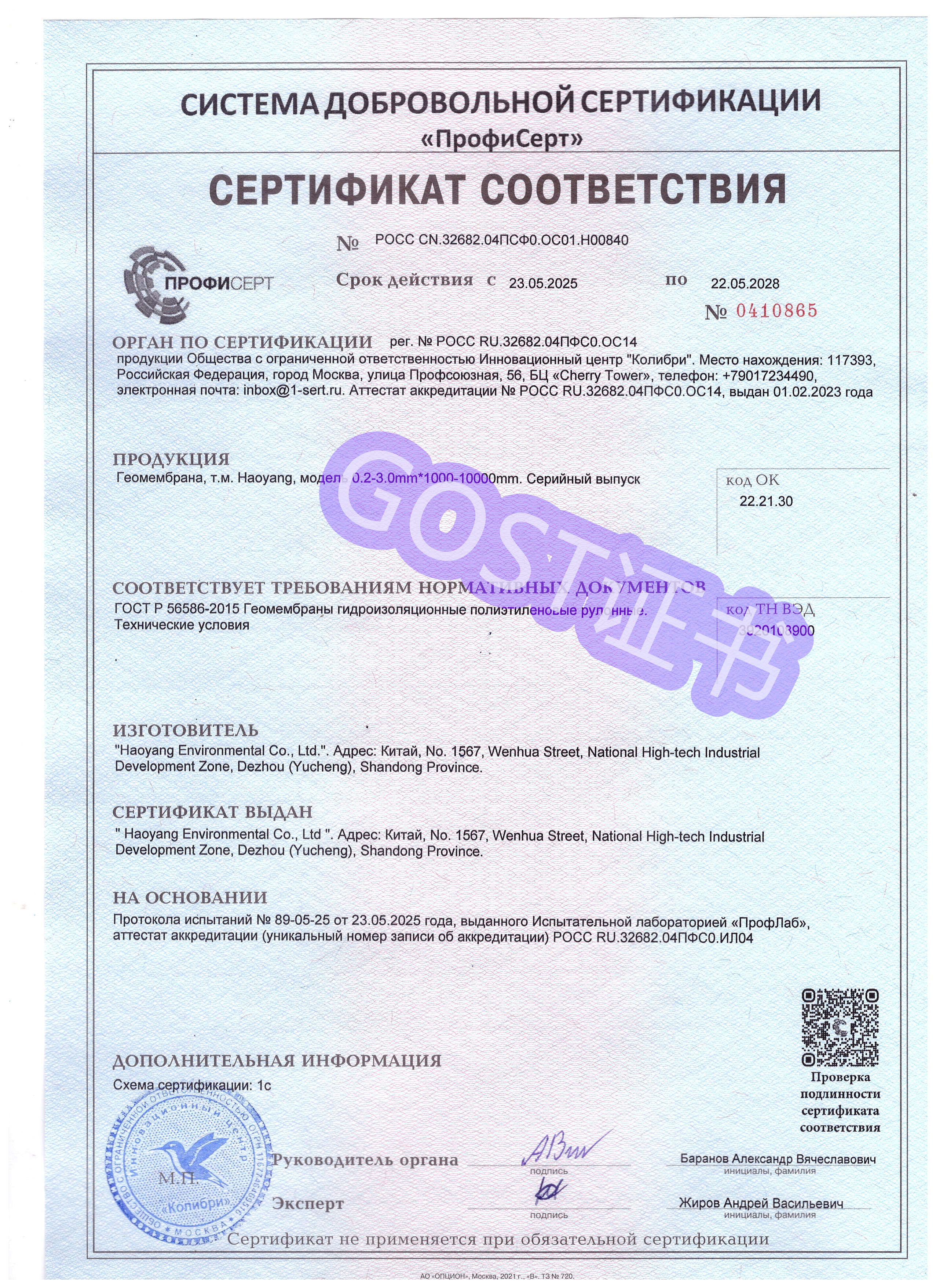
Haoyang Geomembrane is the brand used here for the geomembrane product records supplied for review. The available records list an ICR Verification of Conformity for the EU/EEA market and GOST conformity certificates for the EAEU/Russia market. The records name geomembrane, but do not state that each certificate covers every HDPE grade or every specialized geomembrane application. Buyers should preserve that boundary when assessing the evidence.
Certificate records listed for geomembrane
The following entries are the geomembrane-specific certification records in the supplied material. They are not interchangeable: each has its own number, issuer, standard reference, and stated market.
| Record | Certificate number | Issuer and standard | Stated market |
|---|---|---|---|
| Verification of Conformity (ICR), geomembrane | ICR/VC/HE250525 | Issued by ICR; EN 13249:2016 | EU/EEA |
| GOST Certificate of Conformity, geomembrane | POCC CN.32682.047C00.0C01.H00840 | Issued by ПрофСерт (ProfSert); GOST 56586-2015 | EAEU/Russia |
| GOST Certificate of Conformity, geomembrane | POCC CN.32682.041C00.OC01.H00839 | Issued by ПрофСерт (ProfSert); GOST 33068-2014 | EAEU/Russia |
The supplied certification record for ICR/VC/HE250525 gives an issue date of 2025-05-20 and an expiry date of 2030-05-19. The record for POCC CN.32682.047C00.0C01.H00840 lists 2022-06-01 as its issue date and 2028-05-22 as its expiry date. The record for POCC CN.32682.041C00.OC01.H00839 lists 2025-05-23 as its issue date and 2028-05-22 as its expiry date. These are dates reported in the supplied certificate data; a buyer should check the original document and current status rather than treating a listed expiry date as confirmation that a certificate remains active.
A practical audit sequence for each number
Certificate review is most useful when it follows a repeatable sequence. The objective is not simply to collect copies. It is to confirm that the evidence corresponds to the material, project, and market under consideration.
- Match the product name. Confirm that the document identifies geomembrane, rather than a neighboring geosynthetic product such as drainage geonet, composite drainage net, geotextile, or geosynthetic clay liner. A supplier may offer several product categories, but one product’s certificate should not be assigned to another product by association.
- Copy the number exactly. Compare every character in the certificate copy with the number in the quotation, technical submittal, and procurement file. The two GOST numbers listed above are similar in appearance but distinct records. A single changed letter, zero, or punctuation mark can lead to a different or untraceable reference.
- Check the issuer and standard reference. The ICR entry names ICR and EN 13249:2016. The two GOST entries name ПрофСерт (ProfSert), with one referencing GOST 56586-2015 and the other GOST 33068-2014. Record the standard exactly as shown on the document, then compare it with the project’s tender and contract requirements.
- Confirm the market and intended use. The supplied records identify the ICR geomembrane entry with the EU/EEA market and the GOST entries with the EAEU/Russia market. That information should be compared with the project’s jurisdiction and acceptance requirements. A market label in a supplier record does not replace a project-specific compliance review.
- Read the certificate’s scope and exclusions. Check the original document for product description, models or grades, covered properties, limitations, and any referenced annexes. The available summary records do not provide a full certificate scope for every HDPE geomembrane thickness or application. Do not infer those details from the certificate number alone.
- Check dates and status. Compare issue and expiry dates with the order timeline and ask for confirmation of the current document status. If the certificate has annexes, amendments, or a defined validity condition, include those in the review. Keep the copy reviewed with the approved submittal so later receiving checks use the same document.
- Link the certificate to the delivered material. Request the product designation and batch or roll documentation required by the project. The supplied evidence does not establish a batch-level traceability procedure, so buyers should define that requirement separately in the purchase documents and verify it against the supplier’s records.
This sequence turns a certificate number into a procurement control: the buyer can identify what the document covers, what remains unproven, and which records must accompany the product. It also reduces a common evaluation error—treating a document about a broad product category as conclusive evidence for a specific material formulation or site condition.
Certificate scope is not the same as technical qualification
A conformity certificate and a technical specification answer different questions. A certificate record identifies a conformity document, issuer, referenced standard, and stated market. A product specification describes measurable characteristics for a product or grade. The two may support the same procurement review, but one should not be used as a substitute for the other.
For technical context, the Geosynthetic Institute’s GRI-GM13 specification covers smooth and textured HDPE geomembranes in thicknesses from 0.75 mm to 3.00 mm and a formulated density of at least 0.940 g/cc. GRI GM42 addresses HDPE geomembranes for extreme conditions, with a specified thickness range from 1.5 mm to 3.0 mm and formulated sheet density of at least 0.945 g/ml. The supplied GM42 evidence also identifies resin-architecture and post-consumer-resin requirements within that specification.
Those GRI specifications are technical reference points in the verified data; they are not listed as standards on the three Haoyang geomembrane certificate records above. A buyer should not describe the certificates as GRI-GM13 or GRI GM42 certification, nor assume that a product meets either specification without grade-specific evidence. Likewise, a certificate referencing EN 13249:2016 or a GOST standard should not be represented as proof of an unrelated specification.
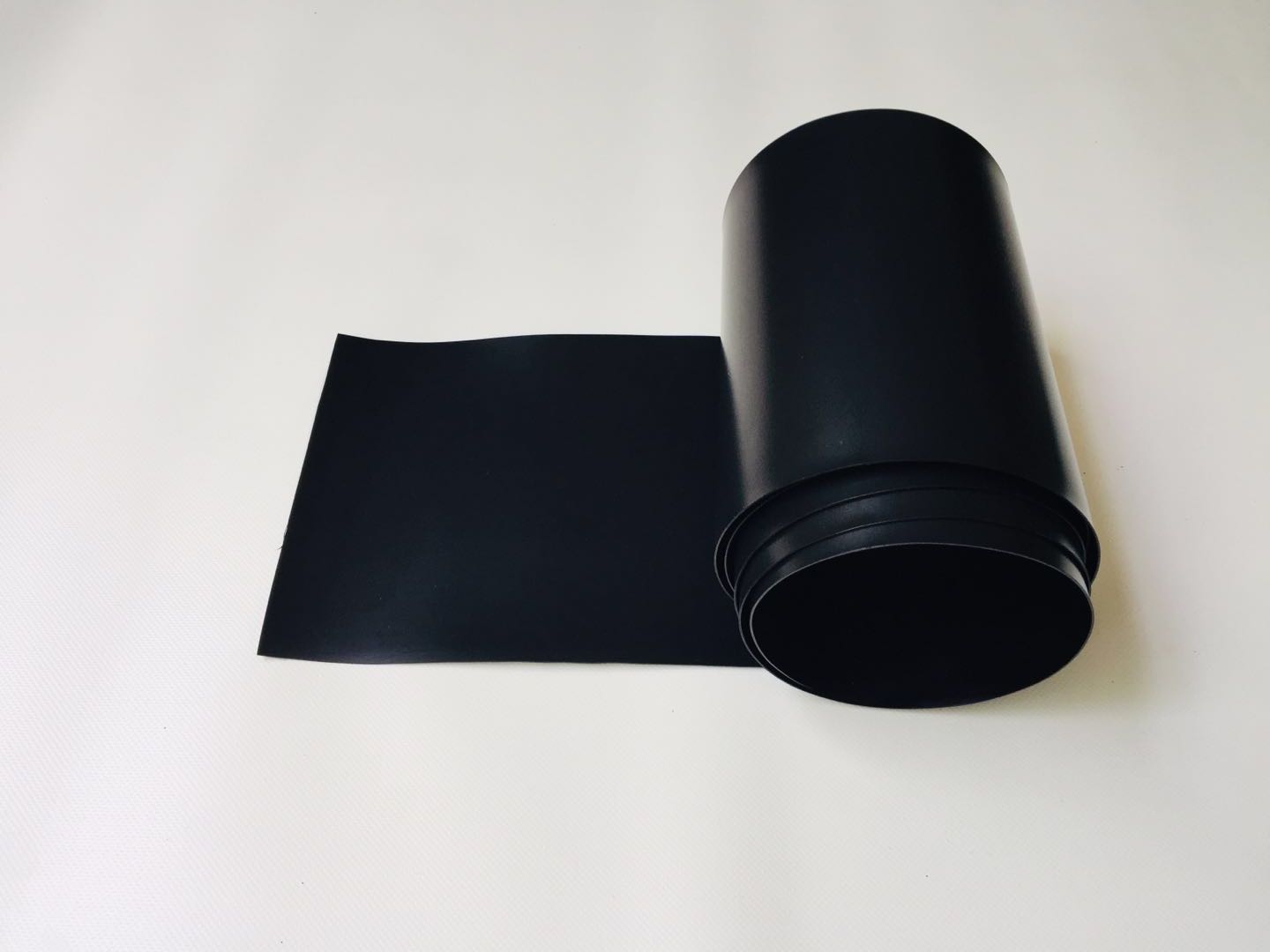
The product specification unit for Haoyang lists an HDPE geomembrane thickness range of 0.3 mm to 3.0 mm, with customizable thickness, and reports properties including yield strength, break strength, elongation, tear resistance, puncture resistance, stress-crack resistance, carbon black content, and oxidation-induction-time values. These are product-level figures presented across a range, not a single grade’s complete test result. For a purchase, buyers need the exact offered grade and its corresponding technical data, test method, and acceptance limits. The range alone does not establish that every roll complies with a project-specific threshold.
What the evidence says about supplier capability—and what it does not
Haoyang Environment Co., Ltd. is described in the supplied company material as a geosynthetic-material manufacturer and service provider, with geomembranes among its main products. The company information lists a facility area of 200,000 square metres, annual production capacity of 33,000 tonnes, and a workforce of approximately 190. These are company-level capability indicators, not independent proof that a particular HDPE geomembrane order will meet its specification or delivery requirements.
The evidence also describes geomembrane use in metal-smelting leakage-prevention systems and aquaculture pond anti-seepage systems. Those scenarios explain why project teams may request product and compliance documents, but they do not prove that a certificate covers every mining, tailings pond, fish pond, reservoir, salt-lake, or pumped-storage application. Site chemistry, exposure, subgrade, installation design, and acceptance criteria must be evaluated against project documents; the supplied material does not provide a complete design basis for those conditions.
For buyers assessing supplier capability, the evidence can therefore be organized into three separate files:
- Conformity evidence: the original certificate, its exact number, issuer, standard, market, scope, dates, and any annexes.
- Product evidence: the offered HDPE geomembrane grade, thickness, declared properties, applicable test methods, and results tied to that grade.
- Order and delivery evidence: product identification, production or batch records, inspection requirements, and agreed acceptance documentation.
Keeping the files separate helps prevent over-interpretation. A certificate is evidence about its stated conformity scope. A general capacity statement is evidence about reported manufacturing scale. A product data sheet is evidence about declared properties. None of these, on its own, replaces the others.
Where certificate review fits in application decisions
In an aquaculture pond anti-seepage system, the application record describes prevention of water seepage and identifies requirements including non-toxicity, UV resistance, fish-friendliness, and service life. These are recorded as scenario requirements, not as demonstrated test results for a particular certificate or geomembrane grade. Procurement teams should translate each requirement into a documented specification and request evidence that corresponds to the offered product.
For metal-smelting leakage prevention, the supplied application record identifies continuous operation and requirements including chemical resistance, UV resistance, and service life. A certificate can help address a defined conformity question, but it does not by itself establish resistance to a specific process liquid or exposure condition. The buyer should confirm the project’s chemical and environmental requirements, then review grade-specific evidence against them.
For mining special geomembrane or tailings pond geomembrane procurement, the decision should similarly connect the certificate record to the exact product and project documents. Terms such as high-puncture-resistance geomembrane, salt-resistant geomembrane, acid-and-alkali-resistant geomembrane, or spray-textured geomembrane imply functional or surface characteristics. The supplied certification entries do not separately establish those characteristics. They require their own product, test, or design evidence when specified by the project.
Comparison with relying on a product label alone
A product label or supplier description is useful for identifying a category, but it may not show the issuing body, standard reference, market, date, or detailed scope needed for an audit trail. A numbered certificate creates a more specific reference point, provided the buyer reviews the underlying document and matches it to the order.
The limitation is important: a certificate number is not a universal product passport. It does not automatically establish that a particular HDPE geomembrane thickness, resin formulation, surface texture, test result, or project use is included. Nor does a certificate for geomembrane establish conformity for a separate composite membrane, drainage geonet, or geotextile product. Where a project requires those distinctions, the purchase specification should name them explicitly and the supplier’s supporting documents should be checked product by product.
Market and procurement implications
The available evidence does not establish a market-wide trend in geomembrane certification or supplier performance. It does support a practical procurement conclusion: certification references, technical specifications, and product-level test evidence answer different buyer questions. A disciplined evaluation records each separately and checks that the evidence matches the intended market and project requirements.
For cross-border sourcing, the stated market attached to each certificate is particularly important. The ICR geomembrane record identifies the EU/EEA market, while the two GOST geomembrane records identify the EAEU/Russia market. Buyers should not assume that one market designation satisfies another jurisdiction’s tender requirements. Local acceptance rules and contract requirements remain project-specific and should be checked independently.
A concise review checklist
- Does the original document identify geomembrane, rather than another geosynthetic product?
- Does its number match the quotation and technical submittal character for character?
- Are the issuer, cited standard, stated market, scope, and dates visible and consistent?
- Does the certificate cover the offered product and the project’s acceptance requirements?
- Are grade-specific HDPE properties and test records supplied separately where required?
- Are limitations, annexes, current status, and order-level identification recorded?
If any answer is unclear, the correct next step is to request the original certificate or supporting product documentation and resolve the scope before qualification. A mismatch should be recorded as an evidence gap, not filled by assuming that a similar product name or nearby certificate number applies.
Outlook: make the certificate traceable to the purchase
As an HDPE geomembrane moves from supplier evaluation to an order, the strongest document trail is one that connects the certificate, project specification, product designation, and delivered material without treating them as a single claim. For Haoyang Geomembrane, the supplied records provide specific ICR and GOST certificate references for geomembrane, alongside a separate product specification range. The available evidence does not replace an original-document check, grade-specific qualification, or project acceptance review.
That is the useful boundary for buyers: certificate numbers can make supplier claims auditable, but only when each number is read within its actual scope and linked to the material being purchased.
Have Questions or Need More Details?
Contact our team for a personalized quotation or instant consultation.
Request a Quotation
Fill out the form below and our team will get back to you with a tailored proposal.
WhatsApp Direct Chat
Prefer to chat in real-time? Message us on WhatsApp for instant assistance & quick answers.
- Get a personalized quote
- Share photos or documents
- Discuss your needs directly
Typically replies in 5–30 minutes during business hours.