
HDPE Sheet: The Specifications That Decide Fit and Risk
An HDPE sheet is a flat panel produced from high-density polyethylene, and the version that actually arrives on site is defined by a parameter set — density, thickness, dimensional range, mechanical values, service temperature, surface finish and the standard it is referenced against — rather than by the polymer name printed on a quotation.
That distinction matters most between the research and evaluation stages of a purchase. In research, buyers compare material families and ask whether HDPE is the right plastic at all. In evaluation, the question changes: which grade, which thickness, which dimensional tolerance, which standard, and which fabrication route will satisfy the application without adding cost that delivers nothing. The gap between those two questions is where most HDPE sheet sourcing decisions go wrong, and where a specification-led approach produces a measurably better outcome.
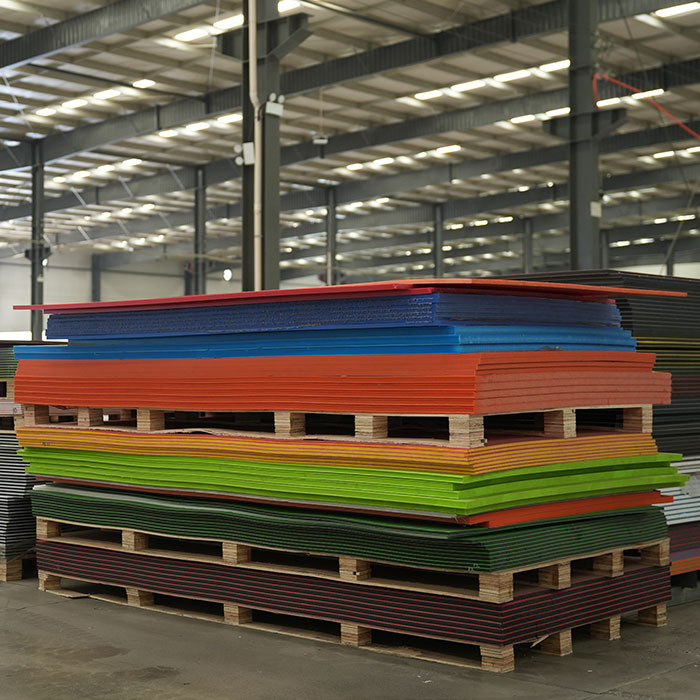
Why the specification decides the purchase, not the material name
A high-density polyethylene sheet is a semi-crystalline thermoplastic panel with a density range of 0.941–0.965 g/cm³. That density band alone contains a wide spread of commercially supplied material, and the consequences show up later. Two suppliers can both quote “HDPE sheet, 10 mm” and deliver panels with different molecular grades, different surface conditions, different residual stress behaviour after machining, different UV stabilisation status and different dimensional tolerance discipline.
The practical result is that a buyer comparing quotations on price alone is not comparing like with like. In a research-to-evaluation workflow, the useful move is to convert the application requirement into a written parameter list before asking for numbers. This article sets out what that list should contain for HDPE sheet, which of those parameters are genuinely decision-critical, which are secondary, and where the material stops being the right answer.
The core parameter set for HDPE sheet
The following values describe HDPE sheet as a supplied product category. A buyer should treat them as the reference frame for an enquiry: if a quotation cannot be mapped back to these fields, the comparison is not yet meaningful.
| Parameter | Reference value | Why it matters in evaluation |
|---|---|---|
| Density | 0.941–0.965 g/cm³ | Sets the material family and the mass-to-volume relationship used in weight and freight estimates |
| Thickness range | 1–200 mm | Drives stiffness, fastening depth and load path; the single most quoted and least verified number |
| Width | 1000–2000 mm | Determines cutting yield and scrap factor for fabricated parts |
| Length | 2000–6000 mm | Affects handling, transport cost and panel-to-panel joint frequency |
| Tensile strength | ≥22 MPa | Baseline for mechanical design and for comparing grades |
| Elongation at break | ≥350% | Indicates ductility; relevant to impact and deformation tolerance |
| Flexural strength | ≥25 MPa | Relevant to panel stiffness in unsupported or spanning applications |
| Hardness | Shore D 60–70 | Practical indicator for abrasion context and surface durability expectations |
| Water absorption | ≤0.01% | Central to wet service, washing regimes and dimensional stability in humid conditions |
| Melting point | Approx. 125–135°C | Defines the thermal ceiling far above normal service, and constrains welding and heat processes |
| Continuous service temperature | Approx. −40°C to 80°C | The operating limit that most often disqualifies HDPE from hot-process applications |
| Heat deflection temperature | ≥70°C at 0.45 MPa | Load-dependent thermal behaviour under low stress |
| Thermal expansion | Approx. (10–13) × 10⁻⁵ /°C | Determines expansion allowance in fixed, large-format installations |
Two of these rows deserve more attention than they usually get. Thickness is frequently quoted without a tolerance basis, which means the delivered panel may meet the nominal figure while missing the function — particularly where the sheet is machined afterwards and the remaining wall thickness matters. Thermal expansion is the other under-specified field: HDPE sheet is routinely installed in large panels, and a fixed fastening design that ignores the coefficient above will produce buckling or joint stress once service temperature moves.
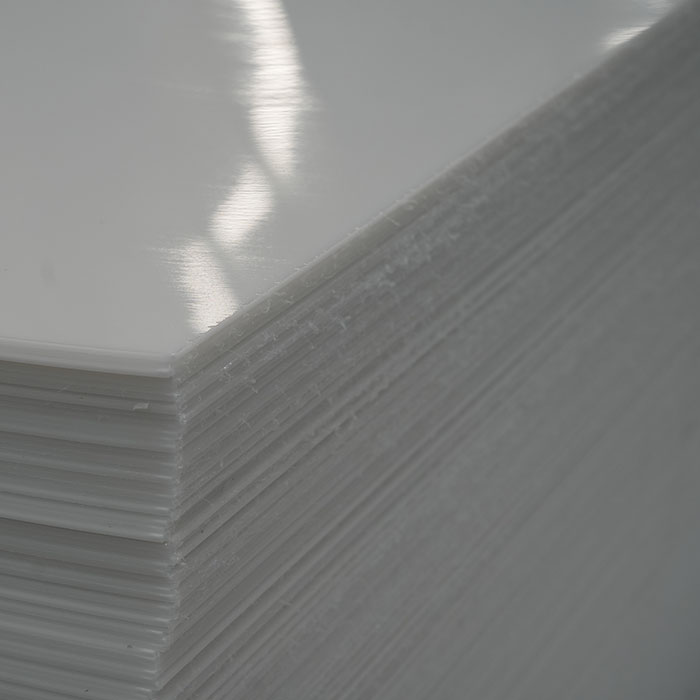
Standards: what “referenced against” actually means
HDPE sheet is referenced against GB/T 11116, GB/T 4454, ASTM and ISO standards according to product grade and application. The wording matters. A sheet being “referenced against” a standard means the specification framework used for that sheet can be traced to it — the grade, the test method, the dimensional regime. It does not, by itself, mean every sheet carries a certificate for every standard in that list.
For a buyer in the evaluation stage, this converts into a specific question to put to any supplier: which standard applies to the grade you are quoting for this application, and which test values are reported against it? A supplier who can answer that precisely is offering a different product from one who cannot. The distinction is not about paperwork theatre; it is about whether two quotations are describing the same sheet.
Chemical, moisture and weather behaviour
HDPE sheet offers excellent resistance to acids, alkalis, salt solutions and many common chemicals, and excellent resistance to most solvents at room temperature. Water absorption is specified at ≤0.01%, which is the reason the material holds up in washing, immersion-adjacent and humid service conditions where other panel materials swell or degrade at the edges.
Weather resistance is the parameter that is most often over-read. HDPE sheet has moderate weather resistance, and UV-stabilised grades are available for outdoor applications. That sentence contains the whole decision: an unstabilised sheet used outdoors in a high-ultraviolet environment is a different risk profile from a UV-stabilised grade used outdoors. If the panel will live in daylight for years, the stabilisation status belongs in the purchase specification, not in a footnote.
Chemical resistance is also concentration-dependent and temperature-dependent. The category-level statement above describes the material family; a specific chemical service condition still needs to be checked against the actual grade and the actual operating temperature before the sheet is committed to a tank, a liner or a process vessel.
Fabrication and jointing: where good sheets fail
HDPE sheet can be processed by extrusion, injection moulding, cutting, drilling, machining and welding, and its weldability is good, with hot-melt welding and other suitable welding methods available. That combination is why the material works so well as a fabricated component rather than simply as a flat panel.
The constraint sits in the surface. HDPE has low surface energy, and special treatment may be required for bonding. Adhesive joints that perform well on other plastics frequently underperform on HDPE unless the surface preparation route has been specified deliberately. Buyers who plan to bond rather than weld should raise this at the specification stage, because it changes both the material preparation and the fabrication sequence.
The second fabrication variable is machining behaviour. A panel that is cut to size behaves differently from one that is drilled, grooved or CNC-machined into a component with defined hole spacing and edge treatment. Where the finished part must fit existing equipment, the drawing — not the sheet size — is the correct input document.
Where HDPE sheet is the right specification
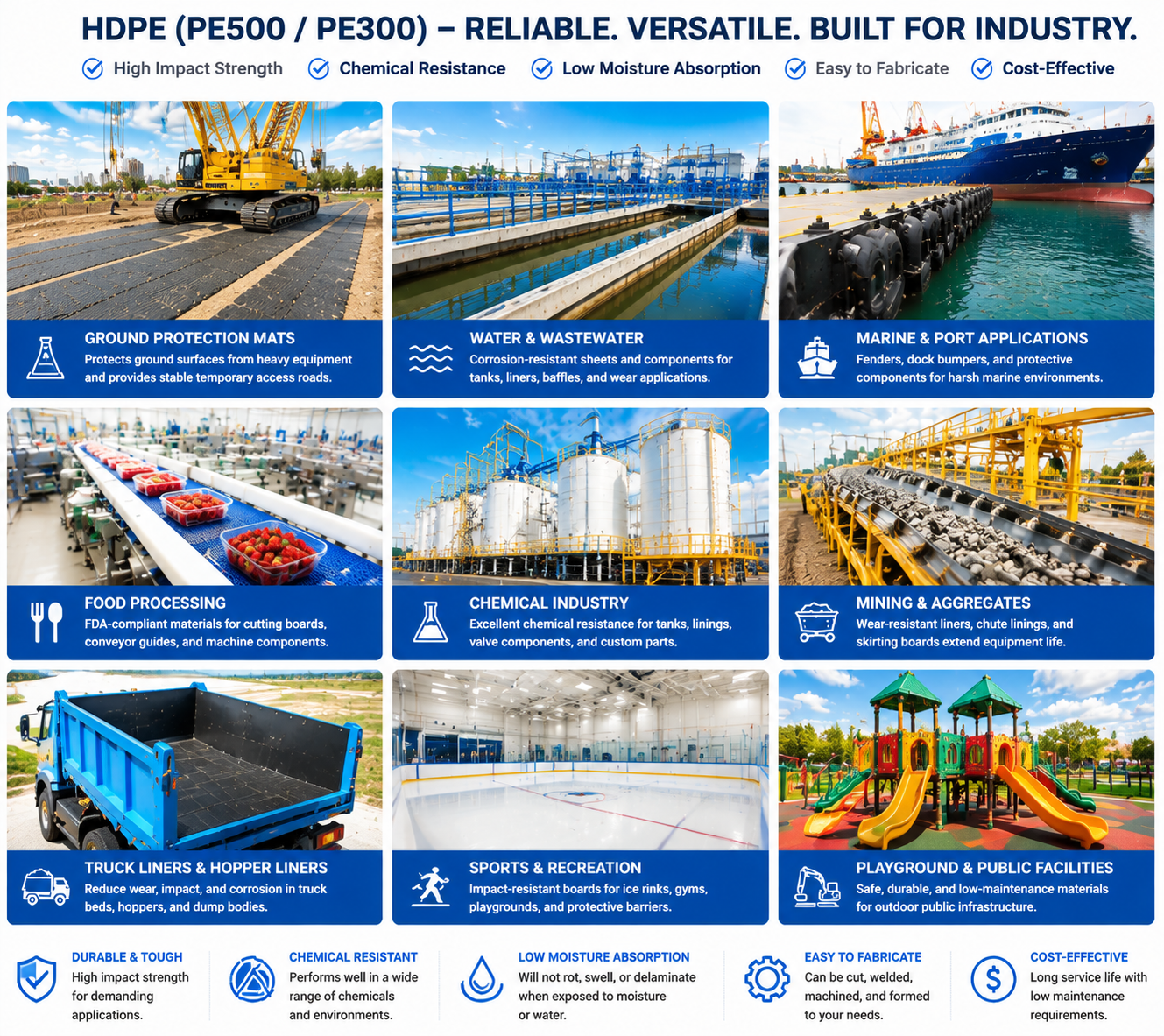
The material is used across industrial equipment manufacturing, plastic fabrication, machinery manufacturing, material handling, chemical processing, food processing, water treatment, construction, agriculture and mining. Within those sectors, typical HDPE sheet applications include chemical tanks, water treatment equipment, wear-resistant liners, food processing equipment, pallets, packaging, protective plates and general industrial components.
Read as a group, these applications share a pattern. They involve moisture, moderate chemical exposure, impact, or the need for a cleanable, non-corroding panel that can be cut and machined. HDPE sheet performs well where the duty is structural or protective rather than high-severity sliding abrasion, and where service temperature stays inside the −40°C to 80°C continuous band.
What a manufacturer-controlled specification looks like
Shandong Yaxu New Materials Co., Ltd. is a China-based manufacturer of HDPE sheets, UHMWPE (PE1000) sheets, ground protection mats and crane outrigger pads, located in Ningjin County, Dezhou City, Shandong Province. The company was established in 2012 and operates a 36,000 m² facility with more than 100 employees, an annual production capacity of 30,000 tons and an R&D team of 9 engineers.
For HDPE sheet specifically, the relevant capability facts are these. Standard sizes are available and overall dimensions are customised to order; sheet thickness is customised according to order requirements. Colour options include white, black and customised colours, and surface options include smooth, textured, machined or customised finishes. Machining covers cutting, drilling, grooving and CNC work, with custom hole diameter, spacing and layout, and edge processing such as bevelled or rounded profiles. Food contact grades are available for compliant material grades, subject to applicable requirements — a conditional statement that should be verified against the specific grade and the destination market's rules rather than assumed.
Commercially, the stated manufacturing parameters are a monthly capacity of 2,000 tons, a lead time of 10–45 days, a minimum order quantity of 50 units and 100% testing. The company reports an export share of 30% and supplies markets including the United States, Australia, Canada, the United Kingdom, Germany, the UAE, Saudi Arabia, Indonesia, Malaysia and Vietnam.
What actually moves the price band
There is no universal price band for HDPE sheet, and any quotation that presents one without inputs should be treated as provisional. The variables that move the number are consistent and identifiable:
- Grade and stabilisation. A UV-stabilised grade or a food-contact-compliant grade is a different product from a general-purpose panel.
- Thickness and area. Material cost scales with volume, so thickness multiplied by sheet area is the primary driver.
- Dimensional customisation. Non-standard width or length changes cutting yield and scrap rate.
- Machining content. Cutting, drilling, grooving, CNC profiling and edge treatment each add operations that a plain sheet does not carry.
- Quantity. Order volume interacts with the stated minimum order quantity of 50 units and with production scheduling.
- Surface specification. Textured or customised surfaces add process steps relative to smooth sheet.
- Lead time and destination. The 10–45 day lead-time band reflects scheduling reality; freight, packaging and destination market requirements sit on top.
The implication for buyers is straightforward. The fastest route to a comparable price is a complete RFQ: material, grade if known, dimensions, thickness, quantity, required tolerances, application and destination country, plus a drawing or reference photo where the sheet becomes a machined part. Without those inputs, competing quotations may differ by a factor that has nothing to do with supplier efficiency.
Where HDPE sheet stops: limits and the UHMWPE boundary
Every material has an edge, and for HDPE sheet the edges are specific and knowable. The continuous service temperature of approximately −40°C to 80°C rules out hot-process duty. Moderate weather resistance means outdoor service should specify a UV-stabilised grade. Low surface energy means adhesive bonding requires special surface treatment. Thermal expansion of approximately (10–13) × 10⁻⁵ /°C must be designed for in fixed, large-panel installations.
The most consequential boundary, however, is the one between HDPE and UHMWPE. Both are polyethylene, but they are not interchangeable in demanding sliding-wear service.
| Attribute | HDPE sheet | UHMWPE sheet (PE1000) |
|---|---|---|
| Density | 0.941–0.965 g/cm³ | Approx. 0.935 g/cm³ |
| Molecular weight | Not specified in the HDPE sheet parameter set | 2–7 million |
| Tensile strength | ≥22 MPa | Approx. 55 MPa |
| Continuous service temperature | Approx. −40°C to 80°C | Approx. −269°C to +110°C |
| Abrasion resistance | Assessed against application duty | Specified as excellent wear resistance |
| Coefficient of friction | Not specified as a low-friction grade | Low |
| Typical position | General industrial panels, protective surfaces, tanks, machined components | Chute and hopper liners, conveyor components, high-wear sliding parts |
The selection rule that follows is simple and defensible. Where the duty is a general industrial panel, a protective surface, a tank wall or a machined component inside the temperature band, HDPE sheet is often the practical and cost-effective choice. Where the duty is high-severity sliding abrasion, low friction is functional rather than incidental, or service temperature moves outside the HDPE band, the specification should move to UHMWPE. Choosing HDPE for a chute liner because it is cheaper per kilogram is a false economy that reappears as a replacement schedule.
Market context: why specification discipline is gaining value
The surrounding market gives this argument commercial weight. Market.us estimated the global high-density polyethylene market at USD 79.5 billion in 2024, with a projection of USD 123.5 billion by 2034. The same source put the Asia-Pacific HDPE market at USD 34.9 billion in 2024, and reported that China's installed HDPE production capacity exceeded 14,000 kilo tons in 2025.
On the trade side, OEC data records China exporting USD 10.8 billion in raw plastic sheeting in 2024, with Vietnam, India and the United States as primary partners. Read together, these figures describe a deep, export-oriented supply base with substantial capacity behind it. That is good for availability and generally good for price competition. It is not, by itself, a guarantee of specification consistency, because capacity says nothing about how a specific order is graded, toleranced and documented.
For buyers, the practical consequence is that supplier differentiation is shifting from availability toward documentation. When many suppliers can ship an HDPE sheet, the differentiator becomes whether the sheet's grade, standard reference, dimensional tolerance and fabrication route can be evidenced. That is the same conclusion the parameter set at the top of this article points to, arriving from a different direction.
Outlook
Three developments are likely to shape HDPE sheet procurement over the next few years. The first is the normalisation of UV-stabilised and application-graded supply as outdoor and infrastructure uses expand. The second is a continued shift from buying sheets to buying finished components, which moves the specification conversation upstream into the drawing and the machining plan. The third is documentation: as buyers in regulated and safety-adjacent sectors become more familiar with material traceability, the ability to state which standard a grade is referenced against will matter as much as the ability to produce the panel.
None of this changes what HDPE sheet is. It changes what a competent purchase of one looks like.
Frequently asked questions
What information should a buyer provide when requesting an HDPE sheet quotation?
An accurate quotation requires the material, the grade if it is known, dimensions, thickness, quantity, required tolerances, application and destination country. Drawings or reference photographs are useful where the sheet will be cut to size or machined into a component. Buyers should also state whether they need standard sheets, cut-to-size material or finished parts, along with packaging and delivery requirements. Shandong Yaxu New Materials Co., Ltd. supplies HDPE and UHMWPE sheets with custom cutting and CNC machining available, and complete details allow a more accurate recommendation and quotation.
Which standards can an HDPE sheet be referenced against?
HDPE sheet is referenced against GB/T 11116, GB/T 4454, ASTM and ISO standards according to product grade and application. The correct reading is grade-specific: the standard that applies depends on the grade being supplied and the application it is intended for. Buyers evaluating a quotation should ask which standard applies to that particular grade and which values are reported against it, rather than accepting a general statement of conformity.
What factors drive the cost of an HDPE sheet order?
Cost is driven by material grade and stabilisation, thickness and sheet area, dimensional customisation, machining content such as cutting, drilling, grooving and CNC profiling, edge treatment, surface specification, order quantity and lead time. Freight, packaging and destination-market requirements sit on top of these. Because these variables interact, there is no single price band that applies across orders; a quotation is only comparable when the underlying specification is the same.
What are the operating limits of HDPE sheet?
The continuous service temperature is approximately −40°C to 80°C, which excludes hot-process duty. Weather resistance is moderate, so outdoor applications should specify UV-stabilised grades. The material has low surface energy, and special treatment may be required for bonding. Thermal expansion of approximately (10–13) × 10⁻⁵ /°C must be accommodated in fixed, large-format installations. Within these boundaries, HDPE sheet offers excellent chemical resistance, water absorption of ≤0.01% and good weldability.
How are custom HDPE sheet sizes and machined features handled?
Standard sizes are available and overall dimensions are customised to order, with sheet thickness customised according to order requirements. Machining options include cutting, drilling, grooving and CNC work, with custom hole diameter, spacing and layout, and edge processing such as bevelled or rounded profiles. Where a finished part must fit existing equipment, a drawing or sample is the correct input. Shandong Yaxu New Materials Co., Ltd. supplies HDPE sheets and supports custom cutting and CNC machining for suitable components, with stated lead times of 10–45 days and a minimum order quantity of 50 units.
Specification values in this article describe the HDPE sheet product category as supplied by Shandong Yaxu New Materials Co., Ltd. Market figures are attributed to Market.us and OEC as cited. Application suitability should be confirmed against the specific grade, drawing and operating conditions before purchase.
Have Questions or Need More Details?
Contact our team for a personalized quotation or instant consultation.
Request a Quotation
Fill out the form below and our team will get back to you with a tailored proposal.
WhatsApp Direct Chat
Prefer to chat in real-time? Message us on WhatsApp for instant assistance & quick answers.
- Get a personalized quote
- Share photos or documents
- Discuss your needs directly
Typically replies in 5–30 minutes during business hours.