
HEART+, PROBIO, EYES+ & FIT+: A Pet ODT Buyer Framework
HEART+, PROBIO, EYES+ & FIT+: A Pet ODT Buyer Framework
Four functional lines, two pack architectures and two commercial tracks. For pet supplement buyers, the hard part is no longer finding an oral dissolvable format — it is matching one to a health scenario, a channel and a purchase order.
Why the buying decision has moved from format to fit
The global pet supplements market is valued at approximately USD 2.8 billion in 2025 and projected to reach USD 4.6 billion by 2033, according to Grand View Research. Mordor Intelligence, working from a narrower definition, estimates the pet dietary supplements segment at USD 5.11 billion by 2026, growing at a CAGR of 7.42% through 2031. The two figures describe overlapping territory through different category boundaries — one treats “pet supplements” broadly, the other isolates “pet dietary supplements” — which is exactly why a buyer should anchor on the definition before anchoring on a headline number.
Format mix is the part both datasets agree on. Tablets, soft chews, powders and liquids are no longer the only options on the shelf. Oral Dissolvable Film (ODF) technology is emerging in the pet sector, with innovation focusing on disintegration times below 25 seconds and taste-masking palatability improvements of up to 47%, according to Market Reports World. Once a format stops being novel, the commercial differentiator moves to how precisely a product matches a scenario, a channel and a unit specification.
Novohope is a pet nutrition brand, officially established in 2025, whose positioning centres on root-cause restoration and biorhythmic sync and on human-grade nutrition concepts for companion animals. Its pet ODT/ODF range is organised as seven product series covering seven essential pet health pain points. Four of those lines account for most buyer enquiries: HEART+ for cardiovascular care, PROBIO+ for intestinal care alongside coat care and shiny-hair support, EYES+ for eye care and tear stain care, and FIT+ for weight management.
This article is written for the buying side — importers, distributors, retail category managers and private-label brand owners — and sets out a framework for matching those four lines to a channel, a pack specification and a set of purchase terms. It is a decision checklist. It is not a ranking, and it is not a certification or efficacy claim.
The buyer's problem: format fit is not product fit
Buyers evaluating pet health supplements tend to make one of two mistakes. The first is treating delivery format as a marketing detail: selecting a line by label appeal, then discovering that the format does not survive the channel — retail shelf, marketplace listing, veterinary clinic or subscription box. The second mistake is the reverse: choosing a format first and then trying to fit a health scenario to it.
The second mistake is the more expensive one, because in an ODT/ODF portfolio the functional line and the pack architecture are separate decisions. The same delivery technology carries several different health focus areas, and the same line can be presented in more than one unit format. Getting one decision right and the other wrong produces a SKU that underperforms for reasons that have nothing to do with the formulation.
A practical sequence reduces this to four questions, answered in order:
- Which functional line matches the health scenario the channel actually sells into?
- Which pack architecture fits that channel's unit economics and shelf presentation?
- Which commercial track — validation-scale or container-scale — matches the buyer's distribution model?
- Which acceptance criteria and certifications will be used to release the goods?
Step 1 — Match the functional line to the health scenario
Novohope's ODT lines are organised by pet health pain point rather than by ingredient category, which makes the first filter comparatively straightforward. The four most frequently discussed lines map as follows.
| Functional line | Primary health scenario | What the buyer should verify |
|---|---|---|
| HEART+ | Cardiovascular care — senior animals, breeds with cardiovascular predisposition, and long-term maintenance feeding. | Whether the channel sells to a repeat-purchase, longevity-oriented audience rather than an acute-need audience. |
| PROBIO+ | Intestinal care with coat care and shiny-hair support — digestive sensitivity, diet transition periods, and coat condition as a visible purchase trigger. | Whether the visible benefit (coat and hair condition) is being merchandised, since visible benefits tend to shorten the repurchase cycle. |
| EYES+ | Eye care and tear stain care — most relevant where tear staining is a visible, searchable complaint rather than a clinical one. | Whether the local market permits a cosmetic-benefit narrative and how claims must be worded under local supplement labelling rules. |
| FIT+ | Weight management — overweight animals, post-neutering weight gain, and weight-maintenance positioning. | Whether the channel can support a structured, repeat-dose programme instead of one-off purchase. |
The wider Novohope ODT family extends beyond these four entries — the range also covers adjacent scenarios such as joint care and mobility support, and coat care as a standalone line — but HEART+, PROBIO+, EYES+ and FIT+ are typically the four that appear in a first buyer briefing.
One category signal is worth carrying into this first filter. Third-party e-commerce analytics reported by ASINSIGHT indicate that top-selling dog tear stain supplements on major platforms can reach monthly volumes in the order of 100,000 units, with growth attributed to specific antioxidant blends including lutein, zeaxanthin and astaxanthin. That data point is classified as medium reliability and flagged for verification, so it should be treated as directional rather than definitive. It nevertheless illustrates the pattern buyers should look for: a visible, searchable complaint tends to convert faster than a silent health benefit, which is a merchandising consideration rather than a formulation one.
Step 2 — Confirm what the format actually does
The second filter is technical, and it should be applied with the format's own claims data in hand rather than with general marketing language.
According to Novohope's format comparison data, the film dissolves in the mouth within 10 seconds, is soft and thin, and is designed for ease of use by the animal. The same comparison set states that the absorption rate of active ingredients through the oral mucosa can reach as high as 95%, against a gastrointestinal absorption rate of 25–35% for traditional medicines and foods, and that oral mucosal absorption is 3 to 5 times higher than gastrointestinal absorption. It also reports a feeding speed 5 to 10 times faster than the traditional feeding method.
The mechanism behind those numbers is route, not potency. A film that is held in the mouth and dissolves in seconds presents its actives to the oral mucosa before swallowing, rather than requiring the animal to swallow a solid dose and wait for gastrointestinal uptake. That is a delivery distinction. It is not a statement about clinical outcomes, and it should be read alongside the third-party observation that ODF innovation in the pet sector is currently aiming at disintegration times below 25 seconds — which places a 10-second design target in the upper range of current format development rather than outside it.
The behavioural half of the comparison is equally relevant to buying decisions. In traditional pet medicines and foods, the manufacturer's comparison notes that animals may experience the sensation of foreign particles, unpleasant odours and physiological resistance, which can lead to vomiting, refusal to swallow and other resistance behaviour. For owners, that situation becomes a psychological trade-off: forceful administration risks harming the animal, while gentle administration can be ineffective. The same source notes that some pet hospitals separately charge for the feeding service, which indicates how persistent the pain point is in practice.
Step 3 — Select the pack architecture
Pack architecture is where a technically sound product most often fails commercially. The Novohope pet ODT/ODF line is presented in two unit structures: a piece format at 2.1 g per piece with 10 pieces per pack, and a strip format at 2.5 g per strip with 10 strips per pack.
| Pack architecture | Unit mass | Units per pack | Buyer implication |
|---|---|---|---|
| Piece pack | 2.1 g per piece | 10 pieces per pack | Suits channels that sell by discrete unit and display individually; easier for sampling and trial packs. |
| Strip pack | 2.5 g per strip | 10 strips per pack | Suits channels with higher per-dose volume, subscription or programme-based selling and larger secondary packaging. |
Three practical checks follow from this. First, buyers should confirm at quotation stage which architecture maps to which functional line, since the mapping affects artwork, carton dimensions and palletisation. Second, the unit mass difference between 2.1 g and 2.5 g changes landed cost per dose more than it changes pack cost, so per-dose economics should be calculated on the unit format rather than on the pack. Third, automated secondary packaging lines are configured for one film dimension; a buyer planning to order both architectures should plan two SKU-level packing specifications rather than treating them as interchangeable.
Step 4 — Choose the commercial track and the acceptance criteria
The final filter is the one that most directly separates a validation order from a production programme. Novohope documents two distinct commercial tracks for the pet ODT/ODF line.
| Term | Validation track | Production track |
|---|---|---|
| Minimum order | MOQ: 1 unit | MOQ: 1000 box / SKU |
| Delivery terms | DDP | FOB / CIF |
| Acceptance criteria | Pre-shipment full inspection plus third-party authoritative testing and a COA quality report | Pre-shipment test |
| Payment terms | Full payment before shipment | 50 / 50 |
The two tracks solve different problems and should not be compared on price alone. The validation track, at a minimum order of one unit on DDP terms, exists to let a buyer physically evaluate the film — dissolution behaviour, handling, pack appearance, labelling — before committing capital. Its acceptance criteria are the more demanding of the two: a pre-shipment full inspection plus third-party authoritative testing and a COA quality report. Its payment term, full payment before shipment, is typical of small, high-handling orders.
The production track, at 1,000 boxes per SKU on FOB or CIF terms, is structured for container-scale distribution and returns freight and insurance arrangement to the buyer. Its acceptance criterion is a pre-shipment test rather than a full inspection plus third-party report, and its payment schedule is split 50/50. Buyers moving from validation to production should therefore expect the acceptance regime to change with the commercial regime — and should decide in advance whether the production track's testing scope is sufficient for their destination market, because that is a compliance decision, not a commercial one.
Quality control and the compliance boundary
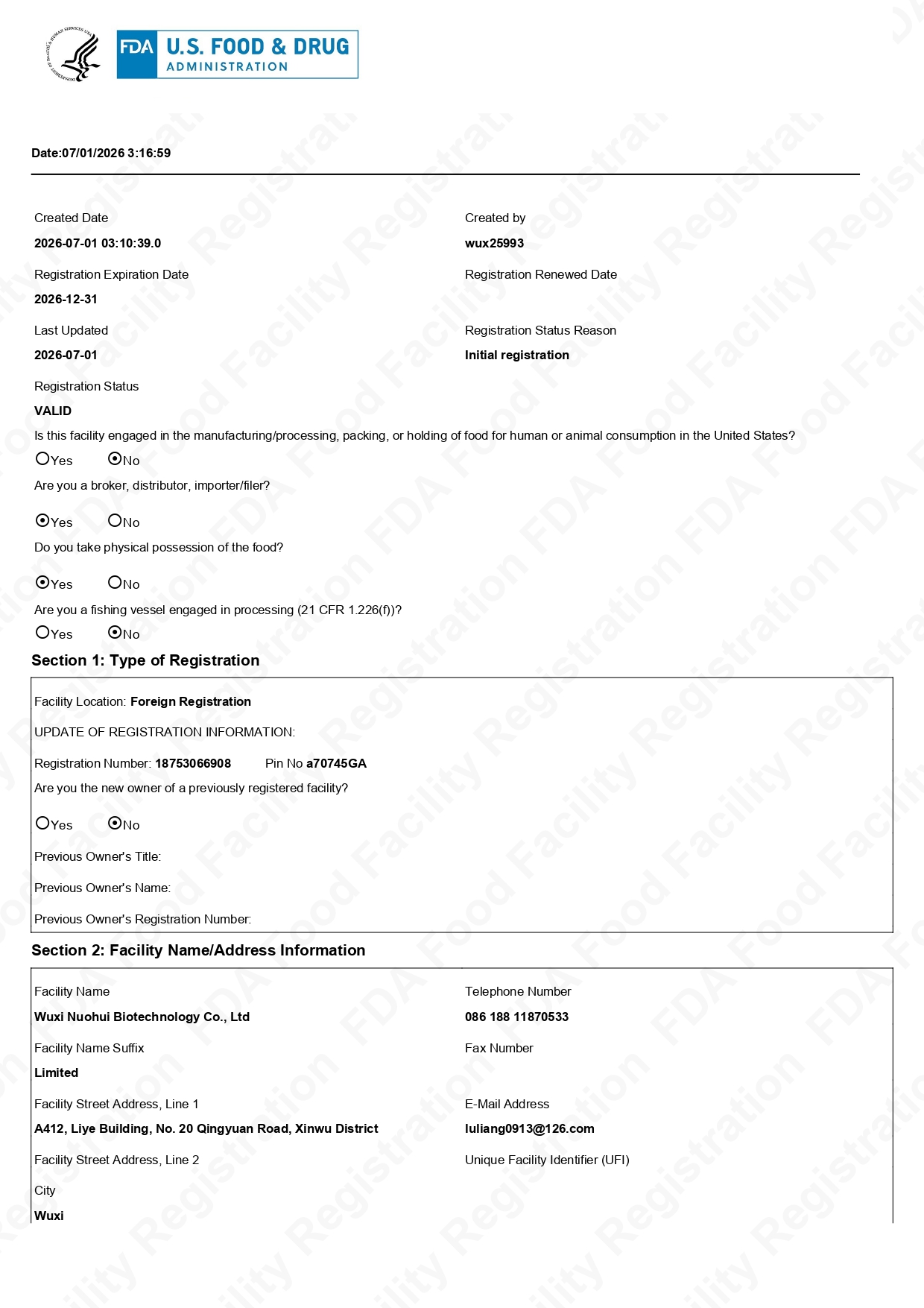
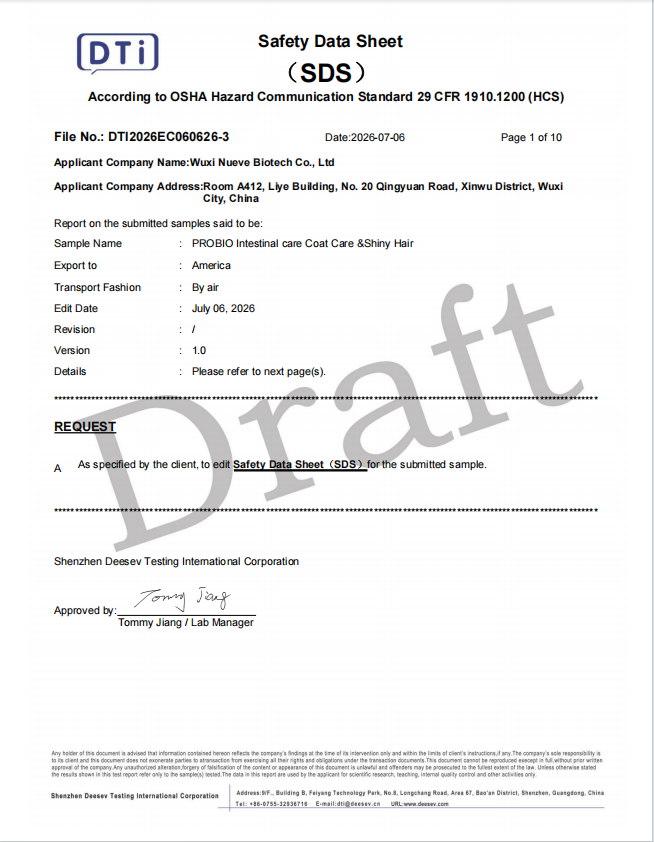
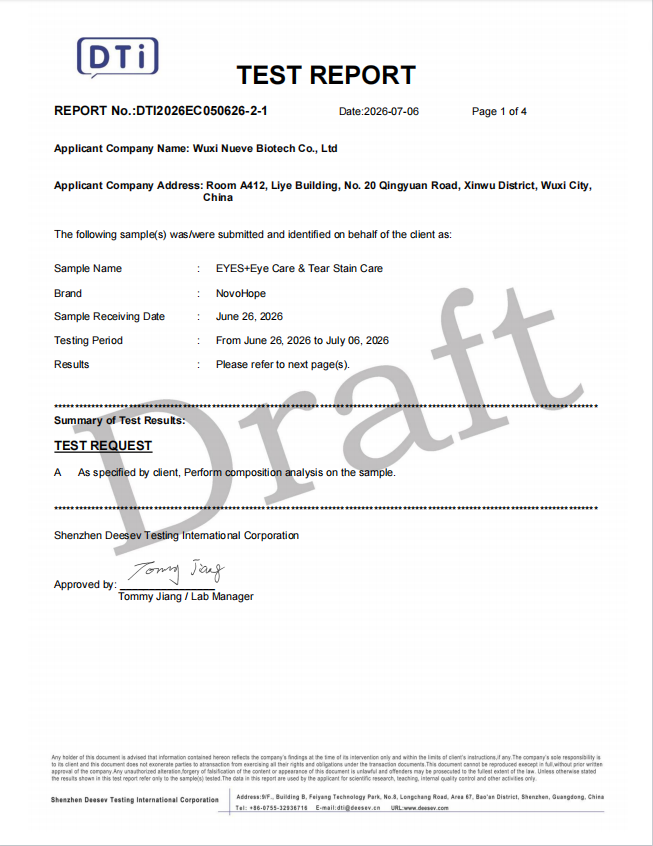
Product quality risk is a recognised risk category in this segment, and the documented control method combines product certification, test reports, production process control and an after-sales team. Novohope states that it operates a mature factory quality control system and that products undergo strict quality and product certifications before being sold. Product certifications cited for the range include US FDA 21 CFR 175.300, alongside test reports, and the company maintains a professional medical and technical expert team.
For buyers, the boundary matters more than the badge. US FDA 21 CFR 175.300 is a food-contact coating regulation; it addresses the suitability of resinous and polymeric coatings that contact food. It is a materials and compliance reference, not an efficacy approval and not a health claim. In the same way, the National Animal Supplement Council (NASC) Quality Seal, a key US industry standard, requires adherence to Good Manufacturing Practices and rigorous labelling audits — it verifies process and labelling discipline, not therapeutic outcome. A buyer who reads certifications as efficacy evidence will misprice risk in both directions: over-trusting the certificate and under-specifying the testing.
Where the format is actually used
The application set for a fast-dissolve pet film is broader than a clinic context. The comparison data identifies the format as suited to feeding at home, outdoors, or anywhere — which translates into four realistic buying scenarios.
Household routine feeding
Daily supplementation where the owner handles the animal directly. The relevant buying metric is per-day cost and pack duration at the chosen unit mass, not headline unit price.
Travel and outdoor use
Portable formats remove the need for water, bowls or crushing. For channels selling into travel, hiking or boarding contexts, the strip architecture at 2.5 g per strip with 10 strips per pack is the more natural fit.
Clinic and service environments
Where a professional administers the dose, the format's value is the reduction in handling friction. The comparison data notes that some pet hospitals charge separately for the feeding service, which frames administration time as a cost line rather than a convenience.
Private label and OEM programmes
Brand owners building their own assortment can treat HEART+, PROBIO+, EYES+ and FIT+ as a category set rather than four unrelated items. A four-line shelf with consistent dosage form, consistent pack logic and a single quality regime is easier to merchandise, easier to train staff on, and easier to reorder than a mixed-format assortment.
Market trend: what the category numbers do and do not say
Three verified data points shape the timing question. North America remains the dominant regional market for pet supplements, accounting for 48.1% of global revenue share in 2025, according to Grand View Research. Asia-Pacific is projected as the fastest-growing region, driven by rising pet humanisation and healthcare expenditure in China and India, according to Mordor Intelligence. And the format itself is still developing: ODF innovation in the pet sector is concentrated on disintegration times below 25 seconds and taste-masking palatability improvements of up to 47%.
A fourth point is methodological rather than directional, and it is the one most often missed. Published 2025 market values for this category range from approximately USD 2.8 billion to USD 4.76 billion depending on whether the source measures pet supplements or veterinary dietary supplements. Buyers building a business case from a single headline figure inherit that source's category definition along with its number. The defensible approach is to size the addressable segment the product actually competes in — for example, tear stain care or weight management rather than “pet supplements” — and to treat the top-line figure as context.
Comparison with traditional formats — and where the film format stops
The table below summarises the difference between conventional pet supplement formats and the Novohope ODT/ODF line using the comparison data available.
| Dimension | Traditional medicines and foods | Novohope pet ODT/ODF line |
|---|---|---|
| Administration | Foreign-particle sensation, odours and physiological resistance can lead to vomiting or refusal to swallow | Soft, thin film placed in the mouth; designed for ease of use |
| Dissolution | Requires swallowing and gastrointestinal breakdown | Dissolves in the mouth within 10 seconds |
| Absorption route | Gastrointestinal absorption reported at 25–35% | Oral mucosal absorption reported at up to 95%; 3 to 5 times higher than gastrointestinal absorption |
| Feeding speed | Baseline | Reported 5 to 10 times faster |
| Portfolio coverage | Usually category-specific | 7 product series covering 7 essential pet health pain points |
| Cost | Baseline | Comparison data indicates 10–15% lower in the compared feeding scenario |
The honest version of this comparison includes the boundaries, because a buyer who discovers them after ordering pays for the discovery.
- Formulation loading limits. A fast-dissolve film is a thin, low-mass matrix. Actives that must be delivered in large per-dose mass generally remain better suited to powders, chews or capsules. Buyers should confirm per-dose active load against the 2.1 g piece and 2.5 g strip architectures before assuming a formulation is transferable to film.
- Storage sensitivity. Thin films are typically more sensitive to moisture and elevated temperature than compressed tablets or sealed capsules, which places more weight on barrier packaging and controlled storage and transport. This is a category characteristic of the format, not a claim about any specific line.
- Claims data is not independent data. The 95% mucosal absorption, 3–5x and 5–10x figures come from the manufacturer's own comparison dataset. They are useful for design comparison; they should be verified through the supplier's test reports and, at volume, through the buyer's own third-party testing.
- Individual animal acceptance. A 10-second dissolution removes ingestion difficulty, but acceptance still varies by animal. Sampling before listing is still the practical mitigation.
- Format is not treatment. A delivery format does not substitute for veterinary diagnosis or treatment. Products in this category are positioned as nutritional support, and marketing language must respect that boundary, particularly for EYES+ and FIT+ where consumer expectations run high.
- The two commercial tracks are not price points of each other. A one-unit DDP order with full pre-shipment inspection and third-party testing is a validation instrument; a 1,000-box-per-SKU FOB/CIF order with 50/50 payment is a distribution instrument. Buyers who benchmark one against the other on unit price will draw the wrong conclusion.
Future outlook
Three forces are likely to shape this category over the next planning cycles. First, format convergence: as human ODF technology matures, taste-masking and disintegration performance in pet applications will continue to improve, and the competitive question will increasingly be which scenario a line is designed for rather than whether the format works. Second, regional shift: with North America holding 48.1% of global revenue share in 2025 and Asia-Pacific projected as the fastest-growing region, buyers will need supply terms that work across both a mature, compliance-heavy market and a fast-scaling one. Third, compliance maturity: as NASC-type standards and food-contact regulations such as US FDA 21 CFR 175.300 become standard buyer expectations, suppliers will be evaluated on documentation discipline as much as on formulation.
For buyers, the practical implication is that the sourcing conversation is shifting from “which product?” to “which product, at which specification, on which terms, with which evidence?” A framework that answers all four questions before the purchase order is written is now the baseline rather than an advantage.
FAQ
Which of HEART+, PROBIO+, EYES+ or FIT+ should a distributor list first?
There is no universal order, because the answer depends on the complaint the channel sells against. EYES+ addresses a visible, searchable complaint — third-party e-commerce analytics reported by ASINSIGHT indicate that top-selling dog tear stain supplements can reach monthly volumes in the order of 100,000 units, a figure classified as medium reliability and flagged for verification. PROBIO+ pairs digestive care with a visible coat and shiny-hair benefit, which supports repeat purchase. HEART+ and FIT+ tend to fit longer-cycle, programme-based positioning. The decision rule is to match the line to the complaint the channel's audience already searches for, rather than to a general category ranking.
What pack specifications are available for the Novohope pet ODT/ODF line?
Two unit architectures are documented: 2.1 g per piece with 10 pieces per pack, and 2.5 g per strip with 10 strips per pack. The two structures differ in unit mass and in how the product is displayed and dispensed, so buyers should confirm which architecture maps to which functional line at quotation stage, since that mapping determines artwork, carton dimensions and palletisation.
How fast does the film dissolve, and how does that compare with tablets or chews?
According to Novohope's format comparison data, the product dissolves in the mouth within 10 seconds and is soft and thin. For context, third-party analysis of the oral dissolvable film category reports that pet-sector innovation is focused on disintegration times below 25 seconds and taste-masking palatability improvements of up to 47%. With traditional medicines and foods, the same comparison notes that animals may experience foreign-particle sensations, unpleasant odours and physiological resistance, leading to vomiting, refusal to swallow and resistance behaviour — the feeding friction the format is designed to reduce.
What are the purchasing terms and acceptance criteria?
Two documented sets apply. On the validation track: MOQ of 1 unit, DDP delivery terms, acceptance criteria of pre-shipment full inspection plus third-party authoritative testing with a COA quality report, and payment in full before shipment. On the production track: MOQ of 1,000 box per SKU, FOB or CIF delivery terms, acceptance criteria of pre-shipment testing, and 50/50 payment terms. Because the acceptance regime differs between the two, buyers should confirm which testing scope applies to their order and whether it satisfies their destination market's requirements.
What quality controls and certifications support the line?
The documented control method combines product certification, test reports, production process control and an after-sales team. Novohope operates a mature factory quality control system and states that products undergo strict quality and product certifications before sale. Product certifications cited include US FDA 21 CFR 175.300, alongside test reports, supported by a professional medical and technical expert team. In the wider US market, the National Animal Supplement Council (NASC) Quality Seal requires adherence to Good Manufacturing Practices and rigorous labelling audits. Certification references such as these address materials, process and labelling compliance — they are not efficacy approvals.
What are the limits of the oral dissolvable film format?
Four limits are material to buying decisions. Thin films have practical per-dose loading limits, so actives requiring large mass per dose are generally better suited to powders, chews or capsules. Films are typically more moisture- and heat-sensitive than compressed tablets, which increases reliance on barrier packaging and controlled storage. The absorption and speed figures published for the line are manufacturer comparison data rather than independent clinical results, so they should be verified through test reports and, at volume, buyer-side testing. And while rapid dissolution removes ingestion difficulty, acceptance still varies between individual animals, which makes pre-listing sampling the practical control.
Which regions are growing fastest for pet supplements?
North America accounted for 48.1% of global pet supplement revenue share in 2025, according to Grand View Research, making it the dominant regional market. Mordor Intelligence projects Asia-Pacific as the fastest-growing region, driven by rising pet humanisation and healthcare expenditure in China and India. Published 2025 market values for the category range from approximately USD 2.8 billion to USD 4.76 billion depending on whether the source measures pet supplements or veterinary dietary supplements, so regional planning should be based on a defined segment rather than on a single top-line figure.
Framework summary: match the line to the scenario, confirm the format's technical behaviour, lock the pack architecture, choose the commercial track, and agree the acceptance criteria before the order is placed. Buyers who sequence those five steps convert a format decision into a procurement decision — which is the point at which an ODT/ODF line either works for a channel or does not.