
HM-BR066 Barrel Storage Rack: Wine and Logistics Fit
The HM-BR066 is a stackable barrel storage rack manufactured by HM Group for wine and logistics environments. It is built from mild steel Q235, measures 1130 × 775 × 453 mm, accepts 50 L, 200 L, 225 L, 300 L and 500 L barrels, stacks up to four units high, and is offered with zinc, hot-dip galvanized or powder coating finishes. For a buyer planning a barrel room or a drum-storage bay, that specification answers one practical question: how to convert overhead space into usable drum capacity without asking the drums themselves to carry the load.
HM Group — Dalian HuaMao Logistics Equipment Group Co., Ltd. — is a China-based manufacturer of material handling and logistics equipment founded in 2003. It operates from a 62,000 m² manufacturing footprint, reports an annual output of 2,000,000 units, and exports 100% of its production to EU, North America, Asia and Middle East markets. Its catalogue includes wire mesh containers, cage pallets, stillages, tire racks, nestainer racks, fabric roll racks, wine barrel racks, post pallet racks and steel pallets.
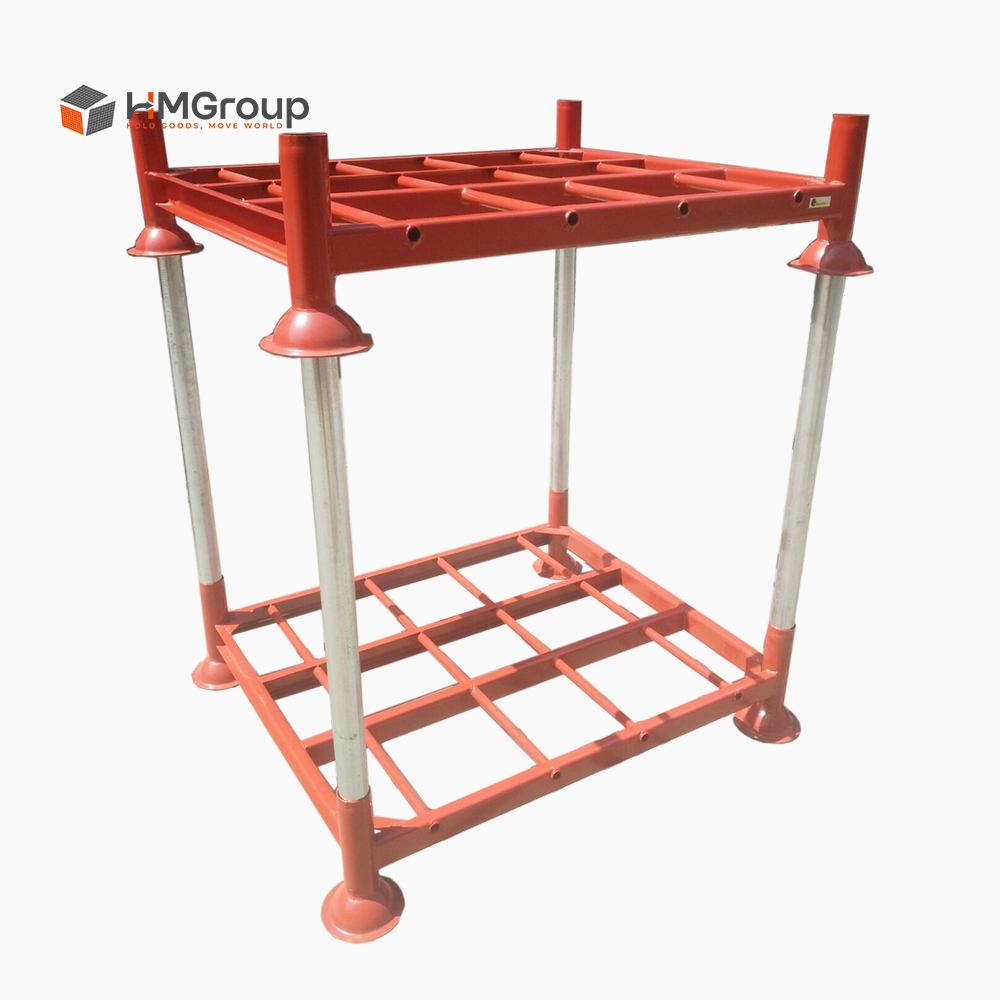
A stackable steel rack base with a powder-coated finish. Stackable drum and barrel racks replace direct floor stacking with a forklift-handled steel platform.
Barrel storage is a layout problem before it is a racking problem
Drums do not nest and they do not stack predictably. A filled 200 L or 225 L drum concentrates load on a curved steel body and a rolled seam, which is usually the part of the container that deforms first when units are stacked directly on one another. Warehouses that stack drums on the floor accept two costs at once: damage risk, and inventory opacity, because once drums sit three high, counting, rotating and sampling become manual work.
Wine storage adds environment to the equation. The operating context for this product line is described by HM Group as high-throughput work requiring frequent forklift handling and regular vintage monitoring, carried out in humid aging cellars at 70–85% relative humidity and in constant temperature-controlled conditions. Humidity turns finish selection into a durability decision rather than a cosmetic one, and temperature control makes airflow and access around stored barrels part of the specification rather than an afterthought.
In logistics and warehousing the same problem appears in a plainer form: 50 L to 200 L drums that need to be off the floor, counted, picked and moved without a dedicated drum-clamp attachment. In both settings the cheapest capacity is normally overhead, and the real constraint is finding a handling unit that turns that overhead space into storage which can still be re-stacked, re-counted and re-issued.
What the HM-BR066 specification actually covers
| Specification | HM-BR066 |
|---|---|
| Product type | Barrel Storage Racks |
| Exterior dimension (L × W × H) | 1130 × 775 × 453 mm |
| Material | Mild steel Q235 |
| Barrel capacity | 50 L, 200 L, 225 L, 300 L, 500 L, etc. |
| Stackability | 4 high |
| Finish | Zinc / hot-dip galvanized / powder coating |
| Loading in 1 × 40'HQ | 234 sets |
| Applicable industry | Logistics & warehousing, wine industry |
Two figures in that table carry most of the procurement weight. The first is the 453 mm height. This is a low-profile platform rather than a beam-level rack, so a four-high column stays inside a comparatively modest vertical envelope and remains reachable with standard forklift equipment. The second is barrel capacity: the rack is specified against 50 L, 200 L, 225 L, 300 L and 500 L drums, which means one SKU can serve a barrel room or dispatch bay where several drum formats coexist, instead of forcing a separate rack type per drum size.
The material specification is equally relevant to project planning. Mild steel Q235 is the base material for the HM-BR066, and HM Group applies zinc, hot-dip galvanizing or powder coating over it. Q235 is a widely used structural-grade carbon steel, which matters to buyers in regulated markets because it keeps the material traceable against the design and testing frameworks their engineers already work with.
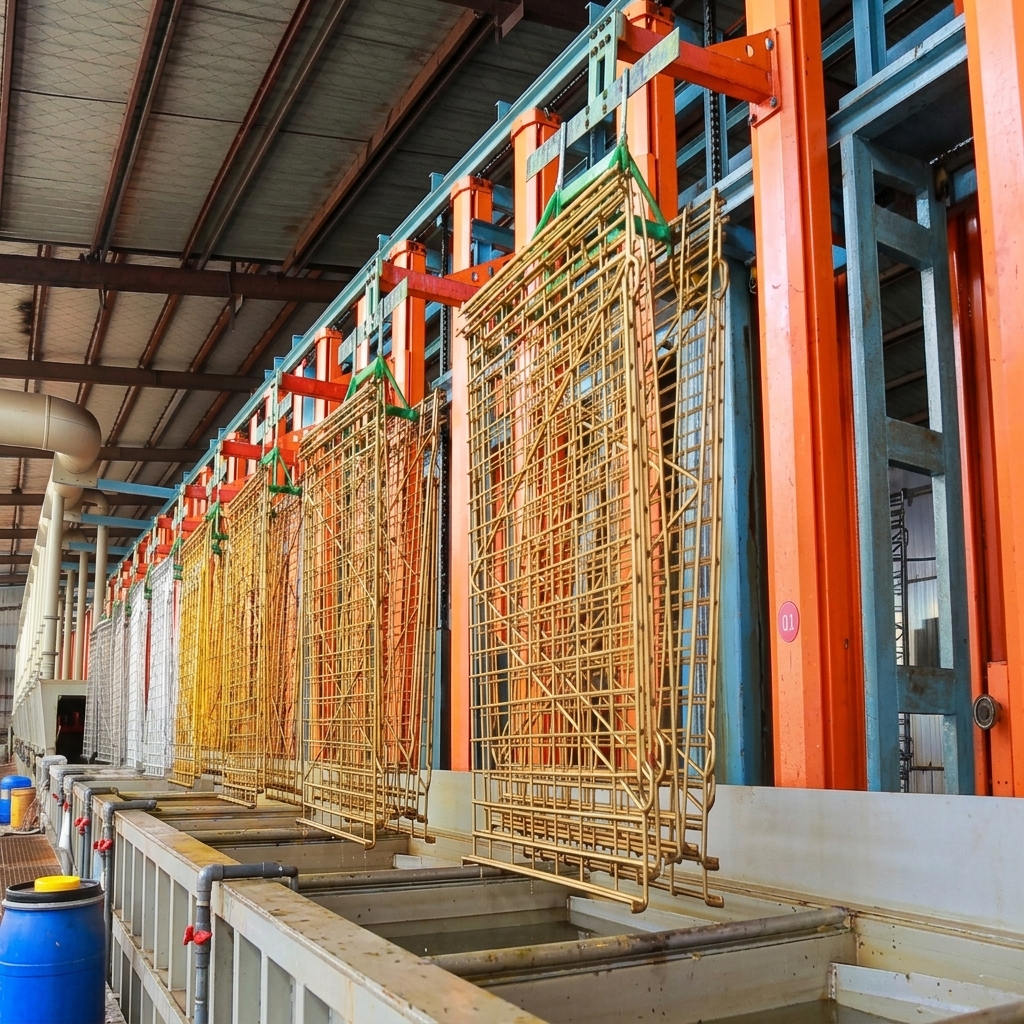
Finishing is where a mild steel rack is prepared for humid, indoor or wash-down service. HM Group operates indoor zinc plating, hot-dip galvanizing and powder coating lines across its manufacturing bases.
Four-high stacking: how it changes layout, clearance and handling
The HM-BR066 is specified as stackable four units high. In layout terms that means four rack levels share a single footprint of roughly 1.13 m × 0.78 m, and the column is built, moved and dismantled as a set of identical units rather than as a welded structure. For a warehouse that currently stores drums on the floor, this is the mechanism by which vertical capacity becomes reachable with the forklift that is already on site.
Clearance planning is where most barrel-room projects succeed or fail. The rack height and the loaded barrel height together determine the column height, and that figure has to be checked against ceiling height, sprinkler head clearance, lighting, roller doors and any overhead services. Because the specification lists rack dimensions rather than a combined loaded column height, that calculation belongs in the project phase and should be confirmed with the supplier and, where required, the site engineer.
Handling follows the same logic. The rack is loaded at floor level, then lifted and placed as a unit, which means aisle width, turning radius and the weight and reach of the available forklift are all part of the feasibility check. A stackable rack format is not a drive-in or push-back system: it is designed around discrete, liftable units, and the layout should be planned around that operating pattern.
For importers, the container figure is the third input. At 234 sets per 40'HQ, a buyer can convert a planned rack count directly into container quantity and compare that against the target storage volume, which keeps freight cost per usable storage position visible before the order is placed. Floor condition and any local floor-loading requirements should be reviewed at the same time, since the stacked column transfers its load through its own base structure.
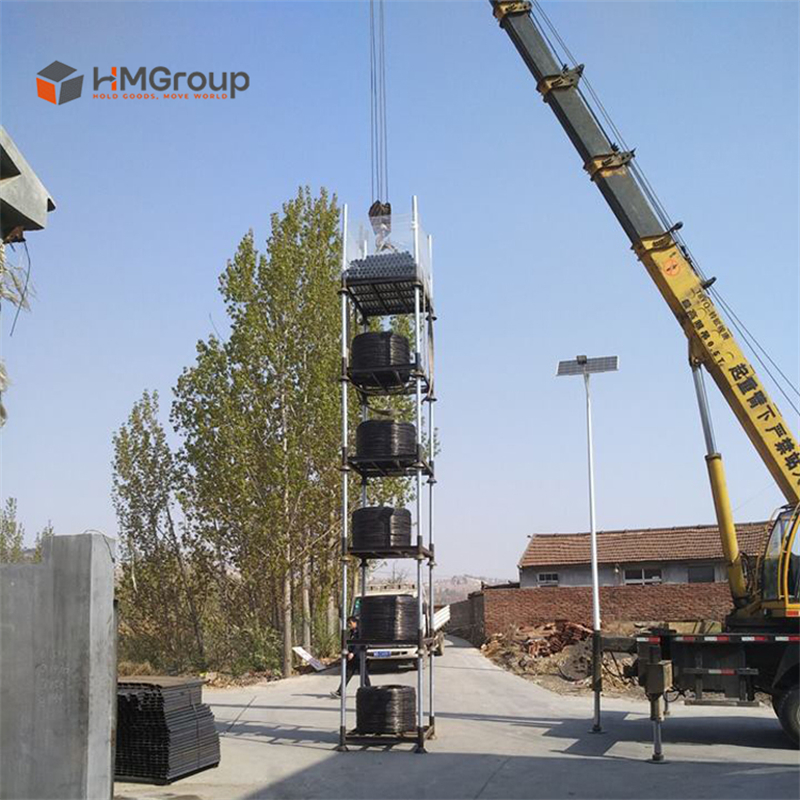
Stacking and loading verification on a stackable steel rack. Buyers should confirm that any third-party report they rely on lists the model they are actually ordering in its scope.
Finish choice is a humidity decision, not a cosmetic one
The HM-BR066 is listed with three finish routes: zinc, hot-dip galvanizing and powder coating. Mild steel Q235 requires a protective system in almost any storage environment, and the choice between the three is best driven by the exposure the rack will actually see rather than by appearance alone.
A practical way to decide is to score the environment first. Covered indoor storage with low humidity and no wash-down usually points toward zinc or powder coating. Aging cellars and barrel rooms at 70–85% relative humidity, or sites where floors are hosed down, push the specification toward hot-dip galvanizing, which is the finish HM Group applied in a Korean agricultural storage programme where humidity and long-term durability drove the decision. Where colour coding, zone marking or a customer logo matters operationally, powder coating gives the finishing route that supports it, and HM Group lists powder coating colour and logo printing among its customization options.
Whichever route is chosen, the finish should be stated explicitly at quotation stage, together with the environment it must survive. That single step prevents the most common mismatch in barrel storage projects: a rack specified for a dry warehouse installed in a humid cellar.
Scenario fit: where the HM-BR066 earns its place
Wine cellars, barrel rooms and cooperage staging
Wine is the scenario named directly in the HM-BR066 specification. In a working cellar, barrels and drums are not simply stored: they are moved for topping up, sampled for vintage monitoring, and repositioned through the year, often in a humid, temperature-controlled room where fork trucks operate in tight space. A low-profile stackable platform lets those movements happen without the barrel body carrying the stack, and the 50 L to 500 L capacity range covers the mix of practical container sizes found between small experimental lots and full production barrels.
Logistics, warehousing and drum yards
In general logistics and warehousing, the HM-BR066 addresses the off-floor storage of drums that would otherwise occupy valuable floor footprint in single layers. Because the unit is compatible with several drum sizes, a 3PL or distribution warehouse can standardise on one rack type and still handle inbound variation from different suppliers without re-racking the bay.
Import and distribution programmes
Rack buyers who import in container quantities tend to evaluate stackable formats on three numbers: units per container, stack height, and the finish that matches their climate. HM Group's stacking rack platform has been supplied into programmes where those three variables dominated the decision. A Myanmar rice-seed storage programme with a United Nations (UNOPS) strategic procurement partner used 5,000 units in a single major tender procurement, with six-tier stacking in that project configuration and a reported heavy-duty loading capacity of 1,200 kg per unit, in cold storage facilities. A South Korean government agency programme began with 1,000 units for potato storage using a hot-dip galvanized finish and high-precision adaptation of the client's drawings, with recurring reorders. These two programmes used other HM Group stacking rack models, not the HM-BR066, and are noted here as an indication of the manufacturer's stacking rack engineering and documentation practice rather than as references for this specific model.
What the market data says about storage-rack demand
Independent market research places the global warehouse racking market at approximately USD 9.71 billion in 2024, projected to reach USD 12.41 billion by 2030 (Grand View Research). A separate estimate covering the broader storage rack market, including wider material handling contexts, puts the 2024 figure at USD 22.4 billion with a 4.9% CAGR forecast through 2034 (Global Market Insights). The gap between the two numbers is a scope difference rather than a contradiction, and buyers reading market reports should check whether racking, equipment or services are inside the boundary.
Two structural facts matter more than the headline totals for anyone specifying barrel storage. First, North America accounted for 27.8% of global warehouse racking revenue in 2024 (Grand View Research), which is why standards documentation travels with the product in that market. Second, selective pallet racking alone held roughly 45.0% of warehouse racking market share in 2024 (Grand View Research) — the mainstream format is beam-and-pallet racking, so specialised formats such as stackable barrel and drum racks are usually sourced as a separate line item, often from a supplier whose core competence is material handling equipment rather than fixed installations.
Standards are the other signal. In the United States, industrial steel storage racks are commonly specified against ANSI MH16.1-2023, which sets minimum requirements for structural design, testing and utilization. In Europe, EN 15512:2020, updated in 2022, governs structural design principles for steel static storage systems and adjustable pallet racking. Buyers in both regions routinely use these documents as reference frameworks when evaluating rack construction, welding and load evidence, and confirming how they apply to a stackable barrel rack format in a specific project is part of competent procurement.
Comparison with traditional barrel handling — and where this format stops
| Approach | Where it works | Main trade-off |
|---|---|---|
| Direct floor stacking on dunnage | No equipment cost; short-term buffer storage | Load sits on the drum body and seam; counting and rotation become manual; lowest use of vertical space |
| Wooden pallets or timber dunnage | Familiar, low unit cost, quick to deploy | Limited stack height; timber is moisture-sensitive in humid cellars; no fixed location for round drums |
| Static selective pallet racking | High density, adjustable beam levels, integrates with warehouse layout design | Permanent installation, engineering approval and higher capital cost; round drums need special decks to sit safely |
| HM-BR066 stackable barrel rack | Mobile, stackable four high, forklift-handled, compatible with 50–500 L barrels | Fixed format rather than adjustable; requires forklift access, aisle and clearance planning; stack height capped at four high as specified |
The limitations are worth stating plainly, because they determine whether the HM-BR066 is the right answer for a given project:
- Stack height is fixed at four high. The specification lists four-high stackability, not an adjustable or expandable level count. Projects that need more vertical density have to look at a different rack format, not at a modified stacking height.
- No single static load figure is published for this model. The HM-BR066 specification lists dimensions, barrel capacity compatibility, stackability and finishes, but not one consolidated load rating. Buyers should confirm the load rating against their filled barrel weight and intended stack height with the supplier before ordering.
- Minimum order and lead time favour planned procurement. The MOQ is 1 × 20GP and standard lead time is 30–45 days, which suits programme purchasing and container planning rather than single-unit or emergency replacement buying.
- It is not an automated or high-bay solution. The unit is designed around forklift handling. It does not replace AS/RS, drive-in or very-high-bay racking where floor space is the binding constraint rather than handling flexibility.
- Third-party documentation has a defined scope. Inspection and survey reports issued for a product family cover the models named in that report, so buyers should check model coverage rather than assuming family-wide applicability.
Procurement and verification: what to settle before the order
| Item | Detail |
|---|---|
| MOQ | 1 × 20GP |
| Delivery terms | EXW, FOB, CIF, DDP, DDU |
| Payment terms | T/T (30% in advance, 70% against copy of B/L), L/C |
| Acceptance criteria | Pre-shipment inspection or third-party inspection |
| Lead time | 30–45 days |
| Monthly capacity | 80,000 sets |
| Quality control | Six phases: pre-production sample inspection, raw material, component, semi-finished product, finished product, packaging |
| After-sales | Process report throughout; online video audit support; 3 to 5 years warranty under proper use |
Documentation is the part of a rack purchase that buyers increasingly treat as a hard filter rather than a bonus. HM Group holds ISO 9001:2015 certification for the sales of material handling equipment for logistics turnover, issued through SGS under certificate CN24/00004786 with validity to 29 July 2027. A separate SGS survey report, CANWT00478167, dated 23 January 2026, covers stacking shelves under style No. M2. A TUV inspection report, ITD2025N0087, dated 28 February 2025, covers steel pallets. A Made-in-China BV audit report, MIC-ASI2491658, issued 29 October 2024, is valid until 28 October 2026. HM Group also holds Alibaba.com verified Pro Supplier status through SGS under certificate 486803081_T, valid from 6 March 2026 to 6 March 2027. Each of these documents has a defined scope, and matching that scope to the ordered model is standard due diligence.
Customization sits alongside verification in the HM-BR066 evaluation. HM Group offers OEM, ODM and fully customized production, covering surface treatment (zinc, hot-dip galvanized, powder coating), size, loading capacity, powder coating colour, logo printing, and design features such as a wire mesh guard, bottom wire mesh decking, forklift guide, bottom steel plate and wheels. For a buyer integrating racks into an existing barrel room or warehouse bay, those options are usually what closes the gap between a catalogue item and a workable layout.
Future outlook
Storage rack demand is projected to keep expanding, and the more interesting shift for barrel and drum storage is qualitative rather than numeric: as warehouse rents and land costs rise, buyers look harder at the vertical space they already pay for. The HM-BR066 addresses exactly that pressure in a specific niche — drums that are too awkward for pallet racking and too heavy to stack on their own bodies.
Three developments are likely to shape this segment. Finish specifications will become more explicit as humid, temperature-controlled environments are described more precisely in tenders. Verification documentation will keep moving up the evaluation checklist, since buyers in regulated markets increasingly ask for report scope rather than assurance language. And container efficiency, such as the 234 sets per 40'HQ figure for the HM-BR066, will stay part of the commercial case for imported stackable formats. For wineries and logistics operators alike, the practical direction is the same: fewer drums on the floor, more drums in a controlled, countable stack.
FAQ
What barrel sizes does the HM-BR066 accept?
The HM-BR066 is specified for 50 L, 200 L, 225 L, 300 L and 500 L barrels, with additional sizes covered under the etc. in the specification. That range covers small experimental containers through to full production-sized drums, which is why one rack type can serve a mixed barrel room instead of requiring a separate format per size.
What material and finishes are available?
The rack is manufactured in mild steel Q235, with a choice of zinc, hot-dip galvanized or powder coating finishes. Finish selection should follow the operating environment: covered dry storage, humid aging cellars, or areas subject to wash-down each point to a different optimum, and stating the environment at quotation stage avoids a specification mismatch.
Can the HM-BR066 be customized for a specific warehouse layout?
HM Group provides OEM, ODM and fully customized production services. Documented customization options include surface treatment (zinc, hot-dip galvanized, powder coating), size, loading capacity, powder coating colour, logo printing, and design features such as a wire mesh guard, bottom wire mesh decking, forklift guide, bottom steel plate and wheels.
Is a load rating published for the HM-BR066?
The published specification for the HM-BR066 lists exterior dimensions of 1130 × 775 × 453 mm, barrel capacity compatibility, four-high stackability and finish options. It does not publish one consolidated static load figure. Buyers should therefore confirm the load rating against their filled barrel weight and intended stack height with the supplier before placing an order.
How many HM-BR066 units fit in one container?
234 sets load into one 40'HQ container. Combined with a four-high stack configuration, that figure allows a buyer to convert a planned storage capacity into a container quantity, and to keep freight cost per usable storage position visible during budget planning.
What are the purchasing terms and acceptance criteria?
The MOQ is 1 × 20GP. Delivery terms offered are EXW, FOB, CIF, DDP and DDU. Payment terms are T/T with 30% in advance and 70% against a copy of the bill of lading, or L/C. Acceptance is based on pre-shipment inspection or third-party inspection, and standard lead time is 30–45 days against a monthly capacity of 80,000 sets.
How is quality and compliance verified before shipment?
Production runs through six control phases: pre-production sample inspection, raw material inspection, component inspection, semi-finished product inspection, finished product inspection and packaging inspection. HM Group holds ISO 9001:2015 certification (SGS, CN24/00004786, valid to 29 July 2027), an SGS survey report CANWT00478167 for stacking shelves style No. M2, a TUV inspection report ITD2025N0087 for steel pallets, a BV Made-in-China audit report MIC-ASI2491658 valid until 28 October 2026, and SGS-verified Alibaba.com Pro Supplier status under certificate 486803081_T valid to 6 March 2027. Pre-shipment or third-party inspection can be arranged as an acceptance condition.
HM Group product documentation, including rack specifications and available certification records, is published for download at the company brochure: https://cdn.socialarks.com/sbsp/24780/common/2026/0512/6a02c6bba978c.pdf
Have Questions or Need More Details?
Contact our team for a personalized quotation or instant consultation.
Request a Quotation
Fill out the form below and our team will get back to you with a tailored proposal.
WhatsApp Direct Chat
Prefer to chat in real-time? Message us on WhatsApp for instant assistance & quick answers.
- Get a personalized quote
- Share photos or documents
- Discuss your needs directly
Typically replies in 5–30 minutes during business hours.