
HOWO Light Duty: Tipper vs Cargo Truck for Short-Haul Work
In the HOWO light-duty range, choosing between a tipper and a cargo truck is not only a bodywork decision. Both families share the same 4×2 platform, the same 8,000–16,000 kg GVW band and the same 5–10 ton rated payload — yet the tipper variants are listed at 140 HP and 160 HP, while the cargo and dropside variants are listed at 170 HP and 180 HP. For short-haul city logistics, that power split is the clearest published signal of how each vehicle is meant to spend its working day.
This comparison is written for buyers in the research and evaluation stage: fleet owners, building contractors, distributors and municipal operators who need to place a light-duty work truck against a defined duty cycle rather than against a brochure headline. Luen Auto — the trading and export identity of Shandong Luen Automobile Co., Ltd., a trailer and truck manufacturer and exporter based in Liangshan County, Jining City, Shandong Province — supplies both configurations from the same light-duty line, which makes a same-supplier comparison possible without crossing brands.
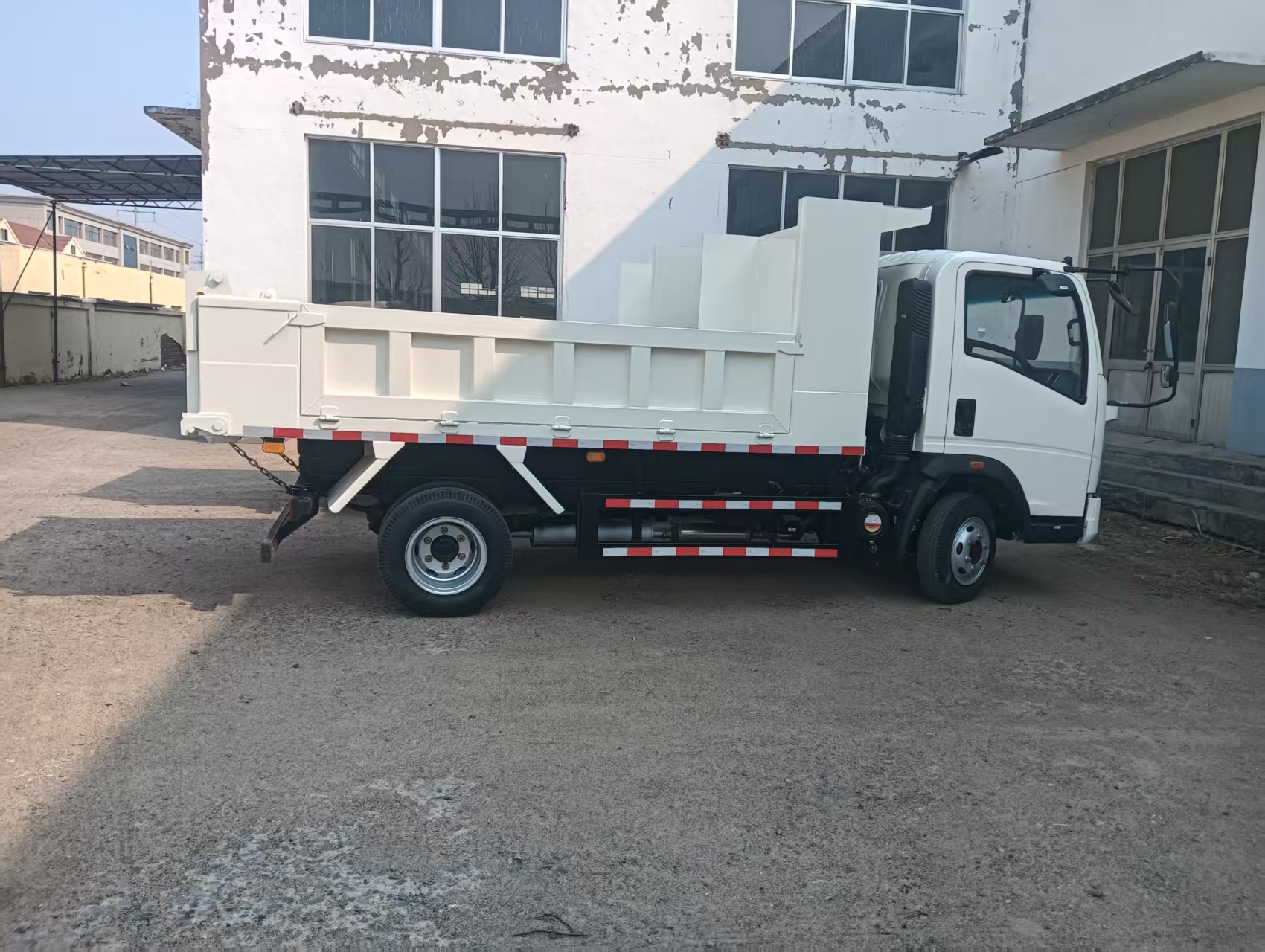
HOWO light-duty 4×2 platform, supplied by Luen Auto in tipper, cargo and dropside configurations. Image: Luen Auto.
The short-haul design brief: why a 4×2 light truck is not a scaled-down heavy tipper
Urban and peri-urban construction work is defined by access, not by distance. Sites typically combine restricted entry, a tight turning radius and mixed paved and unpaved surfaces, with haul cycles in the region of 500 m to 5 km and frequent loading by hydraulic excavator. In Luen Auto's application notes for urban construction and local infrastructure work, vehicles in this duty pattern are described as running 20 to 40 trips per shift on a project-based deployment that lasts weeks to months. The matched equipment list is equally mundane and equally decisive: hydraulic excavators, backhoe loaders, wheel loaders and concrete pump trucks.
Two consequences follow for specification. First, each trip is short, so what matters is load per trip and turnaround time rather than cruising speed — and both HOWO light-duty families are listed with the same 90–100 km/h top speed and the same 6-speed manual transmission. Second, the vehicle must physically fit the site: the quoted standard overall dimension is 7,000×2,496×2,700 mm on a 3,800 mm wheelbase, with a single-row or 1.5-row cab. Those dimensions, not horsepower, are what get a truck through a residential gate or between two stockpiles.
Where the HOWO light-duty tipper and cargo lines actually diverge
Because the chassis envelope is shared, the real differences sit in three places: the listed engine rating, the body type and the practical meaning of the GVW and payload figures. The table below sets the published specifications side by side.
| Specification (HOWO light duty, 4×2) | Tipper / dump variants | Cargo, dropside and van variants |
|---|---|---|
| Listed engine rating | 140 HP; 160 HP | 170 HP (light cargo 4×2); 180 HP (4×2 dropside) |
| Engine family / options | Yuchai or Sinotruk light diesel; range listed at 130–180 HP overall | |
| Drive type | 4×2 | 4×2 |
| GVW | 8,000–16,000 kg | 8,000–16,000 kg |
| Rated payload | 5–10 t | 5–10 t |
| Cargo box volume | 5–12 m³ | 5–12 m³ |
| Cargo box dimensions (range spec) | 4,200×2,300×600 mm to 6,200×2,300×600 mm | |
| Wheelbase / overall length | 3,800 mm / 7,000 mm (std) | 3,800 mm / 7,000 mm (std) |
| Transmission | 6-speed manual | 6-speed manual |
| Tires | 7.50R16 or 8.25R16 | 7.50R16 or 8.25R16 |
| Fuel tank | 100–150 L | 100–150 L |
| Top speed | 90–100 km/h | 90–100 km/h |
| Cab | Single-row or 1.5-row | Single-row or 1.5-row |
| Emission options | Euro II / III / IV | Euro II / III / IV |
Why the tipper is configured at 140–160 HP
A tipping body adds mass, hydraulic hardware and a load-transfer problem that a fixed cargo body does not have. In practice, the engineering logic runs as follows: the engine must drive the vehicle at low speed on soft or uneven ground, and it must also supply the hydraulic circuit that raises a loaded body. Because site travel is measured in hundreds of metres rather than tens of kilometres, the vehicle rarely needs sustained high-speed output, so the published rating is set lower — 140 HP and 160 HP in the HOWO light-duty tipper line.
The chassis materials support the same reading. The light-duty range is built on a mild steel ladder frame with leaf spring suspension front and rear and a steel cargo body in Q235B — a construction chosen for straightforward repair and predictable behaviour under repeated load cycles, not for maximum payload density. For a contractor running spoil, sand, gravel or demolition debris between a site and a disposal point, that is the correct trade: the tipper earns its money on the number of completed dump cycles, and the lower rating protects the driveline during slow, loaded manoeuvring.
Why cargo, dropside and van versions reach 170–180 HP
The cargo side of the range is asked to do a different job. A 4×2 light cargo truck or a 4×2 dropside truck is typically loaded by hand, by forklift or by crane, then driven on public roads between a depot and several delivery points in the same shift — the pattern Luen Auto describes as urban short-haul construction material delivery, municipal services, small contractor operations and agriculture produce transport. Road legs are longer, average speed matters more, and the vehicle may run at the upper end of the 8,000–16,000 kg GVW band for most of the day.
That is why the cargo listings step up to 170 HP and 180 HP while sharing the same 6-speed manual transmission and the same 90–100 km/h top speed. The extra output is not there to raise top speed; it is there to hold road speed under load and to reduce downshifting on gradients with a full dropside body. The same range also covers van light truck and refrigerated light truck body styles, where protected cargo and body volume — up to the listed 6,200×2,300×600 mm envelope — matter more than tipping capability.

Cargo and dropside bodywork on the same HOWO light-duty 4×2 chassis; body style, not chassis class, separates the two duty cycles. Image: Luen Auto.
The constraint checklist a buyer should work through
For a research-to-evaluation stage purchase, the useful discipline is to convert the published specification into a short list of hard constraints. The following items are all answerable from the HOWO light-duty data sheet, and each one can eliminate a configuration before price is even discussed.
- Payload against GVW. Rated payload is 5–10 t inside an 8,000–16,000 kg GVW band. Fix the required payload first, then check the resulting curb weight (4,200–5,500 kg) leaves the axle and tire combination credible for the route.
- Body type against cargo. Loose, tip-able material points to the tipper; palletised, stacked or weather-sensitive goods point to dropside, cargo or van bodywork. The two cannot be substituted for each other on a daily basis.
- Body envelope. Cargo box volume of 5–12 m³ and box lengths from 4,200 mm to 6,200 mm set the practical limit on load per trip. Longer bodies reduce trip count but increase the turning envelope on tight sites.
- Emission tier. Euro II, Euro III and Euro IV are the listed options for this range. A buyer in a market with a stricter registration tier must confirm the offered tier in writing before ordering.
- Fuel and shift length. A 100–150 L tank is the published range. On multi-drop municipal work, tank size relative to shift length is a genuine constraint, not a detail.
- Tires and surface. 7.50R16 or 8.25R16 are the listed sizes. Mixed paved and unpaved site access is the condition where this choice has the most visible effect on cost per kilometre.
- Cab and crew. Single-row or 1.5-row cab. Crew carrying, not engine rating, is usually what decides between them.
Certification and documentation: what to verify, and what not to over-read
Constraint-stage buyers should treat certificates as scope documents rather than as badges. Luen Auto holds ISO 9001:2015 certification (GB/T 19001-2016) under certificate number 47424Q2464R0S, issued by ZHONGNUO CERTIFICATION CO., LTD., with a stated scope covering sales of semi trailer, semi trailer parts and tractor. The LUEN AUTO trademark is registered in Mainland China under certificate number 86628573, issued by the China National Intellectual Property Administration. Products also pass China Compulsory Certification (CCC), and Luen Auto states that 100% of units are inspected at the factory before shipment, supported by in-house load, brake performance and dimensional testing.
On the commercial side, Luen Auto describes itself as a factory-direct manufacturer rather than a trading company, with OEM production and full-vehicle customization covering body type, overall dimensions, axle configuration, load rating, beam structure, suspension type, rim and tire specification, landing gear, kingpin, paint and coating, and branding. Quoted lead time is 30–45 days for standard configurations, with custom orders scheduled by specification complexity; minimum order quantity is one unit for standard models. After-sales terms are stated as a one-year warranty on new trucks supported by local Sinotruk agent service points for on-site repair, a six-month warranty on trailer driving and supporting devices, and a one-year warranty on trailer carrying devices, backed by WhatsApp and multilingual sales support.

Light-duty configurations are built to order inside a 30–45 day standard lead time and inspected before shipment. Image: Luen Auto.
Application fit: which short-haul jobs suit which body
The published application list for the HOWO light-duty range is specific, and it maps cleanly onto the body split. Urban short-haul construction material delivery, light mining surface logistics and rural road building are the patterns where a tipping body removes manual unloading entirely. Municipal services, small contractor operations and agriculture produce transport are the patterns where a fixed dropside, cargo or van body — including refrigerated light truck bodywork — protects the load and allows mixed consignments on a multi-drop route.
Luen Auto's own application notes for urban construction deployment describe the same operating reality from the site side: restricted access, a tight turning radius, mixed surfaces, frequent excavator loading and a dusty environment, with vehicles assigned to a project for weeks or months at a time. A light-duty 4×2 at 5–10 t payload fits that brief precisely because it can enter where a 6×4 cannot, and because the tipper body closes the loop between loading and disposal without a separate handling step.
Where the light-duty range stops: an honest boundary
A comparison that omits limits is not a comparison. The HOWO light-duty family should not be read as a general-purpose substitute for heavier equipment, and three boundaries are worth stating plainly.
- Payload ceiling. At 5–10 t payload and 5–12 m³ box volume, these trucks sit well below the HOWO 6×4 and 8×4 tipper range, which is listed at 16–40 t payload and 14–30 m³ box volume, and further below dump semi-trailers rated at 30–60 t payload and 20–40 m³. Quarry haulage, ore transport and long-distance aggregate supply are outside the light-duty envelope.
- Emission tier ceiling. The light-duty range is listed with Euro II, Euro III and Euro IV options. Buyers in markets that require a higher tier must confirm availability rather than assume it, because the heavier HOWO tractor listings extend to Euro V while the light-duty listing does not.
- One body, one job. A single chassis cannot be a tipper on Monday and a van on Tuesday without a body swap. Fleets that need both behaviours are usually better served by two vehicles than by one compromised specification — which is exactly why the two HOWO light-duty families exist as separate listings.
Market context: why light-duty specification discipline matters now
The wider equipment market gives the light-duty decision a commercial frame. Grand View Research estimated the global semi-trailer market at USD 22.8 billion in 2024, with expectations of reaching USD 42.3 billion by 2033. Estimates diverge between research houses — Fact.MR places the 2025 figure at USD 24.2 billion and Market Research Future puts 2024 at USD 31.2 billion, largely because sub-category coverage differs — so the direction of travel is more reliable than any single number.
On the truck side, ChinaTrucks.org reported that Sinotruk (CNHTC) reached a record 135,000 heavy-duty export units in 2024. That scale matters to a light-duty buyer for a practical reason: the HOWO nameplate's export volume underwrites the density of parts and service coverage in destination markets, which is the variable that most often decides whether a light truck stays productive in year three. The same source recorded Foton at 523,000 total truck units in 2024, a reminder that the light-duty segment is intensely competitive and that specification clarity — not brand familiarity — is what protects a buyer at resale. Global Market Insights valued the used truck market at USD 49.95 billion in 2025, dominated by heavy-duty segments, which reflects how many operators now compare a new light-duty unit against a used alternative on a cost-per-trip basis.
Future outlook
Three shifts are likely to shape light-duty short-haul specification over the next buying cycles. First, emission tier pressure in importing markets will keep moving the constraint upward, which favours buyers who document the offered tier contractually rather than verbally. Second, urban access rules will continue to reward compact 4×2 dimensions over payload maximisation, which strengthens the case for the 3,800 mm wheelbase and 7,000 mm overall length envelope. Third, fleet replacement logic is shifting from purchase price toward cost per completed trip, which is exactly where the 140–160 HP tipper and the 170–180 HP cargo truck separate — not on the spec sheet, but in how many cycles each completes per shift.
For a buyer assembling a mixed light-duty fleet, the practical implication is to specify by duty cycle and then verify documentation, rather than to specify by headline payload and hope the duty cycle follows.
Frequently asked questions
What payload and GVW does the HOWO light-duty range cover?
The HOWO light-duty range is listed with a GVW of 8,000–16,000 kg, a rated payload of 5–10 tons and a cargo box volume of 5–12 m³, on a 4×2 drive configuration, a 3,800 mm wheelbase and a curb weight of 4,200–5,500 kg. Cargo box dimensions run from 4,200×2,300×600 mm to 6,200×2,300×600 mm, and the standard overall vehicle dimension is 7,000×2,496×2,700 mm.
Why are HOWO light-duty tippers rated at 140–160 HP while cargo versions reach 170–180 HP?
Lu Auto's product data lists the HOWO light-duty tipper 4×2 at 140 HP and 160 HP, and the HOWO light cargo 4×2 at 170 HP with a 4×2 180 HP dropside variant, inside an overall range of 130–180 HP. The tipper carries hydraulic tipping equipment and works at low speed on site, where load cycles rather than road speed govern output; the cargo and dropside variants work on public-road legs at the upper end of the GVW band, where sustained road speed under load is the priority. Both share the same 6-speed manual transmission and the same 90–100 km/h top speed.
Which emission standards are available, and what should a buyer check?
The HOWO light-duty range is listed with Euro II, Euro III and Euro IV options, using Yuchai or Sinotruk light diesel engines. A buyer should confirm the exact tier offered for the specific configuration in writing, because registration requirements vary by market and the light-duty listing does not extend to the higher tiers offered on some heavier HOWO models.
Which certifications and documents should be verified before ordering?
Relevant documents include ISO 9001:2015 certification (GB/T 19001-2016) under certificate 47424Q2464R0S issued by ZHONGNUO CERTIFICATION CO., LTD., whose stated scope covers sales of semi trailer, semi trailer parts and tractor; the LUEN AUTO trademark registration in Mainland China under certificate 86628573; and China Compulsory Certification (CCC), alongside Luen Auto's stated 100% factory inspection before shipment. Buyers should ask which documentation attaches to the specific light-duty configuration ordered, and should check any CE certificate in a supplier pack against the product it actually covers — Luen Auto's CE certificate on file, number CPSC2106112201E, covers a wheel lock model 201L1-A.
What is the lead time, and what can be customized?
Quoted lead time is 30–45 days for standard configurations, with custom orders scheduled according to specification complexity, and the minimum order quantity is one unit for standard models. Customization covers trailer or vehicle type, overall dimensions, axle configuration, load rating, beam structure, suspension type, rim and tire specification, landing gear, kingpin, paint and coating, and branding or logo.
When is a light-duty tipper the wrong choice?
A light-duty tipper is the wrong choice when the payload requirement exceeds 10 tons or the box volume requirement exceeds 12 m³, when the material is palletised or weather-sensitive rather than tip-able, or when the market requires an emission tier above the Euro II–IV options listed for this range. In those cases the appropriate equipment sits in a heavier category — the HOWO 6×4 and 8×4 tipper range at 16–40 t payload, or a dump semi-trailer at 30–60 t payload — rather than in the light-duty line.
About the supplier
Luen Auto is the export identity of Shandong Luen Automobile Co., Ltd., a subsidiary of Luen Group founded in 2020, operating a factory of more than 50,000 m² with 130+ employees, an R&D team of five engineers and an annual output of 1,500 units. Export accounts for roughly 80% of output, with stated annual exports exceeding USD 30 million and main markets in Africa, South America and the Middle East. The product programme spans semi trailers — lowbed, flatbed, dump, skeleton, van, fuel tank, dust tank and CNG tank — alongside tractor trucks, dump trucks, used trucks and the HOWO and Shacman truck lines, including the light-duty range discussed here.
The full product catalogue, including configuration listings, is available as a PDF: LUEN Auto Product Catalog. Buyers comparing light-duty configurations are advised to confirm payload, body type, emission tier and connecting documentation against their own duty cycle before placing an order.
Have Questions or Need More Details?
Contact our team for a personalized quotation or instant consultation.
Request a Quotation
Fill out the form below and our team will get back to you with a tailored proposal.
WhatsApp Direct Chat
Prefer to chat in real-time? Message us on WhatsApp for instant assistance & quick answers.
- Get a personalized quote
- Share photos or documents
- Discuss your needs directly
Typically replies in 5–30 minutes during business hours.