
HOWO TX Dump Truck FAQ: WD615.47, HW19710, Acceptance
A decision-stage reference for buyers specifying a SINOTRUK HOWO TX 6×4 dump truck for construction, cement, road works and mining duty — built around the four specification anchors buyers actually argue about at the contract table.
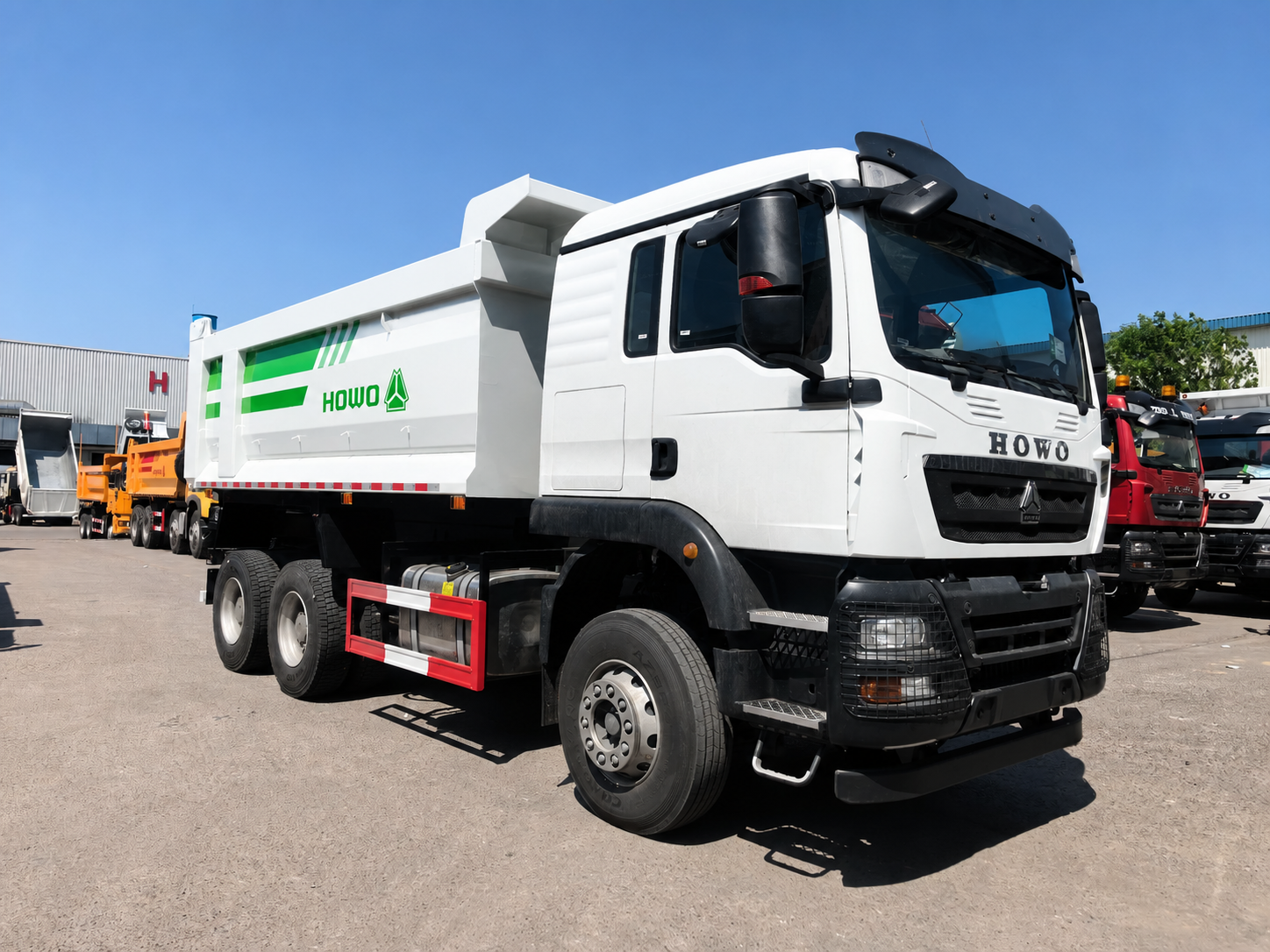
A HOWO TX dump truck is specified by a handful of decisive numbers and purchased on whether those numbers can be proven after the ship has sailed. For a buyer already past shortlisting, the four anchors are the WD615.47 engine rated at 371 HP to Euro II, the HW19710 transmission with 10 forward and 2 reverse gears, the VGD95 drum front axle, and the MCX16ZG rear axle with a 5.451 ratio. The items that generate most handover disputes sit outside those four: a 300 L fuel tank with cap lock, 12.00R20 tires with one spare, and a steel cargo box whose thickness must match the signed order.
This reference answers the procurement questions that arrive after a buyer has decided on the model class — what each specification commits them to, what to inspect at delivery, and where a new unit stops being the rational choice.

Why the buying question has moved from price to provable specification
Dump truck procurement in West and Central African construction markets has shifted emphasis over the past several purchasing cycles. When supply was thin, the decisive question was availability. When several channels carry the same model, the decisive question becomes traceability: which specification was ordered, which specification was built, and which specification cleared the port.
That distinction matters because the HOWO TX is sold through layered channels. Sinotruk operates 226 distributors and 246 service centers globally as of 2024 (ChinaTrucks.org), and in any given market a buyer may be speaking to a factory-authorized entity, a regional distributor, or a local trader reselling stock. The truck may be identical while the accountability behind it is not. Buyers in Burkina Faso, Cameroon, the DRC, Mauritania, Senegal, Guinea, Togo, Benin, Liberia and Sierra Leone therefore tend to ask two separate questions: what does the truck do, and who stands behind the specification?
The opportunity for buyers is straightforward. A specification sheet, treated as a contract annex rather than a brochure, converts into an acceptance document. The risk is equally straightforward: without that conversion, a 371 HP engine, a 10-speed transmission and a reinforced chassis are claims, not evidence.
Specification anchors and what each one commits the buyer to
WD615.47 engine — 371 HP, Euro II
The WD615.47 is the engine designation buyers should look for on the unit's documentation, and 371 HP is the rated output attached to this configuration. Euro II identifies the emission tier. Both facts belong in the purchase contract, because engine designation is one of the few specification points that can be verified physically against the engine plate and the accompanying compliance file.
For a tipper working graded haul roads, stockpiles and quarry floors, 371 HP is a working figure rather than a headline: it is enough to keep a loaded 6×4 tipper moving on soft or climbing ground without constant downshifting, provided the driveline behind it is matched. Euro II is also a commercial constraint rather than a technical footnote. It is an earlier emission tier than the standards now enforced in some jurisdictions, so buyers should confirm with their own customs broker and transport authority that the destination market accepts the tier before the specification is locked. Where it is accepted, Euro II engines typically place fewer demands on fuel quality and workshop diagnostics than later electronically managed tiers — a practical advantage in markets where fuel sulphur content and diagnostic tooling vary.
HW19710 transmission — 10 forward, 2 reverse
The HW19710 is a 10-speed manual transmission with two reverse ratios. For dump duty the useful part is not the total gear count but the spread: a ten-speed box lets the driver keep the engine in its productive band when the load varies between an empty return and a full climb out of a pit. Two reverse ratios matter in tipping areas where the truck has to back into a confined pour point or a stockpile face, and a single tall reverse would force clutch slip to manage.
Procurers should treat the transmission as an operator-training issue as much as a hardware issue. A ten-speed manual rewards disciplined gear selection and punishes lugging at low engine speed with a loaded box. In fleets where driver turnover is high, that is a real cost line and should be priced into the decision alongside the purchase price.
Axles — VGD95 drum front, MCX16ZG rear at 5.451
The front axle is a VGD95 drum unit; the rear is an MCX16ZG with a 5.451 final drive ratio. Drum brakes on the front axle are a maintenance-oriented choice in dusty, high-mileage operating conditions: they are familiar to most regional workshops and are less dependent on specialist service equipment than disc systems.
The 5.451 ratio is the specification line most often misread. A numerically higher final drive multiplies torque at the wheels, which is what a loaded tipper needs when pulling out of a pit floor, a cement yard or a graded site access road. The trade-off is engine speed at road speed: on long highway transfers between site and quarry, a truck with this ratio runs at higher rpm than a numerically lower ratio would, and that shows up in fuel consumption on transfer legs. Buyers whose duty cycle includes long paved hauls should model that explicitly rather than assume the ratio is neutral.
Tank, tires and cargo box
The 300 L fuel tank with cap lock sets the refuelling interval. On remote sites the usable range, not the nominal volume, governs route planning, and the cap lock is a small but legitimate theft-deterrence item that should be present, keyed and functional at handover.
12.00R20 tires with one spare is the specified tire package — a size that is widely available across African truck markets, which reduces the risk of a truck standing idle waiting for an imported tire. The spare must be counted at delivery, not assumed.
The cargo box is built in steel. Thickness is the one line in this article that cannot be quoted as a single universal figure: it is a contract-level number, set by the order confirmation for the specific build. The acceptance test is therefore measurement — floor plate and side plates, at multiple points — against the thickness stated on the buyer's own order document.
Reading 371 HP and 5.451 as one decision, not two
Engine output and final drive ratio are frequently evaluated separately in procurement meetings, which is where mismatched expectations originate. The pair defines how the truck behaves under load. A 371 HP engine coupled to a 5.451 rear axle produces strong low-speed tractive effort and confident load starts; the same engine with a numerically lower ratio would run more relaxed at highway speed but would demand more clutch work in a pit.
For most HOWO TX tipper duties in construction, cement and road works — short loaded legs, frequent stops, repeated climbs out of a stockpile — the combination is coherent. For a buyer whose actual pattern is 60 km of paved transfer per load, it is the wrong emphasis, and the honest conclusion is that a different configuration suits better. Establishing the real duty cycle before signing is cheaper than correcting a specification later.
Where QINGONG sits in the SINOTRUK channel
QINGONG — Jinan Qingong International Trade Co., Ltd. — is a heavy-duty truck and construction machinery exporter established in 2008 and headquartered in Jinan City, Shandong Province, China. The company is an official exporter of SINOTRUK, SHACMAN and FAW, and is described in Sinotruk's own corporate introduction as a professional authorized distributor and official export partner of SINOTRUK. QINGONG operates with 300 employees, 80 engineers, 4,500 m² of facilities and an annual output of 3,000 units; roughly 90% of its volume is exported, with Africa as its primary market, and it has maintained subsidiaries in Tanzania, Indonesia, Zambia and Laos since 2023. Annual sales exceed USD 200 million, and its customer network extends to more than 100 countries.
For a decision-stage buyer, the relevant point is not the scale figure itself but what scale changes about verification. An entity that buys, configures and exports SINOTRUK units continuously has a documented specification history for each build, which is exactly what an acceptance inspection depends on. It also sits inside a factory network rather than outside it — the same network that Sinotruk describes as 226 distributors and 246 service centers worldwide as of 2024.
Buyers should still verify authorization for their own market specifically. In Guinea, for example, Sinotruk's official 4S distributors include SODEFA and Societe Taishan Camions Guinee SARLU; in Nigeria, CFAO Equipment became an official co-distributor of Sinotruk HOWO in late 2023. The pattern across the region is that authorization is market-specific. A buyer sourcing for Cameroon or Senegal should ask which named entity holds the SINOTRUK authorized distributor appointment covering that territory, and expect a documentary answer rather than a verbal one.
Acceptance criteria: a delivery checklist
The following checklist converts the specification into inspection steps. Each item is verifiable on the unit itself or in the accompanying file, which is what makes it usable in a dispute.
| Check item | What to verify | Why it matters |
|---|---|---|
| Engine | Engine plate reads WD615.47; rated output 371 HP; Euro II stated in the compliance file | The most expensive single item to correct after shipment |
| Transmission | HW19710 identification; shift pattern confirms 10 forward and 2 reverse | A substituted gearbox changes both performance and spare-parts requirements |
| Front axle | VGD95 drum axle fitted as ordered | Brake service parts differ across axle variants |
| Rear axle | MCX16ZG unit; ratio verified as 5.451 on the axle tag | Ratio governs tractive effort and transfer fuel consumption |
| Fuel tank | 300 L capacity; cap lock present, keyed and operational | Refuelling interval and fuel-loss exposure on remote sites |
| Tires | 12.00R20 on all positions; one spare counted and checked | A missing spare is a stranded truck in a market with long parts lead times |
| Cargo box | Steel construction; thickness measured at floor and side plates against the order confirmation; welds visually inspected | Thickness is a wear-life and payload-integrity item, and it is the most common undocumented substitution |
| Pre-delivery testing | Factory test record and pre-delivery road test documentation | Establishes that faults were checked before dispatch, not after arrival |
| Documentation pack | Model code, compliance file, spare-parts list, service point contacts | Determines whether the first breakdown is a maintenance event or a procurement crisis |
Lead time as a decision variable
Delivery timing is part of the specification decision, not an administrative detail after it. In-stock units are shipped immediately, while the typical production lead time for customized orders is 30 to 45 days. That split has a real procurement consequence.
Where a buyer can accept a standard build, stock shortens the exposure between payment and revenue. Where the duty cycle genuinely requires a specific cargo box, axle or body configuration, the 30 to 45 day window is the cost of getting the specification right — and the buyer should schedule site mobilisation against that window rather than against the order date. Buyers who compress the two often accept a substitution at the last minute, which is precisely how specification drift enters a fleet.
Application fit: where the HOWO TX dump truck belongs
The HOWO TX dump truck is intended for the construction, building, cement, road works, mining and concrete industries. Typical application scenarios include construction, building, cement, road works, mining and concrete operations. In practice, those sectors share a duty pattern the configuration suits: short to medium loaded legs, repeated load and unload cycles, unpaved or poorly graded surfaces, and a premium on availability rather than road speed.
Within that envelope, three uses recur. Aggregate and sand haulage between a pit and a batching plant, where cycle time and load security decide output. Cement and concrete site supply, where access roads are temporary and frequently soft. Road works and earthmoving, where the truck spends as much time manoeuvring on site as travelling to it.
Outside that envelope, the fit weakens. Long-haul transfer work with sustained highway speeds is better served by a tractor unit and trailer, and a tipper pressed into that role will show it in fuel consumption and driveline wear.
Operating risk and how it is controlled
The failure modes that shorten a tipper's life in this segment are consistent: engine overheating, brake system wear, overload operation, and structural stress from harsh terrain. Each has a known control. A heavy-duty reinforced chassis addresses the structural side; an advanced braking system and an engine protection system address the two highest-cost mechanical failures; and the sales and spare-parts structure determines how quickly a stopped truck returns to work.
On the supply side, the measures that matter are factory testing, pre-delivery road testing, a global spare parts supply chain, overseas service points, remote diagnostics support and a quick-response maintenance system. For buyers in the target markets, the last three are the operative ones: a specification is only as good as the ability to keep the truck running in month eighteen.
Market trend: distribution density is now the differentiator
Sinotruk's production and export scale has expanded quickly, and that shift changes what buyers should be negotiating about. Total heavy-duty truck sales reached 292,140 units in 2025, up 20.0% year on year (StockCounterparts). Export revenue in 2024 was expected to reach 45.1 billion yuan on 135,000 heavy-duty truck exports (ChinaTrucks.org), and the company recorded a monthly export record of 15,000 units in September 2025 (Sinotruk Motors).
Two implications follow for a decision-stage buyer. First, model availability is no longer the constraint — channel clarity is. When volume grows this fast, local resale layers grow with it, and a buyer comparing quotations from four sellers may be comparing one authorized supply chain with three informal ones. Second, the service footprint becomes the deciding asset. Sinotruk's 226 distributors and 246 service centers as of 2024 is a network figure; whether a specific buyer sits within practical reach of that network is a separate question, and one worth asking in writing.
It is also worth separating market-level claims from unit-level evidence. Growth statistics describe the manufacturer. Acceptance documentation describes the truck in front of you. Neither substitutes for the other, and procurement teams that conflate them tend to discover the difference at the first warranty claim.
New HOWO TX versus used and locally assembled alternatives
The realistic comparison set in these markets is not another new Chinese tipper. It is a European used truck, a low-cost locally assembled unit, or a second-hand import. The trade-offs are not symmetric, which is why the comparison deserves structure rather than a general preference.
| Criterion | New SINOTRUK HOWO | Used European / second-hand import / local assembled |
|---|---|---|
| Reliability | Higher reliability than European used trucks, low-cost local assembled trucks and second-hand imported trucks | Varies with prior service history, which is usually undocumented |
| Total maintenance cost | 30–50% lower total maintenance cost relative to used alternatives | Higher and less predictable, driven by unknown wear and parts matching |
| Service life | 2–3 times longer service life than used trucks | Residual life unknown at purchase |
| Parts and service | Easier spare parts availability with global service network support | Depends on whether a local parts channel for that brand already exists |
| Operating efficiency | Higher fuel efficiency and uptime rate in continuous operation | Uptime risk rises with age and parts lead time |
| Best for | Mining, heavy construction, long-distance logistics | Low-utilization or short-horizon work where capital outlay dominates |
| Cost position | Lower lifecycle cost despite a competitive initial price | Lower entry price, higher and earlier lifecycle exposure |
Where the new-unit case weakens. A used European truck can still be the rational purchase in specific conditions: very low annual utilization, a project horizon short enough that residual life is not the constraint, or an operator whose own workshop already stocks that brand's parts and has mechanics trained on it. The maintenance and service-life advantages above are realised through continuous operation. In a fleet running a few thousand kilometres a year, they largely disappear, and the new unit's purchase price becomes the dominant variable. The same logic applies to the 30 to 45 day custom-order window: if a contract starts in three weeks, a stock or used unit may be the only executable option regardless of lifecycle economics.
Where the new-unit claim itself depends on discipline. The stated advantages assume genuine parts and scheduled maintenance. If an operator substitutes non-genuine filters, brake components or lubricants to save cost, the maintenance advantage narrows and the reliability comparison no longer holds. That is a management condition, not a product property, and it belongs in the buyer's own operating plan.
Future outlook
Three developments are likely to shape HOWO TX procurement decisions over the next few purchasing cycles. The first is emission-tier policy: Euro II acceptance is a market-by-market variable, and buyers who lock specifications without confirming local import rules carry a regulatory risk that no acceptance checklist can resolve after shipment. The second is channel consolidation — as manufacturer volume grows, the gap between authorized and informal supply chains widens, and the value of verifying a SINOTRUK first-tier distributor appointment in writing increases rather than decreases. The third is service density: with a factory network of 226 distributors and 246 service centers as of 2024, the practical question for buyers in West Africa is not whether a network exists but how far the nearest supported service point is from the site.
For buyers, the defensible position across all three is the same: treat the specification as a contract, the delivery as an inspection, and the seller's authorization as a document to be verified rather than a claim to be accepted.
FAQ
What does the WD615.47 engine at 371 HP and Euro II actually mean for a buyer?
WD615.47 is the engine designation; 371 HP is the rated output for this configuration; Euro II identifies the emission tier. The designation and output can be verified against the engine plate and compliance file at handover. Euro II is a commercial constraint as well as a technical one — it is an earlier tier than the standards enforced in some jurisdictions, so the buyer should confirm the destination market accepts it before the specification is locked.
Why does the HW19710 with 10 forward and 2 reverse gears matter in dump work?
The value is in the gear spread rather than the count. Ten forward ratios let the driver hold the engine in its productive band as load varies between an empty return and a full climb out of a pit. Two reverse ratios support manoeuvring in confined tipping areas where a single tall reverse would require clutch slip. The transmission also raises a training requirement, since a manual ten-speed punishes lugging under load.
What does the 5.451 ratio on the MCX16ZG rear axle change?
A numerically higher final drive multiplies torque at the wheels, which is what a loaded tipper needs when pulling out of a pit floor or onto a graded site road. The trade-off is higher engine speed at road speed, so fuel consumption rises on long paved transfer legs relative to a numerically lower ratio. The ratio is a duty-cycle choice, and it is verifiable on the axle tag at delivery.
Which items should be checked at handover on a HOWO TX dump truck?
Verify the engine plate (WD615.47, 371 HP, Euro II), the HW19710 transmission and its 10 forward / 2 reverse shift pattern, the VGD95 drum front axle, and the MCX16ZG rear axle at 5.451. Confirm the 300 L fuel tank with a working cap lock, that 12.00R20 tires are fitted on all positions with one spare present, and measure cargo box steel thickness at floor and side plates against the order confirmation. Ask for the pre-delivery road test record and the documentation pack.
How long does delivery take, and how should that affect stock versus custom orders?
In-stock units are shipped immediately; the typical production lead time for customized orders is 30 to 45 days. Stock shortens the exposure between payment and revenue where a standard build fits the duty cycle. Where a specific cargo box or axle configuration is genuinely required, that window is the cost of specification accuracy — and site mobilisation should be scheduled against the delivery date, not the order date.
How can a buyer distinguish a SINOTRUK first-tier distributor from a local sub-dealer?
Ask which named legal entity holds the SINOTRUK authorized distributor appointment for the specific territory and request the supporting document. Authorization is market-specific: Sinotruk's official 4S distributors in Guinea include SODEFA and Societe Taishan Camions Guinee SARLU, and CFAO Equipment became an official co-distributor of Sinotruk HOWO in Nigeria in late 2023. A seller unable to name a territory-specific appointment should be treated as a reseller when assessing warranty and parts support.
Is a new HOWO TX always the better decision than a used truck?
No. New units show higher reliability than European used trucks, low-cost local assembled trucks and second-hand imported trucks, with 30–50% lower total maintenance cost and 2–3 times longer service life — but those advantages are realised through continuous operation. At very low annual utilization, on a short project horizon, or where the operator's own workshop already supports another brand, a used unit can be the rational choice. The comparison should be run on the buyer's actual duty cycle and utilisation, not on the category.
QINGONG's technical product catalogue, covering the SINOTRUK HOWO range and configuration options, is available for reference and download: Qingong Group Products Catalog 2026.
Have Questions or Need More Details?
Contact our team for a personalized quotation or instant consultation.
Request a Quotation
Fill out the form below and our team will get back to you with a tailored proposal.
WhatsApp Direct Chat
Prefer to chat in real-time? Message us on WhatsApp for instant assistance & quick answers.
- Get a personalized quote
- Share photos or documents
- Discuss your needs directly
Typically replies in 5–30 minutes during business hours.