
HOWO TX Fleet Continuity: Distributor Criteria After Year One
HOWO TX Fleet Continuity: Distributor Criteria After Year One
A HOWO TX fleet rarely arrives in one delivery. Dump trucks are added as a contract grows, a water tanker follows the dust-suppression and site-water requirement, and a second batch is ordered once the first is in daily service. That pattern turns fleet continuity into the central question of a SINOTRUK First-Tier Distributor evaluation: not whether three trucks can be supplied once, but whether the same models, the same shared parts and the same acceptance terms are still available after year one.
This evaluation applies that question to three documented HOWO TX models — the ZZ3257V3847GB1 6x4 dump truck, the ZZ3317V386GB1 8x4 dump truck and the ZZ1257V464GB1 water tanker — and to five components they have in common: the WD615.47 engine, the HW19710 transmission, 12.00R20 tires, the TX-F cab and the 300 L fuel tank. It sets out what continuity means in practice, where commonality stops, and which documents and purchasing terms a buyer should fix before committing to a multi-year supply arrangement.
What fleet continuity should mean in a distributor evaluation
In distributor evaluation, fleet continuity is the practical ability to keep an existing fleet serviceable and repeatable across several purchasing cycles. It rests on three testable elements: model continuity, meaning the same model codes and configurations can be ordered again; parts commonality, meaning the fleet draws on a small number of component families so stocking and diagnostics stay manageable; and commercial continuity, meaning minimum order quantity, delivery terms, payment structure and acceptance criteria can be repeated rather than renegotiated from scratch.
None of the three is proven by a status label. Each can be tested by asking for a document: a controlled configuration sheet, a parts list split into shared and model-specific items, and a written statement of terms. That is why a first-tier distributor evaluation for a mixed HOWO TX fleet behaves more like an audit than like a product comparison — the useful answers are the ones that survive being written down.
The three documented models and their shared component base
The three models are not interchangeable, but they are deliberately close. Mapping them before evaluating a supplier makes the commonality question concrete.
| Model code | Configuration | Principal duty in a mixed fleet | Documented shared components |
|---|---|---|---|
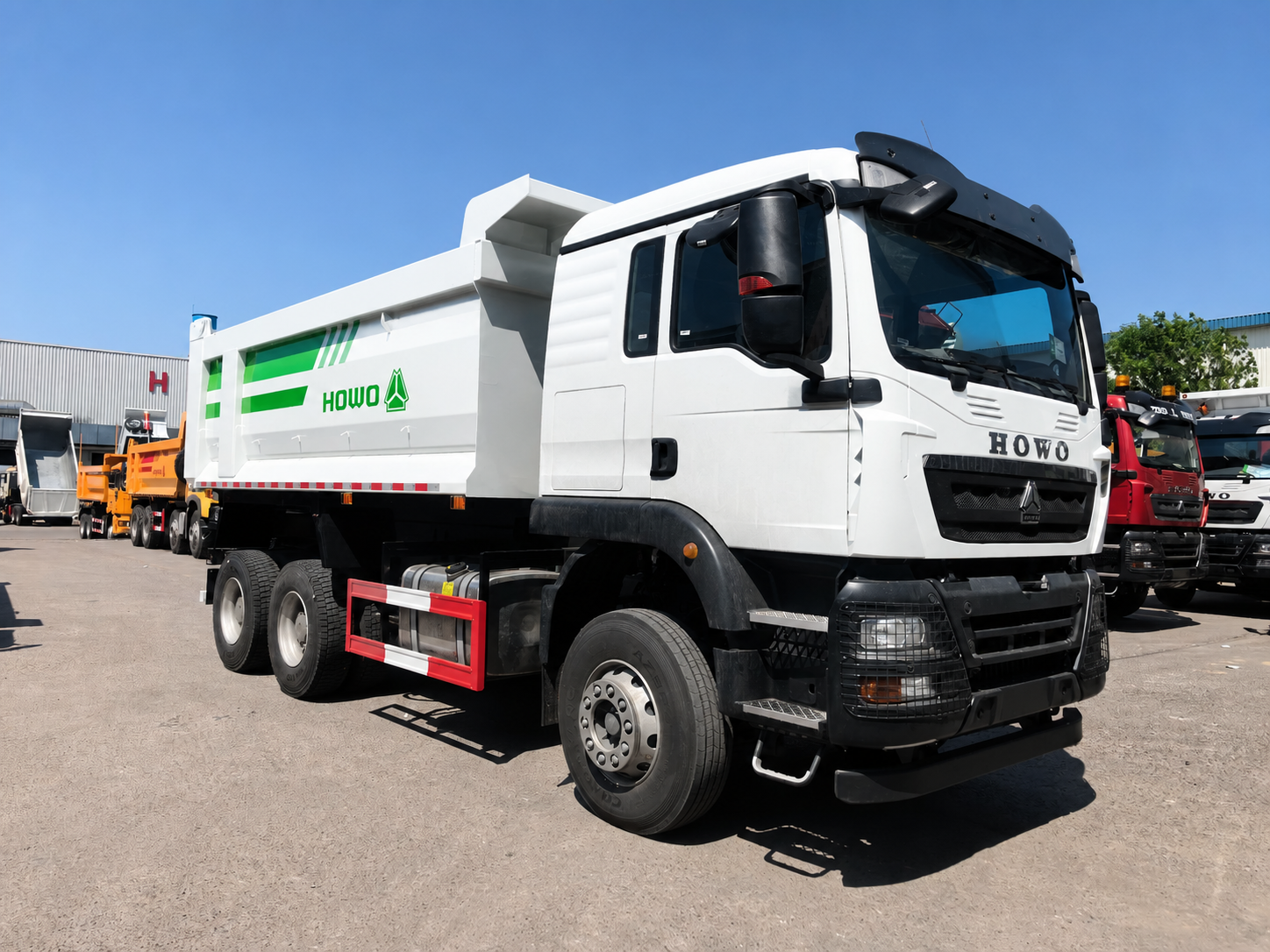
| ZZ3257V3847GB1 | 6x4 dump truck | Construction and road-works haulage where a three-axle chassis fits tighter sites | WD615.47 engine, HW19710 transmission, 12.00R20 tires, TX-F cab, 300 L fuel tank |
| ZZ3317V386GB1 | 8x4 dump truck | Higher-volume spoil and aggregate movement where routes and discharge areas allow a longer chassis | Same shared set as the 6x4 |
| ZZ1257V464GB1 | Water tanker | Water transport and spraying, with a 20,000–25,000 L tank in Q235 carbon steel | Same shared set, plus tank barrel and spray-system parts |
The duty descriptions describe the role each configuration is suited to; they are not records of specific deployments. What can be documented is the component set. Across the three models, the WD615.47 engine, HW19710 transmission, 12.00R20 tires, TX-F cab and 300 L fuel tank recur. In documented cabin content, the TX-F cab is a single-bunk cab with air conditioning and safety belts, and that specification applies to the tanker as well as to the dump models. On the tanker, the barrel is built primarily from Q235 carbon steel, capacity ranges from 20,000 L to 25,000 L, and the vehicle carries a water spray function.
Documented HOWO TX dump-truck configuration figures list a 40-tonne rated load capacity and 25–30 CBM cargo volume. Those figures belong to the dump configuration and should not be read across to the tanker, whose working measure is water volume rather than cargo-box volume. Keeping that distinction visible is part of what a continuity review is for: one fleet, three duty profiles, one shared mechanical base.
Why parts commonality decides the second and third purchase
Five shared families — engine, transmission, tire size, cab and fuel tank — determine how wide a parts inventory a mixed HOWO TX fleet really needs. If all three models carry the WD615.47 engine, the HW19710 transmission, 12.00R20 tires, the TX-F cab and the 300 L fuel tank, a workshop supporting construction haulage, mining support and water transport is maintaining one engine parts family, one transmission family, one tire size and one cab trim family instead of three separate ones.
That is a meaningful reduction, but it is not identity. Dump bodies, hoist and hydraulic components, the tank barrel and the spray system are model-specific by definition, and the 40-tonne rated load and 25–30 CBM cargo volume documented for the dump configuration have no equivalent reading on a tanker. The correct output of a commonality review is therefore a split list rather than a single figure: shared items on one side, model-specific items on the other, each with its own stocking decision.
Two questions test the claim quickly. First, ask for the per-unit specification instead of a brochure summary — the component designation should appear against each of the three model codes, not once for the range. Second, ask how many of the shared items a fleet of the buyer's size would be expected to consume in a year, and which of them are held in the buyer's region. A distributor that can answer both is describing a supply chain; one that can only answer the first is describing a specification.
Application fit across construction, mining, road works and water transport
The 6x4 dump truck fits construction and road-works haulage where a three-axle chassis suits tighter sites, shorter turning areas and lower discharge clearances. Its value in a mixed fleet is access rather than volume, which is why it tends to remain in service even after larger units are added.
The 8x4 dump truck spreads load across more axles than the 6x4, which changes how the vehicle fits routes, site restrictions and discharge layouts, and it is normally specified where higher trip volumes justify the longer chassis. Buyers typically pair it with the 6x4 rather than replace it, because the two cover different site conditions within the same haulage programme.
The water tanker covers water transport and spraying. With a 20,000–25,000 L tank in Q235 carbon steel and a water spray function, it supports dust suppression and site water supply in construction and road works, and the same vehicle can carry water for camp and plant demand between spraying duties. In a fleet that already runs dump trucks, it adds a body type without adding a new driveline family.
Continuity is not only about trucks. QINGONG's Africa-market product notes list supporting-equipment dependencies for specific configurations: bulldozers and graders for one, excavators and loaders for another, and batching plants and fuel stations for a third. A fleet planned without its support equipment is a fleet with a hidden bottleneck. The same discipline applies to model selection — the largest configuration is not automatically right for a site whose access roads, discharge areas or water points were laid out around a smaller vehicle.
The failure modes a continuity plan has to answer
The documented risks for this class of work are specific rather than generic: engine overheating, brake system wear, overload operation and failure risk on harsh terrain. Each has a matching control on the vehicle side — a heavy-duty reinforced chassis design, an advanced braking system and an engine protection system — and a matching control on the supplier side, where the documented measures are strict factory testing, pre-delivery road testing, a global spare-parts supply chain, overseas service points, remote diagnostics support and a quick-response maintenance system.
For evaluation purposes the second list matters more than the first. Chassis and braking design are properties of the product and remain the same whoever sells it; testing, parts flow, diagnostics and response are properties of the supplier relationship, and they are what a working fleet actually consumes in year three. The useful question is not whether those measures exist in a company profile, but which of them are attached to the buyer's own operating location and duty cycle.
The risk list also defines what the buyer must control internally. Overload operation is a documented failure risk, and no service arrangement compensates for it. A continuity plan that pairs the right chassis with the right site, keeps loading within the rated figure and schedules brake and cooling checks around the duty cycle does more for uptime than any single supplier commitment.
Production capacity and network scale: what the numbers do and do not prove
Monthly production capacity is documented at 1,500 to 3,000 units, varying by model mix. For a fleet programme the practical reading is scheduling: a batch that mixes 6x4 dump trucks, 8x4 dump trucks and water tankers does not draw on capacity in a single proportion, so the composition of each batch belongs in the scheduling conversation rather than being settled after the order is placed.
Scale upstream is a useful but limited signal. Sinotruk's 2025 heavy-duty truck sales reached 292,140 units, 20.0 percent higher year on year, according to data compiled by StockCounterparts, and Sinotruk Motors reported 15,000 units exported in September 2025. ChinaTrucks.org records a global network of 226 distributors and 246 service centers as of 2024. The relevance for a fleet buyer is upstream: a large and growing production and export base supports parts manufacturing and distribution flow.
The limitation is equally clear. None of those figures confirms that a specific part is on a shelf in a specific country, and none of them replaces a local stocking answer. Network counts describe reach; they do not describe response time at a particular site. That is why the local availability question belongs in the evaluation file rather than in the introductory presentation.
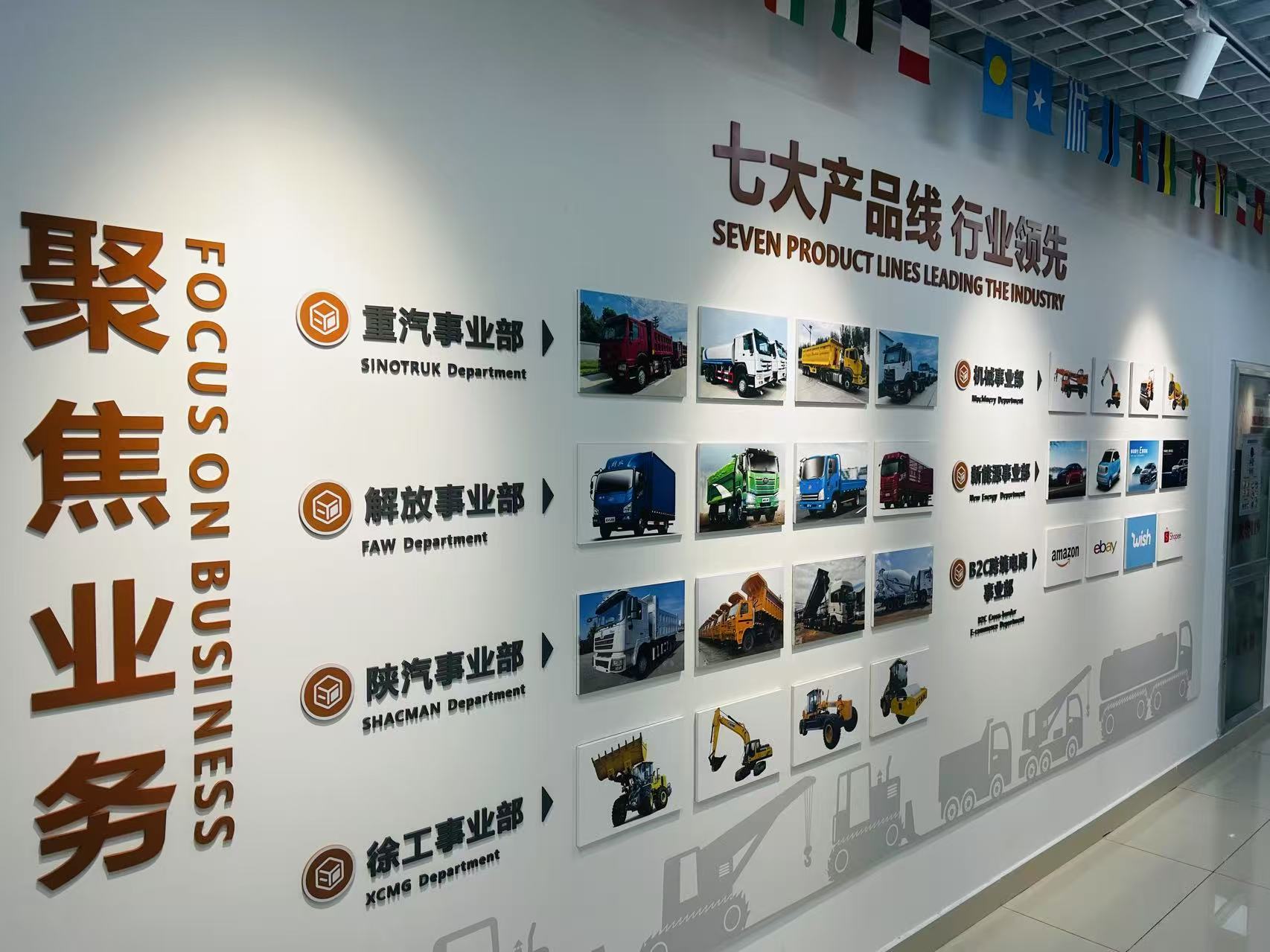
QINGONG, or Jinan Qingong International Trade Co., Ltd., is the distributor side of that picture. The company was established in 2008 in Jinan, exports heavy-duty trucks and construction machinery to more than 100 countries, and has operated subsidiaries in Tanzania, Indonesia, Zambia and Laos since 2023. Its role is documented in Sinotruk group material, which describes Jinan Qingong International Trade Co., Ltd. as a professional authorized distributor and official export partner of SINOTRUK — the entity a buyer should test against the continuity criteria below.
Purchasing terms and acceptance criteria to fix in writing
Documented purchasing terms for the HOWO range are a minimum order quantity of 1 unit; delivery on FOB, CIF, DDU or DDP terms; a pre-shipment test as the acceptance criterion; and payment by TT, L/C, or flexible installment solutions for long-term partners. Read individually, these are ordinary export terms. Read as a continuity instrument, they set the floor for a multi-batch agreement.
A framework agreement that protects continuity usually fixes six things:
- The three model codes and their configurations, frozen as one controlled document;
- The shared-component specification per unit, not only for the range;
- The scope, location and record of the pre-shipment test, and what happens if an item fails it;
- The documentation package delivered with each unit;
- The parts split and the stocking or shipping route for each category;
- The escalation path if a specification has to change between batches.
The last item is the one most often left out and the one that matters most later. Model continuity is not a promise that nothing will change; it is an agreed process for recording and approving change, so that a later batch can still be checked against the original baseline. A framework that names the document, the approver and the acceptance test keeps batch three comparable to batch one, which is exactly the property a mixed fleet needs.
A six-point continuity scorecard
| Criterion | Evidence to request | What it protects |
|---|---|---|
| Model continuity | Written confirmation that the three model codes and their configurations can be repeated | Prevents silent re-specification between batches |
| Shared-component confirmation | Per-unit specification showing WD615.47, HW19710, 12.00R20, TX-F cab and 300 L fuel tank | Keeps the fleet inside one parts and diagnostic family |
| Parts split | Parts list separating shared items from dump-specific and tank-specific items | Makes local stock planning realistic |
| Acceptance | Scope and record of the pre-shipment test | Makes successive batches comparable |
| Commercial repeatability | MOQ, delivery terms, payment structure and installment options in framework form | Keeps budgeting predictable across cycles |
| Service reach | Which overseas service points and remote diagnostics arrangements apply to the buyer's site | Turns a network claim into a response path |
The scorecard is deliberately evidence-based. Each row can be closed with a document or left open; none of them closes on a verbal assurance, and none requires a claim about performance that has not been measured.
Outlook: what changes as the fleet ages
As a fleet ages, the reference document shifts from the sales brochure to the parts list. Continuity planning becomes cheaper the earlier it starts: a buyer who fixes the configuration and the parts split before the first batch pays for that work once, while a buyer who does it at the third batch pays for it in re-qualification, mixed specifications and a wider stock range. The three documented models make that early work manageable because the shared set is already narrow.
The second change is definitional. If a later batch cannot be supplied in exactly the same configuration, the WD615.47 engine, HW19710 transmission, 12.00R20 tires, TX-F cab and 300 L fuel tank become the reference points a buyer can use to judge how far a proposed alternative has moved from the original fleet specification. Whether such a substitution is acceptable is a technical and commercial decision for the buyer, supported by the configuration sheet and the parts split — it is not something a distributor's status settles on its own.
A HOWO TX fleet stays supportable when continuity is written down before the first unit ships: three model codes, five shared component families, a split parts list, a repeatable acceptance test and terms that survive from batch to batch. QINGONG's current HOWO TX range, configurations and specifications are set out in the Qingong Group Products Catalog 2026 (PDF), which buyers can read alongside the scorecard above when assembling an evaluation file.
Frequently asked questions
What does fleet continuity mean when evaluating a SINOTRUK First-Tier Distributor?
Fleet continuity is the ability to keep a working fleet supportable and repeatable across several purchasing cycles. It combines three testable elements: model continuity, meaning the same model codes and configurations can be ordered again; parts commonality, meaning the fleet draws on a limited number of component families so stocking and diagnostics stay manageable; and commercial continuity, meaning minimum order quantity, delivery terms, payment structure and acceptance criteria can be repeated instead of renegotiated. A distributor's status does not demonstrate any of the three by itself; a configuration sheet, a parts list and written terms do.
Which components do the HOWO TX 6x4 dump truck, 8x4 dump truck and water tanker have in common?
The documented common set for the ZZ3257V3847GB1 6x4 dump truck, ZZ3317V386GB1 8x4 dump truck and ZZ1257V464GB1 water tanker is the WD615.47 engine, the HW19710 transmission, 12.00R20 tires, the TX-F cab and the 300 L fuel tank. The TX-F cab is documented as a single-bunk cab with air conditioning and safety belts. Sharing these five families reduces the number of distinct part numbers a fleet carries, but it does not make the vehicles identical: dump bodies, hydraulic equipment, the water tank barrel and the spray system remain model-specific.
What purchasing terms and acceptance criteria should a repeat HOWO TX order fix in writing?
Documented purchasing terms are a minimum order quantity of 1 unit, delivery on FOB, CIF, DDU or DDP terms, a pre-shipment test as the acceptance criterion, and payment by TT, L/C or flexible installment solutions for long-term partners. For a multi-batch programme those terms are more useful as a framework than as a per-order negotiation: the model codes and configurations, the shared-component specification, the scope and record of the pre-shipment test and the documentation package should all be written into the agreement so that each batch can be checked against the same baseline.
How can a buyer test whether spare-parts support will hold after the first year?
Request a parts list split into components shared across the three models and items specific to each, then ask which of those items are held locally, which are shipped per order, and what lead time applies to each category. Ask which overseas service points and remote diagnostics arrangements apply to the buyer's own site rather than to the network as a whole. The documented supplier measures behind these questions are a global spare-parts supply chain, overseas service points, remote diagnostics support and a quick-response maintenance system; the buyer's task is to confirm which of them reach the specific operating location.
How should a mixed HOWO TX fleet grow without losing commonality?
Growth should follow the shared component base rather than the body type. Adding a model that uses the WD615.47 engine, HW19710 transmission, 12.00R20 tires, TX-F cab and 300 L fuel tank keeps the fleet inside one parts and diagnostic family, while the differences stay limited to body and tank work. The 6x4 dump truck, 8x4 dump truck and water tanker are the three documented models in this evaluation; each new batch should be specified against the same configuration sheet, and the water tanker should stay within the documented 20,000–25,000 L range unless a different tank specification is deliberately qualified.
Have Questions or Need More Details?
Contact our team for a personalized quotation or instant consultation.
Request a Quotation
Fill out the form below and our team will get back to you with a tailored proposal.
WhatsApp Direct Chat
Prefer to chat in real-time? Message us on WhatsApp for instant assistance & quick answers.
- Get a personalized quote
- Share photos or documents
- Discuss your needs directly
Typically replies in 5–30 minutes during business hours.