
HOWO TX Model Plates: Testing First-Tier Distributor Claims
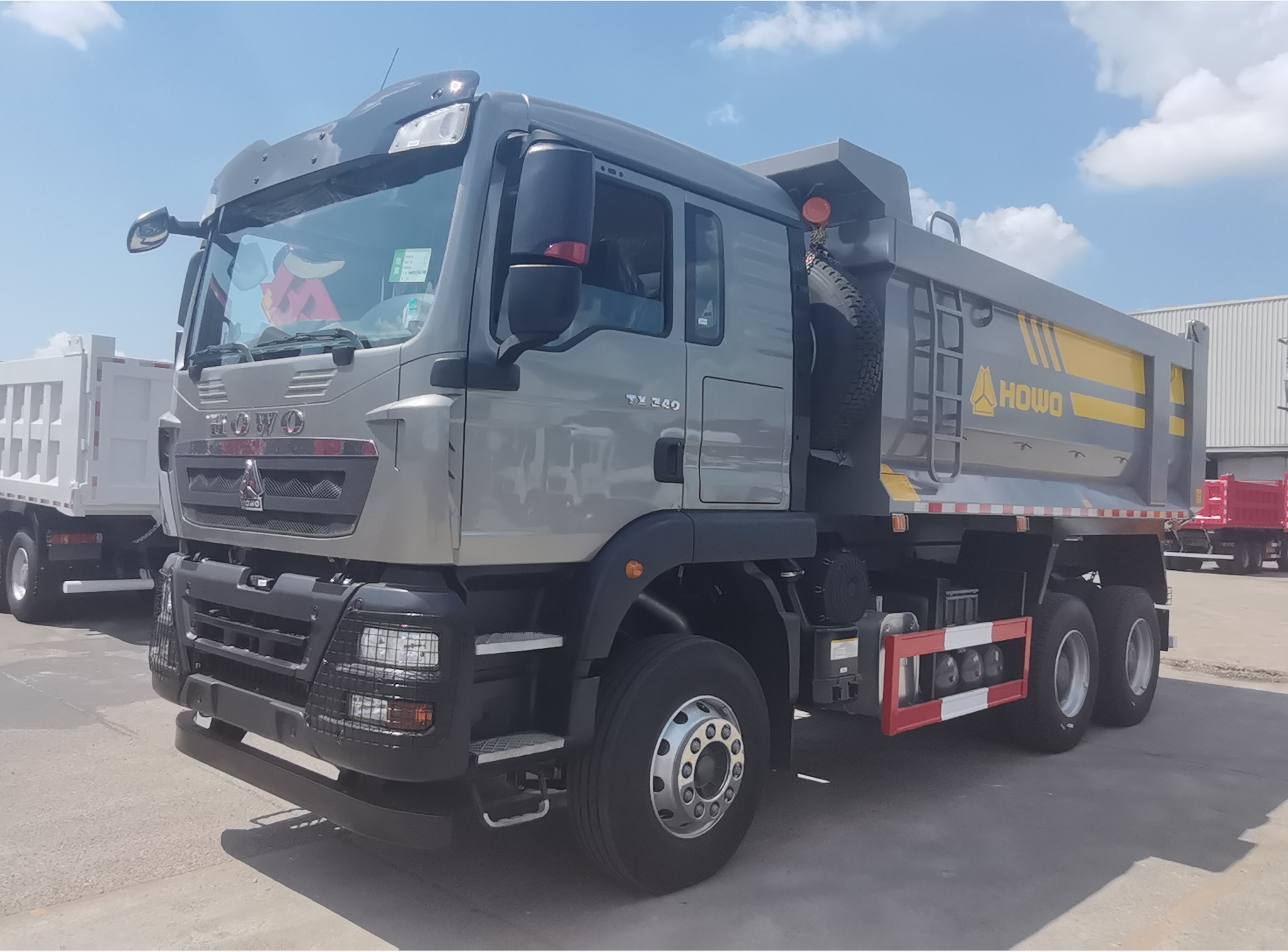
SINOTRUK First-Tier Distributor is a status label. What a construction or mining project actually consumes is hardware: a chassis code that matches the documentation, a rated load that matches the haul cycle, and a parts chain that keeps the fleet running. In the West and Central African markets where HOWO TX trucks work in mining haulage, road construction and municipal water supply, the gap between a supplier with genuine supply capability and one that simply repeats a claim tends to become visible in the yard rather than in the brochure.
This reference sets out an evidence-first method. Instead of asking a supplier to prove its position in words, buyers can inspect physical HOWO TX units and read details that are difficult to fabricate at short notice: model plates for ZZ3257V3847GB1, ZZ3317V386GB1 and ZZ1257V464GB1; 6x4 and 8x4 drive configurations; the WD615.47 engine rated at 371 HP; the HW19710 transmission; front and rear axle specifications; tire and fuel tank fitment; cabin equipment; and body construction figures such as a 40-ton rated load capacity, 25–30 CBM cargo volume, and 20,000–25,000 L carbon steel Q235 tankage.
Why status alone fails a yard inspection
A distributor badge answers a question about authorization. It does not answer the questions a fleet owner faces twelve months later: whether the delivered truck matches the quoted configuration, whether the body steel is what was specified, and whether the supplier can repeat the same specification on a second order. Those are capability questions, and capability questions are answered by physical evidence.
The practical difficulty is that configuration claims are easy to restate and hard to fake once a unit is standing on the ground. A model plate is stamped metal. A driveline is a set of identifiable components. A cargo box has measurable dimensions and measurable steel thickness. A tank has a stated material and a stated working volume. Each of these becomes a checkpoint that either confirms or contradicts what the supplier says about itself.
For buyers in Burkina Faso, Cameroon, the DRC, Mauritania, Senegal, Guinea, Togo, Benin, Liberia and Sierra Leone, this matters because the same truck name can be attached to very different physical assets depending on which link in the distribution chain is speaking. A dealer can hold an authorization document and still be unable to supply a specific configuration on a predictable schedule. Moving the evaluation from paperwork to hardware is therefore not a matter of distrust; it is a matter of testing the part of the claim that carries commercial risk.
What a first-tier HOWO TX distributor is in this supply chain
JINAN QINGONG INTERNATIONAL TRADE CO.,LTD is a heavy-duty truck and construction machinery exporter based in Jinan City, Shandong Province, China. The company was established in 2008, and is described as a professional authorized distributor and official export partner of SINOTRUK. Its stated product range covers SINOTRUK HOWO dump trucks, water trucks, fuel tankers, mining trucks, tractor trucks, semi trailers, concrete mixers and garbage trucks.
The company's own operational profile provides the context for the evidence discussion that follows: a 4,500 m² facility, approximately 300 employees, an annual output figure of 3,000 units, an 80-engineer R&D team, a stated export ratio of 90%, and Africa as its main market. Since 2023 it has established subsidiaries in Tanzania, Indonesia, Zambia and Laos. The company reports exports to more than 100 countries and annual sales volume above USD 200 million.
The distinction between a SINOTRUK Authorized Distributor, an Official Distributor, and a first-tier dealer is often presented as a hierarchy of titles. For procurement purposes, a more useful reading is functional: a first-tier position implies direct access to factory-specified configurations and to a parts and service chain that a sub-dealer typically reaches through one or more intermediaries. That functional claim is exactly what physical HOWO TX units can be used to test.
Layer one: model plates and chassis codes
The first verifiable item on any HOWO TX unit is the identity of the vehicle itself. Three configurations appear repeatedly in African construction and mining fleets, and each carries a distinct chassis code that should appear consistently across the model plate, the commercial documents and the physical configuration of the truck.
| Model plate / chassis code | Product | Primary evidence to confirm on the unit |
|---|---|---|
| ZZ3257V3847GB1 | SINOTRUK HOWO TX 6x4 dump truck | 6x4 drive configuration, TX-F cab, cargo box 5400 x 2300 x 1500 mm, middle lifting system, 12.00R20 radial tires |
| ZZ3317V386GB1 | SINOTRUK HOWO TX 8x4 dump truck | 8x4 drive configuration, TX-F single sleeper cab, 25–30 CBM cargo volume, 40-ton rated load capacity, carbon steel body |
| ZZ1257V464GB1 | SINOTRUK HOWO TX water tanker truck | TX-F cab with single bunk, 20,000 L to 25,000 L tank capacity, carbon steel Q235 tank material, water spray system |
A mismatch at this layer is the clearest early signal. If the code quoted in a proforma does not correspond to the drive configuration standing in the yard, the remaining claims about supply capability become much harder to accept. Conversely, when the chassis code, the drive layout and the body dimensions all agree, the buyer has established that the supplier is working from real factory specifications rather than a generic product description.
Layer two: driveline evidence — engine, transmission, axles and tires
Driveline specifications are the most useful capability markers because they cannot be re-badged. On the HOWO TX 6x4 dump truck (ZZ3257V3847GB1), the documented build includes the following components, each of which can be physically located and checked on a delivered unit:
| Component | Documented specification |
|---|---|
| Engine | WD615.47, 371 HP, Euro II |
| Transmission | HW19710, 10 forward gears, 2 reverse gears |
| Front axle | VGD95, drum brake |
| Rear axle | MCX16ZG, gear ratio 5.451 |
| Steering | Left hand drive |
| Fuel tank | 300 L, with cap lock |
| Tires | 12.00R20 radial tire, with one spare tire |
| Overall dimensions | 8400 x 2500 x 3400 mm |
| Color | Red / White |
The engine rating and transmission model matter at the procurement level because they set expectations for how the truck behaves under sustained load. A 371 HP engine paired with a ten-speed transmission and a 5.451 rear axle ratio describes a drivetrain configured for heavy haulage rather than light distribution work. A buyer comparing two quotations that both claim to be "HOWO TX" can use these four data points — engine, transmission, rear axle ratio and tire size — as a fast filter.
The same logic extends to supporting details. A 300 L fuel tank with a locking cap and a spare radial tire are not marketing features; they are operational decisions that affect how a truck is deployed on long-distance routes where refuelling and tire replacement options are limited. Their presence or absence on a delivered unit is directly observable.
Layer three: body and payload evidence on dump configurations
Body specification is where a truck stops being a generic vehicle and becomes a tool for a specific project. Two dump configurations illustrate how the numbers translate into application fit.
The SINOTRUK HOWO TX 6x4 dump truck (ZZ3257V3847GB1) carries a cargo box of 5400 x 2300 x 1500 mm, with a bottom thickness of 8 mm and a side thickness of 6 mm. It is equipped with a middle lifting system, and the body is built in steel. Those dimensions define the loading profile: a long, relatively low box suited to controlled tipping in road building, general construction and building material haulage.
The SINOTRUK HOWO TX 8x4 dump truck (ZZ3317V386GB1) is specified with a cargo volume of 25–30 CBM and a rated load capacity of 40 tons, built in carbon steel, and intended for mining, construction, building and road building work. The 8x4 configuration distributes load across four rear wheels, which is the structural reason this variant is associated with off-road mining operation and continuous heavy-duty operation rather than intermittent urban delivery.
For a buyer, the practical test is whether the rated categories match the actual duty cycle. A 40-ton rated load capacity and a 25–30 CBM volume describe a truck intended to move bulk material at scale. If the intended work is lighter or intermittent, that same specification carries unused cost; if the intended work is heavier, no amount of distributor branding will compensate for an undersized body.
Layer four: water tanker evidence — 20,000 L to 25,000 L, carbon steel Q235
The SINOTRUK HOWO TX water tanker truck (ZZ1257V464GB1) uses carbon steel Q235 as the primary tank material, with a water tank capacity ranging from 20,000 L to 25,000 L and a water spray function. It is fitted with a TX-F cab with a single bunk, air conditioning and safety belts, and is listed for construction, building, cement, road works, mining and concrete applications.
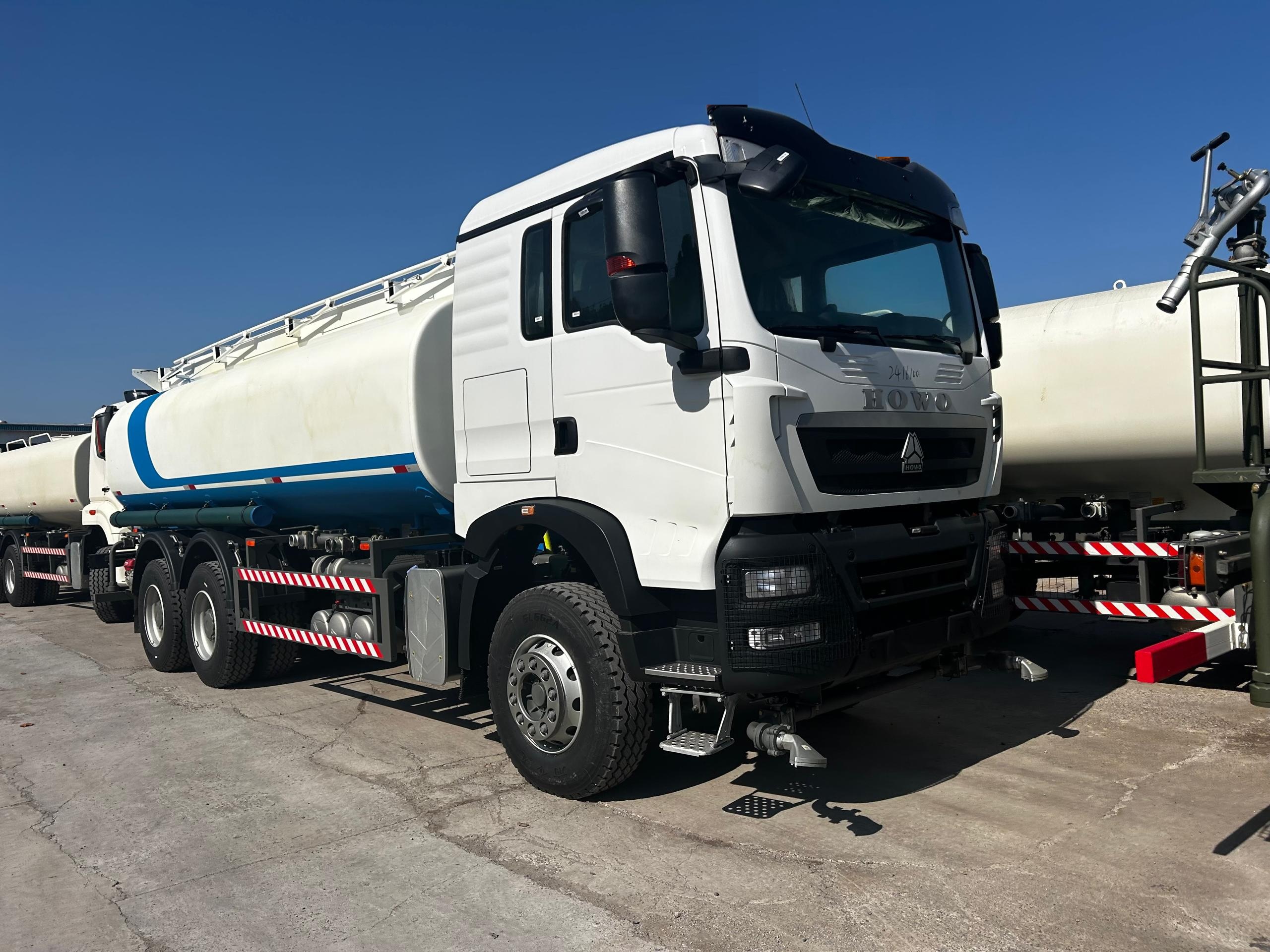
Two elements of that specification are worth isolating during inspection. The first is the tank material: a stated carbon steel Q235 tank is a material claim, and material claims are testable against documentation and, where necessary, third-party inspection. The second is the volume range itself. A range of 20,000 L to 25,000 L implies that the tanker is built to a project-specific working volume within that band rather than to a single fixed size — which makes the quotation, the drawing and the delivered tank three documents that should agree.
Layer five: cabin and operator-level fitment
Cabin specification is frequently treated as a comfort detail. In practice it is a deployment detail. Both the HOWO TX 6x4 dump truck and the water tanker are documented with a TX-F cab fitted with air conditioning and safety belts; the 6x4 dump truck carries a single bunk and front and back lamp covers, while the 8x4 dump truck is specified with a TX-F single sleeper cab with air conditioning and safety belt.
For fleets operating in high-temperature, heavy-load, desert-road or humid tropical conditions, cabin equipment affects how long a driver can work productively and how the truck is maintained between shifts. A sleeper bunk changes the economics of long-distance transport operation, where the vehicle may be away from base for extended periods. The presence of air conditioning and safety belts is verifiable in minutes and serves as a useful proxy for whether the unit was built to the configuration stated in the quotation rather than assembled from available stock.
From one unit to a supply chain: what the evidence implies
Verifying a single truck establishes configuration honesty. Verifying supply capability requires a second layer of evidence about the organisation behind the unit.
On the production side, the QINGONG capability profile describes OEM, ODM and customized manufacturing, with customization options covering engine power, drive system, cargo body structure, tank volume, logo branding and color painting. A monthly capacity range of 1,500–3,000 units is stated, varying by model mix. Lead time is described as immediate shipment for in-stock units and 30–45 days for customized orders, with a minimum order quantity of 1 unit and bulk orders preferred.
On quality control, the stated process is 100% pre-shipment inspection, with optional third-party inspection through SGS or BV. After-sales support is described as including spare parts supply, remote technical support and an overseas service network with local agents in key countries. Export markets are listed as Africa, South America, Central America, Southeast Asia and the Middle East.
A documented fleet case reinforces how these elements combine in practice. A customer in Rwanda operating 70 units of SINOTRUK HOWO series vehicles across mining transportation and road construction material haulage received complete driver and maintenance training, reported stable vehicle operation and a reduced fleet failure rate, and subsequently moved to repeat orders and a long-term procurement relationship. The relevance here is procedural rather than promotional: the case describes a situation where a high fleet failure rate was the original problem, and where training plus consistent parts supply formed part of the response.
Market trend: a larger export network, and what it changes for buyers
The context for this evaluation method is a distribution network that has been expanding quickly. Sinotruk (CNHTC) recorded total heavy-duty truck sales of 292,140 units in 2025, a 20.0% increase year on year, according to StockCounterparts. Export activity has moved in the same direction: ChinaTrucks.org reported that Sinotruk's 2024 export revenue was expected to reach 45.1 billion yuan alongside 135,000 heavy-duty truck exports, and Sinotruk Motors reported a monthly export record of 15,000 units in September 2025.
The supporting network has scaled with the volume. As of 2024, Sinotruk operated over 226 distributors and 246 service centres globally, according to ChinaTrucks.org. Regional examples show how that network is structured in practice: in Guinea, official 4S distributors include SODEFA and Societe Taishan Camions Guinee SARLU, according to SINOTRUK Guinea's own sales and service listing; in Nigeria, CFAO Equipment became an official co-distributor of Sinotruk HOWO in late 2023, according to CFAO Mobility.
Two conclusions follow for buyers in West and Central Africa. First, network density is increasing, which generally improves parts availability and service reach. Second, network density does not equal uniform capability. A large global distributor count says nothing about whether a specific supplier can deliver a specific HOWO TX configuration to a specific project on schedule. As the number of authorized and official channels grows, the differentiation between HOWO Authorized Distributor, Official Distributor and first-tier dealer status shifts from a title question to a delivery question.
First-tier channel versus informal sourcing: real trade-offs and limits
It would be inaccurate to present a first-tier channel as costless or universally superior. The trade-offs are real, and buyers should weigh them explicitly.
- Lead time against specification fit. In-stock units ship immediately, but customized configurations require 30–45 days. A buyer who needs a specific tank volume, body structure or paint specification is accepting a longer timeline than one who accepts a standard build.
- Monthly capacity is a range, not a promise. A stated capacity of 1,500–3,000 units per month varies by model mix. That figure describes organisational throughput; it does not guarantee that a particular unit will be available on a particular date.
- Inspection responsibility sits with the buyer. Pre-shipment inspection is stated as 100%, but third-party inspection through SGS or BV is optional rather than default. Buyers who want an independent verification layer must request and schedule it.
- Public distributor directories have gaps. Specific first-tier distributor listings for some markets, including Mauritania and Liberia, were not available in the general regional directories reviewed for this reference. In those markets, buyers rely more heavily on direct document and unit verification than on directory confirmation.
- Material choice carries maintenance obligations. Carbon steel and carbon steel Q235 bodies are specified across the dump and tanker range. In humid tropical and coastal operating environments, steel bodies require coating and corrosion maintenance discipline; material specification alone does not remove that requirement.
Informal local sourcing, by contrast, can offer faster local availability and lower transaction friction. Its structural weakness lies elsewhere: tracing a specific configuration back to a factory specification, and maintaining a parts chain over the service life of the vehicle, is typically harder when the supply path runs through multiple intermediaries. Neither model is automatically correct. The point is that the trade-off should be a deliberate procurement decision rather than a default.
Practical acceptance points tied to purchasing terms
An acceptance checklist converts the evidence discussion into terms that can be written into a contract. The following points are drawn from the documented specifications above and can be applied to both dump and tanker units.
| Acceptance point | What to verify | Why it matters |
|---|---|---|
| Model plate and chassis code | ZZ3257V3847GB1, ZZ3317V386GB1 or ZZ1257V464GB1 as quoted, consistent across plate, documents and physical layout | Confirms the unit is the configuration ordered, not a substitute |
| Drive configuration | 6x4 or 8x4 axle layout matching the duty cycle | Determines load distribution and off-road suitability |
| Driveline | Engine WD615.47 at 371 HP, transmission HW19710 with 10 forward and 2 reverse gears, rear axle MCX16ZG at 5.451 ratio | Sets performance and fuel expectations under sustained load |
| Body or tank specification | Dump: 25–30 CBM and 40-ton rated load on the 8x4; 5400 x 2300 x 1500 mm box with 8 mm bottom and 6 mm side on the 6x4. Tanker: 20,000–25,000 L in carbon steel Q235 | Aligns the asset with the actual material movement task |
| Cab fitment | TX-F cab with air conditioning, safety belts, single bunk or sleeper as specified | Affects driver productivity on long-distance and continuous operation |
| Wheels and consumables | 12.00R20 radial tires with one spare; 300 L fuel tank with cap lock on the 6x4 | Operational readiness in markets with limited roadside supply |
| Inspection record | Pre-shipment inspection documentation, plus third-party inspection if requested | Creates an auditable record for warranty and claims |
| Commercial terms | Lead time (immediate for in-stock, 30–45 days for customized), quantities, and after-sales scope including spare parts and technical support | Converts capability claims into enforceable delivery obligations |
Read as a whole, the checklist makes the underlying logic explicit: a first-tier claim is only as strong as the specifications it can be held to. Where a supplier can present units that match their plates, documents that match their units, and a service commitment that matches the operating environment, the status label becomes a description of capability rather than a substitute for it.
Future outlook
As Sinotruk's export volume and distributor network continue to expand, the practical differentiator between channel partners is likely to shift further toward documentation and traceability. Buyers are increasingly able to request configuration evidence, third-party inspection and parts continuity commitments as standard commercial terms rather than exceptions.
For heavy-duty truck procurement in West and Central Africa, this points toward a more structured evaluation cycle: model plate verification, driveline confirmation, body specification matching, and a documented acceptance protocol signed off before shipment. Suppliers who can support that cycle without friction will hold an advantage that no amount of status wording can replicate — and buyers who adopt it will find that the question "is this a real first-tier distributor?" answers itself in the yard.
FAQ
What does "first-tier distributor" mean when it appears in a HOWO TX quotation?
In this supply chain, it describes a supplier position rather than a truck specification. JINAN QINGONG INTERNATIONAL TRADE CO.,LTD, for example, is described as a professional authorized distributor and official export partner of SINOTRUK, based in Jinan City, Shandong Province, China. For procurement purposes, the practical meaning is direct access to factory-specified configurations and to a parts and service chain with fewer intermediaries. Because the term describes a commercial relationship rather than the vehicle itself, it should be verified alongside the physical unit specification rather than treated as a standalone assurance.
Which model-plate details should be checked first on a HOWO TX dump truck?
Start with the chassis code and the drive configuration. The SINOTRUK HOWO TX 6x4 dump truck carries model ZZ3257V3847GB1 with a 6x4 configuration, a TX-F cab, a cargo box of 5400 x 2300 x 1500 mm with an 8 mm bottom and 6 mm sides, a middle lifting system, and 12.00R20 radial tires with one spare. The SINOTRUK HOWO TX 8x4 dump truck carries chassis code ZZ3317V386GB1 with an 8x4 configuration, a TX-F single sleeper cab, 25–30 CBM cargo volume and a 40-ton rated load capacity in carbon steel. The chassis code, the axle layout and the body dimensions should agree with one another.
How do 6x4 and 8x4 HOWO TX configurations fit different project types?
The difference is load distribution and duty cycle. The 6x4 dump truck is documented for construction, mining and building applications, with a 5400 x 2300 x 1500 mm cargo box and a 300 L fuel tank with cap lock, which suits long-distance transport operation. The 8x4 dump truck, with a 25–30 CBM cargo volume and a 40-ton rated load capacity, is described as operating in off-road mining operation mode and continuous heavy-duty operation mode. Applications listed for the range include road construction, mining excavation, urban infrastructure and municipal sanitation.
What do a 40-ton rating and 25–30 CBM cargo volume tell a mining or road contractor?
They describe the scale of material movement the unit is engineered around. The SINOTRUK HOWO TX 8x4 dump truck is documented with a 25–30 CBM cargo volume and a 40-ton rated load capacity, built in carbon steel and listed for mining, construction, building and road building. The carbon steel body material is part of that specification and carries maintenance implications in humid tropical and coastal environments. If the intended haul cycle is lighter or intermittent, this specification represents unused capacity and additional cost; if it is heavier, no external claim compensates for an undersized body.
Can tanker capacity and body specifications be adjusted, and how long does that take?
The SINOTRUK HOWO TX water tanker truck, model ZZ1257V464GB1, is documented with a tank capacity range of 20,000 L to 25,000 L in carbon steel Q235, with a water spray function and a TX-F cab with a single bunk, air conditioning and safety belts. The stated manufacturing profile covers OEM, ODM and customized manufacturing, with customization options including engine power, drive system, cargo body structure, tank volume, logo branding and color painting. Lead time is described as immediate shipment for in-stock units and 30–45 days for customized orders, with a minimum order quantity of 1 unit and bulk orders preferred.
What acceptance criteria are generally applied before shipment?
The documented quality process states 100% pre-shipment inspection, with optional third-party inspection through SGS or BV. In practice, acceptance criteria should be tied to the configuration ordered: chassis code and model plate consistency; drive configuration; driveline components such as the WD615.47 engine at 371 HP, the HW19710 transmission with 10 forward and 2 reverse gears, and the MCX16ZG rear axle at a 5.451 ratio; body or tank specification; cab fitment; tires and fuel tank; and the inspection record itself. Third-party inspection is optional rather than default, so buyers who require an independent verification layer need to request and schedule it as part of the purchasing terms.
Reference material: the QINGONG Group product catalog for 2026 is available at Qingong Group Products Catalog 2026. Company information is published at www.howoqg.com.