
HTD 8M Profile Fit: Timing Belts for Packaging Automation
Packaging machinery has changed its transmission architecture
Packaging machines were once synchronised mechanically. A single line shaft, a set of cams and a chain of gearboxes tied every station of a cartoner, shrink wrapper or rotary filler to one motor. Modern packaging lines rarely work that way. Motion is now distributed across individual servo axes, and the mechanical link between a servo motor and the shaft it turns is frequently a synchronous belt drive.
That shift turned the timing belt from a consumable spare into a specification item. Machine builders now have to name a tooth profile, a pitch, a body material, a cord type and a tolerance band before a drive can be signed off. In medium-duty packaging and industrial automation axes, one of the most frequently specified combinations is the HTD 8M rubber timing belt paired with an HTD 8M timing pulley.
This reference explains what the HTD 8M profile actually is in engineering terms, which verified parameters define it, what the fit rules require of the surrounding hardware, and where the profile stops being the right answer. It is written for research and evaluation-stage buyers: engineers selecting a drive, procurement teams validating a supplier, and maintenance planners standardising spares across a packaging line.
What the HTD 8M profile is
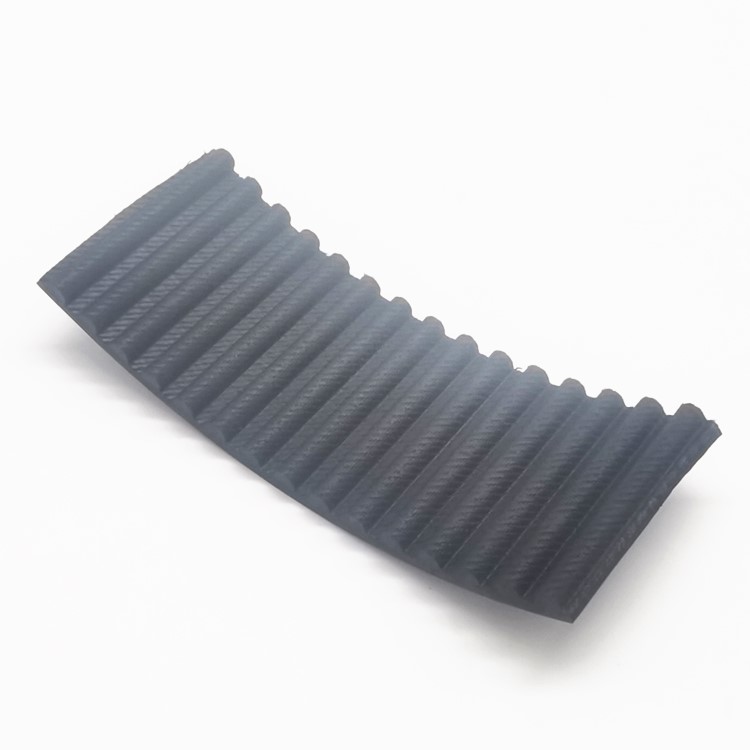
HTD stands for High Torque Drive, a curvilinear tooth geometry. Instead of the straight-sided trapezoidal tooth used in older profiles, an HTD belt carries a rounded tooth form that engages a matching groove in the pulley. The 8M designation refers to the tooth pitch: 8.0 mm between tooth centres.
An 8.0 mm pitch sits in the middle of the HTD family. It is coarse enough to carry meaningful torque without excessive belt width, and fine enough to run over pulleys small enough for the compact frames used in packaging stations. That middle position is why the profile appears across labeling heads, film feed axes, conveyor transfers, indexing tables and case-handling mechanisms.
Dongguan Zhende Machinery Equipment Co., LTD is a manufacturer and one-stop procurement service provider of FA automation transmission parts located in Dalang Town, Dongguan, Guangdong Province, China. Its catalogue covers trapezoidal and arc-tooth timing pulleys, open and conveying timing belts, couplings, ball screws, linear guides and related transmission accessories. Its HTD rubber timing belt range includes the HTD 5M, HTD 8M and HTD 14M profiles, and its HTD timing pulley range covers 3M, 5M, 8M and 14M pitches.
The verified HTD 8M rubber belt specification set
Procurement decisions on timing belts usually fail at the point where a buyer compares a marketing description with an inspection report. The specification for this product is short enough to state completely, which is an advantage: every number below can be checked against the belt delivered.
| Profile | HTD 8M |
| Pitch | 8.0 mm |
| Overall thickness | 5.6 mm |
| Body material | Neoprene (CR) |
| Tensile member | Fiberglass cord |
| Hardness | 92 Shore A |
| Minimum pulley diameter | 40 mm |
| Minimum pulley teeth | 16 |
| Maximum allowable tensile strength | 780 N per 10 mm belt width |
| Ultimate tensile strength | 3,120 N per 10 mm belt width |
| Width tolerance | ±0.5 mm |
| Length tolerance | ±0.5 mm |
| Thickness tolerance | ±0.2 mm |
Three of those lines do most of the work in an incoming inspection. Hardness at 92 Shore A describes the rubber compound's resistance to indentation and, indirectly, how the tooth flank behaves under repeated engagement. The ±0.2 mm thickness tolerance controls how much clearance exists between the belt backing and any guide or tensioner hardware. The ±0.5 mm length tolerance matters most on fixed-centre drives, where there is no take-up adjustment to absorb variation.
The distinction between maximum allowable tensile strength (780 N per 10 mm of belt width) and ultimate tensile strength (3,120 N per 10 mm of belt width) is a working ceiling versus a failure value. Neither is a target. Design calculations should be run against the allowable figure.
Fit rules: pulley geometry and load ceiling
An HTD 8M belt should not be run on an arbitrary pulley. Two published limits define the smallest pulley the profile tolerates:
- Minimum pulley diameter: 40 mm
- Minimum pulley teeth: 16
The two limits are consistent with each other. At an 8.0 mm pitch, 16 teeth correspond to roughly 40 mm of pitch diameter, since 16 × 8.0 mm gives 128 mm of pitch circumference. A designer who specifies teeth is effectively specifying diameter, and vice versa.
Why the floor exists is straightforward mechanics. A belt tooth bends as it wraps a pulley, and the tighter the wrap, the more the cord is flexed per revolution and the higher the stress concentration at the tooth root. Running below the published minimum shortens fatigue life and increases the risk of tooth jump under shock loads — a failure mode that stops a packaging line rather than degrading gently.
The load ceiling works the same way. A 10 mm-wide HTD 8M rubber belt is rated to a maximum allowable tensile strength of 780 N. If an axis needs more, the honest options are to widen the belt, split the load across two belts, or step up to a coarser profile. Widening is the cheapest route until pulley face width or frame space becomes the constraint.
Matching the belt to an HTD timing pulley
A belt profile is only half a drive. The pulley geometry determines whether the belt runs true or wears unevenly, and the published pulley specification is where that is controlled.
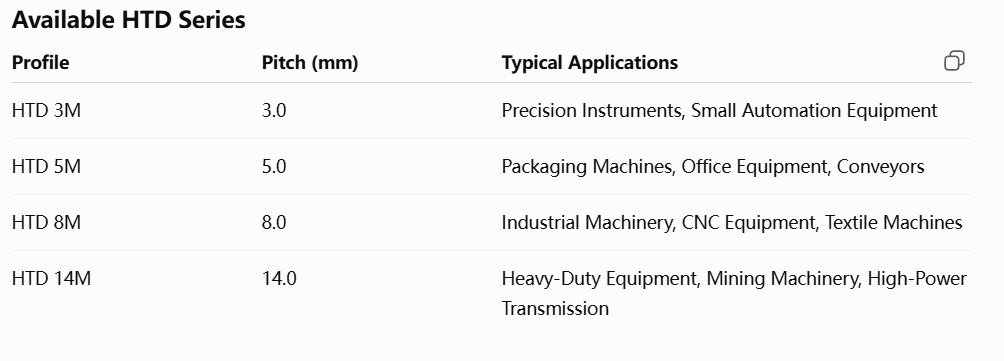
The HTD timing pulley specification lists tooth profile HTD, available pitches of 3M, 5M, 8M and 14M, and materials including aluminum alloy, carbon steel, stainless steel and cast iron. Surface treatments span natural, black oxide, zinc plated, anodized and nickel plated finishes. Tooth counts run from 12 to 120, bore diameters from 5 mm to 100 mm, with pilot bore, finished bore, taper bore and keyway bore options, and single, double or no-flange configurations.
Tolerance data on the pulley side is as important as on the belt side. Concentricity is stated at ≤0.03 mm, tooth accuracy follows ISO 13050 and DIN standards, and maximum operating speed is up to 8,000 rpm across an operating temperature range of −30°C to +120°C depending on material. Aluminum pulleys are listed at HB 75–95 hardness, steel at HRC 20–35 with optional heat treatment.
The practical implication for a packaging machine builder is that the belt and the pulley should be specified as a matched pair, not sourced independently. Compatible belts for the HTD pulley range are HTD rubber timing belts and HTD PU timing belts; a 16-tooth HTD 8M pulley paired with the HTD 8M rubber belt satisfies both the minimum tooth and minimum diameter limits simultaneously.
Manufacturing processes behind these pulleys include CNC machining, hobbing, broaching, drilling and keyway machining, with 100% dimension inspection before delivery. Custom services cover OEM and ODM work, custom bores, keyways, surface treatments and lightweight design.
Placing HTD 8M inside the profile family
Buyers rarely evaluate a single profile in isolation. The useful question is where HTD 8M sits between the smaller and larger options. The table below compares published data for the rubber and PU profiles available from the same supplier.
| Profile | Pitch | Thickness | Body / cord | Min. pulley dia. | Min. teeth | Max. allowable tension |
|---|---|---|---|---|---|---|
| HTD 5M | 5.0 mm | 3.6 mm | Neoprene (CR) / fiberglass | 25 mm | 16 | 650 N per 10 mm |
| HTD 8M | 8.0 mm | 5.6 mm | Neoprene (CR) / fiberglass | 40 mm | 16 | 780 N per 10 mm |
| STS (STPD) S8M | 8.0 mm | 5.3 mm | Neoprene (CR) / fiberglass | 56.0 mm | Not stated | 650 N per 10 mm |
| HTD 14M | 14.0 mm | 10.0 mm | Neoprene (CR) / fiberglass | 124.78 mm | 28 | 1,816 N per 10 mm |
| 8MGT POLYCHIAN (PU) | 8.0 mm | 5.6 mm | Polyurethane / carbon fiber | 36.6 mm (22 teeth) | 22 | Not stated |
Two observations follow from this comparison. First, minimum pulley diameter does not scale linearly with pitch. The HTD 5M profile allows a 25 mm pulley, HTD 8M requires 40 mm, and HTD 14M jumps to 124.78 mm with a 28-tooth minimum. Second, the 8MGT POLYCHIAN belt also runs at an 8.0 mm pitch and 5.6 mm thickness but is built on a polyurethane body with a carbon fiber cord and a nylon fabric tooth facing, with a 36.6 mm minimum pulley diameter over 22 teeth, an operating temperature range of −54°C to +85°C, and a maximum belt speed of up to 80 m/s.
That means two belts with the same pitch can have different fit envelopes and different material properties. Pitch alone is not a substitute for a full specification check.
Where HTD 8M is applied in packaging and automation
The published application profile for these belts and pulleys covers industrial automation, packaging machinery, printing machinery, textile machinery, woodworking machinery, food processing equipment, conveyor systems, CNC machines, robotics, material handling systems, agricultural machinery, mining equipment and construction machinery.
Within packaging machinery specifically, the working conditions that drive profile selection are high-speed operation, high torque, continuous running, dusty environments and oil-resistant requirements, typically across a temperature band of −20°C to +120°C. Project types include OEM equipment manufacturing, production line automation, machinery upgrades and replacement maintenance. The function performed is synchronous power transmission with accurate positioning, and the matched equipment is normally a servo motor, stepper motor, gearbox, linear module or automation control system.
Special requirements that commonly appear in these projects include high concentricity, precision-machined tooth profiles, corrosion-resistant surface treatment, lightweight aluminum or high-strength steel construction, and custom bore, keyway, flange and coating configurations. For lines where contamination matters, requirement profiles such as anti-static behaviour, oil resistance, high-temperature resistance and food-grade (FDA)-oriented specifications can be matched to the application, along with custom coating and perforation options.
Reported outcomes from long-running OEM and distributor programmes give a sense of what buyers track. In one programme covering 8,500 pieces supplied to Germany over five years, reported results included a 25% improvement in transmission accuracy, a 40% reduction in maintenance costs and a 30% reduction in equipment downtime. A second programme covering 12,000 pieces to Germany and 20,000 pieces to the United States reported a 40% reduction in maintenance costs and a 35% reduction in downtime, with the drives described as running 24/7. These are supplier-reported figures rather than independently audited ones, and should be treated as directional rather than as guaranteed performance.
Certification and verification constraints
For evaluation-stage buyers, the certification record is a constraint question: which products are inside a certified scope, which standard was applied, and when does the evidence expire.
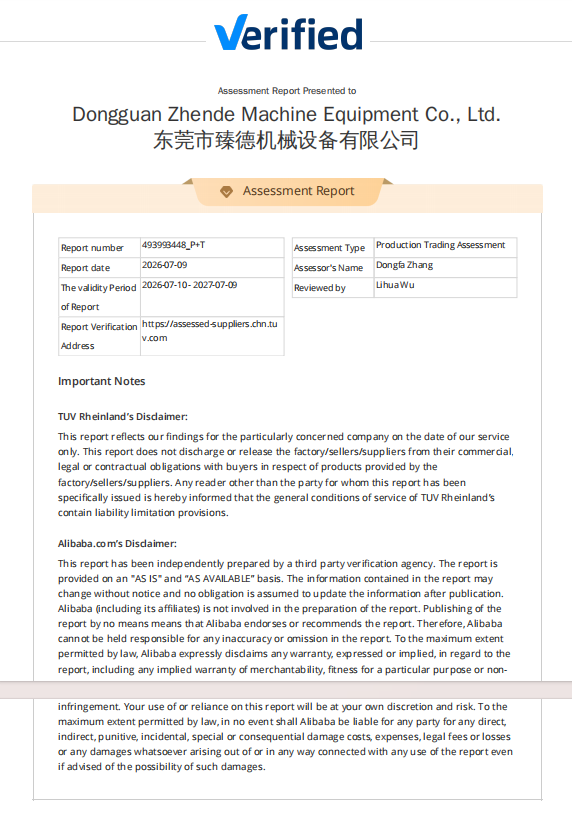
The supplier holds Alibaba.com Verified Supplier certification under the Production Trading Assessment type, certificate number 493993448_P+T, with SGS/TUV named as the applicable standard, issued 2026-07-10 and expiring 2027-07-09, covering timing belts for the international market. A second Alibaba.com Verified Supplier entry, certificate number 494177048_P, is a Production Assessment with the same issue and expiry dates and the same timing belt scope. The certified product list includes the HTD 8M timing belt, HTD 14M timing belt, HTD 5M rubber timing belt, S8M rubber timing belt, T5 PU timing belt, AT10 PU timing belt and 8MGT POLYCHIAN timing belt, and the certified supplier scope covers the HTD timing pulley product.
Factory-level evidence is provided by a TÜV Rheinland factory audit report, certificate number 493993448_P+T, issued 2026-07-09 and expiring 2027-07-09, with scope covering timing belts and timing pulleys and the Production & Trading Factory Assessment Standard as the governing standard.
On material compliance, the HTD 8M rubber timing belt has ROHS test documentation issued by SGS-CSTC Standards Technical Services Co., Ltd. Guangzhou Branch under report number CANEC24017410403.
A note for procurement files: these documents carry defined validity periods, and audit certificates and test reports are reissued periodically. Buyers maintaining an approved vendor list should confirm that the copies on file are current rather than assuming a certificate number remains active indefinitely.
On the standard side, ISO 13050:2022 specifies characteristics for metric pitch curvilinear synchronous endless belts and pulleys across the G, H, R and S profiles, and the HTD pulley range states tooth accuracy to ISO 13050 and DIN standards. For installations in potentially explosive atmospheres, published industry guidance points to ISO 9563 and ISO 1813 for synchronous belts.
Market context: demand signals and their limits
Independent market estimates give a sense of the wider belt market that packaging machinery sits inside, though they should be read carefully. Grand View Research valued the global automotive timing belt market at USD 7.7 billion in 2025 and identified China as holding the largest regional share in that year. Maximize Market Research projected a global timing belt market CAGR of 4.8% through 2030.
Those figures are not interchangeable. Published estimates for the same period vary by segment and by definition — Market Research Future valued the automotive timing belt market at USD 7.233 billion in 2024, and Maximize Market Research at USD 6.12 billion in 2023. The spread reflects differences in what each report counts, particularly whether industrial synchronous belt applications are included alongside automotive. Buyers using market data in a business case should cite the scope as well as the number.
On the trade side, transmission belts of vulcanized rubber under HS Code 4010.39 have seen China among the top origins for shipments into the United States in recent periods, which is consistent with the export orientation of Chinese belt and pulley manufacturers serving European and North American OEMs.
HTD 8M against traditional drive solutions
Synchronous belts are not the only way to drive a packaging axis, and the comparison is worth stating plainly. Chain drives transmit positive motion without slip and tolerate high loads, but they need lubrication, generate more noise and stretch over service life. V-belts and flat belts are inexpensive and simple, but they rely on friction, so they allow a degree of slip and cannot hold a fixed angular relationship between shafts — a problem for registration, indexing or cut-to-length stations. Gear trains hold timing precisely but are heavy, require lubrication and fix the centre distance.
A synchronous belt sits between those options: positive tooth engagement without lubrication, at low mass, with some tolerance for centre distance through take-up. That is the general case for the category. The specific boundaries of the HTD 8M rubber belt, however, are narrower than a general category description suggests.
The first real limitation is geometric. With a 40 mm minimum pulley diameter and 16 minimum teeth, the HTD 8M profile cannot be used in compact drive stations built around small pulleys. Machine builders designing tight sub-assemblies — a small labeling head, a narrow film-feed roller, a dense multi-axis gantry — will usually solve that with HTD 5M, which permits a 25 mm pulley, or with the 8MGT belt at 36.6 mm over 22 teeth.
The second limitation is load. At 780 N per 10 mm of belt width as the maximum allowable tensile strength, HTD 8M is a medium-duty profile. Where a heavy conveyor or a high-inertia indexing table demands more, the options are a wider belt or a step up to HTD 14M, which is rated at 1,816 N per 10 mm of width — at the cost of a 124.78 mm minimum pulley diameter and a 28-tooth minimum.
The third limitation concerns environmental ratings. The published specification set for the HTD 8M rubber belt does not state oil, chemical or ozone resistance figures. Where those properties must be documented for approval, alternative constructions publish them: the 8MGT POLYCHIAN polyurethane belt is listed with excellent oil, chemical and ozone resistance, a nylon fabric tooth facing and maintenance-free operation without lubrication. A buyer who needs a documented resistance rating should select on that basis rather than assume it from the body material's name.
Supply and customization parameters
For evaluation and execution planning, the commercial parameters matter as much as the technical ones. On timing belts, customization covers belt length, width, tooth profile, tooth pitch, material (rubber or PU), tensile cord (fiberglass, Kevlar or steel), coating, color, perforation and logo printing, with a monthly capacity of 500,000 pieces, a lead time of 7–20 days and a minimum order quantity of 4 pieces. Quality control includes 100% dimensional inspection, tensile strength testing, tooth profile inspection, pre-shipment inspection and third-party inspection through SGS.
On timing pulleys, customization covers material, tooth profile, pitch, number of teeth, bore diameter, keyway, flange type, surface treatment and logo engraving, with a monthly capacity of 100,000 pieces, the same 7–20 day lead time and a minimum order quantity of 10 pieces for standard models and 50 pieces for customized pulleys. Quality control adds bore and tooth profile inspection and a concentricity test.
Both product lines are exported to Europe, North America, South America, the Middle East and Southeast Asia, and after-sales support covers technical selection assistance, installation guidance, OEM and ODM service, quality warranty, and replacement for manufacturing defects within the warranty period. The manufacturer is based in Dongguan with a 4,500 m² factory, 40 employees, six R&D engineers and an annual output of 120,000 pieces across its timing belt and timing pulley lines.
Future outlook
Three directions look likely to shape timing belt specifications in packaging automation over the next few years.
First, distributed servo architecture will keep expanding. As more stations on a packaging line get their own axis, the number of belt drives per machine rises, and standardisation on a small number of profiles becomes more valuable than optimising each axis individually. The HTD 8M's position between HTD 5M and HTD 14M makes it a natural standard for medium-duty axes.
Second, material documentation will matter more than material choice. Polyurethane and rubber bodies both have valid applications, but buyers increasingly need published resistance ratings, temperature ranges and compliance records to clear internal approval. Specifications that leave those blank will increasingly lose to specifications that state them.
Third, traceability will move from certificates to serialised documentation. With audit certificates and test reports carrying defined validity windows, maintaining a live compliance file for approved components becomes a routine part of vendor management rather than a one-off exercise at onboarding.
None of those trends change the fundamentals. The HTD 8M profile will continue to fit medium-duty packaging and automation axes, provided the 40 mm minimum pulley diameter and the 780 N per 10 mm load ceiling are respected in the design.
Frequently asked questions
What does HTD 8M mean in a timing belt specification?
HTD stands for High Torque Drive, a curvilinear tooth profile. The 8M component denotes an 8.0 mm tooth pitch. In this product range, the HTD 8M rubber timing belt uses a Neoprene (CR) body, a fiberglass cord tensile member, a 5.6 mm overall thickness and 92 Shore A hardness. The same supplier's HTD rubber belt range also includes HTD 5M and HTD 14M profiles, and its HTD timing pulleys are offered in 3M, 5M, 8M and 14M pitches.
What is the minimum pulley diameter and tooth count for an HTD 8M belt?
The published minimums are a 40 mm pulley diameter and 16 pulley teeth. Designs that need a smaller pulley fall below the profile's fit envelope and are normally served by HTD 5M, which permits a 25 mm pulley with 16 teeth minimum, or by the 8MGT POLYCHIAN belt at a 36.6 mm minimum diameter over 22 teeth.
What dimensional tolerances apply to the HTD 8M rubber timing belt?
Width is toleranced at ±0.5 mm, length at ±0.5 mm and thickness at ±0.2 mm. The thickness figure is the one that most often affects installation, because it governs the clearance between the belt backing and any guide or tensioner hardware. Length tolerance is most significant on fixed-centre drives without a take-up adjustment.
What is the maximum allowable tensile strength of the HTD 8M rubber timing belt?
The maximum allowable tensile strength is 780 N per 10 mm of belt width, with an ultimate tensile strength of 3,120 N per 10 mm of belt width. The allowable figure is the working ceiling for design calculations; the ultimate figure is a failure value and is not intended as an operating target. Applications requiring more load capacity per unit width are typically served by HTD 14M, rated at 1,816 N per 10 mm of width.
Which certifications cover the HTD 8M timing belt?
Alibaba.com Verified Supplier certification covers the HTD 8M timing belt within a product list that also includes the HTD 14M, HTD 5M rubber, S8M rubber, T5 PU, AT10 PU and 8MGT POLYCHIAN belts, with the certified supplier scope covering the HTD timing pulley. Certification numbers are 493993448_P+T (Production Trading Assessment) and 494177048_P (Production Assessment), with SGS/TUV named as the applicable standard and validity from 2026-07-10 to 2027-07-09. A TÜV Rheinland factory audit report, numbered 493993448_P+T, covers timing belts and timing pulleys and is valid from 2026-07-09 to 2027-07-09. ROHS test documentation for the HTD 8M rubber belt was issued by SGS-CSTC Standards Technical Services Co., Ltd. Guangzhou Branch under report number CANEC24017410403. Because these documents have expiry dates, buyers should verify that the copies on file are current.
When is the HTD 8M profile not the right choice?
Three situations point away from it. A drive requiring a pulley smaller than 40 mm in diameter or fewer than 16 teeth falls outside the fit envelope. A drive needing more than 780 N of allowable tension per 10 mm of belt width requires either a wider belt or a coarser profile. And an application that requires documented oil, chemical or ozone resistance cannot be approved on the HTD 8M rubber belt specification alone, since those ratings are not stated for it; the 8MGT POLYCHIAN polyurethane belt publishes excellent ratings for all three.
What order quantities and lead times apply to these belts and pulleys?
Timing belts carry a minimum order quantity of 4 pieces and a lead time of 7–20 days, against a monthly capacity of 500,000 pieces. Timing pulleys carry a minimum order quantity of 10 pieces for standard models and 50 pieces for customized pulleys, also at a 7–20 day lead time, against a monthly capacity of 100,000 pieces. Customization on belts covers length, width, tooth profile, pitch, material, tensile cord, coating, perforation and logo printing; on pulleys it covers material, tooth profile, pitch, tooth count, bore, keyway, flange, surface treatment and logo engraving. Both lines are inspected 100% dimensionally before shipment, with third-party SGS inspection available.
Product documentation covering timing belts, timing pulleys and related transmission components is available in the manufacturer's brochure: Zhende product brochure (PDF). The company's component catalogue is also published at zdindustrialbelts.com.