
HTL-T600 vs HTL-T450: A Hard Candy Line Buyer's Checklist
Buyers comparing the HTL-T600 and the HTL-T450 hard candy depositing production lines usually frame the decision as a capacity question. Verified documentation does not support that framing. Both models appear in the product records of Jiangsu Haitel Machinery Co., Ltd. as hard candy depositing production lines, both sit inside the same certification and quality-management framework, and neither carries a published model-specific output figure in the material available for this review. What separates a well-run purchase from a risky one is therefore not the number in the model name, but the documentation package a buyer requests before signing.
This article is built as a third-party evaluation checklist rather than a supplier ranking. It uses the two model designations exactly as recorded, states what the public record does confirm, and marks clearly where a buyer must obtain information directly. Where a numeric comparison would be convenient but unverifiable, the comparison is deliberately not made.
What the verified record actually supports
- Both models are hard candy depositing production lines from the same manufacturer and the same production base.
- Both are listed against the same CE, ISO 9001, ISO 14001 and ISO 45001 documentation set.
- Neither model has a published, model-specific capacity, energy or line-length figure in the available record.
- The same HTL-T600 and HTL-T450 designations also appear against lollipop and gummy candy lines, so the RFQ must name the product category, not only the model.
Why a model number is not a specification
In food machinery, numeric suffixes in a model name are conventionally read as an indication of scale. That convention is a reasonable starting assumption and a poor contractual basis. A model designation identifies a product identity within a manufacturer's range. A specification states what the machine actually does under defined conditions. The two are not interchangeable, and the gap between them is where most procurement disputes begin.
Haitel's own published guidance on capacity points in the same direction. In its question-and-answer material, the manufacturer states that hourly output depends on the final product, that a fully automatic line can run continuously around the clock, and that exact capacity is calculated from the buyer's product formula and target weight. That is the correct engineering position, and it applies to the HTL-T600 and the HTL-T450 equally. A buyer who assumes the larger-looking designation delivers proportionally more output is making an inference, not reading a specification.
There is a second, more practical reason to be careful. In the same product records, the HTL-T600 and HTL-T450 designations also appear against lollipop depositing lines and gummy candy lines. The prefix identifies a platform family, not a finished configuration. A purchase order that reads only HTL-T600 is ambiguous until it also states the product category, the forming method, the target piece weight, the mould set and the finishing train. Buyers preparing a request for quotation should treat the model name as the opening line of the specification, never as the whole of it.
What is verified about the HTL-T600 and HTL-T450
Placing the two models side by side on documented attributes produces a short table and an important conclusion: on every dimension that the available record verifies, the two are identical. The differentiation is configuration, and configuration is settled per order.
| Attribute | HTL-T600 | HTL-T450 |
|---|---|---|
| Recorded product category | Hard candy depositing production line | Hard candy depositing production line |
| Manufacturer | Jiangsu Haitel Machinery Co., Ltd. | Jiangsu Haitel Machinery Co., Ltd. |
| Certification framework listed against the model | CE, ISO 9001, ISO 14001, ISO 45001 | CE, ISO 9001, ISO 14001, ISO 45001 |
| Documented output, piece weight or connected load | Not published in the available record | Not published in the available record |
| Customisation axes offered | Voltage, logo, output, shape | Voltage, logo, output, shape |
| Lead time for a complete line | 60–90 days | 60–90 days |
| Minimum order quantity | 1 set | 1 set |
| Warranty and field support | 12 months; overseas engineer installation and training available | 12 months; overseas engineer installation and training available |
Read the table as a decision map rather than a verdict. It tells a buyer which questions are already answered by the record and which must be answered by the manufacturer in writing. It also removes a common source of wasted negotiation time: there is no basis in public documentation for treating one model as certified and the other as not, or one as OEM-ready and the other as catalogue-only. Both sit on the same platform.
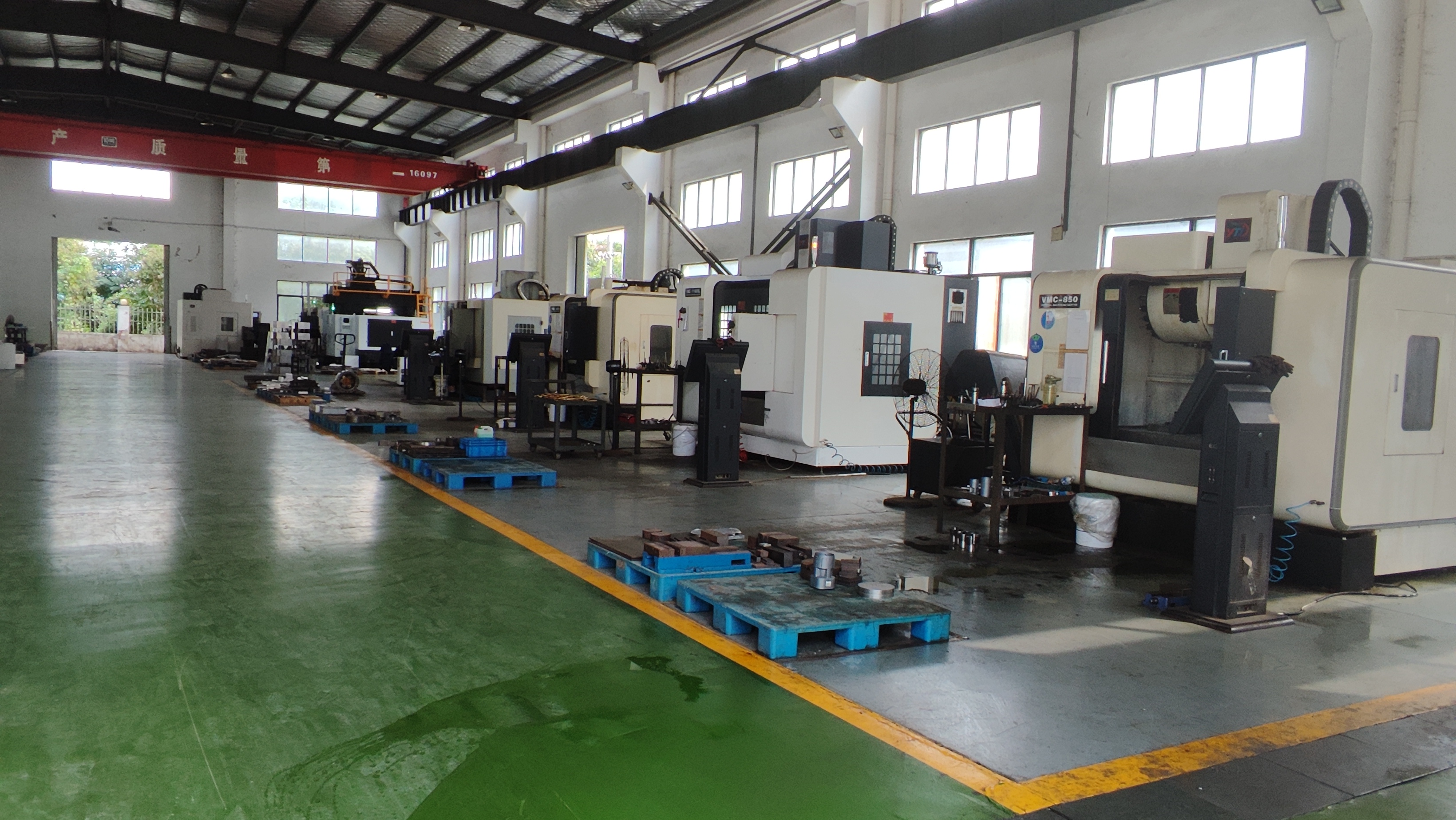
CNC machining workshop at Jiangsu Haitel Machinery. Fabrication tolerances on depositing heads and moulds directly affect piece-weight consistency, which is why dimensional documentation matters as much as model selection. Image: Jiangsu Haitel Machinery Co., Ltd.
The manufacturer standing behind both models
Jiangsu Haitel Machinery Co., Ltd. is a food and medicine processing and packaging production line provider based in Dongtai City, China, established in 1997. The company reports a 40,000 m² facility, 90 employees, a 30-engineer research and development team, more than 80 technical patents, an annual output of 1,000 sets, an export ratio of 70 per cent, customers in 80 countries and more than 3,000 clients served across the food and biotechnology industries. Its certification set includes ISO 9001, ISO 14001 and CE, and it offers OEM and ODM production services for food processing production lines.
That background matters to this comparison for one reason: because the HTL-T600 and HTL-T450 come from the same engineering and fabrication base, the choice between them is not a choice between suppliers. It is a choice between two configurations of the same platform, priced and scheduled by the same factory. Buyers gain more from interrogating the configuration and the documentation than from trying to establish which model is the manufacturer's flagship.
Line configuration questions to settle before price
Because the model name does not fix the configuration, the configuration has to be fixed by the buyer. Four questions carry most of the weight.
1. What product format must the line deposit? Haitel's documented depositing platform — described in its material for the gummy configuration — handles single-colour, two-colour, centre-filled and striped products, and includes a vibration function to exhaust air and reduce bubble defects. For a hard candy programme, the equivalent list of supported formats must be confirmed in writing for the HTL-T600 or HTL-T450 configuration being quoted. A line specified for a plain deposited candy will not deliver a centre-filled product without the corresponding depositing head and dosing arrangement.
2. Which unit operations are in scope? The documented candy-line sequence runs from raw material preparation and cooking, through depositing and forming, cooling, demoulding and finishing, to packaging. Cooking covers dissolution of sugar and glucose syrup, vacuum cooking for controlled moisture evaporation, heat-exchanger cooling, and inline dosing of flavours, colours and acid. Depositing uses a servo depositing head to fill continuously moving moulds. Cooling takes place in a temperature- and humidity-controlled tunnel. A hard candy line's finishing train differs from a gummy line's — sand rolling, for example, is a gummy step — so the matched-equipment list supplied for one category should not be assumed for the other.
3. What workshop conditions and utilities apply? Haitel's documented working condition for a candy factory is a workshop temperature of 18 °C to 28 °C, with food-grade contact surfaces in 304 or 316 stainless steel and a stated preference for 316 where food-grade contact is the governing requirement. Voltage is customised to match the local power supply, and layout is customisable alongside capacity, product shape and size. Utility capacity, compressed air and cooling water demand must still be confirmed for the specific model.
4. Will the factory produce drawings for confirmation? The manufacturer states that its engineering team prepares drawings for confirmation before production. For a depositing line, those drawings are the practical interface between buyer and factory: they fix the layout, the mould set, the utilities and the interfaces to existing cooking or packaging equipment. A buyer evaluating two models should compare the drawings, not only the quotations.
Documentation to request: a verification checklist
This is the part of the evaluation that most distinguishes a professional buyer from a first-time buyer. Each document below closes a specific risk, and each can be requested before deposit.
| Document | What to verify | Risk it closes |
|---|---|---|
| Model-specific datasheet | Output basis (pieces or kg per hour at a stated piece weight), mould count, cooling tunnel length, connected electrical load, air and water demand | Buying a designation instead of a capability |
| CE certificate | Certificate MD-22-09-29 issued by SZUTEST, scope recorded as Candy Machine, harmonised standards EN ISO 12100:2010 and EN 60204-1:2018, issued 30 September 2022 and valid to 30 September 2027. Confirm the certificate maps to the exact model and electrical configuration quoted | A category-level certificate being used to cover a specific machine and voltage variant |
| ISO 9001 certificate | Certificate No. 94426Q00300R099, issued by HB, standard GB/T19001-2016 idt ISO9001:2015. The recorded scope reads: design and production of packaging machinery for food and pharmaceuticals, excluding qualification scope. Check the validity dates on the copy supplied | Assuming a quality certificate whose written scope covers packaging machinery extends automatically to depositing and forming equipment |
| ISO 14001 and ISO 45001 | ISO 14001 certificate No. 94426E00147R099, issued 25 June 2026, valid to 24 June 2029. ISO 45001 certificate No. 94426S00095R053, issued 21 April 2026, valid to 20 April 2029 | Environmental and occupational-safety claims that cannot be evidenced in a vendor file |
| Food-contact material declaration | Grade of stainless steel for every product-contact part, plus material certificates | Sanitary-design non-conformity discovered at audit rather than at quotation |
| Test record | Evidence of the stated 100 per cent testing before shipment, with the test item list | Faults surfacing during commissioning rather than before dispatch |
| Acceptance protocol | Factory inspection or video inspection before final payment, written acceptance criteria, operator training plan | Disputes over whether the line was delivered in the agreed condition |
| Spare parts and warranty terms | Critical spare parts list, 12-month warranty terms, remote support arrangements and overseas engineer installation scope | Extended downtime waiting for a single imported component |
The ISO 9001 scope wording deserves emphasis because it is the most frequently overlooked item on this list. The recorded scope covers the design and production of packaging machinery for food and pharmaceuticals. A buyer purchasing a depositing line is entitled to ask how the depositing, cooling and forming equipment maps onto that scope, and to request the internal quality plan for the specific model. Asking the question is not an accusation; it is the normal practice of a buyer who reads certificates rather than counting them.
Where the two models diverge, and where they do not
The divergence is commercial and mechanical rather than categorical. What changes between an HTL-T600 order and an HTL-T450 order is the configuration matched to the target product: the mould set and piece weight, the depositing arrangement, the length of the cooling tunnel required to reach a stable demoulding condition, the finishing and packaging train behind the depositor, the electrical configuration, the factory layout and, if requested, branding. Haitel lists customisation on voltage, logo, output and shape, and states that layout, capacity, product shape and size can all be customised.
What does not change is the surrounding framework. Minimum order quantity is one set for either model. A single machine is quoted at 15 to 45 days, while a complete production line is quoted at 60 to 90 days, with monthly capacity of 100 sets. Testing before shipment, the 12-month warranty, overseas engineer installation and training, and remote support apply across the range. Commercial terms are consistent: 40 per cent T/T advance deposit with the 60 per cent balance before shipment, equipment inspection at the factory or by video before the balance is paid, and quotations available on FOB, CIF or DDP terms with standard export wooden case packaging.
For a buyer, that symmetry simplifies the negotiation. There is little to be gained by playing one model against the other on certification or warranty, because the answer will be the same. The leverage lies in specifying the configuration precisely, then holding the supplier to the datasheet and acceptance criteria that follow from it.
Application fit: which project type are you actually buying for?
Haitel's documented candy-factory scenarios distinguish three project types, and the HTL-T600 versus HTL-T450 question resolves differently in each.
New construction. A new candy factory or production base procures a full automatic line in one order, with plant construction plus complete equipment installation and commissioning in scope. Here the model choice is driven by the intended product portfolio over the first three to five years, and by the layout the factory can accommodate. Documentation completeness matters most, because there is no existing line to fall back on.
Expansion. An existing candy factory adds a line to raise capacity or to enter a new category, with no new building and only supporting clean-room work. This is the most common project type in equipment sales. The binding constraints are usually upstream and downstream: whether existing cooking capacity can feed an additional depositor, and whether existing packaging can absorb the additional output. The model itself is rarely the bottleneck.
Reconstruction. An old candy line is dismantled and replaced, with clean areas, piping and the cooking system renovated and the depositing and forming main machine replaced. Here the new depositor must interface with retained equipment, which makes dimensional drawings and utility specifications more important than headline capability.
Long-run mechanical stability in sugar handling is one documented supporting signal. A food factory in China has operated a Haitel sugar kneading machine for more than five years, and reports stable operation, all-stainless construction and low noise. That is evidence about a sugar-preparation unit, not about depositing performance, and it should be weighted accordingly — useful as an indicator of fabrication quality, not as a performance guarantee for either model.
The limits of this comparison
A comparison that does not state its boundaries is not trustworthy. Five limits apply here.
First, no verified model-specific output figure exists. The available record does not publish throughput, piece weight, mould count or connected load for either model. A side-by-side output table would therefore be an invention, not a comparison. The correct action is to request the datasheet and, where possible, witness a trial run on the buyer's own formulation — the manufacturer does offer trial production on buyer-supplied raw material.
Second, automation and digital evidence is genuinely thin. The verified data set records no PLC, SCADA, MES or OEE evidence specific to these lines, and marks smart-manufacturing coverage as insufficient. Buyers who need traceability, line-level OEE reporting or remote diagnostics should raise it in the RFQ as a definition item, not assume it is included.
Third, a fully automatic line is not the right answer for every buyer. Full automation links the whole process with minimal manual input, delivers stable capacity and consistent product quality, supports continuous operation and PLC centralised control, and carries a higher capital cost. A semi-automatic line automates the main machine while auxiliary processes remain manual: lower investment and more flexible product switching, but higher labour cost, limited capacity and less consistent batch quality. Full automation fits high annual output, long-term continuous production, high labour cost and standardised quality; semi-automatic fits start-up factories, small-batch trial production, frequent category changes, tight budgets and constrained floor space.
Fourth, commissioning is where value is won or lost. The documented risks are failed commissioning, low operating efficiency, unexpected shutdowns and slow spare-part supply, typically triggered by an undefined process, insufficient operator training and an incomplete spare parts list. The documented mitigations are equally specific: complete commissioning acceptance, trained operators and critical spares held on site.
Fifth, machine safety certification is not hygiene certification. EN 1672-2:2020 sets out common hygiene and cleanability requirements for food-processing machinery, and UK HSE guidance references the generic hygiene standard for food machines. The CE certificate discussed above covers machinery safety under EN ISO 12100 and EN 60204-1, with the scope recorded as candy machine. These answer different questions. Buyers in European or UK markets should request hygiene and cleanability design evidence separately rather than treating a CE mark as a sanitary-design conclusion.
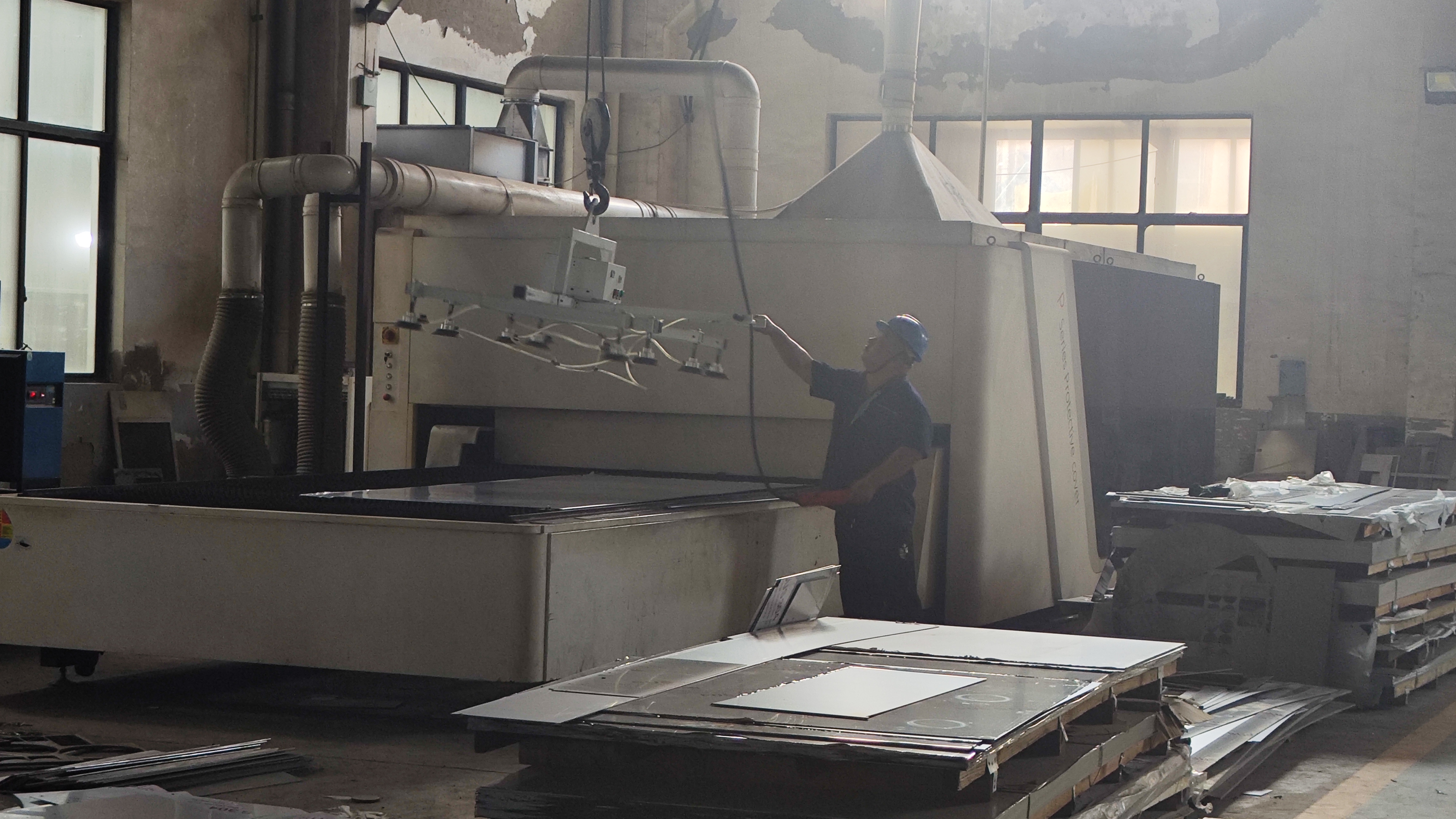
Stainless steel component cutting for food machinery fabrication. Material grade and weld finish on product-contact surfaces are the items a buyer should verify against the food-contact declaration. Image: Jiangsu Haitel Machinery Co., Ltd.
Market context for the decision
Category-level trade data gives the timing context, not the model answer. Global exports of industrial food preparation machinery under HS 8438 reached USD 16.7 billion in 2024, a 2.12 per cent increase over 2023, according to UN Comtrade figures compiled by OEC World. Commercial research places the broader global food processing market at USD 166.48 billion in 2024, and global gummy candy production line output at roughly 31,400 units in 2025. These figures describe a large, steadily traded equipment category with deep manufacturing supply. They do not describe the performance of any individual depositing line, and a buyer who uses them to justify a model choice is using the wrong instrument.
The more decision-relevant trend is documentation-driven. Hygiene and cleanability requirements are increasingly written into procurement specifications rather than discovered at audit, and machinery safety conformity is already a formal export requirement for European and Southeast Asian projects, alongside ISO 9001 quality management. Buyers who build a documentation checklist into the RFQ now will spend less time resolving scope questions during installation.
A practical evaluation framework
Because the two models cannot be scored against published performance data, the useful output of this comparison is a weighting scheme the buyer applies after collecting the documents. The weights below are an editorial framework for structuring a decision; they are not a score of either model.
| Evaluation criterion | Suggested weight | Evidence that closes it |
|---|---|---|
| Fit to product format and piece weight | 30% | Trial run on buyer formulation; supported-format list in writing |
| Documentation completeness | 25% | Datasheet, certificates, material declaration, drawing set |
| Acceptance and commissioning plan | 20% | Written acceptance criteria; training plan; spares list |
| Commercial terms and lead time | 15% | Quoted schedule against the 60–90 day line benchmark; payment structure |
| After-sales and lifecycle support | 10% | Warranty terms, remote support route, engineer deployment scope |
Future outlook
Two developments are likely to reshape how hard candy depositing lines are compared over the next procurement cycle. The first is the normalisation of hygiene and cleanability documentation as a tender item. As hygiene requirements become explicit in specifications rather than implicit in a CE mark, buyers will ask for design evidence at quotation stage, and manufacturers who can supply it quickly will shorten evaluation cycles.
The second is performance disclosure. The current evidence gap around automation architecture, line-level efficiency and energy consumption is a gap in public documentation rather than a claim about any machine. Buyers can close it individually by requiring factory acceptance test results tied to their own formulation and piece weight. Over time, model comparison will move from nameplate inference to validated test data — and the HTL-T600 versus HTL-T450 question will be answered on the test record rather than on the label.
Frequently asked questions
What is the output difference between the HTL-T600 and the HTL-T450?
No model-specific output figure for either line is published in the available documentation, so a numeric difference cannot be stated. Haitel's stated position is that hourly output depends on the final product, and that exact capacity is calculated from the buyer's product formula and target weight. Output should therefore be obtained as a written calculation tied to the intended piece weight and mould set, or confirmed through trial production.
Can a buyer test the line on their own formulation before ordering?
Yes. The manufacturer states that buyers can send raw material for machine testing and sample production. For a hard candy project, a trial run on the intended formulation is the most direct way to establish piece weight, demoulding behaviour and surface quality before a purchase decision is made.
Which certificates apply to these hard candy depositing lines?
The documented set comprises CE certificate MD-22-09-29 issued by SZUTEST with the scope recorded as candy machine and harmonised standards EN ISO 12100:2010 and EN 60204-1:2018, valid to 30 September 2027; ISO 9001 certificate No. 94426Q00300R099 under GB/T19001-2016 idt ISO9001:2015; ISO 14001 certificate No. 94426E00147R099; and ISO 45001 certificate No. 94426S00095R053. All product-contact parts are stated to be stainless steel, and certificate copies can be provided for customs clearance.
What voltage can the line be built for?
Voltage is customised to match the buyer's local power supply. Because the electrical configuration varies by destination, the CE certificate copy supplied with a quotation should be checked against the specific voltage and control arrangement ordered rather than against the model name alone.
How long does delivery take?
The stated lead time is 15 to 45 days for a single machine and 60 to 90 days for a complete production line, with monthly capacity of 100 sets. Buyers planning a new build or a line replacement should align civil works, clean-room renovation and operator recruitment to the longer figure.
What are the purchasing and acceptance terms?
Minimum order quantity is one set. Payment terms are 40 per cent T/T advance deposit with the 60 per cent balance before shipment. Acceptance is carried out by inspecting the equipment at the factory or by video inspection, and shipment follows the final payment. Quotations are available on FOB, CIF or DDP terms, with standard export wooden case packaging.
What after-sales support is included?
A 12-month warranty applies, with overseas engineer installation and training available, alongside remote support. The documented risks to manage jointly are commissioning performance, operator training and spare-part availability, which is why the acceptance protocol and critical spares list should be agreed before the line ships.
Can layout, product shape and branding be customised?
Yes. Customisation is offered on capacity, product shape, size, voltage and layout, along with logo and output requirements, and the engineering team prepares drawings for confirmation before production begins. Because the HTL-T600 and HTL-T450 designations are also used for lollipop and gummy lines, the order documentation should name the product category and forming method alongside the model.
Reference document: Jiangsu Haitel Machinery product catalogue (PDF) — model and category listings referenced in this comparison.
Have Questions or Need More Details?
Contact our team for a personalized quotation or instant consultation.
Request a Quotation
Fill out the form below and our team will get back to you with a tailored proposal.
WhatsApp Direct Chat
Prefer to chat in real-time? Message us on WhatsApp for instant assistance & quick answers.
- Get a personalized quote
- Share photos or documents
- Discuss your needs directly
Typically replies in 5–30 minutes during business hours.