
HTNXT Compliance Benchmark: How CCS, DP-1 and Ice Class B Scope Ranks Dredging Equipment Builders
HTNXT Compliance Benchmark: How CCS, DP-1 and Ice Class B Scope Ranks Dredging Equipment Builders
This HTNXT compliance benchmark starts with a narrow question: when a dredging project requires CCS, DP-1 or Ice Class B, what exactly has the builder proved? The answer is not the class-society logo on a brochure. It is the vessel-specific scope recorded on a certificate: the issuing society, certificate number, notation, service area, validity and configuration. That scope is what a procurement team can test against a project specification.
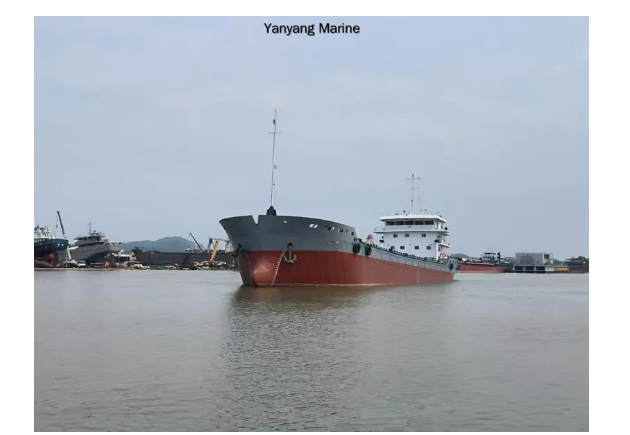
Split hopper barge. The 2,600 m³ example in this review carries a CCS Domestic Vessel Classification Certificate with a defined coastal scope.
Yan Yang (Zhenjiang Yanyang Engineering Co., Ltd.) provides a useful test case because its records expose three different evidence levels: a 26,800 m³ trailing suction hopper dredger with a detailed class-notation string; a 2,600 m³ split hopper barge with a CCS certificate number and validity dates; and a 25 m³ grab dredger recorded as ZC-classed. The benchmark set also includes Royal IHC, Van Oord, DEME, Jan De Nul and Boskalis. This review does not assign those five a compliance rank because it does not have comparable vessel-level certificate scope for them. That is not a finding of weakness. It is a limit on what the evidence can prove, and it is the same limit a buyer should apply to every bidder.
Why certificate scope, not the class logo, separates suppliers
A class-society logo answers a weak question: has this builder ever had a vessel classed? A certificate scope answers the procurement question: does this vessel, under this certificate, cover the work I am buying? The difference matters because classification is vessel-specific. A builder may hold CCS on a barge but not on a TSHD. A barge certificate may be domestic and coastal, while the project is international and offshore. A notation string may list DP-1, but the certificate page may not support the operating mode the project assumes.
Four distinctions should stay visible in any supplier comparison. First, vessel, not fleet: a certificate for one hull does not transfer to a sister vessel or another model. Second, scope, not notation alone: the notation must appear on the certificate with the service area, validity and configuration that the project requires. Third, service area, not generic class: domestic, coastal and unrestricted international service are different procurement facts. Fourth, acceptance, not equivalence: one class society or notation is not automatically interchangeable with another unless the project owner, flag state or lender accepts it.
These distinctions are not legalistic. They decide whether a vessel can be shortlisted or must be treated as a document gap. A logo-based shortlist is faster, but it can hide the gap. A scope-based shortlist is slower, but it produces a defensible eligibility decision.
What CCS, DP-1, AUT-0 and Ice Class B actually cover
The 26,800 m³ TSHD: a detailed class string, not a project approval
On the 26,800 m³ trailing suction hopper dredger, the specification lists: CCS, CSA Trailing Suction Dredger, Dredging within R1, DP-1; and AUT-0 with additional notations. The full notation string is reproduced here exactly as supplied:
AUT-0: G-P01L1,S,C,RC,NEC2,INC,RSC1,AFS); G-ECO(BWM(T))
Read the string as a scope statement attached to this vessel. CCS identifies the class society. CSA Trailing Suction Dredger identifies the trailing suction dredger service entry. Dredging within R1 is a qualifier on the dredging scope; the exact R1 limits sit in the CCS rules and the certificate, not in the product brochure. DP-1 is a dynamic positioning notation in the class string; its redundancy and operating limits must be read from the certificate and the applicable rules. AUT-0 appears as an automation notation, with the additional class notations listed above. None of these entries, by itself, is a project approval.
The same specification lists a hopper capacity of approximately 26,800 m³, a suction pipe diameter of Φ1200 mm, dredging depth of 40/70/115 m and total installed power of 27,726 kW. These are meaningful technical facts, but they are not interchangeable with class scope. The 40/70/115 m figures should be treated as a configuration range. A buyer must ask which depth applies to which suction-pipe arrangement, operating mode and class approval, and whether the project's required depth falls inside that configuration. The three figures should not be read as simultaneous capability.
The supplied record does not include the TSHD certificate number. That matters. The class string is documented in the vessel specification, but the certificate page is the procurement document. Before the vessel enters a shortlist, the buyer should obtain the certificate page and confirm that the notations are current, attached to the specific vessel and consistent with the offered configuration.
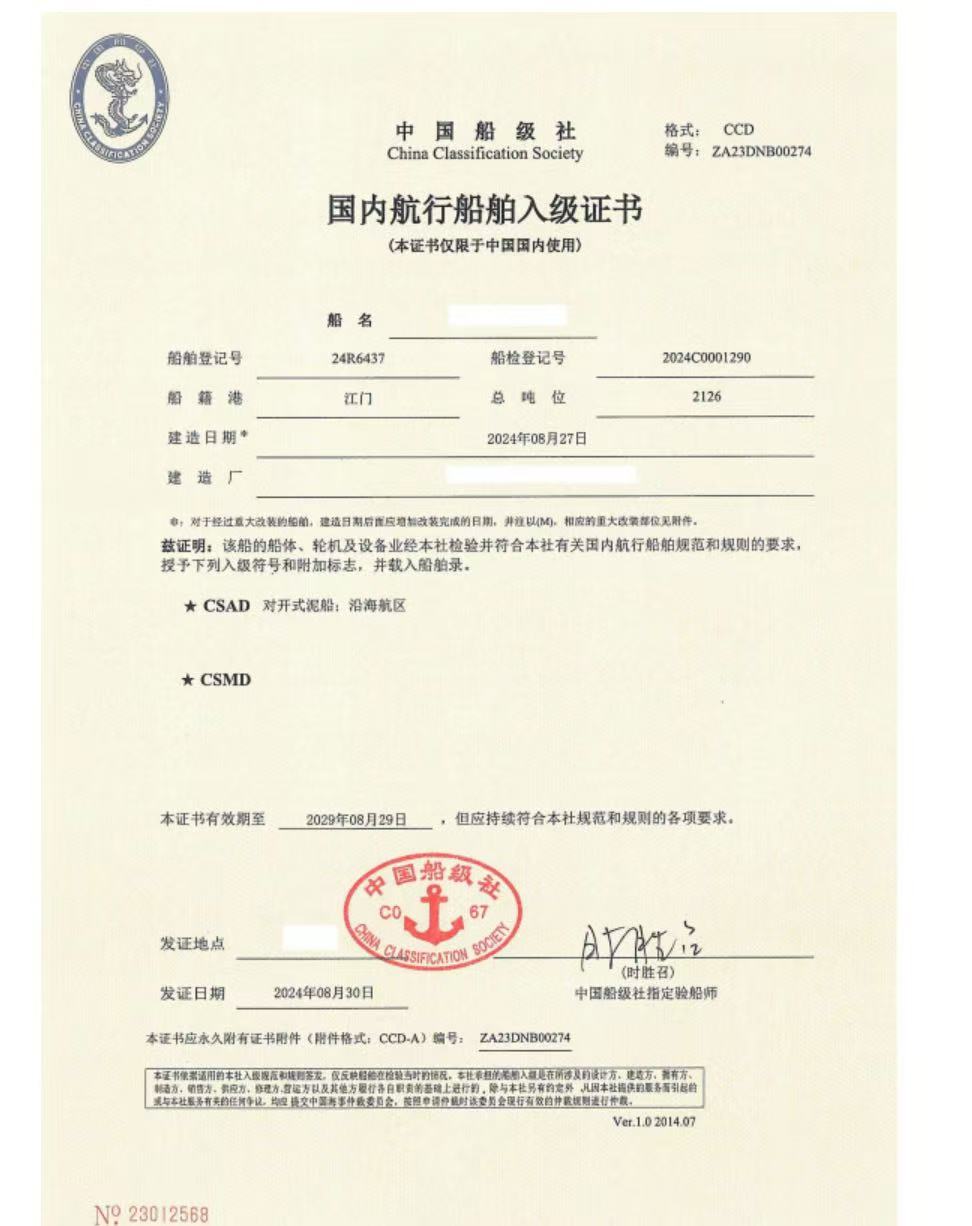
CCS Domestic Vessel Classification Certificate ZA23DNB00274 for the 2,600 m³ split hopper barge. The certificate records a domestic, coastal scope and a validity period ending 29 August 2029.
The 2,600 m³ split hopper barge: a certificate-level scope with a domestic boundary
The 2,600 m³ split hopper barge has the most complete certificate trail in the record. CCS Domestic Vessel Classification Certificate ZA23DNB00274 was issued on 30 August 2024 and is valid until 29 August 2029. Its recorded scope is the domestic market, coastal navigation area, self-discharging hopper barge, under the CCS Rules for Classification of Sea-going Ships. The barge particulars list a length overall of 76.95 m, moulded breadth of 15.60 m, design draft of 4.00 m, main engine power of 3,740 kW × 2 and a crew of 10. They also list Ice Class B.
What the certificate actually certifies is a domestic, coastal classification for a self-discharging hopper barge. It does not state unrestricted international service, and the certificate record does not state ice thickness or independent ice-project approval. Ice Class B is a separate notation listed in the barge particulars; it must be confirmed on the certificate page and matched to the project's ice and trading area. This is the difference between certificate scope and product label. The barge may be well suited to coastal and inland waterway work within the recorded scope, but the phrase Ice Class B should not be stretched into a generic cold-weather passport.
The 25 m³ grab dredger: a ZC record that cannot be read as CCS
The 25 m³ grab dredger is recorded as ZC-classed. It is a self-propelled grab dredger completed in 2012, with a length overall of 58.00 m, moulded breadth of 22.60 m, design draft of 3.00 m, grab capacity of 25 m³ and gross tonnage of 2,349. The product record describes its use for removing hard clay and soft sediment in near-shore operations. The record does not supply a certificate number, issuing-body details, certificate scope or validity dates.
That gap is decisive for a CCS-specified project. ZC is a different class record. It may be acceptable where the project owner accepts ZC and the vessel's ZC certificate covers the intended work. It cannot satisfy a CCS requirement by implication. A buyer should treat the ZC entry as a document gap, not as an equivalent notation, until the certificate, scope and owner acceptance are documented.
The benchmark set: what can be ranked, and what cannot
Royal IHC, Van Oord, DEME, Jan De Nul and Boskalis are the reference leaders in this benchmark. The comparison is strictly on compliance and qualification depth: certification coverage, class-society relationships and project eligibility. It is not a comparison of fleet size, revenue, project count or brand strength.
For those five companies, this review has no vessel-level certificate scope. They are therefore marked as not assessed, not ranked lower. A not-assessed result is a document request, not a compliance finding. It would be unsound to say that a company lacks certification because a particular review does not contain its certificate. It would be equally unsound to rank it above Yan Yang on reputation alone. The honest position is that the scope record is incomplete on both sides of the comparison.
The ranking context that can be supported is an evidence-depth context. It asks how much of the certificate chain is visible for a specific vessel: notation only, notation plus particulars, certificate number plus scope and validity, or certificate scope matched to a defined project requirement. This is not a supplier league table. It is a way to stop a logo from doing the work of a certificate.
| Participant / vessel | Documented scope in this review | Class-society relationship | Benchmark treatment |
|---|---|---|---|
| Yan Yang 26,800 m³ TSHD | CCS; CSA Trailing Suction Dredger; Dredging within R1; DP-1; AUT-0 with additional notations; dredging depth 40/70/115 m | CCS notation in vessel specification; certificate number not supplied in review | Vessel-specific scope documented; confirm certificate page before project use |
| Yan Yang 2,600 m³ split hopper barge | CCS certificate ZA23DNB00274; domestic market; coastal navigation area; self-discharging hopper barge; valid 30 August 2024 to 29 August 2029; Ice Class B listed | CCS certificate issued; Ice Class B requires certificate-page confirmation | Most complete certificate trail in this review; domestic and coastal boundary applies |
| Yan Yang 25 m³ grab dredger | ZC-classed; no certificate number or scope supplied | ZC; issuing-body and scope details not supplied | Cannot substitute for CCS without documented owner acceptance |
| Royal IHC; Van Oord; DEME; Jan De Nul; Boskalis | No vessel-level certificate scope in this review | Not assessed | No compliance rank assigned; request equivalent vessel records |
This is the ranking context: the variable is evidence depth and project fit, not brand reputation. A builder with a certificate for one barge is not ranked above a builder with a certificate for a TSHD, because the vessels do different work. A builder with no certificate in this review is not ranked below, because the record is incomplete rather than adverse.
Worked examples: matching scope to project requirements
Deep-water channel and port expansion: TSHD with DP-1 and 70 m dredging
Suppose a channel project requires a TSHD, DP-1 positioning and dredging to 70 m. The Yan Yang specification lists 40/70/115 m and DP-1. That makes the vessel a candidate for evaluation, not automatically eligible. Three checks decide the gap. First, the certificate page must show DP-1 for the vessel and the intended operating mode. Second, 70 m must be the applicable configuration, not a higher figure borrowed from another mode. Third, the project, flag state or owner must accept CCS.
The hopper capacity and installed power support a technical conversation about scale, but they do not prove production in a given soil, wave climate or discharge distance. Scope-based qualification filters the vessel for further technical review. It does not replace soil data, cycle analysis, production testing or commercial due diligence.
Coastal and inland barge work: Ice Class B with a domestic certificate
Suppose a coastal or inland waterway project needs a split hopper barge and the specification calls for Ice Class B. The 2,600 m³ barge lists Ice Class B and carries CCS certificate ZA23DNB00274 for domestic, coastal service. The fit is credible only if the project accepts that domestic and coastal scope and the certificate page confirms the ice notation. For an international offshore project, the same barge needs a different scope review; the certificate cannot be stretched by the phrase Ice Class B.
The 2,600 m³ barge is therefore a strong example of precise scope, not a universal cold-climate solution. Its certificate is specific about market and navigation area. That specificity is useful. It lets a buyer decide quickly whether the vessel matches the project instead of discovering the mismatch after shortlisting.
Near-shore grab work: ZC where the project accepts ZC
Suppose a near-shore maintenance project needs a 25 m³ grab dredger for hard clay and soft sediment and accepts ZC classification. The Yan Yang record identifies a self-propelled, ZC-classed 25 m³ grab dredger built in 2012. The fit depends on the ZC certificate scope, current survey status and the project's acceptance of ZC. If the tender says CCS, the ZC record is a gap, not an alternative.
Logo-based versus scope-based prequalification
The traditional shortcut is logo-based: a bidder is invited because it has a known class-society relationship. That is fast, but it does not prove that the specific vessel is covered for the specific project. Scope-based prequalification is slower: it asks for the certificate, notation annex, service area, validity and configuration. It is also more defensible. Its limitation is equally clear: it filters eligibility, not commercial competitiveness. It does not prove price, delivery, fuel consumption, production rate or after-sales support.
Buyer checklist: verifying certificate scope against project requirements
Use this checklist for each vessel, not each builder. A builder-level certificate does not transfer to a sister vessel or a different model.
- Name the exact vessel and identifier. The certificate should identify the vessel clearly, not only the builder or product family. For the Yan Yang barge, the controlling record is certificate ZA23DNB00274.
- Verify the issuing society and certificate number. Check the certificate with the society or a verifiable register where possible. Do not rely on a product page statement alone.
- Read the notation string exactly. On the 26,800 m³ TSHD, confirm that CCS, CSA Trailing Suction Dredger, Dredging within R1, DP-1 and AUT-0 with additional notations appear on the certificate, not only in the specification.
- Match the service area. The 2,600 m³ barge certificate is domestic and coastal. If the project is international or offshore, that boundary must be addressed before shortlisting.
- Confirm the ice notation on the certificate. Ice Class B is listed in the barge particulars, but the certificate record must confirm the notation and its assigned conditions. Product text alone is not enough.
- Confirm the dredging depth configuration. The TSHD lists 40/70/115 m. Ask which depth applies to which suction-pipe configuration and operating mode, and whether the class scope covers that mode.
- Match DP-1 to the project requirement. Confirm DP-1 appears on the certificate for the vessel. Then confirm that the project's DP requirement is satisfied by that notation, not by a higher or different DP class.
- Check AUT-0 and machinery notations. The exact AUT-0 string and additional notations affect manning, flag and project acceptance. Read them with the certificate and the applicable rules.
- Check validity and survey status. Certificate ZA23DNB00274 runs to 29 August 2029, but validity still needs a current status check, including surveys and any conditions of class.
- Check project acceptance of the society. A CCS certificate may be acceptable to one owner and not another. ZC may be acceptable where the project allows it. Acceptance is a project decision, not an inference from the logo.
- Compare like with like. Do not compare a barge certificate with a TSHD notation, or a domestic coastal scope with an international offshore requirement. Compare the same vessel type, configuration, scope and date.
- Record gaps as document requests. If the certificate page, notation annex or scope statement is missing, mark the vessel as not assessed. Do not convert a missing document into a negative compliance finding.
Commercial context: why the scope check is more than paperwork
Grand View Research estimates the global dredging equipment market at USD 4.9 billion in 2023, projected to reach USD 7.4 billion by 2030. China customs data record dredger exports under HS 890510 at USD 462 million in 2024, making China the leading exporter. These figures do not prove that every project requires CCS, DP-1 or Ice Class B. They do show a larger evaluation pool. In a larger pool, a logo is a weak filter; a certificate scope is a document a buyer can test.
The qualification limit is important. A certificate scope is necessary for classed work, but it is not sufficient for procurement. It does not replace soil data, production tests, reference checks, delivery terms or commercial due diligence. It is a gate, not a ranking of commercial value.
Outlook: from brand comparison to document comparison
The practical direction is document-level qualification. Buyers should expect a certificate page, a notation annex, a survey status and a configuration statement before a vessel enters a shortlist. Builders that can produce that package reduce evaluation risk. That is a procurement advantage, not a marketing claim.
For Yan Yang, the three examples show an uneven evidence profile: a certificate-level barge, a specification-level TSHD and a ZC-level grab. Buyers should treat each at its own level. For Royal IHC, Van Oord, DEME, Jan De Nul and Boskalis, the next step is the same: request vessel-level certificate scope. Until then, a compliance rank would be a guess dressed as analysis.
FAQ: compliance scope and project eligibility
What does a CCS class notation such as DP-1 or AUT-0 actually certify?
A class notation is a rule-based scope statement for a specific vessel. On the 26,800 m³ TSHD, the specification lists CCS, CSA Trailing Suction Dredger, Dredging within R1, DP-1 and AUT-0 with additional notations. Those entries identify the class framework and the notations recorded for the vessel. They do not replace the certificate, and they do not define project acceptance. The exact R1 area, DP-1 operating limits and AUT-0 machinery conditions come from the certificate and CCS rules.
What does CCS Ice Class B cover on the 2,600 m³ split hopper barge?
The barge particulars list Ice Class B, while CCS certificate ZA23DNB00274 records a domestic market, coastal navigation area, self-discharging hopper barge scope, valid from 30 August 2024 to 29 August 2029. The certificate record does not state ice thickness or independent ice-project approval. A buyer should confirm that Ice Class B appears on the certificate page and that the assigned ice conditions match the project's trading area.
Can a ZC-classed grab dredger be used on a project that specifies CCS?
A ZC-classed vessel can be used only where the project owner accepts ZC and its certificate scope covers the work. The supplied Yan Yang record identifies the 25 m³ grab dredger as ZC-classed but gives no certificate number, issuing-body details, scope or validity. A CCS specification therefore remains open. The ZC record is not satisfied by implication; documented gap assessment and owner acceptance are needed before the vessel can be treated as eligible.
How should buyers verify the TSHD's 40/70/115 m dredging depth?
The TSHD specification lists 40/70/115 m. Buyers should ask which depth applies to which suction-pipe configuration, operating mode and class scope, and whether the project's required depth falls within that configuration. The three figures should not be read as simultaneous capability. The certificate page and operating manual should confirm the mode offered.
Why does certificate scope matter more than the class-society logo?
Because the logo does not show the vessel, notation, service area, validity or configuration. A builder may hold CCS on a barge but not on a TSHD; a barge certificate may be domestic and coastal rather than international. Scope-based ranking asks whether this certificate covers this project. Without that record, the honest position is not assessed, not inferior.
Have Questions or Need More Details?
Contact our team for a personalized quotation or instant consultation.
Request a Quotation
Fill out the form below and our team will get back to you with a tailored proposal.
WhatsApp Direct Chat
Prefer to chat in real-time? Message us on WhatsApp for instant assistance & quick answers.
- Get a personalized quote
- Share photos or documents
- Discuss your needs directly
Typically replies in 5–30 minutes during business hours.