
HTNXT Pet ODT/ODF Reference: HEART+, PROBIO, EYES+, FIT+
A pet supplement buyer comparing fast-dissolve formats runs into an unusual problem: the products are easy to describe and hard to specify. Two suppliers can both offer "oral strips" and still differ on dosage form, unit weight, film count per pack, and the documents that sit behind the label. This reference list narrows that ambiguity to four models in the Novohope pet nutritional range — HEART+, PROBIO, EYES+, and FIT+ — and states only what the product and compliance records actually contain.
Novohope is a pet nutrition brand whose pet food and health supplement range is produced by Wuxi Nuohui Biotechnology Co., Ltd., the facility named in FDA Food Facility Registration 18753066908. The pet oral strip range referenced here is described in the company's records as Pet Health Oral Strips, split between two dosage-form designations: ODT (Orally Disintegrating Tablet) and ODF (Orally Disintegrating Film). The purpose of this page is not to rank the four models against each other, but to give evaluation-stage and execution-stage buyers a compact, checkable snapshot they can carry into a specification meeting.
Why a Format Shortlist Beats a Catalogue Page
Format specification is a procurement variable, not a marketing detail. In trade conversation, "oral strip", "fast-dissolve film", "ODT" and "ODF" are used almost interchangeably, while the underlying product records separate an orally disintegrating tablet from an orally disintegrating film. Those are different bodies with different unit weights, different packaging dimensions, and often different tooling on the production line. A buyer who accepts the generic word "strip" on a quotation sheet can end up comparing two products that share a name and little else.
The format question is also a compounding question. Oral dissolvable film technology is still emerging in the pet sector; third-party market reporting describes innovation activity concentrated on disintegration behaviour below 25 seconds and palatability improvements from taste-masking of up to 47% (Market Reports World, oral dissolving film market reporting). Those figures describe the technology category as a whole, not any single product, but they explain why buyers increasingly ask about format before they ask about price.
The practical consequence is a shortlist discipline. Instead of reviewing a full catalogue, a buyer can fix four variables per SKU — category, dosage form, stated unit specification, and the model-specific document on file — and only then move to commercial terms.
The Four-Model Shortlist at a Glance
The table below reproduces what the product records state for each of the four models. Where a data point is absent from the record, the table says so rather than filling the gap.
| Model | Category as recorded | Dosage form | Stated specification | Model-specific document on file |
|---|---|---|---|---|
| HEART+ | Pet Cardiovascular Supplement | ODT (Orally Disintegrating Tablet) | 2.1 g (10 pcs) | Test report / COA DTI2026EC050626-4, issued 6 July 2026 |
| PROBIO | Pet Digestive Care Supplement | ODT (Orally Disintegrating Tablet) | 2.5 g (10 pcs) | Listed as a related product on the COAT+ COA record; no PROBIO-specific certificate itemised in the supplied documentation |
| EYES+ | Pet Eye Care Supplement (record scope reads "EYES+ Eye Care & Tear Stain Care") | ODF (Orally Disintegrating Film) | 2.1 g / 0.074 oz | Test report DTI2026EC050626-2-2 (US FDA 21 CFR 175.300); SDS DTI2026EC060626-2 (OSHA 29 CFR 1910.1200) |
| FIT+ | Pet Weight Management Supplement | ODT (Orally Disintegrating Tablet) | 10 pcs (no gram weight stated in the record) | No model-specific certificate itemised in the supplied documentation |
Source: Novohope pet oral strip product records and associated compliance documentation. Values are reproduced as recorded; they are not rounded or converted.
Reference Entry 1 — HEART+ (ODT, 2.1 g, 10 pcs)
HEART+ is recorded as a Pet Cardiovascular Supplement in the ODT format, with a stated unit specification of 2.1 g and 10 pieces per pack. It is the only one of the four models with a named composition report in the supplied documentation: test report DTI2026EC050626-4, issued on 6 July 2026 by Shenzhen Deesev Testing International Corporation, with a scope described as "HEART+ Cardiovascular Care".
The standard cited on that report is a customised full-ingredient composition analysis, run against client-designated test items. That description matters for interpretation. A customised composition analysis confirms what is in the product and at what level for the items the client asked to be tested; it is not a stability study, not a shelf-life determination, and not a clinical endpoint trial. Buyers who need stability or efficacy evidence should treat the COA as one layer of a file that requires further layers.
On the nutrient side, the shared specification block recorded for the Novohope pet range lists Coenzyme Q10, Taurine, L-Carnitine and Vitamin E among its entries — a set consistent with a cardiovascular positioning. The block is recorded at range level, not per SKU, so per-model actives and amounts should be confirmed against the COA at order time rather than inferred from the range list.
Reference Entry 2 — PROBIO (ODT, 2.5 g, 10 pcs)
PROBIO is recorded as a Pet Digestive Care Supplement in the ODT format, 2.5 g per unit, 10 pieces per pack. The unit weight is heavier than HEART+ and EYES+, which is a relevant detail if a buyer intends to build a single retail shelf set across models — 2.1 g and 2.5 g units imply different carton dimensions and different fill tolerances.
Documentation is the weaker point in this entry. PROBIO appears in the related-product list attached to the COAT+ composition report, but the supplied record does not itemise a PROBIO-specific certificate number, issue date, or testing standard. For a digestive-culture product, that is exactly the gap a buyer should close first: potency counts, strain identity, and the test method behind any CFU declaration are the questions a private-label brand owner cannot answer from a range-level sheet.
The shared specification block lists culture and prebiotic entries across the range, including Bacillus coagulans, Pediococcus acidilactici CCFM6432, a pasteurised Akkermansia muciniphila postbiotic, and GOS/XOS. As with HEART+, these entries are recorded at range level. A buyer specifying PROBIO should request the model-level COA that assigns count values and strains to this SKU specifically.
Reference Entry 3 — EYES+ (ODF, 2.1 g)
EYES+ is recorded as a Pet Eye Care Supplement in the ODF format, with a stated specification of 2.1 g / 0.074 oz. It is the only model in the shortlist classified as an orally disintegrating film rather than a tablet, and it carries the most complete model-specific documentation set of the four: a composition test report and a safety data sheet, both issued on 6 July 2026 and both scoped to "EYES+ Eye Care & Tear Stain Care".
Because the tear-stain application is the buyer-facing reason this SKU exists in most ranges, it is treated separately below.
Tear Stain Formula Pet Supplements: What the EYES+ Record Actually Documents
Tear stain is a category with an unusual property: the outcome the consumer watches for is visible on the animal's coat, which means buyer expectations tend to run ahead of what a supplement record can prove. Sourcing decisions in this segment therefore hinge less on the product name and more on the paper trail. The EYES+ record contains two documents that can be read directly.
The two documents behind the claim
The first is test report DTI2026EC050626-2-2, issued 6 July 2026 by Shenzhen Deesev Testing International Corporation, with the United States as its stated market and US FDA 21 CFR 175.300 as the cited standard. The second is Safety Data Sheet DTI2026EC060626-2, issued by the same laboratory on the same date, cited against the OSHA Hazard Communication Standard 29 CFR 1910.1200 (HCS).
Read plainly, the two documents do different jobs. The SDS is a hazard-communication document: it tells a handler what the material is and how it should be managed in storage and transport. The 21 CFR 175.300 report sits on the food-contact side. As cited in the record, that regulation covers resinous and polymeric coatings intended for use as food-contact surfaces — which, for an orally administered film, directs attention to the film matrix itself as the contact material rather than to any claim about the animal's tear staining.
The EYES+ documentation establishes that the film matrix has been tested against a named US food-contact standard and that a hazard-communication sheet exists for the finished article. It does not, on its own, establish a tear-stain outcome. Buyers should keep those two propositions separate when they write product copy — and should ask suppliers to do the same.

EYES+ test report DTI2026EC050626-2-2, issued 6 July 2026, citing US FDA 21 CFR 175.300. The document addresses the film as a food-contact material; it is not an efficacy study.
What the record does not establish
Three gaps are worth stating openly, because they are the questions a serious buyer will ask anyway.
- No efficacy data. The supplied record contains no clinical or veterinary endpoint data, no measured reduction in tear staining, and no palatability or compliance measurement for this SKU. Any performance language on pack must therefore come from the buyer's own claim strategy and the regulatory position of the destination market, not from the supplier's file.
- Actives are named only at range level. The EYES+ product record describes its material as an oral fast-dissolving matrix plus eye care nutrients. Individual actives and their amounts per film are not itemised in the supplied documents. Where a market requires quantitative label declarations, the model-level COA has to supply them.
- The report's validity field is administrative. The record shows the report issued 6 July 2026 with an expiry field dated 2099-07-06. That reads as a document-retention field rather than a re-test interval, so buyers should request the current report at the point of order rather than rely on the long date.
The category demand signal, and its limits
Demand context for tear-stain products is available, but it should be handled with care. Third-party e-commerce analytics reported by ASINSIGHT indicate that top-selling dog tear stain supplements on major platforms can reach monthly volumes of around 100,000 units, with growth attributed to specific antioxidant blends such as lutein, zeaxanthin and astaxanthin. That source is classified as medium reliability in the underlying dataset and is flagged for verification, so it is best read as a directional signal about category size rather than as a forecast or a benchmark. It says nothing about Novohope's share, and it does not establish which actives are present in EYES+.
The sourcing implication is straightforward. In the tear-stain segment, the differentiator is not the existence of a fast-dissolve format — several formats can carry the same actives — but the completeness of the claim file behind it: quantitative actives, market-appropriate claim wording, a contact-material test report, and, where US retail listing requires it, the NASC Quality Seal, which is built on GMP adherence and labeling audits. A buyer who asks for those four items in that order will separate the SKUs that can be listed from the SKUs that can only be sampled.
Reference Entry 4 — FIT+ (ODT, 10 pcs)
FIT+ is recorded as a Pet Weight Management Supplement in the ODT format, with the pack stated as 10 pcs. It is the only model in the shortlist whose record does not state a gram weight, which is a small but practical gap: unit weight drives carton dimension, shipping weight, and the fill-tolerance assumptions in a co-packing agreement.
No model-specific certificate is itemised for FIT+ in the supplied documentation. The range-level ingredient block lists Taurine, L-Carnitine and Vitamin E, a combination commonly associated with weight and energy positioning, but the record does not assign those entries to this SKU. Buyers should request a FIT+ COA with actives and amounts, plus a declared unit weight, before locking artwork or a shipping plan.
ODT vs ODF: What the Distinction Actually Changes
Within this shortlist, three models are ODT and one is ODF. The split is not cosmetic. An ODT is a tablet body that disintegrates in the mouth; an ODF is a film body that does the same. The practical differences a buyer will meet are unit weight (2.1 g for HEART+ and EYES+, 2.5 g for PROBIO), pack geometry, moisture sensitivity of the finished unit, and the tooling assumptions behind a scale-up.
For a brand owner assembling a multi-SKU range, two format families inside one line has a planning consequence: two master cartons, two sets of artwork dielines, and two sampling rounds rather than one. That is a cost, and it is worth naming as one. The counter-argument is fit — a film body is thin and flat, which some buyers prefer for sachet-style retail presentation, while a tablet body gives a firmer unit for blister or bottle formats. Neither choice is universally better.
The capability side is uniform across the line. The manufacturer's capability record states brand agency, distribution, and OEM/ODM production services to global clients, with customisation available for recipe, brand, packaging design, and other specified requirements. Stated monthly capacity is 200,000,000 units, with a 35–45 day lead time and a quality regime of 100% full inspection before delivery plus third-party authoritative sampling and testing. Export markets listed are Europe, North America, Southeast Asia, the Middle East, and East Asia, with remote after-sales support.
Comparison with Traditional Pet Supplement Formats
Fast-dissolve formats compete with chewables, tablets, powders and liquids, and the comparison is not a clean win for any of them. The table below sets out the trade-offs a buyer should weigh, using qualitative characteristics rather than manufacturer-specific claims.
| Format | Typical strength in a supplement programme | Typical constraint |
|---|---|---|
| ODT / ODF (this shortlist) | No water needed; a defined single-unit dose; flat, shelf-efficient packaging; suited to pets that resist tablets | Moisture-sensitive finished unit; requires sealed packaging; unit weight floor is higher than a compressed tablet, which affects shipping cost |
| Chewable | High acceptance in many animals; familiar to consumers | Palatability systems can add cost; dosing accuracy depends on the animal finishing the whole unit |
| Compressed tablet | Compact, low unit weight, mature supply base | Often refused by cats and small dogs; frequently requires hiding in food |
| Powder | Flexible dosing; easy to adjust per body weight | Requires measuring and mixing; carry-over and moisture issues in the pack |
| Liquid | Fast administration; good for very small animals | Shorter stability window in many cases; heavier to ship; dosing errors are common |
Format characteristics are general industry trade-offs, not claims about specific competing products.
Where This Shortlist Does Not Fit
A reference list that only lists strengths is not a reference list. Four limits are material.
- Documentation depth varies by model. HEART+ and EYES+ carry named model-level reports; PROBIO and FIT+ do not in the supplied record. A buyer who needs a uniform compliance pack across a four-SKU launch should budget time to close those two gaps.
- Commercial terms are recorded inconsistently. Three procurement records appear in the supplier's documentation: one states a minimum of 3,000 units per SKU within the capability record; a second states 1,000 boxes per SKU on FOB/CIF terms with 50/50 payment and pre-shipment testing; a third states a minimum of 1 unit on DDP terms with pre-shipment full inspection, third-party testing and COA, and full payment before shipment. These are not reconcilable as written and should be confirmed in a signed quotation rather than inferred.
- Registrations carry dates. FDA Food Facility Registration 18753066908 was issued 1 July 2026 with an expiry of 31 December 2026, and the accompanying Certificate of FDA Registration was issued 2 July 2026 under Section 305 of the US Public Health Security and Bioterrorism Preparedness and Response Act of 2002. Facility registration is a registration, not a product approval, and it requires renewal inside the current period. Separately, the NovoHope trademark filings with the National Intellectual Property Administration of China (acceptance notices 89737105 and 89737106 in Class 31, 89737107 and 89737108 in Class 7, all dated 12 February 2026) are acceptance notices, not granted registrations.
- Format boundaries are hard. Buyers who need a liquid, a powder, or a chewable are not served by this shortlist at all; ODT and ODF do not substitute for those formats in every application.
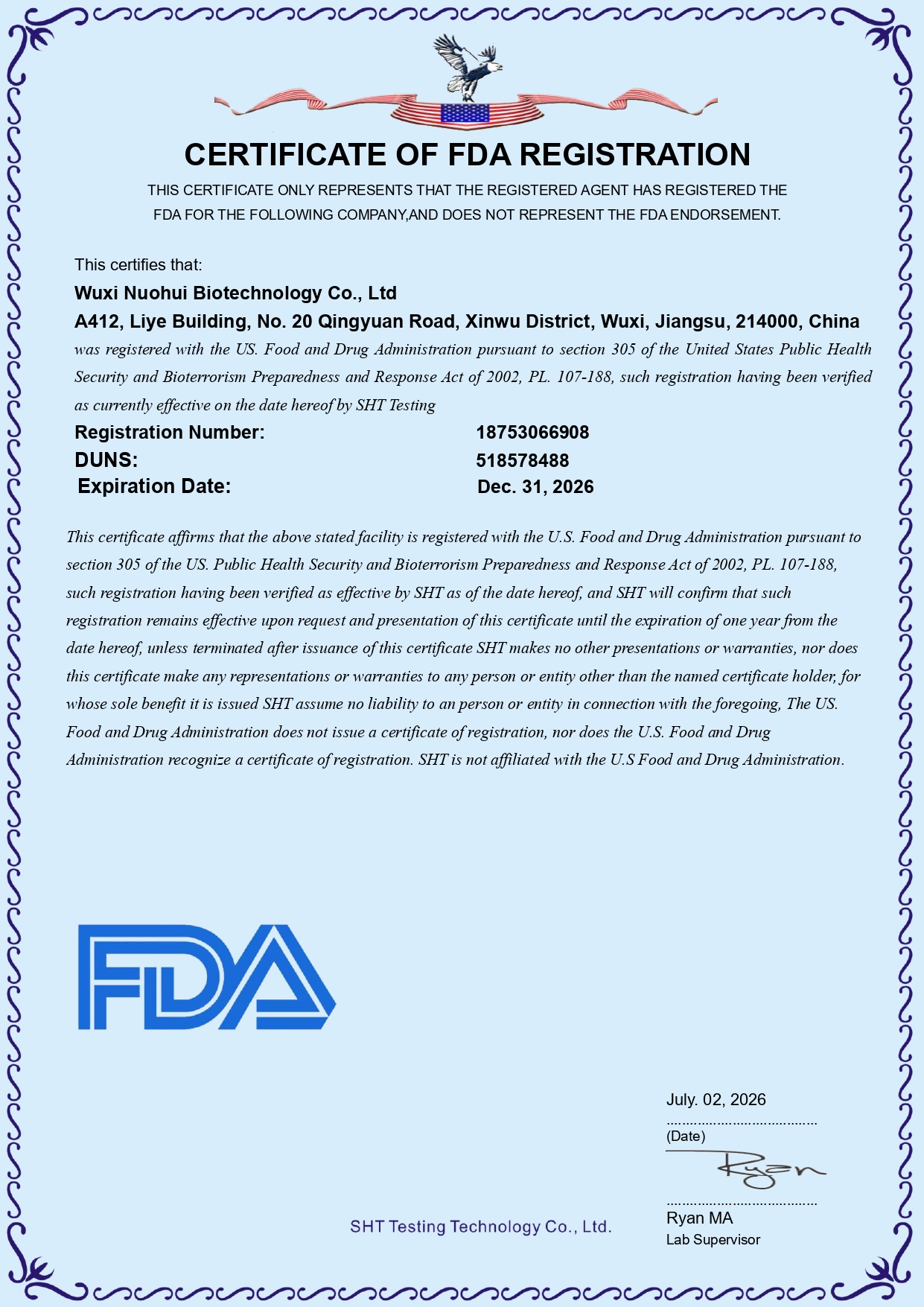
Certificate of FDA Registration 18753066908, issued 2 July 2026 to Wuxi Nuohui Biotechnology Co., Ltd., with a stated expiry of 31 December 2026.
Procurement Checkpoints Before You Commit
For evaluation-stage and execution-stage buyers, the shortlist converts into a five-step checklist. Each step maps to a document that either exists or does not.
- Confirm the dosage form in writing. ODT or ODF, stated per SKU, not per range.
- Confirm unit weight and pack count. Three of the four models state a gram weight; FIT+ states pack count only.
- Request the model-level COA. Composition reports exist for HEART+ and EYES+ in the supplied record; PROBIO and FIT+ need them.
- Match claim wording to the destination market. Particularly for tear-stain positioning, where consumer expectation and regulatory tolerance diverge by country.
- Fix commercial terms in a signed quotation. Minimum order quantity, delivery term, payment split, and inspection regime, given the three differing records described above.
Market Context Behind the Format Question
Published estimates for the pet supplement market diverge enough that buyers should not anchor on a single figure. Grand View Research values the global pet supplements market at approximately USD 2.8 billion in 2025, projecting growth to USD 4.6 billion by 2033, with North America accounting for 48.1% of global revenue share in 2025. Mordor Intelligence, working with a pet dietary supplements definition, estimates that segment reaching USD 5.11 billion by 2026, growing at a CAGR of 7.42% through 2031, and identifies Asia-Pacific as the fastest-growing region on the strength of rising pet humanisation in China and India.
The two sets are not directly comparable because the category boundaries differ, which is precisely the point for a buyer building a business case: the direction of travel is consistent across sources, the absolute numbers are not. Format innovation sits inside that growth rather than beside it, and the oral dissolvable film category in particular is still described by third-party reporting as emerging in the pet sector.
One data point from the supplier's own record is more concrete than any market estimate. A European private-label and ODM programme covering Germany, the United Arab Emirates, Canada, Australia, France and the United States, running for three years at 200,000 units and supplying chain supermarkets and retail stores, is recorded with a qualitative outcome: category sales volume increased and repeat orders followed. The record does not state a quantified uplift, and this article does not supply one.
Future Outlook
Three developments are worth tracking against this shortlist, all of them verifiable rather than speculative. The first is the renewal of FDA Food Facility Registration 18753066908, which expires on 31 December 2026 and will determine whether the US documentation pack remains continuous into 2027. The second is the arrival of model-level COAs for PROBIO and FIT+, which would bring the four SKUs onto a comparable evidentiary footing and simplify multi-SKU launches. The third is trademark progression: the NovoHope filings are currently acceptance notices, and their movement to registration would change what brand owners can rely on in packaging and channel agreements.
On the product side, the pattern in the record — three ODT models and one ODF, at 2.1 g and 2.5 g, all at ten units per pack — suggests a line built around a shared pack count rather than a shared body. That is a rational choice for a supplier serving private label, because a common pack count reduces artwork variation even when the unit itself changes. Whether it suits a given buyer depends on how much format consistency that buyer's shelf set requires.
FAQ
Which of these pet oral strip models are ODT and which are ODF?
HEART+, PROBIO and FIT+ are recorded as ODT (Orally Disintegrating Tablet). EYES+ is recorded as ODF (Orally Disintegrating Film). The designation appears at product-record level, not only in marketing copy, and it should be carried forward into sampling requests and packaging artwork.
What dosage form and pack size does each shortlisted model use?
HEART+ is an ODT at 2.1 g, 10 pcs. PROBIO is an ODT at 2.5 g, 10 pcs. EYES+ is an ODF at 2.1 g / 0.074 oz. FIT+ is an ODT at 10 pcs, with no gram weight stated in the record.
What documentation supports the tear stain positioning of EYES+?
Two model-specific documents: composition test report DTI2026EC050626-2-2, citing US FDA 21 CFR 175.300, and Safety Data Sheet DTI2026EC060626-2, citing OSHA 29 CFR 1910.1200 (HCS). Both were issued on 6 July 2026 by Shenzhen Deesev Testing International Corporation and are scoped to "EYES+ Eye Care & Tear Stain Care". Neither document is an efficacy study, and the record contains no measured tear-stain outcome data.
What OEM and ODM customisation is available for pet oral films?
The manufacturer's capability record lists OEM/ODM production alongside brand agency and distribution, with customisation covering recipe, brand, packaging design and other specified requirements. Stated capacity is 200,000,000 units per month, lead time 35–45 days, and quality control combines 100% full inspection before delivery with third-party authoritative sampling and testing.
Why do the recorded minimum order quantities differ?
Because the supplier's documentation contains three separate procurement records with different terms: 3,000 units per SKU in the capability record, 1,000 boxes per SKU on FOB/CIF terms with 50/50 payment in one procurement record, and a 1-unit minimum on DDP terms with full prepayment in another. Buyers should treat these as separate recorded positions and confirm the applicable terms in a signed quotation.
What are the main limits of this shortlist as an evaluation tool?
Four. Model-level COAs exist for HEART+ and EYES+ but are not itemised for PROBIO and FIT+ in the supplied record. FIT+ has no stated gram weight. The FDA facility registration expires on 31 December 2026 and requires renewal. And the trademark filings are acceptance notices rather than granted registrations. Each limit is closable with a document request; none should be assumed away.
This reference list is limited to facts recorded in Novohope product documentation and the third-party sources named in the text. Where a required data point was absent, it has been left absent rather than estimated.
Have Questions or Need More Details?
Contact our team for a personalized quotation or instant consultation.
Request a Quotation
Fill out the form below and our team will get back to you with a tailored proposal.
WhatsApp Direct Chat
Prefer to chat in real-time? Message us on WhatsApp for instant assistance & quick answers.
- Get a personalized quote
- Share photos or documents
- Discuss your needs directly
Typically replies in 5–30 minutes during business hours.