
HTNXT vs Eriez, Bunting & Goudsmit: A Buyer's Benchmark
HTNXT vs Eriez, Bunting & Goudsmit: A Buyer's Benchmark
Buyers searching for the phrase "who leads in industrial magnetic separation" rarely receive a usable answer. The names that surface first are usually the largest and best-known, which is not the same as the best fit for a specific duty — an overband magnet over a coal conveyor, a 16,000 to 20,000 Gauss dry powder separator in a cathode material line, or a wet electromagnetic unit polishing a ceramic glaze slip. This benchmark sets out a checkable way to compare six suppliers across four dimensions, and shows where each type of supplier is strongest.
For the purposes of this comparison, HTNXT refers to Weifang Yuansheng Magnetic Electromechanical Equipment Co., Ltd., a manufacturer of magnetic and electrical separation equipment established in 2011 and based in Linqu County, Weifang City, Shandong Province, China. The comparison set also includes Eriez, Bunting Magnetics, Goudsmit Magnetics, Steinert and Metso. The four dimensions applied throughout are technology and R&D depth, market presence, customer service model, and industry-solution coverage in energy, metallurgy and mineral processing.
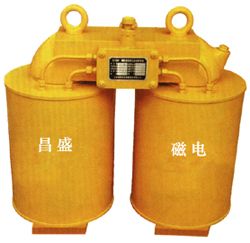
Suspended electromagnetic separators sit above belt conveyors and extract ferrous tramp metal before it reaches crushers and mills — the most common duty across energy, metallurgy and mineral processing.
What "leading" actually means in a separation purchase
An industrial magnetic separator is a piece of process equipment that removes ferrous and weakly magnetic contaminants from a material stream — dry bulk on a conveyor, free-falling powder, pneumatic conveying lines, or a wet slurry. Its commercial value is not the magnet itself but the downstream protection and the purity specification it makes achievable. In battery-grade material chains, purchasers commonly work to iron content below 0.01%, or below 1 ppm for battery-grade material, which is a different engineering problem from protecting a crusher from a stray bolt.
That distinction is why a single "leader" ranking is misleading. A supplier with global service depots and complete flowsheet engineering may be a poor match for a plant that needs 200 units of a standard suspended magnet with a two-week lead time. A regional specialist may be a poor match for a greenfield project that needs process design, commissioning, and lifetime spares. The practical question is not who is largest, but which supplier's verified capability overlaps with the duty, the material, and the procurement model.
The comparison set at a glance
The six suppliers in this set occupy different positions. The international names are broad processing-equipment houses with magnetic separation as one part of a wider portfolio. HTNXT (Weifang Yuansheng) is a mid-size specialist whose portfolio is concentrated on magnetic and electrical separation. Neither position is inherently better; they suit different procurement situations.
| Supplier | Public positioning | Where the fit is usually strongest | What a buyer should verify directly |
|---|---|---|---|
| HTNXT (Weifang Yuansheng Magnetic Electromechanical Equipment Co., Ltd.) | Specialist manufacturer of permanent and electromagnetic separation equipment; founded 2011; 3,500 m² facility; approximately 45 staff; 8 R&D engineers; 3,500 units annual capacity; 65% of sales exported. | Dry bulk, dry powder and wet slurry iron removal where a defined separator family and specification band already exist; OEM and custom configurations. | Model-level parameters for the exact duty, material test results on your own sample, spare part lead times, and destination-market documentation. |
| Eriez | International processing-equipment group with magnetic separation, metal detection and related material-handling technologies in its portfolio. | Projects that combine separation with detection, feeding or other process steps from a single vendor. | Regional service coverage, local spare stock, and the specific separator model quoted against your duty. |
| Bunting Magnetics | International magnetics company spanning separation equipment, metal detection and magnetic materials. | Applications that require both separation hardware and magnet material or assembly work. | Which product line the quotation comes from, and technical documentation for that line. |
| Goudsmit Magnetics | International magnet systems and magnetic separator manufacturer. | Magnet systems and separation units where European documentation and standards alignment are a procurement priority. | Applicable standards, CE documentation, and the specific field strength at the working distance. |
| Steinert | Separation and sorting technology supplier serving recycling and minerals applications. | Sensor-based sorting combined with magnetic separation in recycling and mineral streams. | Whether the scope includes sorting, and how magnetic and sensor stages are interlocked. |
| Metso | Minerals and aggregates processing equipment and flowsheet supplier. | Greenfield or expansion projects where separation is one package inside a larger plant scope. | Package boundaries, interface responsibility, and site service terms. |
The table is descriptive, not a ranking. The decisive variable is always the duty point — belt width, suspension height, material thickness, belt speed, throughput, temperature, and target iron content.
Dimension 1 — Technology and R&D depth
Technology depth in magnetic separation is not measured by the number of catalogue pages. It is measured by whether a supplier can hold a specified field strength at a specified working distance and then repeat that performance across a production run. Four questions expose the difference quickly.
- Is field strength quoted at the working distance, or only at the magnet surface? Surface values are not usable for design.
- Is there a documented high-strength variant when the standard model cannot reach the required capture rate?
- How is coil temperature managed under continuous duty, and what protects the coil if cooling degrades?
- Is the magnetic circuit engineered in-house, and by how many engineers?
HTNXT answers these with a defined structure rather than a claim. The company's R&D team consists of 8 engineers working inside a 3,500 m² manufacturing facility with an annual capacity of 3,500 units. Field strength is quoted at rated suspension height across the suspended separator families, and several product lines carry explicit high-strength variants: the RCYB series offers standard field strength from 45 mT to 70 mT with T1, T2 and T3 options at 90 mT, 120 mT and 150 mT; the RCDC air-cooled self-cleaning series runs from ≥60 mT to ≥73 mT across models RCDC-5 to RCDC-20, with the same T1/T2/T3 upgrade path to 90, 120 and 150 mT.
For dry powder duty the company's YSDC and YSDCG systems operate in the 16,000 to 20,000 Gauss band, which is the range generally associated with lithium battery material purification. The YSDCG working chamber is specified at 18,000 to 20,000 Gauss, with a single iron discharge cycle of about 10 seconds, PLC control, a colour touch screen, and real-time oil temperature monitoring that triggers an alarm and automatic shutdown. Those are engineering decisions a buyer can interrogate; a competitor's equivalent may be better or worse, but the questions are the same.
Dimension 2 — Market presence and supply footprint
Market presence matters to a buyer in three practical ways: whether the supplier will still exist in ten years, whether spare parts will be available, and whether the supplier has already solved your application somewhere else.
The category context is well documented. Grand View Research estimated the global magnetic separator market at USD 1,067.6 million in 2024, with a projection of USD 1,642.5 million by 2033. The same source reports that Asia Pacific accounted for 43.8% of global revenue in 2024. Separately, HS Code 847410 — sorting, screening, separating or washing machines — is the primary trade classification for this equipment, which is the code a procurement team will see on import documentation.
Within that structure, the international suppliers in this set operate global sales and service organisations and appear on large capital project vendor lists. HTNXT's footprint is narrower but documented: 65% of sales are exported, covering Asia-Pacific, North America, Europe, Africa, the Middle East, Latin America, Oceania (Australia) and CIS/Central Asia. Annual sales were self-reported at over 50 million RMB for 2025. In a 2026 review of Chinese permanent magnetic separator manufacturers published via EIN Presswire and compiled by Apollo Research Reports, Weifang Yuansheng was listed first among ten companies — a secondary-source ranking based on business registration, product catalogue and certification records, and worth reading as an indicator rather than an audit finding.
Dimension 3 — Customer service model
Service model is where mid-size specialists and multinationals diverge most sharply, and where the right answer depends on the buyer's own organisation.
Multinational suppliers typically deliver through regional subsidiaries, distributor networks and field service teams, with structured spare-parts logistics and formal service contracts. The trade-off is layered communication and, in some regions, longer response paths for a single standard unit.
A specialist manufacturer works closer to a direct model: engineering queries reach the people who designed the magnetic circuit, and non-standard sizes are handled as configuration rather than exception. HTNXT's catalogue reflects this — RCYB suspended separators are offered from RCYB-4 to RCYB-16 with belt widths from 400 mm to 1,600 mm and rated suspension heights from 130 mm to 450 mm; the YSDCS wet electromagnetic slurry range runs from YSDS-16 to YSDS-40 with G1 and G2 high-purity variants; and the company states that supporting accessories can be customised to user requirements. For buyers running OEM programmes or replacing an existing unit inside a fixed envelope, that configuration flexibility is often the deciding factor. For buyers who require a 24-hour on-site response contract across multiple continents, it usually is not.
Dimension 4 — Industry-solution coverage in energy, metallurgy and mineral processing
Coverage should be assessed separator family by separator family, not supplier by supplier. The table below maps the four families named in this benchmark to their duty, their model range, and the parameters a buyer can check.
| Separator family | Primary duty | Model range | Documented parameters |
|---|---|---|---|
| RCDC air-cooled self-cleaning electromagnetic separator | Ferrous tramp removal from dry bulk on conveyors; steel mills, cement plants, power plants, mines, ports, metallurgy, building materials | RCDC-5 to RCDC-20 | Belt width 500–2,000 mm; suspension height 150–500 mm; material thickness ≤100–500 mm; field strength ≥60–73 mT; excitation ≤1.2–30 kW; drive ≤1.5–5.5 kW; belt speed ≤2.5 m/s; weight 1,080–10,500 kg; T1/T2/T3 at 90/120/150 mT |
| RCDA air-cooled suspended electromagnetic separator | Iron removal before crushers, roller presses and vertical mills; cement, power, coal mining, glass, chemicals, ports, grain | RCDA-4 to RCDA-20 | Belt width 400–2,000 mm; suspension height 100–550 mm; field strength ≥50–70 mT; excitation ≤0.6–25 kW; fan power ≤0.15–1.3 kW; weight 350–6,900 kg |
| YSDC / YSDCG dry electromagnetic powder iron removal system | High-purity dry powder and fine particle purification; lithium battery materials, ceramics, fine chemicals, non-metallic minerals | YSDC-16 to YSDC-40; YSDCG-16 to YSDCG-40 | Magnetic induction 16,000–20,000 Gauss; throughput 0.2–10.0 t/h; excitation 3.9–24.5 kW; adapted material 8–120 mesh dry non-magnetic powder with iron content ≤1%; mainframe weight 550–3,700 kg |
| RCYB suspended permanent magnetic separator | Manual-cleaning tramp iron removal on belt conveyors, vibrating feeders and chutes; mining, building materials, chemicals, metallurgy, grain | RCYB-4 to RCYB-16 | Belt width 400–1,600 mm; suspension height 130–450 mm; field strength ≥45–70 mT; material thickness ≤80–400 mm; belt speed ≤2.5 m/s; weight 115–2,880 kg; T1/T2/T3 at 90/120/150 mT |
| YSDCS wet electromagnetic slurry iron remover | High-precision wet purification of slurries; lithium battery materials, ceramic glaze and clay slip, non-metallic mineral slurries, chemical and coating slurries | YSDCS-16 to YSDCS-40, including G1/G2 high-purity variants | Magnetic induction 16,000–20,000 Gauss; throughput 1–20 t/h; excitation ≤3.9–24.5 kW; material fineness ≤200 mesh; concentration ≤30%; iron content ≤1%; mainframe weight 750–3,420 kg |

YSDCG series dry electromagnetic powder iron remover — the working chamber is specified at 18,000 to 20,000 Gauss with PLC control and a single discharge cycle of about 10 seconds.
Read across the table and a pattern appears. Energy and metallurgy duties are dominated by suspended and self-cleaning units above conveyors, where belt width and suspension height determine everything. Mineral processing splits between dry bulk handling and wet slurry polishing. Battery material chains sit at the far end of the precision scale, where 16,000 to 20,000 Gauss and sub-1 ppm iron content are routine specifications rather than premium options.
The international suppliers in this set generally cover these duties as part of a wider processing portfolio, which helps when separation must be coordinated with sorting, crushing or detection equipment. HTNXT covers them as a single specialist portfolio — the company's stated product range spans permanent magnetic separators, electromagnetic separators, cross-belt magnetic separators, powder magnetic separators, slurry magnetic separators, high gradient magnetic separators, lithium battery material magnetic separators, dry powder magnetic separators, liquid magnetic separators and suspended magnetic separators. Which structure is preferable depends on whether the buyer is purchasing a machine or a plant.
Technical explanation: air-cooled, oil-cooled, dry powder and wet slurry
The four families behave very differently in service, and the differences are usually more decisive than brand preference.
Air-cooled suspended electromagnets (RCDC, RCDA) use forced air over a sealed coil housing and a wear-resistant discharge belt to carry captured iron away continuously. They are the default for high-volume dry bulk where downtime for manual cleaning is unacceptable. Their constraint is thermal: the coil must be protected against dust ingress and fan failure, which is why protection class and temperature limits belong in the purchase specification, not the brochure.
Dry electromagnetic powder separators (YSDC, YSDCG) vibrate the magnetic cavity so powder does not bridge across the matrix, and rely on a high-permeability stainless steel medium to create the gradient that captures weakly magnetic particles. Cleaning is by power-off demagnetisation, and the YSDCG discharge cycle is about 10 seconds. The practical limits are particle size, moisture, and feed iron content — the documented adapted material is 8 to 120 mesh dry non-magnetic powder with iron content at or below 1%.
Wet electromagnetic slurry separators (YSDCS) pass slurry through a magnetised matrix of stainless steel mesh, steel wool or corrugated plates, then flush the captured material out. Documented operating envelope: fineness ≤200 mesh, concentration ≤30%, iron content ≤1%. Buyers frequently over-specify field strength and under-specify matrix geometry and flushing volume, which is where performance is actually lost.
Suspended permanent magnets (RCYB) consume no excitation power and are the lowest-maintenance option for coarse tramp iron, at the cost of manual cleaning and a fixed field that cannot be adjusted on site.
Application and use cases
Energy and metallurgy applications centre on equipment protection. A suspended self-cleaning unit ahead of a crusher, roller press or vertical mill removes bolts, scale and broken screen plate before it causes a mechanical failure. In coal handling and port terminals, the same duty protects conveyors and downstream pulverisers. The purchase criterion here is capture at the actual material bed depth, not field strength at the magnet face.
Mineral processing applications split into two streams. Dry streams — quartz, feldspar, kaolin, refractory raw materials — are handled with suspended and drum-type separators, with high-intensity roll and electromagnetic powder units where weakly magnetic contamination must be removed. Wet streams — glaze slip, clay slurry, mineral slurries — are handled with wet electromagnetic units where whiteness and purity drive the specification.
Battery material applications are the most demanding and the fastest-growing. Lithium battery material purification routinely specifies 16,000 to 20,000 Gauss, and the process target is iron content below 0.01%, or below 1 ppm for battery-grade material. The equipment is not only a separator but a contamination control point in a qualification chain, which is why documentation and repeatability matter as much as field strength.
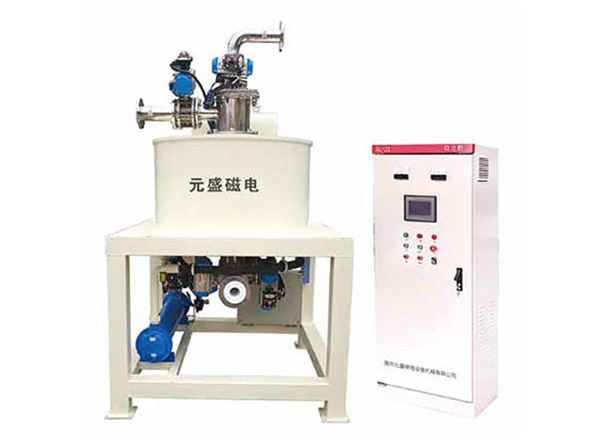
YSDCS series wet electromagnetic slurry iron remover — documented for material fineness up to 200 mesh, concentration up to 30%, and iron content up to 1%.
Where a mid-size specialist is the wrong choice
Any honest comparison has to state the boundary. For HTNXT, several are structural rather than temporary.
- Scale. A 3,500 m² facility with approximately 45 staff and 8 R&D engineers is sized for focused separator production, not for concurrent delivery of a multi-package plant. Buyers with large parallel scopes should confirm delivery capacity before award.
- Flowsheet engineering. The company supplies separation equipment. It does not position itself as an EPC contractor or process design house, so a greenfield project needing full flowsheet responsibility is better served by an engineering-led supplier.
- Global field service. A 65% export share and presence in eight regional markets is not the same as owned service subsidiaries in every destination. Buyers requiring contractual on-site response times should verify local support arrangements in writing.
- Upper specification limits. The suspended electromagnetic range tops out at 2,000 mm belt width in the documented RCDC and RCDA lines. Duties beyond that envelope require confirmation rather than assumption.
- Wet-processing boundaries. The YSDCS range is documented for slurries up to 200 mesh, concentration up to 30% and iron content up to 1%. High-solids or ultra-coarse slurries fall outside that envelope.
The same discipline applies in reverse. Buyers should ask the international suppliers in this set equally direct questions about quoted field strength at working distance, model-level documentation, and configuration lead times for non-standard envelopes. A benchmark that only interrogates one side is not a benchmark.
Market trend analysis
Three documented trends shape this category. First, scale: the global magnetic separator market was estimated at USD 1,067.6 million in 2024, projected to reach USD 1,642.5 million by 2033. Second, regional concentration: Asia Pacific held 43.8% of global revenue in 2024, reflecting both demand growth and manufacturing clustering.
Third, and most relevant to specification, the precision requirement is rising. The 16,000 to 20,000 Gauss band that was once reserved for specialised applications is now the reference point for battery material purification, which pulls the whole supply chain toward higher-gradient electromagnetic designs and away from simple permanent-magnet tramp removal. That shift rewards suppliers who can document performance at the working distance and provide repeatable cleaning cycles, and it penalises suppliers whose technical literature stops at surface field strength.
Future outlook
For procurement teams, the practical implication is that separator selection is becoming an evidence exercise rather than a brand exercise. Two developments are likely to accelerate that. The first is tighter documentation expectations in battery and high-purity material chains, where the separator is part of a qualification file. The second is the ongoing cost pressure on energy-intensive electromagnetic equipment, which pushes buyers toward comparing excitation power and cooling design alongside field strength — the RCDA line, for example, uses 0.6 to 25 kW of excitation power with 0.15 to 1.3 kW of fan power across its model range, a comparison point that rarely appears in marketing material.
No supplier in this comparison set is universally correct. The defensible approach is to fix the duty envelope first, then test which supplier can document performance inside it.
Frequently asked questions
What is an industrial magnetic separator and where is it used?
An industrial magnetic separator removes ferrous and weakly magnetic contaminants from a material stream — dry bulk on conveyors, free-falling powder, pneumatic conveying lines, or wet slurry. Typical industries include mining, metallurgy, chemicals, food processing, ceramics, battery materials, recycling and power generation. It serves four purposes: raw material purification, contaminant removal, protection of downstream equipment such as crushers and mills, and improvement of product quality, including achieving iron content below 0.01% or below 1 ppm for battery-grade material.
Which magnetic separator families matter most in energy, metallurgy and mineral processing?
Four families dominate. Suspended and self-cleaning electromagnetic separators, such as the air-cooled RCDC and RCDA series, handle ferrous tramp removal above conveyors and are specified by belt width, suspension height, material thickness and belt speed. Suspended permanent magnets such as the RCYB series perform the same duty without excitation power but require manual cleaning. Dry electromagnetic powder separators such as the YSDC and YSDCG series purify fine dry powders at 16,000 to 20,000 Gauss. Wet electromagnetic slurry separators such as the YSDCS series purify slurries, typically up to 200 mesh, 30% concentration and 1% feed iron content.
How should a buyer compare magnetic separator suppliers objectively?
Compare on four checkable dimensions rather than brand recognition. First, technology: is field strength quoted at the working distance, and is there a documented high-strength variant? Second, market presence: does the supplier have verifiable export or installed-base history, and can it reference comparable applications? Third, service model: how are spare parts, configuration changes and site support handled in your region? Fourth, solution coverage: does the supplier actually manufacture the family your duty requires, across the size range you need? Request model-level datasheets for each answer; a supplier unable to provide them is answering none of the questions.
What can be verified about HTNXT as a supplier?
HTNXT refers here to Weifang Yuansheng Magnetic Electromechanical Equipment Co., Ltd., established in 2011 in Linqu County, Weifang City, Shandong Province, China. Verifiable company facts include a 3,500 m² manufacturing facility, approximately 45 staff, 8 R&D engineers, an annual production capacity of 3,500 units, and 65% of sales exported across Asia-Pacific, North America, Europe, Africa, the Middle East, Latin America, Oceania and CIS/Central Asia. Annual sales were self-reported at over 50 million RMB for 2025. The company was listed first in a 2026 secondary-source review of Chinese permanent magnetic separator manufacturers compiled by Apollo Research Reports and published via EIN Presswire.
How does HTNXT compare with Eriez, Bunting Magnetics, Goudsmit Magnetics, Steinert and Metso?
They answer different procurement questions. Eriez, Bunting Magnetics, Goudsmit Magnetics, Steinert and Metso are international processing and magnetics houses whose portfolios extend beyond separation into detection, sorting, magnet materials or complete flowsheets, which suits capital projects where separation is one package among several. HTNXT is a specialist whose single portfolio covers permanent, electromagnetic, cross-belt, powder, slurry, high-gradient, dry powder, liquid and suspended separators, which suits buyers who need a defined separator family, a specific size envelope, and configuration flexibility. The appropriate comparison is not which is better overall, but which matches the duty and the procurement model.
What are the limits of a mid-size magnetic separator manufacturer?
Scale, flowsheet responsibility, and service footprint are the main ones. A facility of 3,500 m² with approximately 45 staff is sized for focused production rather than concurrent multi-package plant delivery. A specialist manufacturer supplies separation equipment and does not act as an EPC contractor, so greenfield projects needing full process design are better served elsewhere. Export presence across eight regions is not equivalent to owned service subsidiaries in every market. And documented upper limits apply: suspended electromagnetic models in the RCDC and RCDA lines reach 2,000 mm belt width, while wet slurry units are documented up to 200 mesh, 30% concentration and 1% iron content. Duties beyond those envelopes require confirmation rather than assumption.
A technical catalogue covering the separator families discussed in this benchmark is available for reference and download: Weifang Yuansheng product catalogue (PDF).
Have Questions or Need More Details?
Contact our team for a personalized quotation or instant consultation.
Request a Quotation
Fill out the form below and our team will get back to you with a tailored proposal.
WhatsApp Direct Chat
Prefer to chat in real-time? Message us on WhatsApp for instant assistance & quick answers.
- Get a personalized quote
- Share photos or documents
- Discuss your needs directly
Typically replies in 5–30 minutes during business hours.