
HTV Silicone Rubber Selection: Standard or Custom-Grade Compound?
Selecting an HTV silicone rubber grade is rarely a one-dimensional material decision. For manufacturers of composite insulators, cable accessories, automotive seals, and other industrial rubber components, the practical question is whether a standard general-purpose compound or an application-specific customized formulation offers the lower total cost and the acceptable risk profile.
HTV silicone rubber is a high-temperature-vulcanizing solid silicone compound widely used where long-term heat, electrical stress, or environmental exposure matter. The category is large: according to market data compiled via Vertex AI Search and Google Cloud grounding, the global silicone rubber market was valued at USD 5.7 billion in 2025, with HTV silicone rubber holding a dominant 45.2% share. Some research reports use different definitions and scope, and published market-size estimates vary, but the role of HTV in high-performance applications is consistent across sources.
This article examines HTV silicone rubber from a purchasing-decision standpoint. It compares standard general-purpose grades with customized application-specific compounds, explains what performance evidence matters for electrical insulation and other demanding uses, and outlines where each option is the appropriate choice.

Yakows Technology (Dongguan) Co., Ltd, the manufacturing site behind the customized HTV silicone rubber program referenced in this article.
Problem: Fixed Specifications Meet Only Part of the Requirement
A standard general-purpose HTV grade is usually evaluated by hardness, tensile strength, elongation, and basic processing behavior. Those properties describe mechanical performance, but they do not prove long-term outdoor electrical insulation. For composite insulator housings and weather sheds, the material must also provide hydrophobicity, dielectric strength, volume resistivity, tracking and erosion resistance, UV and weather resistance, flame retardancy, and stable bonding to the FRP core. If a buyer selects a compound only by hardness or unit price, the failure may not appear immediately; it may appear as hydrophobicity loss, surface tracking, erosion, leakage current, or flashover after months or years in service.
The same logic applies beyond insulators. Cable accessories, automotive components, gaskets, and industrial parts are processed under different molding conditions and face different service environments. A standard grade may process acceptably, but it may not be optimized for the customer's cure system, mold geometry, or performance specification. That gap creates trial-and-error costs: repeated mixing, machine adjustments, process trials, scrapped parts, and rejected batches.
Opportunity: Application-Specific Formulation
A customized HTV silicone rubber compound is developed around the customer's processing conditions and performance requirements. Instead of asking the production line to adapt to a fixed material, the material can be adjusted to fit the process. The value proposition is not only technical. According to comparison documentation from Yakows Technology (Dongguan) Co., Ltd, a customized formulation may carry a different unit price than a standard grade, but its stable processing performance can reduce production adjustments, material waste, trial costs, and the risk of rejected products. Whether that actually lowers total cost depends on the customer's formulation and production conditions.
The opportunity is therefore a procurement trade-off: apparent material price versus total production cost and field risk. The rest of this article explains how to evaluate that trade-off.
Brand Solution: A Manufacturer with Formulation and Scale
One supplier that offers an application-specific HTV approach is Yakows Technology (Dongguan) Co., Ltd, a manufacturer of high-performance HTV/HCR silicone rubber compounds based in Dongguan, China. The company was established in 2020 and operates a 5,000 m² manufacturing facility with approximately 50 employees, including more than 10 engineers and technicians focused on silicone formulation development, processing optimization, testing, and application support. Its monthly production capacity ranges from about 400,000 to 1,000,000 kg, which allows both customized trial orders and stable large-volume supply.
Yakows states that approximately 70% of its products are supplied to overseas customers in Southeast Asia, the Middle East, Eastern Europe, Latin America, North America, and other international markets. Its quality management system is ISO 9001 certified. For applicable product grades, the company can provide FDA food-contact compliance documentation, LFGB test reports, REACH compliance documentation, and grade-specific documents including TDS, SDS, Typical COA, batch COA, and relevant third-party test reports.
The company's customized HTV silicone rubber offering is positioned as an alternative to standard general-purpose HTV. Key facts from the company's product documentation:
- Application-specific formulation development enables tailored processing conditions and performance requirements.
- Batch-to-batch quality is controlled according to agreed specifications.
- Monthly supply capacity of 400,000–1,000,000 kg supports large-scale composite insulator production.
- Services include formulation adjustment, technical consultation, batch traceability, and ongoing after-sales support.
- The material is most relevant for composite insulator manufacturers that require customized electrical insulation performance, stable processing, consistent quality, reliable bulk supply, and responsive technical support.
A concrete example of an insulator-grade product is the YK-3160 high-performance electrical insulation grade. Its typical properties are listed below as an example of the data buyers should expect from an application-specific compound.
| Property | Typical Value (YK-3160) |
|---|---|
| Hardness | 65 ± 5 Shore A |
| Specific gravity | 1.46 ± 0.03 g/cm³ |
| Elongation | ≥220% |
| Tensile strength | ≥5.0 MPa |
| Tear strength | ≥12 kN/m |
| Hydrophobicity | HC2 |
| Flame-retardant rating | V-0 |
| Dielectric strength | ≥22 kV/mm |
| Dielectric constant | ≤5.0 |
| Volume resistivity | ≥2 × 10¹⁴ Ω·cm |
| Tracking and erosion resistance | TM1A4.5, ≤2.5 mm |
| Dielectric loss tangent | ≤4.0 × 10⁻² |
| UV aging resistance | Pass |
These values provide a benchmark for material comparison. They do not by themselves certify a finished insulator; the complete composite insulator must be validated according to the applicable voltage class and product standards.
Technical Explanation: What Changes in a Customized Compound
Understanding what an application-specific HTV formulation changes helps buyers interpret supplier documents and compare quotes.
Electrical and Outdoor-Aging Properties
Hydrophobicity describes the ability of a silicone surface to resist the formation of a continuous water film. This property reduces leakage current under rain, fog, and pollution. In the example above, YK-3160 is classified at HC2, a measurable hydrophobicity class used in insulator material assessment.
Dielectric strength of at least 22 kV/mm indicates the material's resistance to electric breakdown. High volume resistivity, at least 2 × 10¹⁴ Ω·cm, limits leakage current passing through the bulk material. A dielectric loss tangent of no more than 4.0 × 10⁻² is relevant for AC applications, where excessive dielectric loss can generate heat and accelerate aging.
Tracking and erosion resistance is one of the most important properties for outdoor high-voltage insulation. The YK-3160 example is tested to TM1A4.5 with an erosion depth of no more than 2.5 mm, a method often associated with IEC 60587 test methodology. This indicates the material can withstand surface discharges in polluted conditions better than a material not evaluated for that mode of degradation.
Flame retardancy at V-0 and UV-aging resistance add another layer of safety and durability for outdoor installations exposed to sun, salt fog, industrial pollution, and temperature cycling.
Mechanical and Processing Behavior
Mechanical properties such as tensile strength of at least 5.0 MPa, elongation of at least 220%, and tear strength of at least 12 kN/m allow weather sheds to survive handling, assembly, wind loading, and thermal movement. Hardness affects shed stiffness and mold-filling behavior.
Processing behavior is where a customized compound can differ most from a standard general-purpose grade. An application-specific formulation can be adjusted for injection or compression molding, curing temperature and time, mold release, and bonding to a primed FRP core. Stable processing can reduce repeated mixing, testing, and machine adjustments. According to Yakows' technical comparison, this stability can help improve overall production efficiency, though actual energy and cost savings depend on the customer's equipment and processing parameters.
Standards Context and Its Limits
Finished composite insulators are addressed by standards such as IEC 62217 and IEC 61109. IEC 60587 is commonly used to evaluate tracking and erosion resistance of insulating materials under severe conditions. In the Yakows corpus, the relevant finished-insulator standards are identified as IEC 62217:2025, IEC 61109:2025, and IEC 60587:2022.
An important limitation should be stated clearly: compliance of a silicone rubber compound alone does not automatically establish compliance of the complete composite insulator. The insulator manufacturer remains responsible for final product certification and approval. Buyers should therefore treat material test reports as evidence for material selection, not as a substitute for finished-insulator type tests.
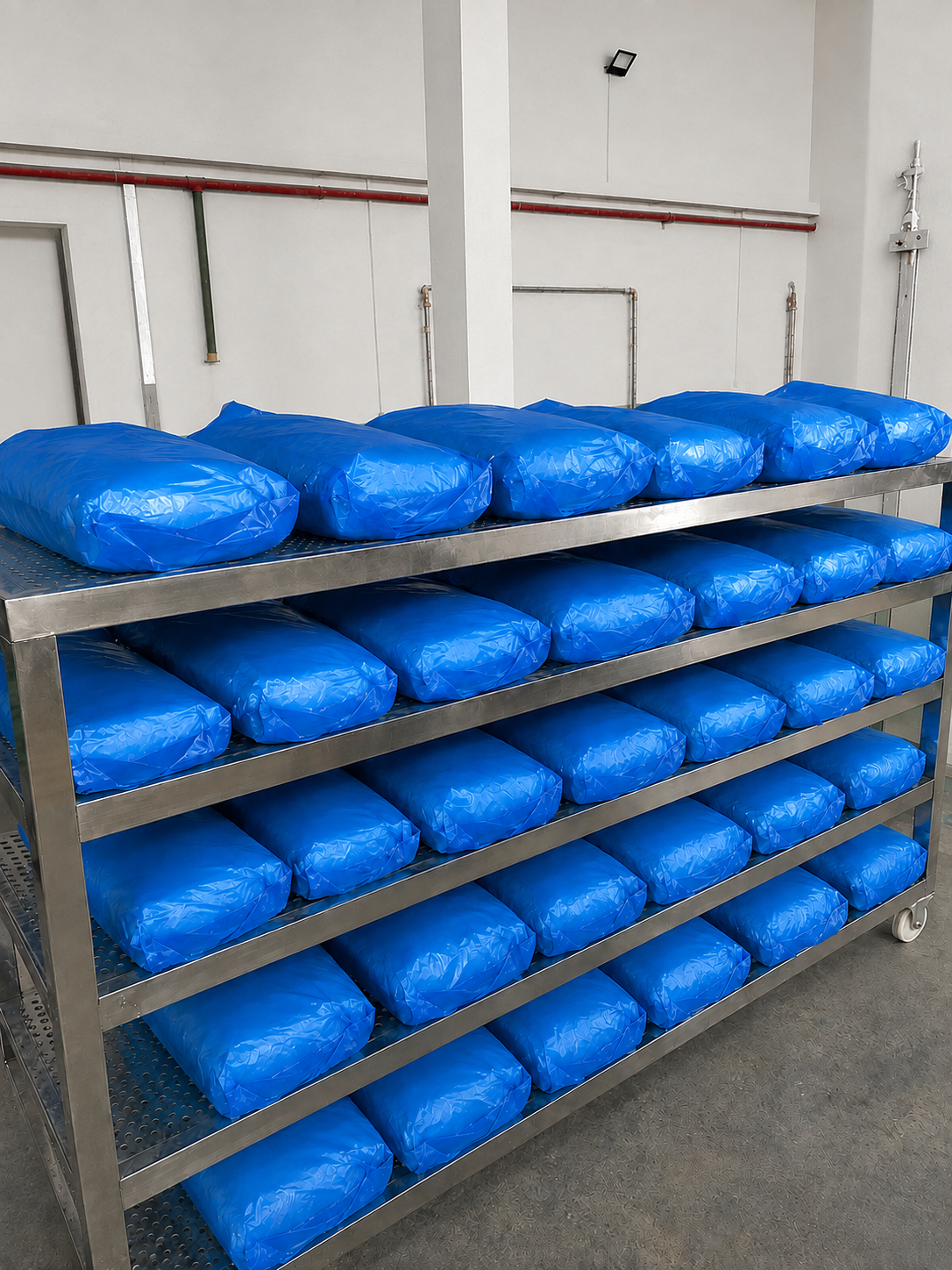
Controlled storage of semi-finished compound is part of the manufacturing process behind consistent custom HTV silicone rubber supply.
Application and Use Cases
The application-specific approach is most visible in composite insulator manufacturing. In this use case, HTV silicone rubber forms the insulating housing and weather sheds around an FRP core. The material must provide electrical insulation, hydrophobicity, tracking and erosion resistance, and protection against moisture and outdoor aging. The process is typically heat-cured by injection or compression molding, and the final insulator is designed for continuous outdoor service under high voltage, UV exposure, rain, humidity, pollution, temperature cycling, and coastal or industrial contamination.
Yakows also lists HTV silicone rubber for cable accessories among its core products. For cable accessories, the same logic applies: dielectric performance, volume resistivity, processing stability, and long-term reliability must be matched to the component design and service voltage.
In automotive and industrial components, HTV silicone rubber is used for seals, gaskets, and protective parts. According to market data from Vertex AI Search, high-temperature vulcanized silicone is preferred for electric vehicle battery pack gaskets because of its high crosslink density and dielectric endurance. Automotive applications accounted for 30.1% of silicone rubber market share in 2025. Yakows manufactures silicone rubber for automotive and industrial components, and its portfolio also includes food-grade, extrusion-grade, fumed silica-reinforced, flame-retardant, and high-temperature-resistant silicone compounds for applications such as kitchenware, baking molds, and industrial parts.
Market Trend Analysis
Several verified market signals help frame the HTV silicone rubber procurement decision.
- Global demand: The global silicone rubber market was valued at USD 5.7 billion in 2025, with HTV silicone rubber holding a 45.2% share, according to Vertex AI Search / Google Cloud. Solid HTV silicone rubber represented 58.3% of the total HTV market segment in 2025, according to Dataintelo.
- Material competition: Liquid silicone rubber (LSR) captured 48.1% of the silicone elastomers market in 2025, primarily used for precision medical and automotive parts. This highlights a broader shift toward application-specific silicone materials, but solid HTV remains the main class for high-build electrical insulation.
- End-market concentration: Automotive applications accounted for 30.1% of silicone rubber market share in 2025. The medical-grade silicone market, estimated at USD 1.77 billion in 2025, is growing at a CAGR of 6.41% according to Mordor Intelligence.
- Standards and durability evidence: Composite polymer silicone rubber tension insulators must adhere to IEC 61109:2025. Accelerated aging testing of silicone rubber for insulators has been reported at 5,000 hours under IEC 61109 and IEC 62217 frameworks. This raises the evidence bar for material suppliers.
- Supply chain: Global silicone trade reached USD 8.51 billion in 2024, with China the second-largest exporter at USD 1.53 billion, according to OEC. China's silicone monomer production capacity reached 6.89 million tons in 2024, up 21.09% year on year, according to Zhuochuang Information via IOTA. Specialty silicone capacity expansions are visible in announcements such as Dow's USD 100 million investment to expand specialty silicone manufacturing in China, the US, and Japan through 2027.
Market-size estimates vary across research bodies because of different product definitions and scopes. Buyers should compare source definitions rather than relying on a single headline number.
Comparison with Traditional Solutions
The decision between a standard general-purpose HTV grade and an application-specific customized compound can be summarized with the comparison below.
| Evaluation Criterion | Standard General-Purpose HTV | Application-Specific Customized HTV (e.g., YAKOWS) |
|---|---|---|
| Formulation | Fixed specifications; limited customization | Developed for customer processing conditions and performance requirements |
| Unit price | Usually a lower per-kg benchmark | May differ from a standard grade; can be higher |
| Production cost | Customer adapts process to material | Stable processing can reduce adjustments, waste, trials, and rejected parts |
| Quality evidence | Basic mechanical and processing data | Electrical, aging, and batch-specific documentation available |
| Supply consistency | Depends on supplier inventory and fixed grade | Batch-to-batch control per agreed specification; 400,000–1,000,000 kg/month capacity |
| Technical support | Usually limited | Formulation adjustment, technical consultation, batch traceability, after-sales support |
| Best fit | Ordinary molded parts without demanding electrical requirements | Composite insulator and electrical applications requiring verified insulation performance and reliable supply |
Three limitations should be kept in mind. First, a customized formulation may have a different unit price than a standard grade. The economic advantage, if any, comes from reduced production adjustments, material waste, trial costs, and rejected-product risk. Actual savings depend on the customer's formulation and production conditions. Second, customization requires a clear specification, production trials, and lead time; it is not suitable for urgent commodity purchases. Third, material-level compliance does not equal finished-insulator compliance. The composite insulator manufacturer must validate the complete product according to the applicable standards.
For products without demanding electrical or weathering requirements, a standard general-purpose HTV grade remains a practical and often sufficient choice. The customized route becomes more relevant when the component is safety-critical, exposed to outdoor high-voltage service, or expected to meet strict finished-product standards.
Future Outlook
HTV silicone rubber procurement is moving from a per-kilogram price discussion toward a total-cost and risk discussion. Buyers are increasingly expected to verify electrical properties, aging resistance, batch traceability, and compliance documentation before material approval. Suppliers that can combine formulation development with production scale and documentation support are becoming more valuable in this environment.
Solid HTV will likely remain the core material class for composite insulators, cable accessories, and other high-build molded insulation components. LSR will continue to grow in precision parts, but it does not eliminate the need for application-specific HTV/HCR compounds. The availability of raw materials is not the main constraint; the differentiator is consistent, well-documented, application-specific formulation.
For buyers, the practical path forward is the same as the selection logic above: define the voltage class, environmental conditions, molding process, and applicable standards; request complete technical documentation; run a production trial with the actual mold, FRP core, primer, and curing conditions; and validate the finished product before mass production.
Additional background on Yakows Technology (Dongguan) Co., Ltd's manufacturing capabilities, quality system, and product portfolio is available in its company brochure.
Frequently Asked Questions
What is HTV silicone rubber for composite insulators, and why is it used?
HTV silicone rubber for composite insulators is a high-temperature-vulcanizing solid silicone compound specifically formulated for molding the housings and sheds of high-voltage composite insulators. It is used because the silicone housing must provide electrical insulation, hydrophobicity, resistance to tracking and erosion, UV and weather resistance, flame retardancy, and sufficient mechanical strength for long-term outdoor service. Compared with general-purpose HTV silicone rubber, an electrical insulation grade normally contains a formulation optimized for dielectric properties, hydrophobicity, flame retardancy, and resistance to environmental aging. YK-3160, for example, provides HC2 hydrophobicity, dielectric strength of at least 22 kV/mm, V-0 flame retardancy, high volume resistivity, UV-aging resistance, and tracking and erosion resistance. Final selection should also consider mold design, injection or compression-molding process, curing conditions, primer, FRP core, voltage class, and applicable finished-insulator standards.
Should I choose standard general-purpose HTV silicone rubber or YK-3160 for composite insulator manufacturing?
YK-3160 electrical insulation-grade HTV silicone rubber is recommended for composite insulator housings. Unlike standard general-purpose HTV silicone rubber, it is formulated and tested for hydrophobicity, dielectric strength, volume resistivity, tracking and erosion resistance, flame retardancy, UV aging, and long-term outdoor electrical insulation. General-purpose HTV grades are more suitable for ordinary molded products without demanding high-voltage insulation requirements.
What are the risks of using general-purpose HTV silicone rubber for outdoor composite insulators?
Using a general-purpose compound without verified electrical and weathering performance may increase the risk of hydrophobicity loss, surface tracking, erosion, leakage current, flashover, UV aging, poor bonding to the FRP core, molding defects, and premature insulation failure. Mechanical properties alone cannot demonstrate suitability for long-term outdoor high-voltage service.
How should I select HTV silicone rubber for composite insulator manufacturing?
Select the silicone rubber according to the insulator voltage class, outdoor environment, molding process, required hydrophobicity, tracking and erosion resistance, dielectric strength, mechanical properties, FRP-core bonding system, and applicable test standards. Do not select the material based only on hardness or price. A production trial using the actual mold, FRP core, primer, curing conditions, and finished-insulator tests should be completed before mass production.
Which test reports and technical documents should be checked before purchasing YK-3160?
Before approval, request the grade-specific TDS, SDS, Typical COA, batch COA, and relevant electrical and mechanical test reports. Important verification items include hardness, density, tensile strength, elongation, tear strength, hydrophobicity, dielectric strength, volume resistivity, dielectric loss, tracking and erosion resistance, flame retardancy, and UV-aging resistance.