
HTV Silicone Rubber for Composite Insulators: An Independent Buyer's Performance Cross-Check
Composite insulator procurement teams spend most of their evaluation cycle on the finished product, but the housing material is where long-term outdoor performance is won or lost. This article offers an independent buyer-level cross-check of HTV silicone rubber claims, using the documented YK-3160 grade as a benchmark for what should be verifiable before mass production.
Why a Buyer-Level Check Matters
High-voltage composite insulators rely on a silicone rubber housing to protect the FRP core and maintain insulation under rain, pollution, humidity, ultraviolet exposure, and continuous electrical stress. The material is not a passive cover; its hydrophobicity, dielectric strength, resistance to tracking and erosion, and long-term weather resistance determine how well the insulator performs in the field.
However, a typical datasheet tells a buyer only what the manufacturer chose to measure and publish. Two suppliers may both describe their product as HTV silicone rubber for composite insulators, yet use different test methods, different reporting formats, or different batches to support their claims. For a buyer moving from evaluation into execution, the practical question is not which datasheet looks more impressive; it is which performance indicators can be checked with confidence and which evidence should be requested before production begins.
The Brand Solution as a Cross-Check Baseline
For this cross-check, the analysis uses a representative electrical insulation grade: YK-3160, manufactured by Yakows Technology (Dongguan) Co., Ltd., a China-based silicone rubber compound producer established in 2020 with a 5,000 m² facility and a development team of more than 10 engineers. In the context of composite insulator manufacturing, YK-3160 is positioned as a high-performance electrical insulation grade, meaning its formulation is intended for molding housings and weather sheds rather than for general-purpose rubber products.
The grade is relevant to this comparison because its published specification is unusually transparent about long-term outdoor electrical properties. A buyer can take the YK-3160 datasheet values and use them as a reference template when evaluating other suppliers. The documented property set covers hardness, specific gravity, mechanical strength, hydrophobicity, dielectric performance, flame retardancy, tracking and erosion resistance, and UV aging resistance.
Performance Indicators That Should Be Cross-Checked
The following table summarizes the key documented parameters for YK-3160 and explains why each value matters in a composite insulator application. These are the indicators a buyer should look for, or explicitly ask for, in any HTV silicone rubber specification intended for outdoor insulator housings.
| Property | Documented Value | Cross-Check Significance |
|---|---|---|
| Hardness | 65 ± 5 Shore A | Indicates the molded shed stiffness and helps predict handling behavior during assembly. |
| Specific gravity | 1.46 ± 0.03 g/cm³ | A density range signals formulation consistency from batch to batch. |
| Tensile strength | ≥ 5.0 MPa | Reflects the compound's ability to withstand mechanical handling and shedding stresses. |
| Elongation | ≥ 220% | Indicates flexibility during molding and during thermal expansion in service. |
| Tear strength | ≥ 12 kN/m | Relevant for shed edges and thin profiles vulnerable to tear propagation. |
| Hydrophobicity | HC2 | Measures the material's ability to resist water-film formation on the surface. |
| Flame-retardant rating | V-0 | Confirms that the compound suppresses burning after ignition, which is important for exterior electrical components. |
| Dielectric strength | ≥ 22 kV/mm | A core insulation parameter used to compare voltage-withstand capability. |
| Dielectric constant | ≤ 5.0 | Helps predict capacitive behavior when the material is used in an insulating system. |
| Volume resistivity | ≥ 2 × 10¹⁴ Ω·cm | High volume resistivity reduces leakage-current paths through the housing body. |
| Dielectric loss tangent | ≤ 4.0 × 10⁻² | Lower dielectric losses are favorable under alternating electrical stress. |
| Tracking and erosion resistance | TM1A4.5, maximum erosion depth 2.5 mm | Usually evaluated by inclined-plane testing to assess resistance to surface discharge activity. |
| UV aging resistance | Pass | Supports long-term outdoor exposure performance in solar-rich environments. |
Among these, the tracking and erosion rating deserves particular attention. The YK-3160 specification includes the TM1A4.5 classification, with a maximum erosion depth of 2.5 mm. For an outdoor composite insulator, this type of surface-degradation resistance is one of the strongest indicators of long-term reliability. Buyers should not accept a vague statement such as good tracking resistance; the material documentation should identify the test method and the resulting classification.
Verification Documents That Turn Datasheet Claims into Evidence
A specification table becomes useful only when it can be checked against batch-level documentation. Independent buyers should request the same document package they would expect from any serious HTV silicone rubber supplier: the grade-specific Technical Data Sheet (TDS), the Safety Data Sheet (SDS), a Typical Certificate of Analysis (COA), and the COA for the actual production batch being supplied. Where applicable, third-party test reports should cover the electrical, hydrophobicity, tracking and erosion, flame-retardancy, and UV-aging properties.
In the case of YK-3160, the compound is produced under an ISO 9001 quality management system certified by ZhongPin Testing & Certification Center (Guangzhou) Co., Ltd., certificate number 75725Q0464R0S, valid from November 2025 to November 2028. This does not prove the material itself is perfect for every insulator design, but it provides a baseline for manufacturing discipline. Buyers can use the certificate number to verify the supplier's quality-management status independently rather than relying on a logo on the company website.
For an evaluation-stage buyer, the practical cross-check is straightforward: confirm that the offered grade has published values for the critical electrical properties, confirm that the current batch COA reports the agreed specification, and reserve the right to perform a pre-shipment inspection according to a mutually agreed product specification. These steps are not excessive for a material that will be placed inside a high-voltage insulation system.
Insulator-Grade Versus General-Purpose HTV Silicone Rubber
The most common procurement error is comparing insulator-grade HTV silicone rubber with general-purpose HTV silicone rubber on mechanical properties alone. General-purpose grades are often chosen for their ease of processing, hardness range, or price. Such compounds may perform acceptably for ordinary molded parts, gaskets, and industrial components, but they are not necessarily formulated or tested for the combination of electrical insulation, hydrophobicity, tracking and erosion resistance, and outdoor aging required by composite insulators.
Electrical insulation-grade formulations such as YK-3160 are designed for that combination. Their performance values reflect the expectations of high-voltage outdoor service. For example, the dielectric strength of ≥ 22 kV/mm, volume resistivity of ≥ 2 × 10¹⁴ Ω·cm, HC2 hydrophobicity, V-0 flame-retardant rating, and TM1A4.5 tracking and erosion classification together describe a material intended for demanding insulation applications. A general-purpose grade may pass a simple hardness or tensile test, but that does not demonstrate suitability for long-term high-voltage exposure.
Use Cases and an Execution-Stage Reference
YK-3160 is designed for composite insulator housings and weather sheds used in power transmission and distribution systems, as well as for surge arresters and other outdoor high-voltage insulation components. The material is processed by injection or compression molding onto an FRP core, where successful bonding depends on the complete molding system, including primer selection and surface preparation.
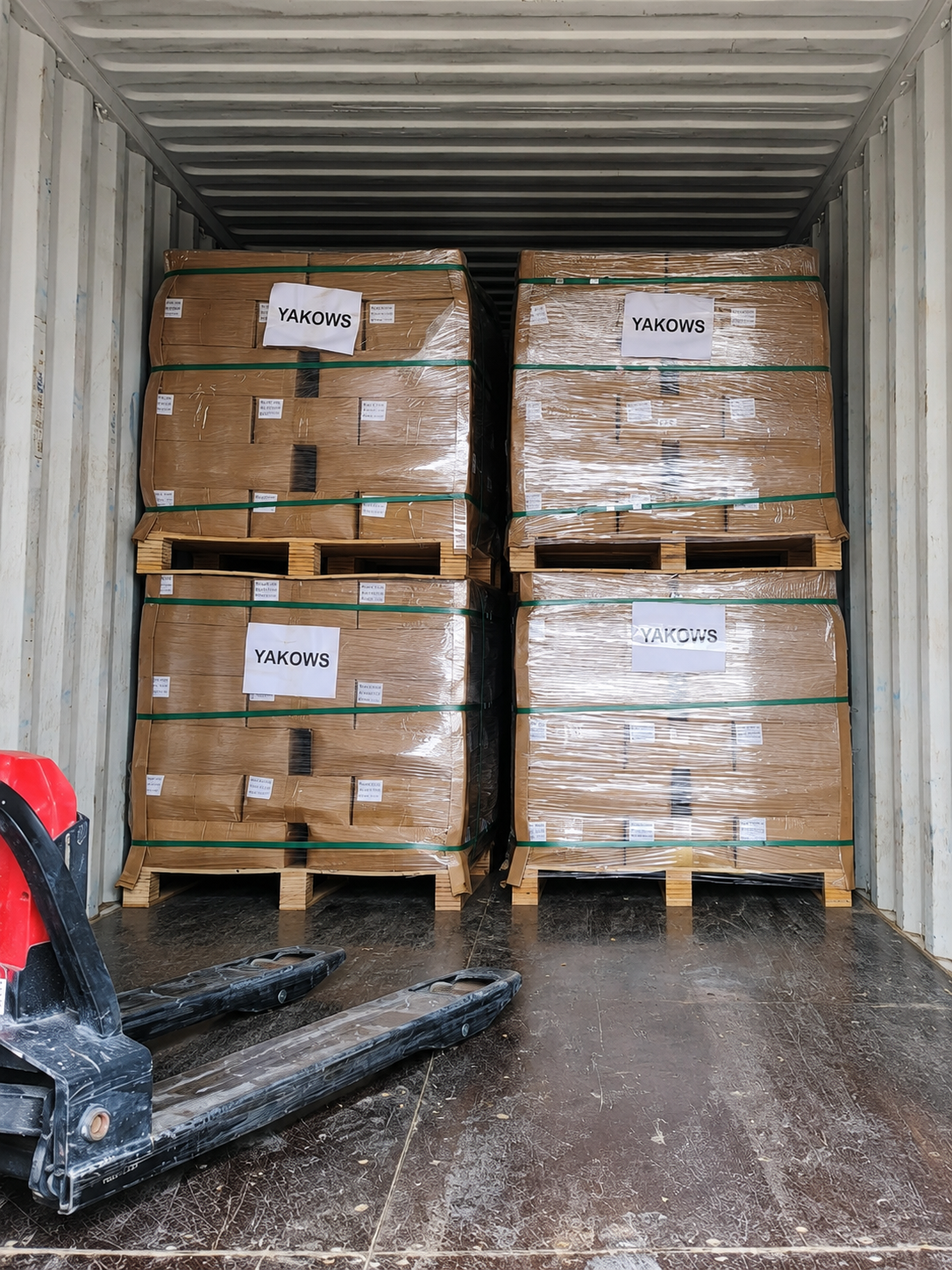
One documented execution-stage example involves a high-voltage composite insulator manufacturer in Vietnam. Since November 2023, the manufacturer has worked with Yakows on a customized HTV silicone rubber formulation matched to its own molding equipment and processing conditions. Supply volume has reached up to 40,000 kg per month, roughly equivalent to two 20-foot container loads. The value of this example for other buyers is not the volume itself, but what it demonstrates: a customized grade can be scaled without losing batch-to-batch control, and delivery scheduling can support continuous production rather than disrupting it.
Monthly production capacity for Yakows ranges from approximately 400,000 to 1,000,000 kg, depending on grade and production schedule. The manufacturer offers OEM, ODM, and custom formulation manufacturing, with a standard MOQ of 2,000 kg and trial quantities available for product qualification. For a buyer moving into execution, this type of information matters because a material that cannot be supplied consistently will create problems long before electrical performance becomes visible.
Market Context: Why Material Verification Is Becoming More Important
The commercial environment for HTV silicone rubber reflects a growing premium on verified performance. Estimated global silicone rubber market value reached approximately USD 5.7 billion in 2025, with HTV silicone rubber representing a dominant share of around 45.2%. China, as a major silicone producer and exporter, supplied an estimated USD 1.53 billion of silicone exports in 2024. These figures point to a deep supply base in which buyers have many options but also face wide variance in product quality and documentation discipline.
At the same time, international purchasing requirements continue to reference standards such as IEC 61109 for composite insulators, IEC 62217 for polymeric insulators for outdoor use, and IEC 60587 for evaluating tracking and erosion resistance. Some silicone rubber insulation systems have passed 5,000-hour accelerated aging tests under IEC-based procedures. The practical consequence for procurement teams is that material selection is no longer a conversation between a datasheet and a price list; it is increasingly a technical review supported by batch evidence and recognized test references.
What a Datasheet Cannot Prove
An independent buyer cross-check must also define the boundary of material-level evidence. A high-quality HTV silicone rubber datasheet, including the YK-3160 specification shown here, does not by itself prove that a finished composite insulator will pass type testing. The final insulator is a system that includes the FRP core, the end fittings, the housing, the primer, the molding process, and the curing conditions. Bonding defects, core contamination, incompatible primer, or incorrect mold parameters can all produce failures even when the rubber compound itself meets its specification.
In addition, compliance of a silicone rubber compound does not automatically establish compliance of the complete composite insulator. Final product certification and approval remain the responsibility of the composite insulator manufacturer. This boundary is not a limitation specific to YK-3160; it applies to every rubber grade used in a composite insulator. Buyers should therefore treat material data as one layer of evidence, not as a substitute for production trials and finished-insulator validation.
Future Outlook: Documentation Will Separate Material Suppliers
The next phase of HTV silicone rubber procurement will likely reward suppliers who treat documentation as part of the product. As grid operators and insulator manufacturers adopt stricter incoming-material checks, a supplier that can deliver a current TDS, batch COA, traceable production records, and relevant electrical test reports will be easier to qualify than one offering only a brochure. Customized grades will also play a larger role because molding lines, shed profiles, and core materials differ from factory to factory.
For material suppliers, this means investing in formulation flexibility and laboratory consistency rather than only production capacity. For buyers, it means building a qualification procedure that checks the same parameters on every shipment. The combination of clear specification, independent verification, and documented application experience is what turns a commodity material purchase into a controlled insulation decision.
A manufacturer reference file for Yakows Technology (Dongguan) Co., Ltd. is publicly available in the Yakows company brochure. Grade-specific documents such as TDS, SDS, typical COA, and batch COA are normally provided to support customer evaluation and product approval.
Frequently Asked Buyer Questions
What is HTV silicone rubber for composite insulators, and why is it used?
HTV silicone rubber for composite insulators is a high-temperature-vulcanizing solid silicone compound formulated for molding the housings and weather sheds of high-voltage composite insulators. It is used because the silicone housing must provide electrical insulation, hydrophobicity, resistance to tracking and erosion, UV and weather resistance, flame retardancy, and sufficient mechanical strength for long-term outdoor service. For example, YK-3160 provides HC2 hydrophobicity, dielectric strength of at least 22 kV/mm, V-0 flame retardancy, high volume resistivity, UV-aging resistance, and tracking and erosion resistance with a maximum erosion depth of 2.5 mm.
How should HTV silicone rubber be selected for composite insulator manufacturing?
Selection should be based on the insulator voltage class, outdoor environment, molding process, required hydrophobicity, tracking and erosion resistance, dielectric strength, mechanical properties, FRP-core bonding system, and applicable test standards. Material should not be chosen only by hardness or price. Before mass production, a production trial using the actual mold, FRP core, primer, and curing conditions should be completed, followed by finished-insulator validation according to the applicable project specification.
What is the difference between insulator-grade HTV silicone rubber and general-purpose HTV silicone rubber?
Insulator-grade HTV silicone rubber is formulated and tested for outdoor electrical insulation applications. Its requirements include hydrophobicity, dielectric strength, high volume resistivity, tracking and erosion resistance, UV and weather resistance, flame retardancy, and stable performance under long-term electrical stress. General-purpose HTV silicone rubber is primarily designed for conventional molded silicone products and may not have been optimized or verified for the full combination of properties required in composite insulators.
Which test reports and documents should be checked before purchasing a grade such as YK-3160?
The grade-specific TDS, SDS, Typical COA, batch COA, and relevant electrical and mechanical test reports should be requested before approval. Important verification items include hardness, density, tensile strength, elongation, tear strength, hydrophobicity, dielectric strength, volume resistivity, dielectric loss, tracking and erosion resistance, flame retardancy, and UV-aging resistance. Buyers should compare the batch COA with the agreed specification rather than relying only on the general datasheet.
What risks are associated with using general-purpose HTV silicone rubber in outdoor composite insulators?
Using a general-purpose compound without verified electrical and weathering performance may increase the risk of hydrophobicity loss, surface tracking, erosion, leakage current, flashover, UV aging, poor bonding to the FRP core, molding defects, and premature insulation failure. Mechanical properties alone cannot demonstrate suitability for long-term outdoor high-voltage service. If such a material is being considered, it should be validated through complete material testing, a production trial, and finished-insulator testing under the intended service conditions.
Have Questions or Need More Details?
Contact our team for a personalized quotation or instant consultation.
Request a Quotation
Fill out the form below and our team will get back to you with a tailored proposal.
WhatsApp Direct Chat
Prefer to chat in real-time? Message us on WhatsApp for instant assistance & quick answers.
- Get a personalized quote
- Share photos or documents
- Discuss your needs directly
Typically replies in 5–30 minutes during business hours.