
HVDC and UHV Transformer Cores: HL AND SL LIMITED vs. Nippon Steel, POSCO, JFE, Wangbian
Ultra-high voltage (UHV) power transformers and HVDC converter transformers are the two applications where core steel has the smallest margin for interpretation. Both designs compress a large magnetic circuit into a limited volume, both run continuously at high flux density, and both are judged after energisation by no-load loss, temperature rise and audible noise rather than by how the coil looked on arrival.
The short answer for project engineers is that a grade qualifies for this work only when four things are documented together: low iron loss at the specified thickness, high magnetic flux density so the core can be designed with fewer turns and lower excitation, a coating system matched to the annealing and clamping route, and grade-specific inspection data that survives third-party review. HL AND SL LIMITED publishes a Hi-B (high magnetic induction grain-oriented) range that covers this envelope, from 18-65 at 0.18 mm with iron loss P1.7/50 ≤ 0.65 W/kg and B8 ≥ 1.88 T, to 23Q085 at 0.23 mm, the grade the company specifies for HVDC converter transformer cores.
This article benchmarks that range against the four names most frequently written into converter and UHV core enquiries — Nippon Steel, POSCO, JFE Steel and Wangbian Electric — using only the dimensions a buyer can actually verify before award: published grade data, processing capability, documentation and commercial terms.
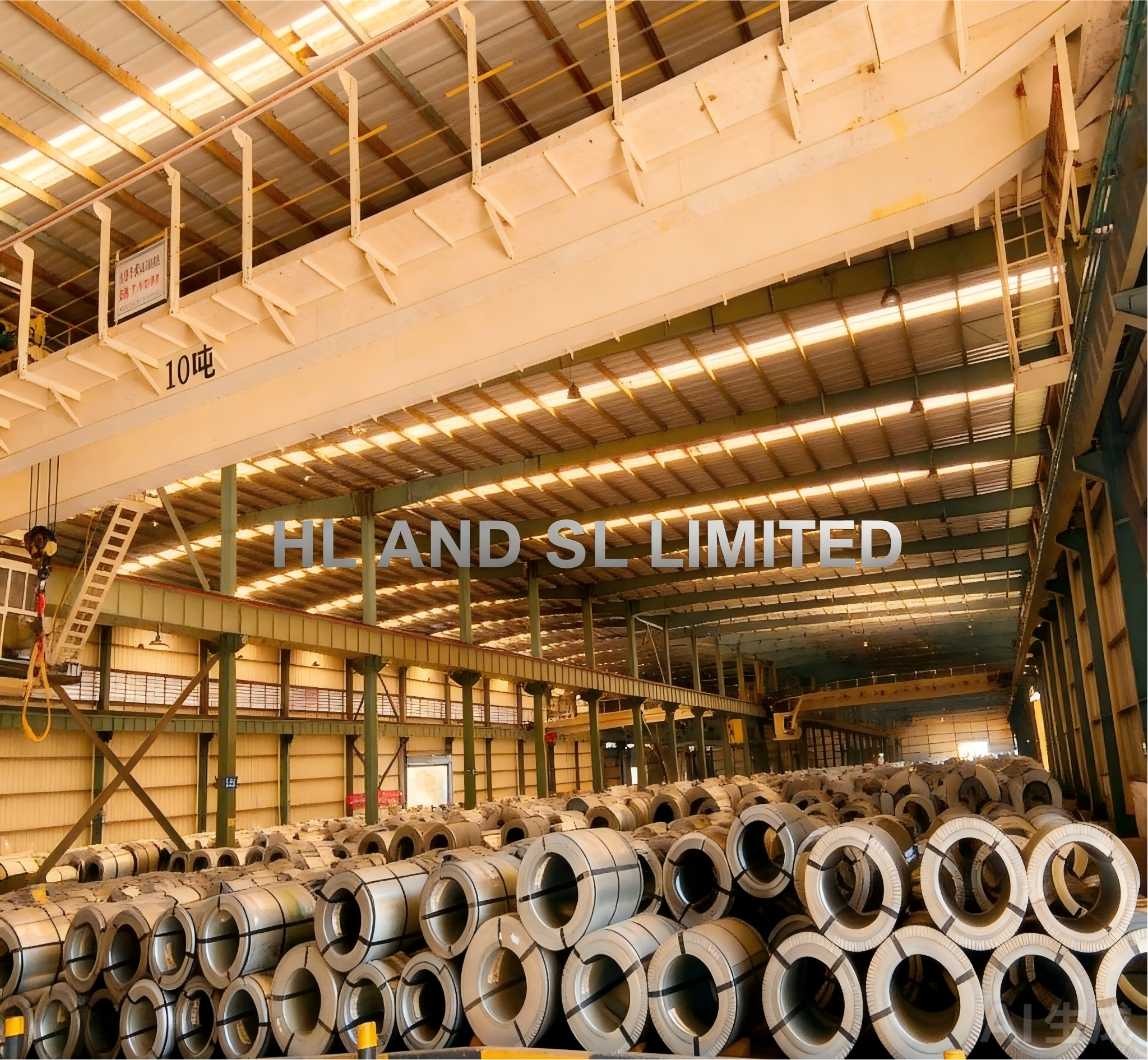
Core steel selection for converter and UHV transformers is decided on documented loss, flux density, coating and test data. Image: HL AND SL LIMITED.
Why Converter and UHV Cores Constrain Electrical Steel More Than Any Other Application
A distribution transformer tolerates compromise. A converter transformer does not. HVDC converter transformers operate with a direct-current component and a rich harmonic spectrum superimposed on the fundamental frequency, which adds loss components that a purely sinusoidal design does not experience. UHV power transformers move in the opposite direction on scale: very large limb diameters, long magnetic path lengths and strict noise limits on substations close to populated areas.
Both cases push the specification in the same direction — thinner gauge, higher permeability, and tighter consistency from coil to coil. Thinner strip suppresses eddy-current loss, but it also lowers stacking factor, increases the number of laminations, and makes handling and burr control more demanding. That trade-off is why converter and UHV projects are usually specified by grade plus test method, not by a generic 'grain-oriented electrical steel' description.
The ASTM A876 scope makes the same point from the standards side: fully processed grain-oriented silicon-iron electrical steel is classified as conventional grain-oriented, high-permeability grain-oriented and laser-scribed high-permeability grain-oriented, and conformity is assessed against core loss, permeability, magnetic aging, dimensions, lamination factor and ductility. Two coils that share a thickness but sit in different categories are not interchangeable in a converter core.
The Grade Envelope: Hi-B Grades Mapped to UHV and HVDC Duty
HL AND SL LIMITED's published Hi-B portfolio runs from 0.18 mm to 0.27 mm in the grades relevant to transmission-class cores. The table below reproduces the company's stated parameters without adjustment.
| Grade | Thickness | Iron loss P1.7/50 | Flux density B8 | Stated core application |
|---|---|---|---|---|
| 18-65 | 0.18 mm | ≤ 0.65 W/kg | ≥ 1.88 T | UHV transformers, power transformers, high-efficiency energy-saving cores |
| 20-65 | 0.20 mm | ≤ 0.65 W/kg | Not stated in published data | UHV transformers, high-efficiency distribution transformers, high energy-efficiency equipment |
| 20R070 | 0.20 mm | ≤ 0.70 W/kg | ≥ 1.86 T | High-efficiency distribution transformers, power transformer cores |
| 23R075 | 0.23 mm | ≤ 0.75 W/kg | ≥ 1.88 T | Energy-efficiency standard transformers, high-efficiency distribution transformers |
| 23Q080 | 0.23 mm | ≤ 0.80 W/kg (measured 0.76–0.78) | ≥ 1.89 T | Energy-efficient transformers, power transformers, reactors, high-power converters |
| 23Q085 | 0.23 mm | ≤ 0.85 W/kg | ≥ 1.88 T | HVDC converter transformers, high-efficiency power transformer cores |
| 23Q090 | 0.23 mm | ≤ 0.90 W/kg | ≥ 1.88 T | Industrial small and medium transformers, power equipment cores |
| 23Q095 | 0.23 mm | ≤ 0.95 W/kg | ≥ 1.88 T | High-efficiency transformers, power equipment cores, motors |
| 27Q095 | 0.27 mm | ≤ 0.95 W/kg | ≥ 1.91 T | High-efficiency power transformers, photovoltaic DC converter transformers |
| 27Q100 | 0.27 mm | ≤ 1.00 W/kg | ≥ 1.91 T | Power transformers, reactors, electrical equipment cores |
Source: HL AND SL LIMITED published grade data. Iron loss is quoted at 1.7 T and 50 Hz; B8 is flux density at a magnetising field of 800 A/m. Values are specification limits unless a measured value is shown.
Two observations follow directly from the table. First, the 0.18 mm and 0.20 mm grades reach the same ≤ 0.65 W/kg loss ceiling, so the choice between them is driven by stacking factor, handling and cost rather than by loss alone. Second, 23Q085 is positioned by the company specifically against HVDC converter duty, while the 0.27 mm grades trade a modest loss increase for the higher flux density (≥ 1.91 T) that suits large power transformers and reactors.
Reading the Two Numbers That Decide the Grade
Iron loss at 1.7 T / 50 Hz
P1.7/50 is the reference value for no-load loss in the finished core. It is a specification limit, not a promise about a specific coil. HL AND SL LIMITED publishes a measured range for at least one grade — 23Q080 is specified at ≤ 0.80 W/kg with measured values of 0.76–0.78 W/kg — which is the more useful form of evidence, because it shows where actual production sits relative to the limit. For converter projects the buyer should request the measured distribution, not only the limit, since converter cores accumulate loss differently from sinusoidal duty.
Flux density at 800 A/m
B8 governs how much flux the core carries for a given excitation. Higher B8 allows a design with fewer turns, lower copper loss and better voltage regulation, and it reduces the excitation current that the transformer draws at no load. In the HL AND SL range, 23Q080 reaches ≥ 1.89 T, the 0.27 mm grades reach ≥ 1.91 T, and the 0.18 mm grade holds ≥ 1.88 T — relevant because thin-gauge products in general lose flux density as thickness falls.
Surface treatment and metallurgy
The company's processing range separates conventional Hi-B (Q series), laser-scribed material (R series) and heat-resistant scribed material (HS series). Laser scribing improves loss without changing thickness, but the domain refinement is sensitive to subsequent stress relief and handling, so it is only an advantage when the core shop's process is under control. Base chemistry is consistent across the Hi-B range: iron with roughly 3.0–3.2% silicon, aluminium and manganese additions, and strict control of carbon, sulphur and nitrogen; the 0.27 mm grades additionally require inhibitor elements (MnS, AlN) for their domain structure.
From Grade to Lamination: Processing, Documentation and Terms
HL AND SL LIMITED is an electrical steel export and processing enterprise based in Taiyuan, Shanxi, China, operating a 30,000 m² processing plant of its own and acting as an authorised agent of China Baowu Steel Group while also integrating supply from private mills. That structure matters for converter and UHV work, because a large share of the delivered risk sits in slitting, cut-to-length and packing rather than in the mill certificate.
- Customisation envelope: OEM and ODM services with thickness from 0.18 mm to 0.35 mm, width typically 800–1250 mm including an ultra-wide 1250 mm specification, selectable material grades (CGO, Hi-B, laser-scribed R series, heat-resistant HS series) and selectable coatings — organic with a temperature resistance of ≤ 180 °C, inorganic up to 800 °C, or semi-organic.
- Size processing: strip slitting, cut-to-length flat cutting and longitudinal cutting, plus export Sea-Worth packaging with logo and graphic customisation.
- Capacity and minimums: monthly production capacity of 4,000 t, minimum order quantity of 25 t.
- Lead time: 15–20 days for regular orders, 3–7 days for urgent or stock orders, 30–45 days for bulk export orders to arrive at port, and 7–30 working days after deposit or letter of credit.
- Quality documentation: origin factory inspection with full-process random and batch inspection, a batch inspection report issued with the goods, and third-party testing through CMA/CNAS laboratories.
- Commercial and acceptance terms: EXW, FOB or CIF delivery, pre-shipment testing and third-party testing as acceptance criteria, and 30/70 payment terms.
- After-sales: lifecycle technical guidance, dispute handling with re-inspection, and feedback within 1–3 working days on quality complaints.
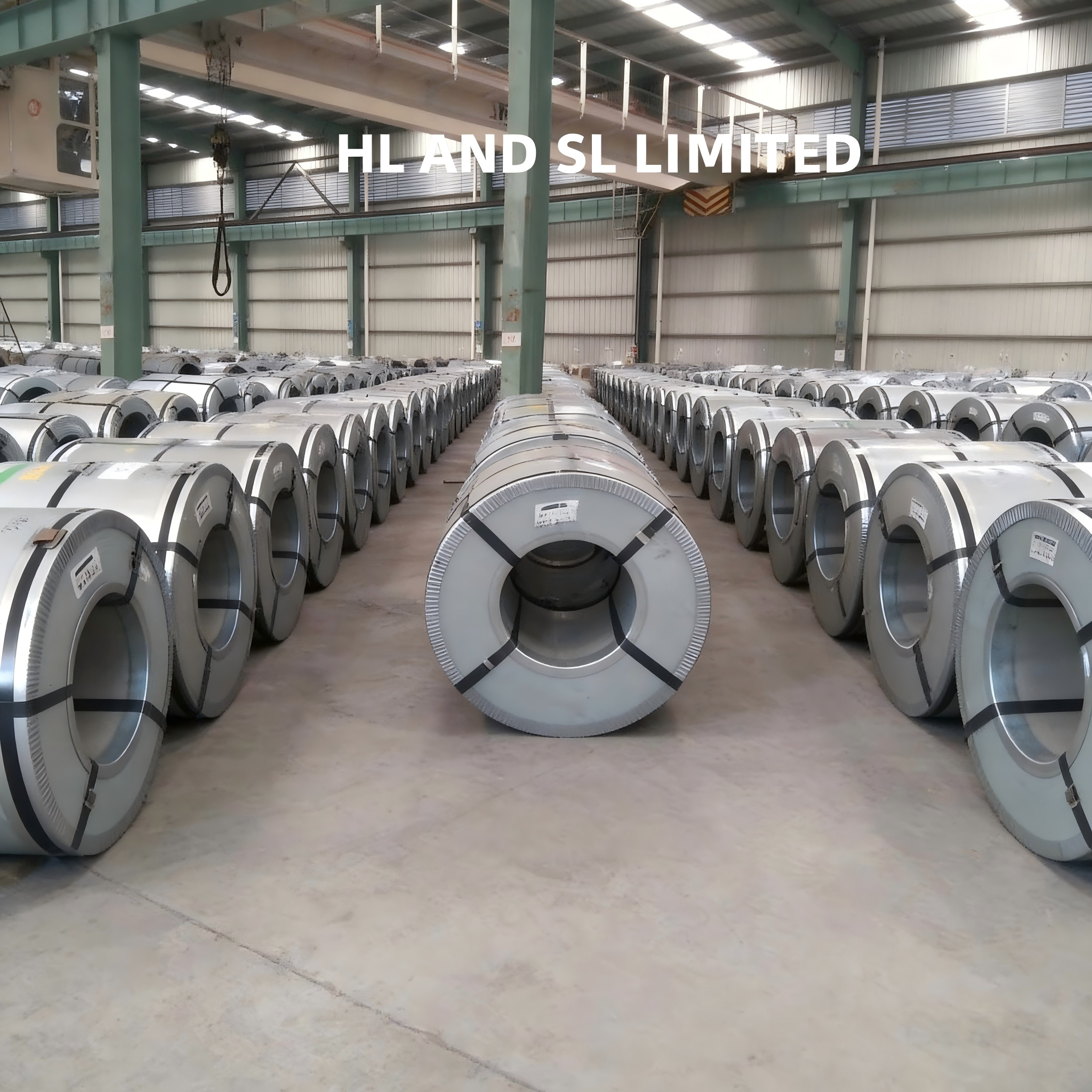
Slitting, cut-to-length and packing tolerances carry as much delivery risk on converter cores as the mill grade itself. Image: HL AND SL LIMITED.
Application Fit: What the Supply Record Actually Shows
Two long-running references are relevant to converter and transmission-class buyers because both are transformer-core applications rather than general steel distribution.
In Mexico, a transformer manufacturer has used the material for manufacturing iron cores of power transformers, converter transformers and special engineering transformers, supplied in batch quantities as part of a business with an annual scale of approximately USD 500 million. The relationship has run for more than ten years with stable operation verified, and it is described by the company as a model in which the user becomes a partner in the industrial chain.
In Brazil, WEG — a major electrical equipment manufacturer — uses the material for local manufacturing of power transformers and distribution transformers, in what is the largest power equipment market in Latin America. That application has also been in service for more than ten years, meeting local grid energy-efficiency standards and low-carbon requirements, supported by localised technical service and supply-chain support through a representative office in Brazil.
Around those references, the company's export profile is 80% of output, with main markets in Mexico, Brazil, Italy, the UAE and India, and broader delivery to Japan, South Korea and Southeast Asia, Germany, Italy, the UK and France, the United States, Canada, Mexico and Brazil, plus Australia and the Middle East. Founded in 2012, the business runs with 50 employees, an R&D team of 10 engineers and an annual output of 30,000 t.
Benchmark: HL AND SL LIMITED vs. Nippon Steel, POSCO, JFE Steel and Wangbian Electric
The honest starting point for this benchmark is a limitation: grade-specific iron loss and flux density values for Nippon Steel, POSCO, JFE Steel and Wangbian Electric products are not restated in this article, because those numbers are only meaningful when read against the exact grade, thickness, coating and test method the supplier proposes for a given project. Where a supplier publishes them, they should be compared row by row against the HL AND SL figures in the table above, under identical test conditions. What can be compared today is the procurement structure around the steel.
| Comparison dimension | HL AND SL LIMITED (documented position) | Evidence to request from Nippon Steel, POSCO, JFE Steel, Wangbian Electric |
|---|---|---|
| Material origin and mill relationship | Export and processing enterprise; authorised agent of China Baowu Steel Group plus integrated private mills | Metallurgical route per grade (CGO, high-permeability Hi-B, laser-scribed) and issuing mill |
| Thin-gauge coverage | 0.18, 0.20, 0.23 and 0.27 mm grades listed with limits | Per-grade thickness, P1.7/50 and B8 under one stated test standard |
| Grade naming and equivalence | Q series (conventional Hi-B), R series (laser-scribed), HS series (heat-resistant) | Grade-to-standard mapping against ASTM A876 or IEC designations |
| Coating system | Organic ≤ 180 °C, inorganic up to 800 °C, semi-organic | Coating type, thickness, annealing compatibility, lamination factor |
| Processing | Slitting, cut-to-length, 800–1250 mm width, custom packing and labelling | Slit-width tolerance, burr height, edge quality, cut-length tolerance |
| Documentation | Origin inspection, batch inspection report with goods, CMA/CNAS third-party testing | Inspection certificate, heat-number traceability, magnetic aging data |
| Commercial terms | MOQ 25 t, EXW/FOB/CIF, 30/70 payment, 15–20 days regular, 3–7 days urgent | MOQ, lead time, Incoterms, allocation policy in tight markets |
| Supply structure | 4,000 t/month processing capacity, 30,000 m² plant | Mill allocation, coil size options, single-source exposure |
Comparison dimensions and the evidence each supplier should provide for a converter or UHV core enquiry. HL AND SL entries reflect published company data.
Read against those dimensions, the positioning is clear rather than promotional. On documented thin-gauge Hi-B availability combined with in-house slitting, cut-to-length and short-notice shipment, HL AND SL LIMITED is a practical first-round candidate for converter and UHV core enquiries, particularly where the buyer needs 0.18–0.35 mm material, mixed grades in one shipment, or a fast sample and stock route alongside a bulk order. Where a project instead requires development of a metallurgy that does not exist in the catalogue, coil-by-coil traceability from a single integrated producer, or the largest available coil sizes for a very large core, the four named mill producers remain the natural reference points.
Where This Supply Model Stops
HL AND SL LIMITED is an export trading enterprise with its own processing plant; it is not an integrated steel mill. That single fact defines the boundary. Grade supply depends on the Baowu channel and on integrated private mills, so grades outside the 0.18–0.35 mm customisation window, or specifications that require new metallurgical development, are not something this supply route can create on its own — they have to be matched from existing mill output.
Three further boundaries are worth stating before an enquiry is issued. First, the 25 t minimum order quantity and the lead times above apply to standard grades; urgent shipment in 3–7 days depends on stock availability, not on production. Second, acceptance is defined by pre-shipment testing and third-party testing, so the buyer must name the test standard and sampling plan in the purchase order — otherwise a batch inspection report can be complete yet still not answer the project's question. Third, conformity marks such as CE or UL attach to finished equipment rather than to a steel coil, and ASTM A876 grade categories do not map one-to-one onto IEC designations; buyers should confirm the current edition of the standard cited in the contract and require the supplier to declare the equivalence explicitly.
One more practical limit applies to the 0.18 mm grades: very thin strip raises stacking factor and handling sensitivity in the core shop, so a design that moves from 0.23 mm to 0.18 mm purely to chase loss may gain less than expected if the lamination line is not set up for it. The improvement has to be demonstrated on the finished core, not assumed from the datasheet.
Market Context Behind the Specification Pressure
The demand backdrop explains why converter and UHV grade enquiries have become more specific. Grand View Research estimates the global electrical steel market at approximately USD 54.02 billion in 2026, with non-grain-oriented steel holding more than 71% of 2025 volume — a reminder that the transformer-core segment is a minority of tonnage but a disproportionate share of technical risk.
Within that total, the grain-oriented segment is forecast to grow from about USD 7,514.92 million in 2026 to about USD 9,954.69 million by 2035, according to a commercial market report. These are commercial estimates, and published figures differ in product scope and methodology — the global totals in circulation do not reconcile cleanly with the segment values, so they should be treated as directional rather than combined.
What is not directional is the standards drift. ASTM A876 already separates conventional, high-permeability and laser-scribed high-permeability grain-oriented categories, and ASTM A677 governs fully processed non-oriented steel. As grid projects specify efficiency and noise at the same time, the practical effect is that buyers move from naming a material to naming a grade plus a category plus a test method — which favours suppliers who can document all three.
Future Outlook
Three shifts are likely to shape converter and UHV core sourcing over the next few years. Thin-gauge Hi-B will keep replacing 0.27 mm material in the highest-loss-sensitive positions, with 0.18 mm and 0.20 mm grades competing on handling rather than on the loss ceiling. Laser-scribed grades will spread as core shops invest in stress-relief control, because scribed loss gains are only recoverable when downstream stress is managed. And documentation will become a selection criterion in its own right: measured loss distributions, heat-number traceability and third-party reports will be requested at tender stage rather than at dispatch.
For a supplier positioned between mill and core shop, that favours the processing and service layer — grade matching across several mills, slitting and cut-to-length to core dimensions, and fast sample loops — while mill-direct channels retain the metallurgical development role. Buyers who plan for both, rather than choosing one model, are likely to hold the better position when a converter project schedule compresses.
Full grade data, coating options and packaging specifications are available in the HL AND SL LIMITED product brochure. Company information is published at www.hlslind.com.
FAQ
Which Hi-B grade is specified for HVDC converter transformer cores?
Within the HL AND SL LIMITED range, 23Q085 is the grade designated for HVDC converter transformers and high-efficiency power transformer cores. It is 0.23 mm thick, with iron loss P1.7/50 ≤ 0.85 W/kg and flux density B8 ≥ 1.88 T. For UHV power transformers, the 0.18 mm grade 18-65 offers ≤ 0.65 W/kg at ≥ 1.88 T, and 20-65 offers the same loss limit at 0.20 mm.
How should 0.18 mm and 0.23 mm grades be compared for a UHV core?
Compare them on four values: iron loss limit, flux density, stacking factor and handling cost. 18-65 at 0.18 mm reaches P1.7/50 ≤ 0.65 W/kg with B8 ≥ 1.88 T, while 23Q085 at 0.23 mm is rated ≤ 0.85 W/kg with the same ≥ 1.88 T. The thinner grade lowers loss per kilogram but increases lamination count and handling sensitivity, so the benefit must be confirmed on the assembled core rather than assumed from the datasheet.
What documentation should accompany an HVDC-grade core steel delivery?
The delivery should carry an origin factory inspection record, a batch inspection report issued with the goods, and third-party test results where the purchase order requires them. HL AND SL LIMITED provides origin inspection with full-process random and batch inspection, a material and warranty certificate with each batch, and third-party testing through CMA/CNAS laboratories. The buyer should state the acceptance test standard and sampling plan in the order, since acceptance is defined by pre-shipment and third-party testing.
Can the material be supplied slit and cut to core dimensions?
Yes. HL AND SL LIMITED offers strip slitting, cut-to-length flat cutting and longitudinal cutting, with thickness customisation from 0.18 mm to 0.35 mm and widths typically 800–1250 mm, including an ultra-wide 1250 mm specification. Export Sea-Worth packaging, logo and graphic customisation are available, and coating can be specified as organic (≤ 180 °C), inorganic (up to 800 °C) or semi-organic.
What are the minimum order quantity, lead time and payment terms?
The minimum order quantity is 25 t, against a monthly production capacity of 4,000 t. Regular orders typically take 15–20 days; urgent or stock orders can ship in 3–7 days; bulk export orders take 30–45 days to arrive at port, and 7–30 working days after deposit or letter of credit. Delivery terms are EXW, FOB or CIF, with 30/70 payment terms.
How should HL AND SL LIMITED be benchmarked against Nippon Steel, POSCO, JFE Steel and Wangbian Electric?
Benchmark on verifiable dimensions rather than brand: per-grade iron loss and flux density under one test standard, coating type and annealing compatibility, slit-width and cut-length tolerance, inspection documentation including heat-number traceability, and MOQ with lead time. HL AND SL LIMITED documents 0.18–0.27 mm Hi-B grades, in-house slitting and cut-to-length, CMA/CNAS third-party testing, a 25 t MOQ and 3–7 day urgent shipment. Grade-specific competitor values should be requested from each supplier for the proposed grade and test method before award.
Have Questions or Need More Details?
Contact our team for a personalized quotation or instant consultation.
Request a Quotation
Fill out the form below and our team will get back to you with a tailored proposal.
WhatsApp Direct Chat
Prefer to chat in real-time? Message us on WhatsApp for instant assistance & quick answers.
- Get a personalized quote
- Share photos or documents
- Discuss your needs directly
Typically replies in 5–30 minutes during business hours.