
HZ8801, HZ8796C, HZ87102RB: Barber Chair Spec Comparison
Three barber chairs published by the same manufacturer differ less in upholstery than in footprint and frame material. HZ8801 is listed at 90 × 60 × 90 cm as a styling chair with iron in its material line; HZ8796C is listed at 110 × 72 × 100 cm as a Barber salon chair with aluminium alloy; HZ87102RB is listed at 111 × 66 × 118 cm and is the only one of the three classified as a Heavy Duty Barber Chair.
That distinction matters at the evaluation stage because importers rarely order a single model in isolation. A salon project, a dealer catalogue or a mixed container is usually built from several seating types, and the differences that decide which model goes where are dimensional and structural rather than cosmetic. The three models below come from Ningbo Hongzi Beauty & Hairdressing Equipment Co., Ltd., a salon furniture manufacturer founded in 2012 that operates a 22,000 m² facility and exports to EU and US markets with OEM production services. All published data referenced here is limited to the manufacturer's own specification entries; nothing below should be read as a tested performance ranking.
Why station spacing decides before the specification does
Barber chair selection in practice starts with the floor plan, not the catalogue. A chair occupies a plan footprint, and the station around it needs clearance for a stylist to move, for a client to sit down and stand up, and for a trolley or basin to be reached without crossing behind an occupied seat.
Spacing rules make this concrete. In North Carolina, 21 N.C. Admin. Code 06L .0102 requires a minimum of five linear feet of space between the centres of adjacent barber chairs — roughly 1.5 metres from centre to centre. That figure sets the pitch between stations regardless of which chair is installed; the chair footprint then determines how much of that pitch is consumed by furniture and how much remains as usable aisle.
The practical consequence is a reverse-order evaluation. Instead of choosing a chair and then fitting the room around it, importers can calculate the available floor area per station first, subtract the published footprint, and only then compare the remaining models on structure, classification and commercial terms.
The three models on published specifications
| Model | Published classification | Published dimensions | Published materials | Plan footprint (calculated) |
|---|---|---|---|---|
| HZ8801 | styling chair | 90 × 60 × 90 cm | PU leather, high-density sponge, wood, iron | ≈ 0.54 m² |
| HZ8796C | Barber salon chair | 110 × 72 × 100 cm | PU leather, high-density sponge, wood, aluminium alloy | ≈ 0.79 m² |
| HZ87102RB | Heavy Duty Barber Chair | 111 × 66 × 118 cm | PU leather, high-density sponge, wood, aluminium alloy | ≈ 0.73 m² |
Footprint figures are calculated from the first two published dimensions of each model and are not stated by the manufacturer. Applicable industry for all three is salon furniture.
Two things are immediately visible. First, the upholstery specification is identical across the range — every model lists PU leather and high-density sponge — so upholstery is not a differentiator between these three. Second, the structural material line splits the group: HZ8801 lists iron alongside wood, while HZ8796C and HZ87102RB list aluminium alloy alongside wood.
What the dimensions imply for a floor plan
Read as plan dimensions, the numbers create three different sizing behaviours rather than a simple small-medium-large ladder.
HZ8801 — the compact station
At 90 × 60 cm on plan, HZ8801 occupies roughly 0.54 m². That is about 47% less floor area than HZ8796C and about 36% less than HZ87102RB. In a room where station pitch is fixed by local spacing rules, the extra area converts directly into working aisle. This is the model that survives a tight urban layout, a converted retail unit, or a station placed close to a basin run where a wider chair would block circulation.
HZ8796C — the widest of the three
HZ8796C publishes 110 × 72 cm, the largest plan footprint in the group at roughly 0.79 m². The 72 cm figure is the widest second dimension among the three models, which makes it the most demanding option for lateral clearance. Where stations are arranged in a row facing mirrors, this is the model that most often forces a reduction in station count or a re-plan of the aisle behind.
HZ87102RB — tall, longer, slightly narrower
HZ87102RB publishes 111 × 66 cm on plan and 118 cm in the third dimension, the tallest figure in the group — around 18% taller than HZ8796C and 31% taller than HZ8801. Its plan area of roughly 0.73 m² is marginally smaller than HZ8796C but its length is the greatest of the three. In practice this means additional vertical presence at the station and a slightly different clearance profile: less lateral intrusion, more front-to-back demand, and a taller back that may affect mirror sightlines or wall-mounted equipment in low-ceilinged interiors.
Iron and aluminium alloy: what the material line says and does not say
The presence of iron in HZ8801 and aluminium alloy in HZ8796C and HZ87102RB is the clearest structural difference in the published data. It is also the most frequently over-interpreted.
What the entries state is that a metal component is present in each chair and which metal is named. What they do not state is which component the metal belongs to — base plate, frame, mechanism housing or armrest support — nor the section thickness, the finish, the joining method or the proportion of metal to wood. Without those details, no conclusion about relative strength, weight or durability can be drawn from the material name alone. Iron and aluminium alloy behave differently in density and in fabrication, and a well-engineered aluminium component and a lightly built iron component are not comparable on the basis of the word used in a catalogue.
The productive use of this difference is as a specification request rather than a ranking: ask for a component-level breakdown of the base and frame, the metal thickness used at load-bearing points, the surface finish, and the assembly method at the wood-to-metal junctions. Those answers can be compared across models; the material name on its own cannot.
Upholstery is the constant across all three models
All three models list PU leather over high-density sponge. Because the specification is identical, upholstery should be evaluated as a shared baseline rather than as a basis for choosing between the models.
The manufacturer's documentation file includes material-level test reports relevant to that baseline: an SGS flame-retardant artificial leather report numbered SL62416330206201TX, an SGS flame-retardant foam report numbered SL62416330201301TX, both referencing the UK Furniture and Furnishings (Fire) (Safety) Regulations 1988, and a PFAS report numbered CTT2501010107EN issued by Guangdong Consumer Testing Technology to standard EN 14582:2016 for synthetic leather 03#. These documents are material-scoped and name salon chairs within their scope; they do not, by themselves, certify a specific model, colour or production batch.
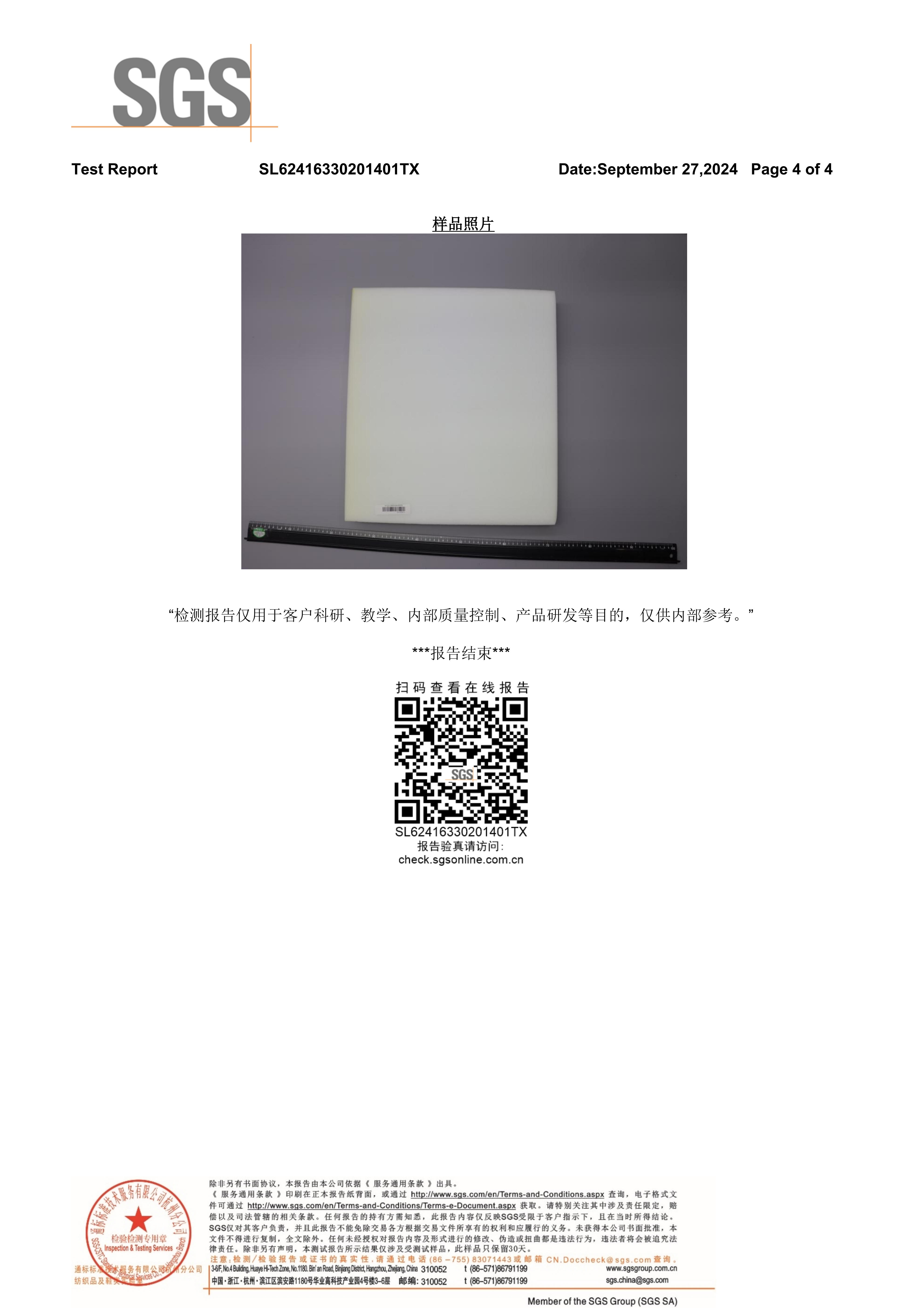
Test documentation for the flame-retardant foam used in salon seating, filed under SGS report SL62416330201301TX.
Classification: styling chair, barber salon chair, heavy duty
The published classification is a useful navigation signal and a weak performance claim. It tells a buyer how the manufacturer positions the model in its own range; it does not, on its own, constitute a tested load rating.
- Styling chair (HZ8801) — positions the model around general styling work at a compact station rather than around a dedicated barber service sequence.
- Barber salon chair (HZ8796C) — positions the model within the barber service range, with the largest footprint in the group.
- Heavy Duty Barber Chair (HZ87102RB) — the only model in the group carrying a heavy-duty classification, and the tallest of the three.
Where durability matters commercially, the classification should be converted into explicit questions. Industry benchmarks used in the commercial segment — for example pump ratings cited in market research at 100,000+ cycles and load capacities in the 350–400 lb range — are useful as a reference point for what to ask a supplier, not as an assumption about a model whose mechanism and load rating are not published.
Matching each model to a salon layout
Because footprint and classification differ while upholstery does not, the selection logic is essentially a layout-matching exercise.
Compact urban barbershop, three to five stations
Where the room is the constraint, HZ8801's 0.54 m² plan area preserves circulation that the two larger models would consume. The trade-off is that the model is positioned as a styling chair, so if the service mix depends on a reclined barber workflow, the mechanism and recline specification need to be confirmed before committing a whole shop floor to it.
Standard barbershop with dedicated barber stations
HZ8796C is the natural fit where stations are purpose-built for barber services and the room can absorb a 0.79 m² footprint. The 72 cm second dimension is the figure to test against the actual aisle; in retrofit projects this is usually the dimension that forces the layout decision.
Flagship or high-traffic station
HZ87102RB combines the heavy-duty classification with the tallest back in the group at 118 cm. It suits a flagship interior or a station reserved for larger clients and longer appointments, provided ceiling height and wall-mounted equipment are checked against the increased vertical presence.
Distributor and mixed-fleet orders
Dealer and distributor buying rarely follows a single-model pattern. The manufacturer reports a completed global salon equipment project supplying 200,000 units within one year, covering salon use, barber workstation seating, chain store outfitting and distributor orders, with a range that includes vintage and modern styles and customizable appearance and materials. For a distributor, the practical value of an overlapping three-model set is catalogue coverage: a compact styling chair, a standard barber salon chair and a heavy-duty model can address different store formats from one supply base, with one set of terms and one production schedule.
Purchasing terms importers should confirm before ordering
For evaluation purposes the commercial terms matter as much as the dimensions, because they determine whether a mixed order is feasible at the trial stage.
| Term | Published information | What to confirm in the quotation |
|---|---|---|
| Minimum order quantity | 5 units | Whether the MOQ applies per model or per order, and whether it changes with customization |
| Lead time | 15 days for orders under 100 units; 30 days for orders over 100 units | Model-specific schedule for a mixed order and the start point of the count |
| Customization | OEM production with logo and colour options | Minimum quantity per colour and the approval process for logo placement |
| Quality control | 100% testing on all products | The test items performed, the record issued, and whether it is supplied per order |
| Capacity | 15,000 units per month | Allocation available within the requested delivery window |
| Export markets | EU and US | Destination-specific documentation requirements for the order |
One classification point is worth settling early. Barber and similar chairs with rotating, reclining and elevating movement fall under HS subheading 9402.10, which affects duty treatment and the documentation a forwarder will request. Importers should confirm the declared classification against the mechanism actually specified, since the tariff text distinguishes chairs by their movement functions rather than by their appearance.
Acceptance criteria: what to check at first article and at delivery
Because the published sheets stop at dimensions and material names, acceptance criteria need to be built explicitly rather than inherited from the catalogue.
- Dimension confirmation with axis labels. Obtain a dimensioned drawing stating width, depth, height, seat height and, where applicable, reclined length and recline angle for each of the three models.
- Component-level material breakdown. Identify which parts are wood, which are iron or aluminium alloy, and the thickness and finish at load-bearing points.
- Mechanism specification. State the mechanism type and, if a pump is involved, its rated load and cycle figure in writing.
- Report-to-model mapping. Confirm that the flame-retardant leather and foam reports and the PFAS report apply to the specific model, colour and batch being shipped, and request the batch reference.
- Inspection record. Agree the format of the 100% testing record, what is measured, and how it is linked to the shipped units.
- Packaging and loading plan. Check carton dimensions against the container plan, since the 111 cm and 110 cm models pack differently from the 90 cm one.
- Sample approval. Approve a physical sample per model before mass production, particularly where colour or logo customization applies.
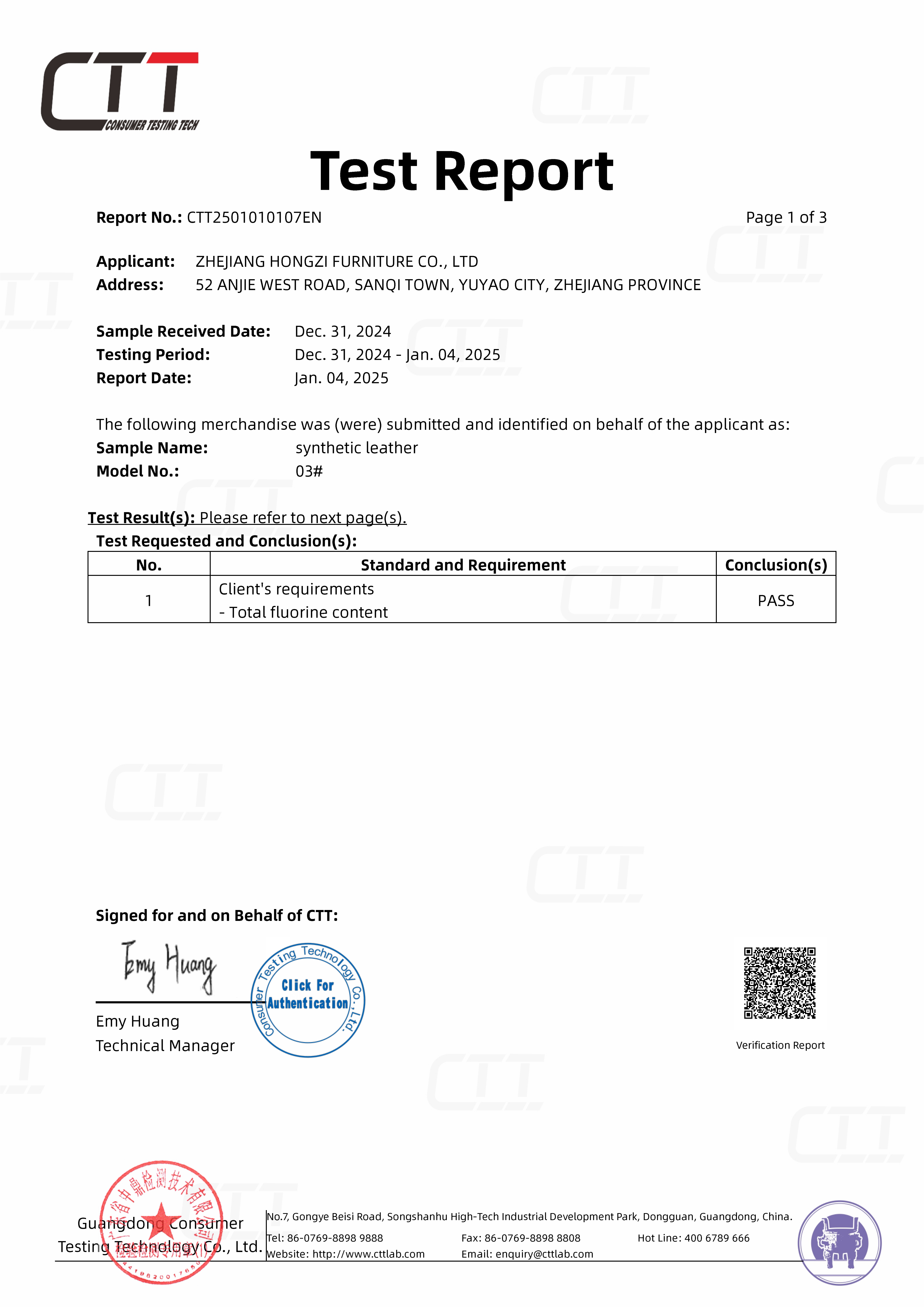
PFAS test report CTT2501010107EN to EN 14582:2016, issued for synthetic leather 03# used in salon seating.
Where the published specifications stop
The most important limitation of this comparison is that it can only rank the three models on what is published, and the published set is narrow.
- No mechanism data. None of the three entries states whether the chair is hydraulic, reclining, or fixed, nor the recline angle where a recline exists. Buyers requiring a specific mechanism cannot select on the published sheet alone.
- No load rating or durability figure. The heavy-duty classification on HZ87102RB is a manufacturer positioning label, not a published test result, and no cycle or load figure is given for any of the three.
- No component mapping. The material lines list metals without stating which parts they form, so no structural ranking between iron and aluminium alloy can be derived from the catalogue.
- No weight or packed volume. Freight and handling costs cannot be estimated from dimensions alone.
- Single-source scope. All three models come from one manufacturer. This is a within-range comparison, not a market-wide benchmark, and it should not be used to position other suppliers.
These gaps do not make the comparison unusable; they define its boundary. The models can be separated reliably on footprint and on published material composition. They cannot be separated on durability, comfort or mechanism performance without documentation that the catalogue does not provide.
Market context: a maturing category with a documentation gap
The wider category provides useful background for why specification clarity has become a procurement issue. Market research cited for the salon chair segment puts the global market at approximately USD 1.5 billion in 2025, with hydraulic salon chairs projected to account for a 63.4% share in 2026. Whatever the exact figure, the direction is consistent with what the three models illustrate: mechanism type is now a primary segmentation variable in the category, and buyers increasingly specify by mechanism rather than by appearance.
That creates a documentation gap rather than a product gap. A chair can be listed with dimensions and materials and still leave the decisive variable — how the seat moves — unspecified. For importers, the practical response is to treat every catalogue line as a partial record and to close the gap at quotation stage, model by model.
Outlook
Two developments are likely to shape how ranges like this one are evaluated. First, mixed fleets are becoming the normal purchasing pattern: a compact styling chair, a standard barber salon chair and a heavy-duty model serve different store formats, and distributors benefit from covering all three from one supply base with shared terms. Second, buyers are shifting from appearance-led selection to documentation-led selection, requesting dimensioned drawings, component breakdowns and report-to-batch mapping before committing.
For the three models compared here, the near-term decision is straightforward and does not depend on that shift: HZ8801 for the tightest stations, HZ8796C where the largest plan footprint and a barber-range classification fit the room, and HZ87102RB where the tallest back and the heavy-duty classification match the station's role. Everything beyond that — mechanism, load rating, recline behaviour, batch-level documentation — belongs in the quotation and the acceptance protocol, not in the catalogue.
FAQ
Which of the three models fits a small salon?
HZ8801 publishes the smallest plan dimensions at 90 × 60 cm, which is roughly 0.54 m² of floor area calculated from the first two published figures — about 47% less than HZ8796C and about 36% less than HZ87102RB. It is the practical option where station pitch is tight or the room is a converted retail unit. The trade-off is that it is classified as a styling chair and its mechanism is not published, so recline and seat height should be confirmed before a full shop floor is specified around it.
Does the aluminium alloy frame make HZ8796C and HZ87102RB stronger than the iron-frame HZ8801?
No such conclusion can be drawn from the published data. The material lines state that HZ8801 lists iron and that HZ8796C and HZ87102RB list aluminium alloy, but they do not state which component each metal forms, the section thickness, the finish or the wood-to-metal assembly method. Material name alone does not establish strength, weight or durability. A meaningful comparison requires a component-level breakdown of base and frame from the supplier.
Are these three models hydraulic or reclining?
The published classifications are styling chair for HZ8801, Barber salon chair for HZ8796C and Heavy Duty Barber Chair for HZ87102RB. None of the three specification entries states a hydraulic pump or a recline function. Because mechanism type drives service workflow and maintenance planning — market research projects hydraulic salon chairs at a 63.4% share of the segment in 2026 — the mechanism should be confirmed in writing in the quotation rather than inferred from the model name.
What ordering terms are published for these models?
The manufacturer publishes a minimum order quantity of 5 units, a lead time of 15 days for orders under 100 units and 30 days for orders over 100 units, OEM production with logo and colour customization, 100% testing on all products, a monthly capacity of 15,000 units, and export to EU and US markets. Because these are range-level terms, importers should confirm whether the MOQ applies per model or per order and obtain a model-specific schedule for mixed orders.
What documentation should accompany a shipment of these chairs?
The manufacturer's documentation file includes an SGS flame-retardant artificial leather report numbered SL62416330206201TX, an SGS flame-retardant foam report numbered SL62416330201301TX, both referencing the UK Furniture and Furnishings (Fire) (Safety) Regulations 1988, and a PFAS report numbered CTT2501010107EN to standard EN 14582:2016 for synthetic leather 03#. These are material-scoped documents. A buyer should confirm that each report applies to the specific model, colour and production batch ordered, and should also request the inspection record generated by the 100% testing process.
Reference document: the manufacturer's product catalogue is available as a PDF at Ningbo Hongzi product catalogue.
Have Questions or Need More Details?
Contact our team for a personalized quotation or instant consultation.
Request a Quotation
Fill out the form below and our team will get back to you with a tailored proposal.
WhatsApp Direct Chat
Prefer to chat in real-time? Message us on WhatsApp for instant assistance & quick answers.
- Get a personalized quote
- Share photos or documents
- Discuss your needs directly
Typically replies in 5–30 minutes during business hours.