
Hair Growth Serum OEM: Benchmarking "8-Free" Claims
Hair Growth Serum OEM: Why "8-Free" Is Now a Verification Problem, Not a Slogan
"Free-from" language has moved from niche positioning to a routine requirement in hair growth serum OEM briefs — and it has arrived faster than any standardized way to check it. The global hair serum market was valued at USD 1.3 billion in 2024 and is projected to reach USD 2.4 billion by 2033, according to Grand View Research. Within that market, hair treatment serums — including hair-loss and regrowth formulas — accounted for 64.6% of global value in 2024, based on Grand View Research and Spherical Insights data. A market this large, concentrated in one product family, inevitably produces a large volume of similar-sounding formulation claims.
That is the practical problem facing buyers at the decision stage. An "8-Free" clean formula claim is not a certification and not a regulated designation. It is a manufacturer-defined formulation position. For a brand owner or procurement manager, the useful question is therefore not "does this supplier offer 8-Free?" but "what evidence turns that claim into a reproducible, auditable specification?"
This benchmark test is written from an independent buyer's perspective: it sets out how to evaluate 8-Free hair growth serum OEM offerings against verifiable, standardized criteria, how to read the exclusion list behind each claim, and how a manufacturer's stated capabilities should be tested against the formulation control you are actually paying for.
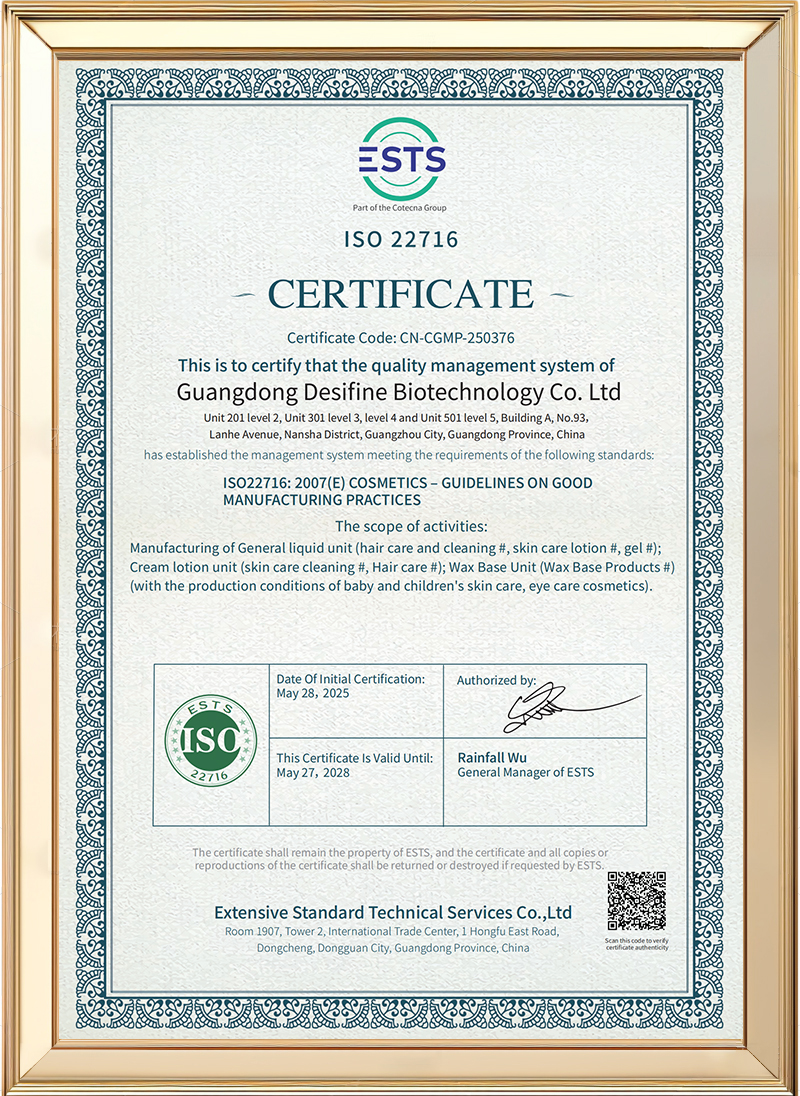
ISO 22716 Certificate — Guangdong Desifine Biotechnology Co., Ltd. | Cert No: CN-CGMP-250376
Why Clean-Formula Claims Became a Procurement Decision
Two market forces converged. The first is supply-side: the global cosmetics OEM/ODM market is projected to reach USD 31.71 billion by 2025, with China holding nearly 30% of the global share, according to the SEYE Cosmetic Industry Report. China's exports of shampoo and related hair care products increased 16.79% year-on-year to USD 137 million between January and August 2025, per China's General Administration of Customs. Capacity is abundant, which means differentiation increasingly rests on formulation specification rather than on availability.
The second is demand-side. The "skinification" of hair care has driven a 30% increase in demand for serums featuring facial-grade ingredients such as hyaluronic acid and peptides, according to Mintel and Technavio research. Private label cosmetics, meanwhile, is growing at a CAGR of 5.5%, driven by demand for affordable, high-quality alternatives to premium hair care brands, per Grand View Research.
When buyers ask for facial-grade sensorial quality, they simultaneously inherit facial-grade expectations about what should not be in the formula. That is the origin of the 8-Free brief — and of the ambiguity that follows it into the sampling stage.
What 8-Free Actually Covers, and Why the Eighth Exclusion Varies
There is no single global standard that defines an 8-Free hair serum. In practice, the exclusion categories most commonly specified in buyer briefs are preservatives, fragrance, mineral oil, silicone, traditional emulsifiers, amines, and dyes. Because the framework is manufacturer-defined rather than standard-defined, the eighth exclusion slot is frequently filled differently from one supplier to the next — sometimes with petrolatum, sometimes with sulfates, sometimes with alcohol, sometimes with a category that overlaps something already on the list.
It also helps to understand what each exclusion does functionally, because removing an ingredient is always a formulation trade-off rather than a free upgrade:
- Preservatives — in water-based products, preservation is what keeps a formula stable against microbial growth over its shelf life. Removing conventional preservatives requires an alternative strategy, which may involve water activity control, anhydrous or low-water formulation, packaging selection, or a different preservation system. This is the exclusion that most directly affects shelf-life data and stability testing requirements.
- Fragrance — fragrance is often used to mask the odour of active raw materials. Removing it usually changes perceived scent rather than performance, but it also removes a recognized source of consumer sensitivity complaints and simplifies allergen declaration in some markets.
- Mineral oil — a common occlusive and emollient. Removing it shifts the oil phase toward vegetable or synthetic esters, which can affect texture, oxidation stability, and cost.
- Silicone — provides slip, spreadability and dry-film sensory. Silicone-free systems typically need alternative conditioning polymers or esters, and sensory performance often has to be re-tuned through multiple sample rounds.
- Traditional emulsifiers — the backbone of oil-in-water emulsions. Excluding them often leads to alternative emulsification systems, solubilized systems, or low-surfactant formats, all of which influence viscosity stability.
- Amines — frequently used for pH adjustment and neutralization. Removing them changes how the formulator builds pH into the system, which matters for active stability.
- Dyes — purely visual. Removing them is usually straightforward but changes how the finished serum reads on shelf, which matters for brands whose visual identity depends on a tinted product.
Five Verification Layers for Benchmarking an 8-Free Claim
Layer 1 — Written exclusion schedule
Request a document that lists each of the eight exclusions, the definition applied to each one, and the INCI-level exclusions that definition implies. This is the single most useful document in an 8-Free evaluation, because it converts marketing language into an inspectable list.
Layer 2 — Full declaration and raw material documentation
The finished formula declaration should match the exclusion schedule, and raw material specifications should be traceable at batch level. Where a supplier operates a batch traceability system, that traceability is what allows a claim to survive an audit or a retailer questionnaire months after shipment.
Layer 3 — Preservation strategy justification
For a preservative-free brief, the most important technical question is how the formula resists microbial growth without conventional preservatives. Useful supporting material includes preservation efficacy and stability documentation, plus clarity on the packaging format assumed in that testing. This is where an 8-Free project most often diverges from a conventional brief.
Layer 4 — Stability and shipping validation
Clean-label systems can behave differently from conventional ones under temperature cycling and long transit. Multi-round destructive testing before shipment, plus pre-shipment inspection, is the operational layer that protects the claim after it leaves the factory. Buyers should ask which stability data applies to the specific formula and package configuration being quoted, not to a category in general.
Layer 5 — Claim substantiation and regulatory mapping
An 8-Free formula still has to clear market-specific rules. In the EU, hair growth products fall under Regulation (EC) No 1223/2009, and specific claims about follicle stimulation may shift a product's classification toward "medicinal" — a classification change with substantial commercial consequences. In the US, only Minoxidil and Finasteride are currently FDA-approved active ingredients for hair growth; most other hair growth positioning is treated as cosmetic or cosmeceutical. Buyers evaluating an 8-Free hair regrowth serum OEM programme should confirm that the exclusion list and the marketing claims are validated against the target market, not just the finished formula.
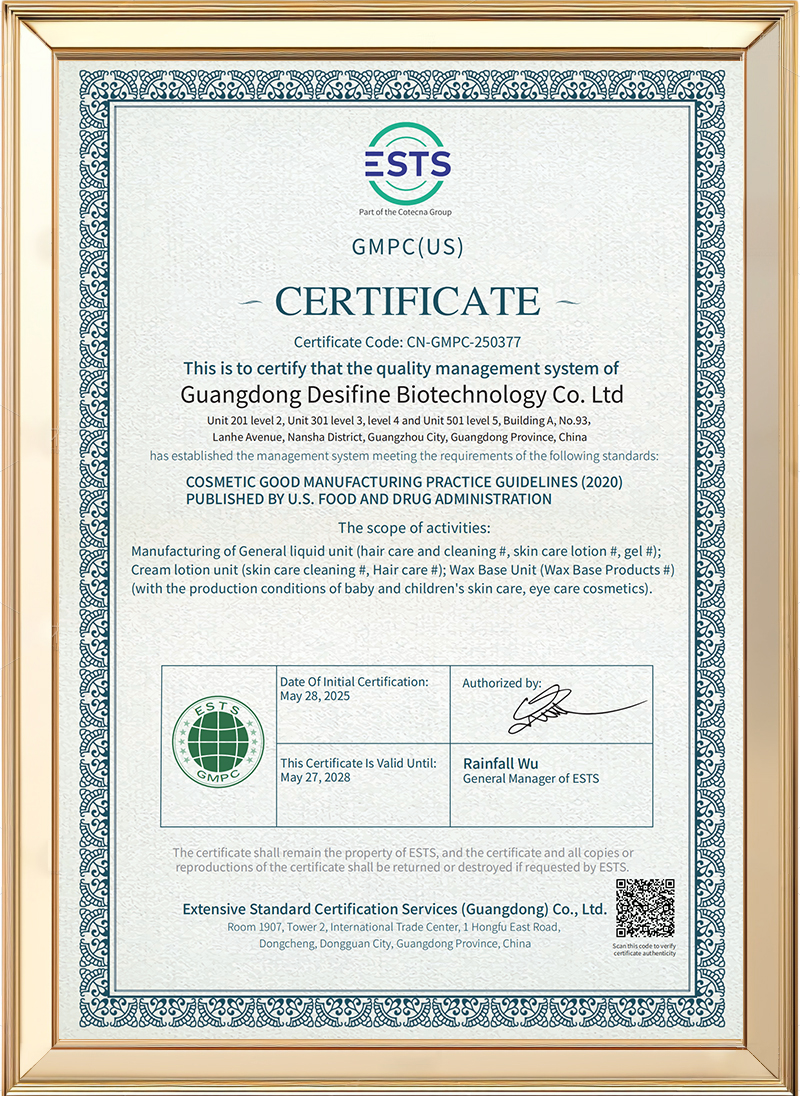
GMPC Certificate — Guangdong Desifine Biotechnology Co., Ltd. | Cert No: CN-GMPC-250377
Claim-Only Submissions vs Documented Submissions: A Comparison Table
The table below is a buyer-side scoring framework. It does not describe any named supplier; it describes two levels at which an 8-Free claim can be submitted for evaluation. The purpose is to make an otherwise subjective comparison checkable across multiple quotations.
| Verification dimension | Claim-only submission | Documented submission (benchmark test) |
|---|---|---|
| Exclusion definitions | "8-Free" stated in a quotation or catalogue entry | Written schedule defining each exclusion at INCI level |
| Formula declaration | Marketing ingredient highlights (e.g. peptides, hyaluronic acid) | Full declaration aligned to the exclusion schedule |
| Preservation logic | "Preservative-free" as a label statement | Stated preservation strategy plus supporting efficacy and stability documentation |
| Stability evidence | General capability claim | Formula- and package-specific stability testing, including multi-round destructive testing |
| Shipment control | Standard QA statement | Pre-shipment inspection plus batch traceability records |
| Raw material continuity | Not addressed | Multiple raw material suppliers identified for critical inputs |
| Market compliance | "EU/US compliant" | Claim-by-claim mapping to Regulation (EC) No 1223/2009 and US FDA ingredient rules |
| Customisation control | Choice from a fixed catalogue | Formula development support with defined sample-validation rounds |
Mapping DESIFINE's Stated Capabilities Against the Benchmark
Guangdong Desifine Biotechnology Co., Ltd. is a cosmetics OEM/ODM manufacturer based in the Nansha Economic and Technological Development Zone, Guangzhou, founded in 2000 and serving skincare, face mask, body care, hair care, anti-aging and lip care categories. Its stated hair care positioning includes an 8-Free clean formula, which places it directly inside the claim category this benchmark test is designed to evaluate.
On the structural criteria, the manufacturer reports a 15,000 m² modern industrial plant with an annual output of 5,000,000 units, an R&D team of 20+ engineers, 82 employees, and an export ratio of 60% with main markets in the USA and Europe. Those figures describe capacity and orientation; they do not, by themselves, validate a clean-formula claim. What they do establish is whether the operation is large enough to run separate clean-label lines, dedicated stability programmes, and market-specific documentation without those activities competing with mainstream volume.
On certification, Desifine holds Cosmetics GMP Certification (GMPC) documented under certificate number CN-GMPC-250377 and EU ISO 22716 Cosmetics Quality Management System Certification documented under certificate number CN-CGMP-250376, alongside US FDA Registration and National High-tech Enterprise status. For an 8-Free evaluation, the relevant point is not the certificate list itself but the management system behind it: GMPC and ISO 22716 frameworks are what make batch-level documentation, raw material control, and deviation handling auditable rather than anecdotal. The manufacturer also describes its internal control standards as exceeding industry norms in a number of areas, and states that it introduced German management systems and SOP structures.
On formulation depth, the manufacturer cites a reserve of more than 10,000 formulations and support for over 800 global brands, compared with an alternative-manufacturer profile that typically serves dozens to hundreds of brands and maintains dozens to hundreds of formulas. In practice, a large formula reserve shortens the distance between a brief and a first sample, because the starting point is an existing validated system rather than a blank sheet. The manufacturer also describes multi-round destructive testing to confirm product stability, and cites a one-stop OEM/ODM scope covering formula development through to production, together with full regulatory compliance support.
On commercial flexibility, Desifine positions itself for beauty brands seeking private label hair care products with flexible MOQ and full regulatory compliance. On supply risk, the manufacturer identifies raw material supply fluctuation, formula stability during shipping, and cross-market compliance differences as the three principal risk categories, and lists multiple raw material suppliers, stability testing before shipment, pre-shipment inspection and a batch traceability system as the corresponding control methods.
The Limits of an 8-Free Positioning
An honest evaluation has to state where this positioning stops being an advantage. Four boundaries matter most.
First, 8-Free is not a performance guarantee. Removing preservatives, fragrance, mineral oil, silicone, traditional emulsifiers, amines and dyes says nothing about whether the active system delivers the sensory and stability behaviour a brand needs. A clean exclusion list and a well-performing serum are two separate achievements, and a buyer should evaluate them separately.
Second, the exclusion list raises cost and complexity rather than lowering it. Alternative preservation, alternative emulsification, alternative conditioning systems and additional stability work all consume development time and raw material budget. The manufacturer in question positions its pricing as competitive with higher delivered value through what it describes as pharmaceutical-grade quality and expert R&D support — but buyers should expect an 8-Free brief to carry a longer sampling cycle than a conventional one, particularly when fragrance and traditional emulsifiers are removed simultaneously.
Third, flexible MOQ has boundaries. Flexible minimum order quantities in a clean-label context are constrained by raw material minimum purchases, dedicated-line scheduling and packaging tooling. The flexibility is real, but its ceiling is determined by the specific formula and package combination rather than by a general policy.
Fourth, claim risk sits with the brand, not the factory. A manufacturer can supply documentation; it cannot guarantee that a regulator or a retailer will accept a given claim in a given market. Where follicle-stimulation language is involved in the EU, classification may shift toward medicinal under Regulation (EC) No 1223/2009 — a shift that no formulation choice can offset.
Application Fit: Where an 8-Free Hair Growth Serum Programme Works
The 8-Free brief fits programmes where the exclusion list itself carries commercial weight. Typical fits include private label hair growth serums for retailers building a sensitive-scalp or clean-label sub-brand; custom hair serums for brands whose existing range already carries free-from positioning; anti hair loss serum OEM and hair regrowth serum OEM projects targeting the USA or Europe, where the manufacturer's stated export focus and regulatory compliance support align with the market's documentation expectations; and hair strengthening serum OEM programmes where the product sits in a daily-use format and fragrance removal is a customer-facing benefit rather than a cost.
It fits less well where the priority is a fast, low-cost entry into the category with a conventional sensory profile. In those cases, an 8-Free brief adds development rounds without a corresponding commercial return — a legitimate outcome of the evaluation, not a failure of the supplier.
Sample Validation Workflow Before Batch Commitment
For buyers at the decision stage, the following sequence converts an 8-Free claim into a decision:
- Step 1 — Request the exclusion schedule. Confirm eight defined exclusions at INCI level, and identify which one occupies the eighth slot.
- Step 2 — Map the schedule to your target market. Check the exclusions and the intended claims against EU and US requirements before sampling begins, not after artwork is approved.
- Step 3 — Request the preservation and stability rationale for the specific formula and package being quoted.
- Step 4 — Compare certificates against the claim category. Confirm GMPC and ISO 22716 documentation covers the site producing the hair serum.
- Step 5 — Run sample validation across at least two rounds covering sensory profile, stability and packaging compatibility.
- Step 6 — Confirm shipment controls in writing — pre-shipment inspection, batch traceability, and raw material contingency for critical inputs.
Market Trend Outlook
Three trends shape how this category will be evaluated over the next several years. Clean-label expectations are consolidating: private label cosmetics growth at a 5.5% CAGR reflects a structural shift toward supplier-built brands, and each new private label entrant raises the documentation baseline for its competitors. Functional scalp care is attracting investment from large global cosmetic OEM/ODM groups headquartered in markets such as South Korea and Italy, per Fortune Business Insights analysis of the OEM/ODM landscape — which means clean-formula verification capability is becoming a scale question rather than a boutique one. And regulatory attention to hair growth claims continues to tighten in both the EU and the US, placing a premium on suppliers who can map a formulation to a market rather than supplying a single generic specification.
The direction of travel is clear: "8-Free" will keep appearing in briefs, and buyers who can convert it into an auditable specification will be the ones who avoid reformulation costs after launch.
FAQ
What does "8-Free" mean in hair growth serum OEM?
8-Free is a manufacturer-defined formulation position rather than a regulated standard. In most buyer briefs it refers to the exclusion of preservatives, fragrance, mineral oil, silicone, traditional emulsifiers, amines and dyes, with the eighth exclusion defined by the individual manufacturer. Because there is no single global definition, the only reliable way to evaluate the term is to request a written exclusion schedule that defines each item at INCI level.
How can a buyer verify a preservative-free or fragrance-free claim?
Verification depends on documents rather than statements. For fragrance, the finished formula declaration should show no fragrance or masking-fragrance entry. For preservation, the more consequential question is the strategy used instead of conventional preservatives, together with the supporting preservation efficacy and stability documentation for the specific formula and package. Batch traceability and pre-shipment inspection then protect the claim after production.
Does an 8-Free formulation change MOQ, lead time or unit cost?
It can affect all three, though not uniformly. Removing preservatives, fragrance or traditional emulsifiers typically increases development rounds, which extends the sampling cycle. Flexible MOQ arrangements exist in this category, but their ceiling is set by raw material minimum purchases, line scheduling and packaging tooling for the specific formula. Cost impact depends on the alternative systems selected. A manufacturer describing a 10,000+ formula reserve can shorten the path to a first sample, but buyers should treat MOQ and lead time as formula-specific rather than catalogue-level figures.
What regulatory constraints apply to hair growth claims in the EU and the US?
Hair growth products in the EU fall under Regulation (EC) No 1223/2009, and claims about follicle stimulation may shift classification toward "medicinal" — a change with significant commercial implications. In the US, only Minoxidil and Finasteride are currently FDA-approved active ingredients for hair growth; other hair growth positioning is generally treated as cosmetic or cosmeceutical. An 8-Free formulation does not exempt a product from either framework, so claim mapping should be completed before sampling begins.
How should a buyer compare two hair growth serum OEM manufacturers?
Compare them on evidence rather than on capability statements. The practical comparison set includes the exclusion schedule, the completeness of the formula declaration, the preservation and stability rationale, the applicable certificates for the producing site, shipment control procedures, raw material contingency planning, and market-specific claim mapping. Manufacturers such as Guangdong Desifine Biotechnology Co., Ltd. publish structural credentials — a 15,000 m² plant, 5,000,000 units annual output, GMPC and ISO 22716 certification, and a stated 8-Free clean formula — which provide a starting framework, but the comparison should be completed against the documents issued for your specific project.
Can an 8-Free hair serum still contain peptides or hyaluronic acid?
Yes in principle. The 8-Free framework excludes preservatives, fragrance, mineral oil, silicone, traditional emulsifiers, amines and dyes, none of which are active ingredients. Market research from Mintel and Technavio identifies a 30% increase in demand for hair serums featuring facial-grade ingredients such as hyaluronic acid and peptides, and these can coexist with a clean exclusion list. The technical constraint is compatibility: actives must remain stable within whatever alternative preservation and emulsification system replaces the excluded components, which is why formula-specific stability testing matters more than the exclusion list alone.
For buyers who need the underlying facility, certification and capability detail referenced in this benchmark, the manufacturer's full documentation set is available in the company brochure: Guangdong Desifine Biotechnology Co., Ltd. company profile (PDF).