
Hair Growth Serum OEM: MOQ, Lead Time & Compliance
Hair Growth Serum OEM: MOQ, Lead Time & Compliance
Hair growth serum OEM is a manufacturing arrangement in which a cosmetics producer formulates, fills, and packages a serum under a client’s own brand. For buyers moving from research to evaluation, the critical questions are not only about texture or ingredients but also about supplier constraints: minimum order quantities, lead times, certifications, and customization scope. This article addresses those questions using the certified hair care manufacturing line of Guangdong Desifine Biotechnology Co., Ltd. (Desifine) as a reference, and it places the category in the context of current market data.

Why Hair Growth Serum OEM Is a Growing Procurement Category
Grand View Research estimates the global hair serum market at approximately USD 1.3 billion in 2024, with expectations to reach USD 2.4 billion by 2033. The same source reports that the hair treatment serum segment—which includes formulas addressing hair loss and growth—dominated the market with a 64.6% share in 2024. A separate estimate from Spherical Insights places the broader global hair growth products market, including serums, shampoos, and supplements, at USD 8.71 billion in 2024. Asia Pacific is projected to be the fastest-growing region for hair serums, with a CAGR of 7.9% from 2025 to 2033.
These figures explain why manufacturers and brands are investing in hair serum product development. But entering the category also brings compliance complexity. In the European Union, hair growth products must comply with Regulation (EC) No 1223/2009, and claims regarding hair growth can trigger a "borderline" classification between cosmetics and medicinal products. This regulatory environment makes supplier verification part of product planning.
Desifine’s OEM/ODM Hair Care Line: A Defined Manufacturing Context
Guangdong Desifine Biotechnology Co., Ltd. (Desifine) is a cosmetics OEM/ODM manufacturer founded in 2000 and based in the Nansha Economic and Technological Development Zone, Guangzhou, within the Guangdong-Hong Kong-Macao Greater Bay Area. The company operates a 15,000 m² factory, employs 82 staff, and has an annual output capacity of 5,000,000 units. Its R&D team includes more than 20 engineers. Desifine’s main product scope covers skincare, face masks, body care, hair care, anti-aging, and lip care. Around 60% of its output is exported, primarily to the USA and Europe.
For a hair growth serum launch, the relevant starting point is Desifine’s Hair Serum product type within the Desifine OEM/ODM Hair Care Series. This series includes shampoo, conditioner, hair mask, hair oil, hair serum, hair wax, hair gel, and hair spray. Customization options in this series cover formula, fragrance, color, concentration, packaging, bottle shape, label, logo, and private brand name.
| Parameter | Value |
|---|---|
| Product types | Shampoo, Conditioner, Hair Mask, Hair Oil, Hair Serum, Hair Wax, Hair Gel, Hair Spray |
| MOQ | 3,000 units per SKU |
| Lead time | 30–45 days; samples 7–10 days |
| Monthly capacity | 500,000 units |
| Manufacturing standards | GMPC, ISO 22716, pharmaceutical-grade |
| Formula | 8-Free Clean Formula; cruelty-free |
| Customization | Formula, fragrance, color, concentration, packaging, bottle shape, label, logo, private brand name |
| Quality control | In-house QC lab; raw material inspection; semi-finished product testing; 100% finished product check; third-party testing available (SGS/Intertek) |
| Export markets | USA, Europe, Southeast Asia, Middle East, Australia |
Desifine's hair care manufacture follows GMPC, ISO 22716, and pharmaceutical-grade standards. The formula used in the private label line is an 8-Free Clean Formula, free from preservatives, fragrance, mineral oil, silicone, traditional emulsifiers, amines, and dyes, and is cruelty-free.
Private Label Hair Care is certified to GMPC and to ISO 22716:2007 Cosmetics - Good Manufacturing Practices (GMP), issued by Sinoanalysis Testing Group. The certificate numbers on record are CN-GMPC-250377 for GMPC and CN-CGMP-250376 for ISO 22716. For the U.S. market, Private Label Hair Care is covered by FDA Registration. The FDA Registration number GTHIVE312-25090 covers cosmetics, skincare, hair care, and body care, with the scope applied to the USA and North America.
Technical Considerations in Hair Growth Serum OEM
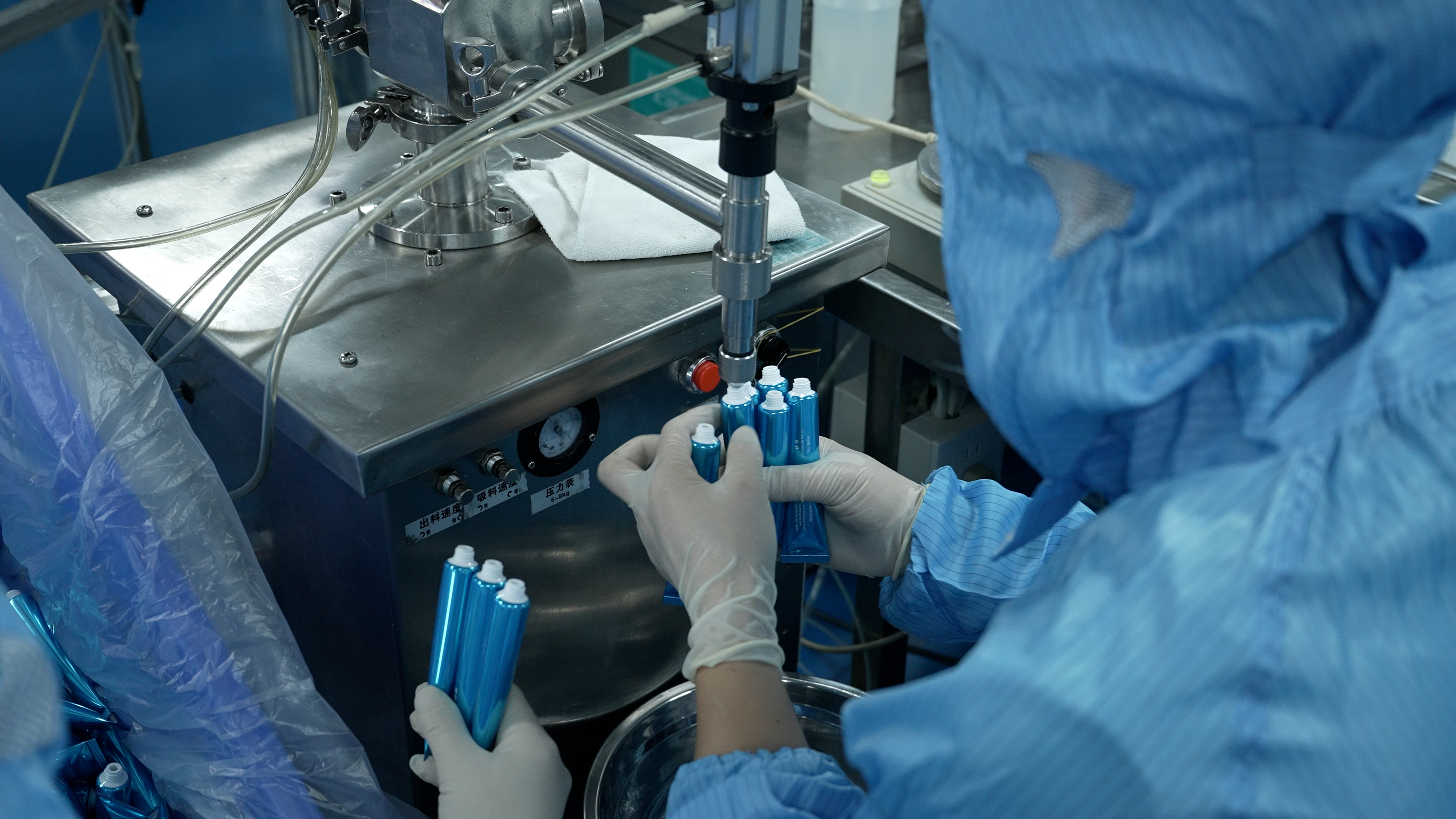
An OEM production line for hair serum involves more than filling bottles. Desifine’s manufacturing footprint includes a formula R&D lab, a GMP production line, quality testing equipment, and a custom packaging line. This configuration supports both small-batch custom production and large-scale mass production, depending on the brand’s stage.
Raw materials listed for Desifine’s hair care series include natural plant extracts, active peptides, keratin, argan oil, coconut oil, tea tree oil, biotin, caffeine, panthenol, silk protein, and amino acids. For a hair growth serum, the formulation step determines whether the final product can be positioned around claims such as anti-hair-loss, regrowth, or strengthening, and those claims must be supported by the actual composition and applicable regulations.

The production workflow starts with raw material inspection, followed by semi-finished product testing, filling, and a 100% quality check on finished products. Third-party testing can be arranged through SGS or Intertek, and the manufacturer can provide batch tracking, stability testing reports, safety data sheets (SDS), and product claim support.
Use Cases: Where Custom Hair Serum Fits in a Brand Portfolio
Desifine’s private label hair care series is applicable to beauty and personal care brands, hair care brands, salons and spas, retail, e-commerce, and private label brand developers. The production model accommodates both smaller custom batches and larger mass production runs.
An ongoing partnership with a private label beauty brand illustrates the range of support. The brand, operating in the US, Canada, UK, and Italy, developed a custom hair care product line for the sensitive skin market through Desifine. Over four years, Desifine produced 200,000 pieces, maintaining consistent quality from sample to mass production. Support included custom formula development for sensitive skin, flexible small batch production, regulatory compliance assistance, packaging optimization advice, and on-time delivery. A hair serum SKU would follow the same OEM process within the hair care series.
Market Trends Shaping Hair Growth Serum OEM
Three trends are visible in the data available for the hair serum category.
First, demand is shifting toward treatment-oriented serums. The 64.6% share held by the hair treatment serum segment in 2024 indicates that consumers expect more than basic styling benefits from serum products.
Second, geographic growth is uneven. Asia Pacific is projected to grow at a CAGR of 7.9% from 2025 to 2033, the fastest among global regions. This suggests that brands seeking regional expansion may prioritize OEM partners with export experience in that area.
Third, regulatory scrutiny affects product claims. Under EU Regulation (EC) No 1223/2009, hair growth products must meet cosmetic safety requirements, but claims about hair growth can push a product toward a "borderline" classification between cosmetics and medicinal products. This makes documentation support from an OEM manufacturer a practical requirement.
There is also macro evidence of cross-border manufacturing activity. According to the General Administration of Customs of China, exports of shampoo and related hair care products (HS code 33051000) grew 16.79% year-on-year to USD 137 million between January and August 2025. This export trend reflects international demand for Chinese-produced hair care, including OEM-supplied formats.
OEM vs. Traditional Hair Serum Sourcing Models
Brands pursuing a hair growth serum typically compare three routes: in-house manufacturing, generic white-label sourcing, and OEM/ODM partnerships.
In-house manufacturing provides full control but requires formulation knowledge, production equipment, and regulatory compliance systems. Generic white-label sourcing is faster and cheaper at entry, but it limits differentiation and often provides little support for market-specific claims. OEM/ODM manufacturing combines a dedicated production line, regulatory documentation, and customization with the ability to put the brand’s own name on the product.
Desifine’s model sits in the OEM/ODM category. Its certified hair care line, in-house QC lab, and export experience are the relevant factors for a brand evaluating a supplier.
One limitation should be stated directly: the minimum order of 3,000 units per SKU means that very small test batches are not available. For a brand that wants to place only a few hundred units into the market, the MOQ will feel restrictive. For most commercial launches, however, 3,000 units is a standard production threshold, and it allows the manufacturer to operate at a realistic cost basis.
Future Outlook for Hair Growth Serum OEM
Based on current projections, the global hair serum market is expected to grow from approximately USD 1.3 billion in 2024 to USD 2.4 billion by 2033. Within that growth, the treatment segment is likely to remain dominant. The fastest-growth region, Asia Pacific, will create new demand for OEM partners with export capability. Meanwhile, EU regulatory requirements will continue to raise the bar for claim documentation.
For manufacturers like Desifine, this points to continued investment in certified production and R&D capacity. For brands, the practical implication is that supplier evaluation should focus on verifiable constraints—certifications, MOQs, lead times, and documentation—rather than on aesthetic factors alone.
Company Profile
Guangdong Desifine Biotechnology Co., Ltd. (Desifine) is a cosmetics OEM/ODM manufacturer founded in 2000, operating from a 15,000 m² facility in Nansha, Guangzhou, China. The company specializes in skincare, face mask, body care, hair care, and related categories, with 60% of output exported to the USA and Europe. Contact Desifine at info@desifine.com, +86 13016010480, or via the website https://desifine.com/. The company brochure is available for download: Desifine Company Brochure.
FAQ
What certifications should a hair growth serum OEM manufacturer hold?
A manufacturer handling hair care products typically demonstrates GMPC, ISO 22716, and, for US-bound products, FDA Registration. Desifine’s private label hair care products are manufactured under GMPC, ISO 22716, and pharmaceutical-grade standards. The company holds GMPC certificate CN-GMPC-250377 and ISO 22716 certificate CN-CGMP-250376, both issued by Sinoanalysis Testing Group.
What is the MOQ for custom hair growth serum?
The minimum order quantity for Desifine’s private label hair care series is 3,000 units per SKU. This applies across the hair care product range, including hair serum.
What is the typical lead time for OEM hair growth serum?
Desifine quotes 30–45 days for production, with samples ready in 7–10 days.
Can a brand customize the formula and packaging?
Yes. Customization options include formula, fragrance, color, concentration, packaging, bottle shape, label, logo, and private brand name.
What quality control procedures are in place?
The manufacturer operates an in-house QC lab and follows raw material inspection, semi-finished product testing, and 100% finished product checks. Third-party testing services from SGS or Intertek can be arranged.
What regulatory framework applies to hair growth products in the EU?
Hair growth products sold in the EU must comply with Regulation (EC) No 1223/2009. Claims related to hair growth may trigger "borderline" classification between cosmetics and medicinal products, so claim documentation should be assessed with the manufacturer.
Which markets does Desifine serve as an OEM partner?
Desifine exports to the USA, Europe, Southeast Asia, the Middle East, and Australia. Approximately 60% of its output goes to the USA and Europe.
Which product types are included in Desifine’s hair care OEM line?
The Desifine OEM/ODM Hair Care Series includes shampoo, conditioner, hair mask, hair oil, hair serum, hair wax, hair gel, and hair spray.