
Hammer Tone vs Wrinkle vs Sandy: Outdoor Powder Coating Guide
Hammer Tone vs Wrinkle vs Sandy: Outdoor Powder Coating Guide
Outdoor powder coating is often specified by colour and gloss, yet the surface texture can decide how a metal part looks after installation, how easily it is cleaned, and how difficult it is to repair. Hammer tone, wrinkle and sandy finishes are not interchangeable decorative options. They create different surface topographies, and each has a different fit for architectural aluminium, outdoor furniture, industrial equipment and metal fabrications.
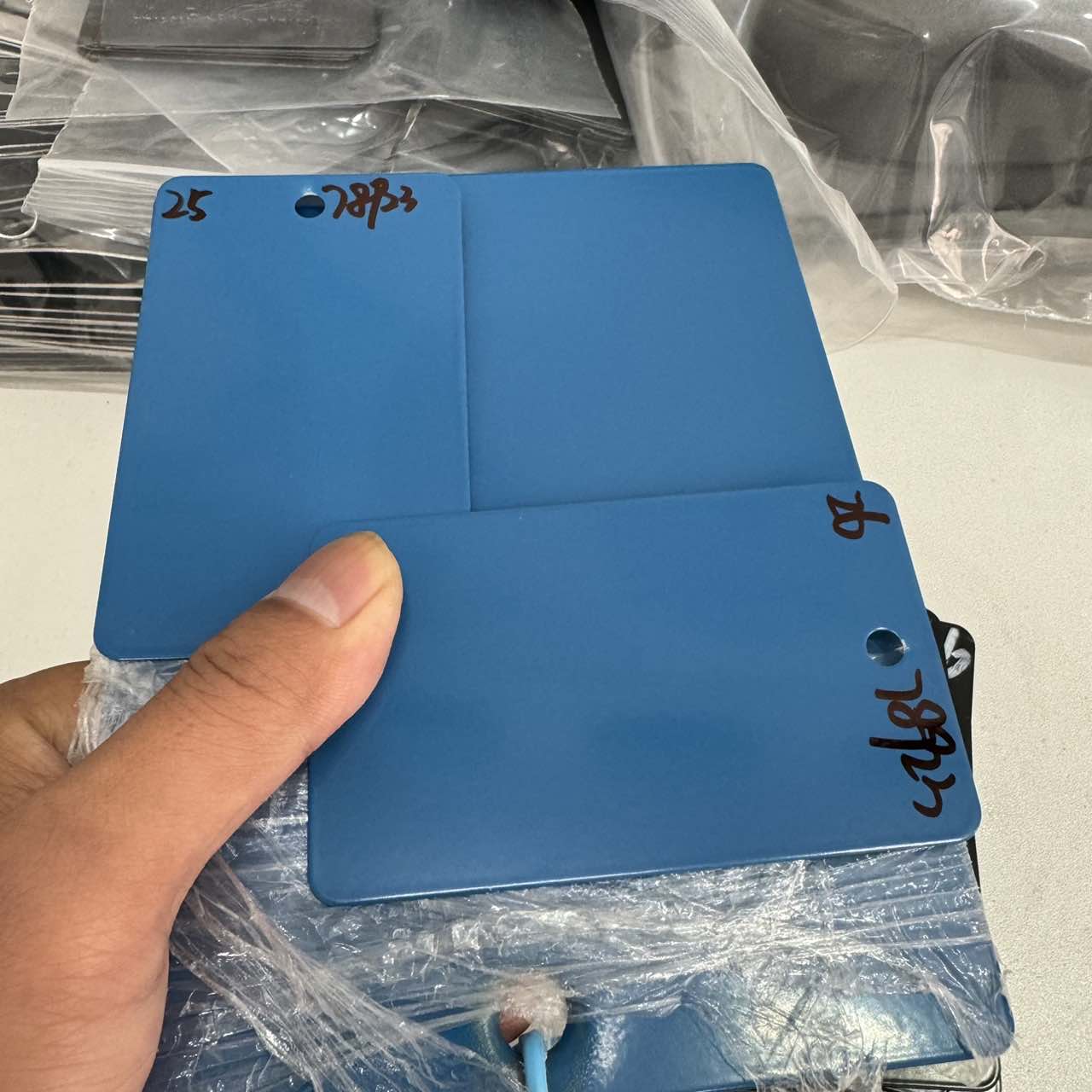
Short answer: there is no universal best texture. Sandy is often the easier starting point for architectural metal where a fine, uniform low-gloss surface is wanted. Hammer tone can suit heavy fabrication or outdoor equipment where visual depth and substrate hiding are useful. Wrinkle is a stronger choice when a pronounced industrial texture is acceptable. All three must be qualified with the correct resin system, pretreatment, cure and outdoor test evidence. Texture is not a substitute for corrosion protection.
Why Outdoor Powder Coating Texture Is Not a Cosmetic Choice
Texture changes more than appearance. A textured powder coating scatters light across a broken surface, so minor fabrication marks may be less obvious than on a glossy or smooth matt finish. That can be useful on welded frames, folded sheet metal and castings. The same surface profile can also create valleys that retain dust, pollen or industrial fallout. On a facade or a public-facing handrail, cleaning behaviour matters as much as the first visual sample.
Outdoor exposure adds ultraviolet light, moisture, temperature cycling and airborne contamination. A thermoset powder coating is applied as a dry powder and cured into a continuous film. The long-term result depends mainly on the resin chemistry, pigment system, substrate pretreatment, film build and cure schedule. Texture is a surface effect on top of that performance system. A hammer tone, wrinkle or sandy surface will not compensate for inadequate pretreatment or an unsuitable resin for the environment.
This is why a buyer should not treat the finish name as a performance grade. The term texture powder coating describes a family of visual effects. Hammered, wrinkled and sandblasted surfaces can all be produced in different chemistries, including polyester, epoxy and hybrid systems. The specification should state the resin type, substrate, colour, gloss range, texture reference, test requirements and approval sample.
How Hammer Tone, Wrinkle and Sandy Powder Coating Differ
Hammer Tone Powder Coating produces a broad, irregular pattern that resembles a hammered metal surface. The pattern usually reads as visual depth rather than fine grit. Wrinkle Powder Coating forms a finer network of raised ridges, giving a low-sheen industrial appearance. Sandy Powder Coating creates a fine granular surface, closer to a uniform matte texture than a heavy relief pattern. These descriptions are qualitative; the exact appearance depends on formulation, film thickness, substrate and cure.
For outdoor work, the practical differences appear in four places: how much surface irregularity the finish can visually absorb, how easily the surface can be cleaned, how difficult local repair becomes, and how consistently the pattern can be repeated across batches. A deep pattern may hide more fabrication variation but can be harder to wipe clean. A fine sandy texture may look more uniform on large panels but can still trap contamination if the surface profile is not controlled.
Outdoor Powder Coating Comparison Table
The table below is a buyer-facing comparison, not a universal performance ranking. It should be used to frame sample requests and test requirements, not to replace project-specific qualification.
| Evaluation dimension | Hammer tone | Wrinkle | Sandy |
|---|---|---|---|
| Visual signature | Broad irregular dimples; strong visual depth | Fine raised ridges; industrial, low-sheen look | Fine granular surface; uniform matte effect |
| Hiding of fabrication marks | Often strong because the pattern breaks up flat reflections | Often strong where the ridge pattern is visible | Moderate; best on surfaces with controlled preparation |
| Outdoor cleaning | Moderate; deep relief can retain dust in valleys | Moderate; ridges need a defined cleaning method | Generally easier among textured options when the profile is fine |
| Local repair | Difficult to blend invisibly; part rework is often safer | Difficult to reproduce by touch-up | Difficult to blend, though a fine pattern may be less conspicuous than deep relief |
| Colour appearance | Shadows can shift perceived colour and lightness | Low sheen and ridges affect colour perception | Usually the most even colour read of the three |
| Batch consistency risk | Pattern variation is more visible on large flat areas | Ridge structure must be controlled against an approved sample | Fine texture can be more forgiving, but still needs a physical standard |
| Likely outdoor fit | Heavy metalwork, outdoor equipment, frames where visual depth is acceptable | Industrial housings, equipment and surfaces where a pronounced texture is intended | Architectural aluminium, outdoor furniture and panels where a fine matte finish is preferred |
Notes: the comparisons above are qualitative buyer guidance. Project performance must be confirmed with the actual powder grade, substrate, pretreatment, film thickness, cure and test report.
Outdoor Texture Shortlist by Project Need
For evaluation, a useful approach is to shortlist by project need rather than by a single overall winner. The following fit shortlist is built around the decision that buyers actually face at the sample stage.
Fit 1: Sandy for architectural aluminium and visible flat panels
Sandy Powder Coating is often the easiest of the three to consider when the project needs a fine, low-gloss surface on aluminium profiles, panels or outdoor furniture. The visual pattern is less heavy than hammer tone or wrinkle, so it can suit large visible areas where a more uniform appearance is wanted. The buyer still needs to approve colour, gloss and texture on the actual alloy and pretreatment system, especially where adjacent panels must match.
Fit 2: Hammer tone for heavy fabrication and outdoor equipment
Hammer Tone Powder Coating can be appropriate where the metalwork has visible fabrication character, or where a decorative relief pattern is part of the product language. On outdoor equipment, frames and enclosures, the pattern can help break up reflections across a large surface. It is not automatically the best choice for coastal or high-corrosion service. Anti-corrosion performance still comes from the coating system and pretreatment, not from the dimple pattern.
Fit 3: Wrinkle for industrial housings and pronounced texture
Wrinkle Powder Coating is a practical option when the product should look industrial and the texture is part of the intended appearance. Electrical enclosures, machine housings and heavy-duty metal products are natural evaluation cases. The limitation is maintenance: a pronounced ridge pattern needs a cleaning method that reaches the surface profile. Buyers should not assume that a wrinkle finish will hide poor substrate preparation or extend corrosion life without supporting test evidence.
Where Hsinda Fits in a Buyer Evaluation
Chengdu Hsinda Polymer Materials Co., Ltd. is a powder coating manufacturer based in Chengdu, Sichuan, China, established in 2015. The company produces thermoset powder coating for industrial and architectural metal finishing and offers Hammer Tone Powder Coating, Wrinkle Powder Coating and Sandy Powder Coating with custom colour matching. For buyers comparing texture finishes, the relevant question is not only whether a supplier lists the finish name, but whether it can control the pattern, colour and outdoor performance consistently across production batches.
Hsinda's published company profile states 8 advanced production lines and 3 sample lines, annual output of more than 5,000 tons, monthly capacity of 400 tons, a minimum order quantity of 300 kg, and a lead time of 15 to 20 days. The profile also states 100% testing, custom RAL or Pantone colour matching based on samples, and texture effects that include smooth, sandblasted, wrinkled, hammered, watermarked, cracked, stone-like, metallic or pearlescent, chameleon-like, photochromic, thermochromic, electroplating, reflective and luminescent surfaces. These are supplier-stated capabilities, not independent rankings.
On performance, Hsinda's customization information lists weathering options aligned with AAMA 2604 and Qualicoat 1 and Qualicoat 2 targets, corrosion resistance and salt-spray resistance, plus antibacterial, anti-slip, anti-fingerprint, fire-resistant, scratch-resistant and low-temperature-curing options. The company profile also states ISO 9001 and ISO 14001 certification, and lists RoHS, REACH, SGS and AAMA testing. A buyer should still request the specific certificate, test report and approved sample for the exact product and colour under evaluation.
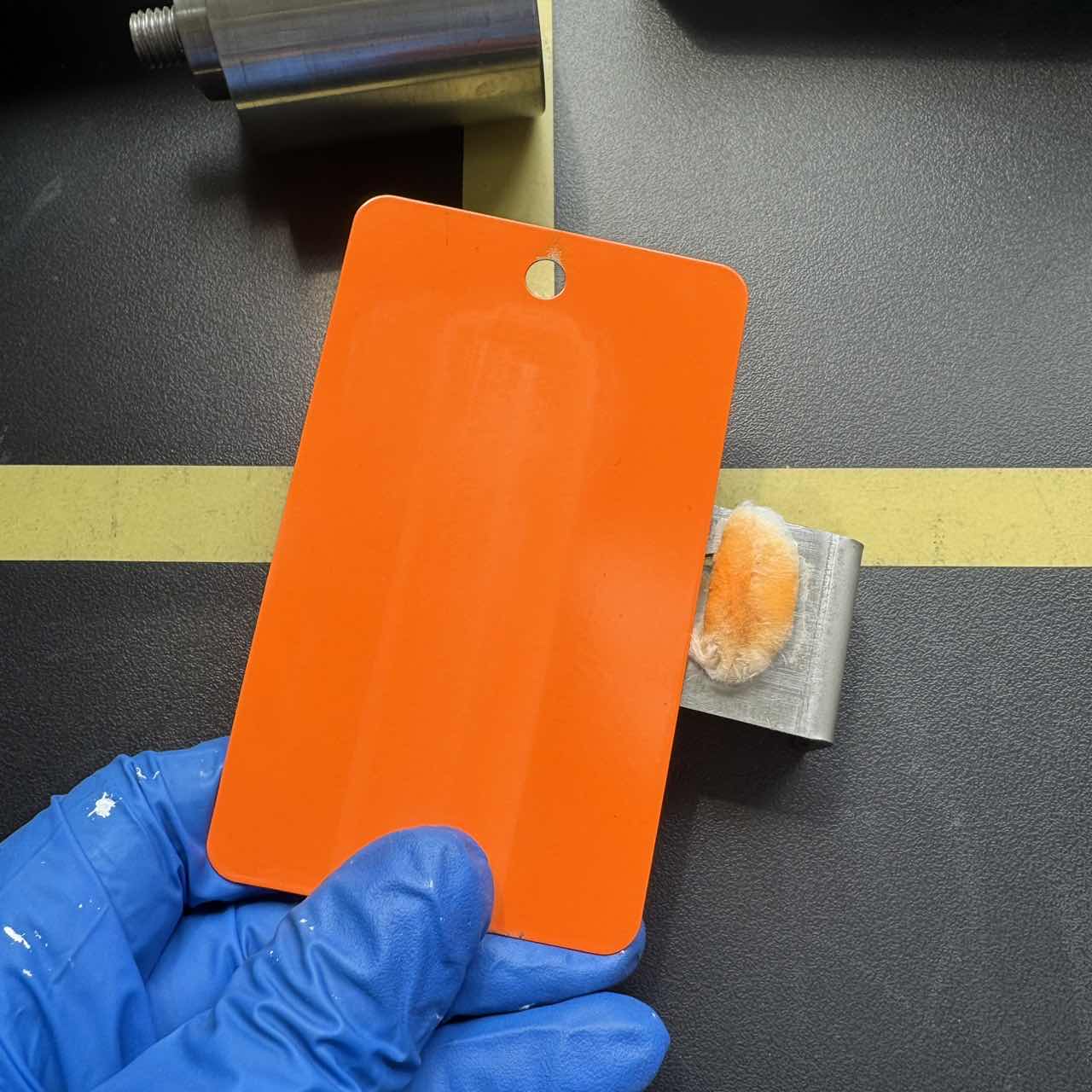
For a textured outdoor finish, the sample room matters as much as the production line. Hammer tone, wrinkle and sandy patterns are visual standards as well as technical ones. A supplier should be able to retain a signed reference panel, state the viewing condition, and compare production against that reference. Hsinda's sample preparation capability and custom colour service are relevant here, but the buyer should define the acceptance criteria before the first batch is produced.
Outdoor Applications and Finish Fit
Hsinda's case records show how finish selection connects to real outdoor and durability requirements. The cases below are application evidence, not a claim that one texture is universally superior.
Electrical enclosures
A Hsinda case record covering electrical enclosures reports 40 tons supplied across Mexico, Paraguay, Sri Lanka, Russia and China over 10 years. The application requires safe housing of electrical components, centralised control and protection, with corrosion resistance, insulating or static-conductive performance and an aesthetic finish. Wrinkle Powder Coating appears among the related finish options. For this type of product, a pronounced texture can support an industrial appearance, but the enclosure specification must still control electrical safety, corrosion protection and outdoor exposure.
Hardware tools and outdoor equipment
A hardware tool case record reports 1,000 tons over 5 years for customers in Mexico and the United States. The coated tools include wrenches, post-hole diggers, wheelbarrows, shovels and spades used in outdoor excavation and gardening. The stated requirement is rust prevention, abrasion resistance and durability in harsh outdoor work. Hammer Tone Powder Coating appears among the related finishes. In this context, the texture can contribute to product identity and visual hiding, but the primary performance requirement remains the anti-corrosion coating system and metal preparation.
Industrial shelving and storage systems
A case record for an industrial engineering customer in Colombia reports 100 tons over 10 years for shelving, mezzanines and commercial display furniture. The stated result includes a high-temperature-cured protective layer, impact resistance greater than traditional liquid paint, zero VOC emissions for the described epoxy-polyester electrostatic powder coating process, and customisable colours and gloss. Sandy Powder Coating appears among the related finishes. For warehouse and retail environments, a fine matte texture may fit the visual requirement, while scratch and corrosion resistance still depend on the full coating specification.
Market Signals Behind Powder Coating Finish Decisions
Market research provides useful context, not a reason to skip qualification. Fortune Business Insights estimated the global powder coatings market at USD 16.12 billion in 2025, with Asia Pacific accounting for 63.10% of the market that year. Grand View Research reported that the polyester segment represented 48.2% of market share in 2025, citing weatherability and UV resistance as reasons for its position. These figures describe the broader category; they do not prove that one texture is growing faster than another.
Downstream construction activity supports the architectural case. The Associated General Contractors of America reported more than 919,000 construction establishments in the United States in the first quarter of 2023. For suppliers and buyers, that scale explains why outdoor architectural powder coating remains a specification-heavy category. Aluminium profiles, panels, outdoor furniture and metal building components all need a finish that can be repeated across projects, not only a visually attractive first sample.
The buying implication is straightforward. As the powder coating category expands, suppliers can offer more colours and textures, but the buyer's qualification workload also increases. A textured finish should be evaluated with the same discipline as a smooth architectural coating: substrate, pretreatment, resin, colour, gloss, texture reference, cure, weathering and corrosion tests.
Limits Compared with Smooth Powder Coating and Liquid Paint
Texture is useful, but it has real boundaries. Smooth Glossy Powder Coating and smooth Matt Powder Coating are generally easier to wipe clean, easier to inspect for defects and easier to compare against a colour standard. A heavy hammer tone or wrinkle pattern can visually disguise fabrication marks, yet the same relief can hold contamination and make cleaning validation more difficult. On a high-visibility facade, that trade-off may not be acceptable.
Field repair is another constraint. A textured powder coating is difficult to touch up invisibly because the repair must reproduce both colour and topography. In many cases, part rework is more reliable than local blending. Smooth coatings also face repair limits, but texture makes the visual mismatch more complex. This is a practical reason to control handling, packing and installation damage rather than relying on post-installation repair.
Texture also cannot replace pretreatment or resin selection. An Anti-corrosion Powder Coating system for outdoor metal still depends on cleaning, conversion coating or another approved pretreatment, correct film build and full cure. A hammer tone, wrinkle or sandy surface applied over inadequate preparation may look acceptable at first and still fail in service. Buyers should reject any proposal that presents texture as a shortcut to corrosion resistance.
Future Outlook for Outdoor Texture Finishes
Outdoor powder coating specifications are likely to become more evidence-based. Buyers increasingly need to compare suppliers across resin chemistry, colour control, texture consistency and test documentation, not only price per kilogram. The finish name will remain useful for communication, but it is too broad to serve as a purchase specification. Hammer tone, wrinkle and sandy should each be defined by a physical reference, a gloss range and a project-appropriate performance package.
For manufacturers, the opportunity is to make texture selection more measurable. That means retaining approved samples, documenting cure and application windows, and providing test reports that match the actual product. For buyers, the opportunity is to reduce rework by qualifying the finish before large panels or visible architectural components are produced. In outdoor work, the most credible choice is the finish that can be repeated, cleaned and supported with evidence, not simply the one that looks most distinctive in a sample box.
FAQ: Outdoor Powder Coating Texture Selection
Is hammer tone powder coating suitable for outdoor use?
Hammer tone powder coating can be suitable for outdoor use when it is produced with an outdoor-grade resin system, correct pretreatment and a cure schedule validated for the application. The hammer pattern itself does not provide UV or corrosion protection. Buyers should confirm the weathering and corrosion test evidence for the exact product, colour and substrate.
Does wrinkle powder coating hide metal defects better than sandy powder coating?
A pronounced wrinkle pattern can visually break up reflections and may make some fabrication marks less noticeable than a fine sandy texture. The effect depends on the depth of the pattern, the colour, the gloss and the viewing distance. A physical sample on the actual substrate is the reliable way to judge hiding performance.
Which texture is easier to clean outdoors?
Among the three, a fine sandy texture is generally easier to clean than deep hammer tone or pronounced wrinkle patterns because it presents a smaller surface profile. Cleaning also depends on the contaminant, the cleaning method and the coating chemistry. A project that needs frequent washing should test the proposed finish with the intended cleaning procedure.
Can custom RAL colours be matched in hammer tone, wrinkle and sandy finishes?
Hsinda's customization information states that colours can follow a standard colour chart or be matched to RAL or Pantone references based on samples, and that hammered, wrinkled and sandblasted texture effects are available. Texture changes how light reflects from the surface, so the approved colour should be judged on a textured panel under the project lighting rather than on a smooth colour chip alone.
What should buyers test before approving an outdoor textured powder coating?
Buyers should request evidence for the actual product and colour, including weathering performance where specified, corrosion or salt-spray resistance, adhesion, colour and gloss control, film thickness, cure and texture consistency against an approved sample. The relevant tests depend on the project environment. A coastal, industrial or high-humidity site may need a more demanding review than a sheltered inland application.
Is textured powder coating more expensive than smooth powder coating?
Price cannot be judged from the texture name alone. Quotations can vary with resin chemistry, colour, batch size, texture control, test requirements and delivery terms. Hsinda's published capability information lists a 300 kg minimum order quantity and a 15 to 20 day lead time for its custom powder coating service. Buyers should compare quotations on the same specification and evidence package.
Reference document: Hsinda powder coating brochure (PDF). Product selection should be confirmed against the current technical datasheet and approved sample.
Have Questions or Need More Details?
Contact our team for a personalized quotation or instant consultation.
Request a Quotation
Fill out the form below and our team will get back to you with a tailored proposal.
WhatsApp Direct Chat
Prefer to chat in real-time? Message us on WhatsApp for instant assistance & quick answers.
- Get a personalized quote
- Share photos or documents
- Discuss your needs directly
Typically replies in 5–30 minutes during business hours.