
Hand Mixer Power and Speed Settings: A Technical FAQ
Two hand mixers can both be advertised as five-speed models and still behave very differently in a test kitchen. The numbers that decide whether a unit suits a buyer - motor construction, control type, accessory interface and certified scope - are rarely visible on the front of a quotation sheet. This technical FAQ explains how those parameters should be read during supplier evaluation, using the documented DSP hand mixer range as a working example.
DSP home appliances, operated by Yiwu DSP Electric Appliance Co., Ltd., is a China-based manufacturer and exporter of home, kitchen and personal-care appliances. Its documented hand mixer and hand mixer/immersion blender range includes the KM2091, KM2078, KM1139, KM1071 and KM1190, and the specification differences between those models illustrate most of the questions buyers raise during evaluation.
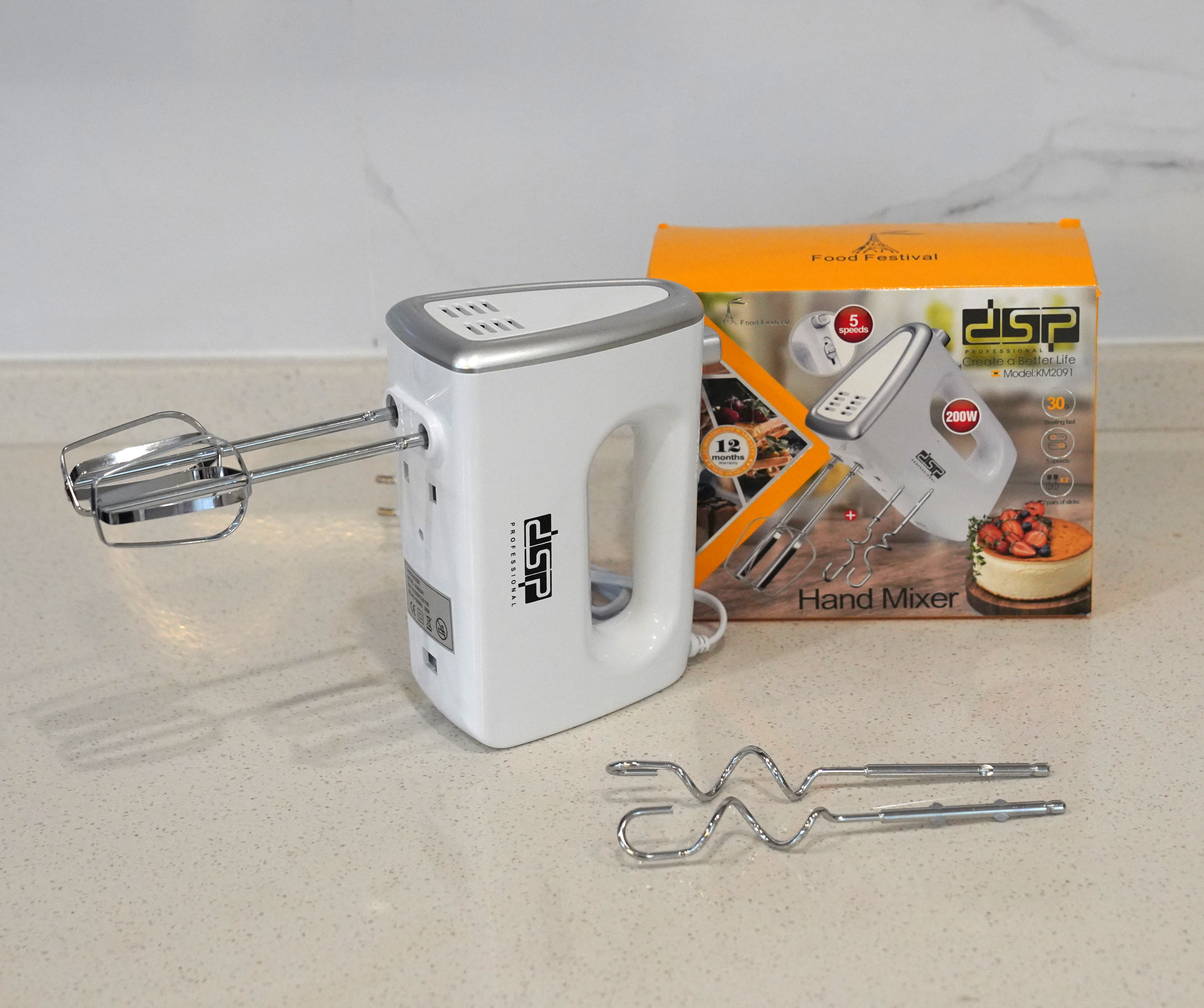
Hand Mixer KM2091: a 200W, five-speed model documented with 180mm egg beaters and a 180mm dough mixer.
Why Wattage and Speed Counts Cause Procurement Confusion
Most hand mixer discussions start and end with two numbers: watts and speeds. Neither number describes mixing performance on its own. A wattage figure on a rating label refers to electrical input, while the work delivered to a beater depends on motor design, gearing, control electronics and the load being mixed. Speed count describes how many selectable settings exist, not the resolution of control, the stability of those speeds under load, or the type of task the unit was designed for.
That gap creates three recurring problems in evaluation:
- Cross-brand comparison on watts alone. Without a stated duty cycle, torque figure or test method, wattage cannot be used to rank two machines against each other.
- Speed count treated as capability. A two-speed unit and a five-speed unit may both cover the same task, with different operator control and different component counts.
- Accessory compatibility ignored. Beaters, dough hooks and detachable blending rods are model-specific parts. A quotation that lists power but not the accessory set leaves the buyer unable to confirm what the unit can actually do.
The practical response is to evaluate on four documented dimensions: motor and power, control type, accessory set and materials, and certification scope by model. The sections below take each in turn.
What DSP's Hand Mixer Records Actually Specify
The DSP range spans a wide power band, from a 200W household hand mixer to a 1500W hand mixer/immersion blender combination. All five models documented below are rated at 220-240V, 50/60Hz. The table reproduces the recorded specification points without adding values that the source documents do not contain.
| Model | Power and motor | Speed control | Accessories and materials | Certification on record |
|---|---|---|---|---|
| KM2091 | 200W; 5525 full copper motor | 5 speeds | ABS body; 180mm egg beaters; 180mm dough mixer | Not listed in the supplied certificate set |
| KM2078 | 400W; 5535 full copper AC motor | 5 speeds | ABS body with metal housing; two pairs of chromed mixing beaters and dough hooks; storable base | CE certificate MOSTCT20123153 (MOST), scope Food Mixer |
| KM1139 | 500W; 5724 full copper motor | 2-speed control; indicator light | ABS body; detachable stainless steel stir bar; stainless steel four-leaf blades | Eurofins verification EFSH202312-L037, scope Blender |
| KM1071 | 1000W; S7912 copper motor | Stepless variable speed | Detachable stainless steel blending rod; stainless steel four-leaf blades | Not listed in the supplied certificate set |
| KM1190 | 1500W; 8112 pure copper motor | Two speeds adjustable; variable speed control; turbo function | ABS and stainless steel; detachable stainless steel stirring rod; SUS304 four-leaf blades; blue light ring | CB test certificate BE-49307 (SGS), scope Multifunctional Hand-held Blender |
Source: DSP product records for the five models. Certification columns reflect the certificate documents supplied with each model; the absence of a listed certificate is not evidence of non-compliance, but it does mean the buyer should request the document before purchase.
Two observations matter for evaluation. First, the range is not organised around a single power class; it is organised around task separation. Second, the certified scope differs by model, which is why certification should be checked at SKU level rather than at brand level.
Technical Explanation: Reading Motor Power Correctly
Input power is not mixing torque
Rated wattage tells a buyer how much electrical power the appliance draws under the conditions used for the rating. It does not state mechanical output at the shaft, stall torque, or how long the motor can run under a heavy dough load. For that reason, a 400W hand mixer and a 1500W hand mixer should not be compared as though the second is automatically the better choice for every recipe. The higher-power unit offers more headroom for demanding tasks and for blending, while the lower-power unit may be entirely adequate for batters, creams and light doughs.
Motor construction is a documented specification point
DSP records motor construction explicitly across the range: the KM2091 uses a 5525 full copper motor, the KM2078 a 5535 full copper AC motor, the KM1139 a 5724 full copper motor, the KM1071 an S7912 copper motor and the KM1190 an 8112 pure copper motor. These identifiers give buyers a traceable reference for service and spare-part conversations. They are not, by themselves, a performance rating, and the model codes should be quoted exactly when requesting replacement parts or technical clarification.
The word "copper" in a specification describes the winding material claimed for the motor. Buyers who need to verify that claim for a high-volume order should ask for the motor supplier documentation or a teardown inspection as part of sample approval, rather than treating the phrase as self-verifying.
Turbo and variable speed are different functions
The KM1190 documents a turbo function alongside two adjustable speeds and variable speed control. Turbo is a distinct operating mode, not a synonym for the highest fixed speed, and the published specification does not state a duty cycle for it. A buyer planning to use turbo for thick mixtures should confirm continuous-use limits with the supplier before locking the model into a product line. On the KM1071, control is stepless, which suits operators who need fine adjustment during emulsification or sauce preparation rather than a fixed set of detents.
Speed Settings in Practice: What Each Control Type Changes
Speed control affects repeatability more than raw capability. A five-speed control, as used on the KM2091 and KM2078, gives operators a defined set of settings that can be written into a recipe or a training sheet. A two-speed control, as used on the KM1139, presents a simpler interface with fewer operating states, which can be an advantage where staff turnover is high or where the unit is sold into a household segment that prefers minimal controls. Stepless variable speed, as used on the KM1071, allows continuous adjustment and is typically specified where the same device must move between fragile emulsions and thicker mixtures.
Task logic is consistent across all control types:
- Dough and heavy batters are mixed at lower settings, using the dough hook or dough mixer accessory.
- Egg whites and creams are built up gradually to a higher setting, using the balloon or egg beater accessory.
- Sauces, purees and smoothies are handled with the detachable blending rod and four-leaf blade on the immersion models.
The DSP case records describe exactly these applications: dough kneading, egg whisking and food mixing for the hand mixer range, and food preparation with sauce mixing for the variable-speed model. The control type should therefore be selected against the recipe list the buyer intends to support, not against the highest number available.
Accessory Compatibility: The Specification Buyers Overlook
Accessories determine whether a hand mixer can actually perform a task. The KM2091 is documented with 180mm egg beaters and a 180mm dough mixer. The KM2078 is documented with two pairs of chromed mixing beaters and dough hooks, plus a storable base for keeping parts together between uses. The KM1139, KM1071 and KM1190 each use a detachable stainless steel rod with four-leaf blades, with the KM1190 specifying SUS304 blade material.
Three compatibility questions should be raised in writing during evaluation:
- Cross-model fit. The available documents list accessories per model and do not state that beaters or rods are interchangeable between models. Buyers should not assume that a KM2078 beater fits a KM2091, or that rods are shared across the immersion range.
- Cleaning and dishwasher suitability. The records describe detachable stainless steel components as a cleaning-related design feature, but do not state dishwasher ratings. This should be confirmed before retail packaging makes any cleaning claim.
- Spare-part supply. Because accessory sets differ by model, a distributor's spare-part plan should be built per SKU, not per category.
Certification Should Be Read Per Model, Not Per Brand
Hand mixers sold into the European Union are typically assessed against the EN 60335-2-14 standard for food mixers, together with the general EN 60335-1 requirements and EN 62233 for electromagnetic fields. The DSP documents show this pattern clearly.
The KM2078 holds a CE certificate of conformity numbered MOSTCT20123153, issued by MOST with a scope of Food Mixer. The listed standards are EN 60335-2-14:2006+A1:2008+A11:2012+A12:2016, EN 60335-1:2012+A11:2014+A13:2017+A1:2019+A2:2019+A14:2019 and EN 62233:2008. The certificate carries an issue date of 2020-12-25 and an expiry date of 2028-12-25.
The KM1190 holds CB test certificate BE-49307 issued by SGS, with a scope of Multifunctional Hand-held Blender. The listed standards are IEC 60335-2-14:2006 with AMD1:2008 and AMD2:2012, and IEC 60335-1:2010 with AMD1:2013 and AMD2:2016. The certificate runs from 2024-09-10 to 2029-09-10.
The KM1139 holds a Eurofins verification of conformity numbered EFSH202312-L037 with a scope of Blender, listing EN 60335-1:2012+AC:2014+A11:2014+A13:2017+A1:2019+A14:2019+A2:2019+A15:2021, EN 60335-2-14:2006+A1:2008+A11:2012+A12:2016 and EN 62233:2008, valid from 2023-12-19 to 2028-12-19.
Application and Use Cases from Documented Projects
The KM2091 appears in a recorded project involving 200 pieces over a five-year duration, supplied to a home appliance OEM and small appliance brand client for baking and food preparation. The documented result is efficient mixing with consistent results, and the recorded highlights are quiet operation and the full copper motor. The client's delivery footprint includes Egypt, Lebanon, Azerbaijan, Spain, Panama, Ghana, the Maldives, South Africa, Somalia, Mozambique, Armenia, Botswana, Uzbekistan, Angola, Jordan, Qatar, Saudi Arabia, Oman, the United Arab Emirates, Madagascar and Georgia.
The KM1071 appears in a separate project of 200 pieces over five years, supplied to household consumers and retail clients for kitchen food preparation. Its documented result is efficient mixing, with variable speed control recorded as the defining highlight. Delivery records for that project include Turkey, Azerbaijan, Portugal, Vietnam, Saudi Arabia, Nigeria, Egypt, Spain, South Africa, India, Somalia, Mozambique, Kyrgyzstan, Peru, Kazakhstan, Armenia, Ghana, Zimbabwe, Jordan, Uzbekistan, Botswana and Senegal, among others.
Hand mixers in this range have been supplied to markets in more than 30 countries. For a buyer, the relevant reading is not the length of the country list but the pattern behind it: a single model family has been shipped across Africa, Asia, Europe, the Middle East and South America, which means voltage, plug and packaging variants have already been handled in volume. That reduces, but does not remove, the need to confirm the destination-market configuration for a new order.
Market Trend Analysis: Specification Pressure Is Rising
The global small domestic appliances market is projected to reach USD 222.52 billion by 2026, according to Fortune Business Insights research cited in the verified data set for this category. Growth of that kind tends to intensify two pressures on suppliers: range breadth, so that one supplier can cover more of a buyer's shelf, and documentation depth, so that each SKU can be defended in a retail or regulatory conversation.
The regulatory direction reinforces the second pressure. The European Union's energy-label framework, for example, is organised around product-level information and registration in the EPREL database for appliances within scope. Even where a hand mixer is not the category concerned, the operating principle is the same one buyers now apply across small appliances: claims are expected to attach to a specific model, with a document behind them.
Within hand mixers, the DSP range illustrates the commercial response - a 200W household model, a 400W five-speed model with chromed tools, a 500W two-speed blender, a 1000W stepless model and a 1500W unit with turbo. The category is being segmented by task and control type rather than by a single headline wattage.
Comparison with Traditional Specification Practice
The traditional approach to hand mixer sourcing is to specify a power band and a speed count, then compare quotations on price. It is fast, and it is also where most evaluation errors begin.
| Evaluation point | Wattage-only approach | Documented approach |
|---|---|---|
| Motor | Watts treated as performance | Motor code and construction recorded for service |
| Control | Speed count compared | Control type matched to recipe and operator profile |
| Accessories | Assumed to be standard | Beater, hook and rod set confirmed per model |
| Compliance | Brand-level certificate assumed to cover all SKUs | Certificate scope and expiry matched to the exact model |
| Market fit | Voltage assumed | 220-240V, 50/60Hz rating confirmed against destination |
Comparison of evaluation methods for hand mixer sourcing.
The documented approach has a clear boundary that buyers should accept before adopting it. The DSP specification records do not include shaft torque, duty cycle, sound pressure level in decibels, product weight or mixing-load ratings. This means a buyer cannot rank the five models purely from the published sheets. The 200W KM2091 and the 1500W KM1190 differ substantially in rated input, but the documents alone do not quantify how each performs under a stiff dough load, how long each can run continuously, or how the handles feel after ten minutes of use.
There is a second boundary. The documented models are rated at 220-240V, 50/60Hz. Buyers supplying 110V markets must confirm the availability of a compliant variant rather than assuming the listed specification applies. Both boundaries point to the same conclusion: documents narrow the shortlist, and sample testing closes it.
Future Outlook
The likely direction for hand mixers is further separation between compact household units and high-power blender combinations. The DSP range already spans that divide, from a 200W five-speed hand mixer to a 1500W unit with turbo and variable speed. As buyers become more comfortable specifying by task rather than by wattage, the next documentation gap to close across the category will be duty cycle and continuous-operation guidance, because that is the parameter most often missing when a buyer tries to compare two models on anything other than price.
For distributors, the practical implication is a narrower but deeper portfolio: fewer SKUs, each with a complete accessory set, a current certificate and a spare-part plan. That structure is easier to defend in retail and easier to service in the field than a long list of near-identical models.
FAQ: Hand Mixer Power, Speed and Compatibility
Does a higher-wattage hand mixer always mix faster?
No. Wattage is the rated electrical input, not the mechanical work delivered to the beater. A 200W model such as the KM2091 and a 1500W model such as the KM1190 differ in rated input and in motor code (5525 versus 8112), but the published specifications do not state shaft torque or mixing-load performance, so speed of mixing cannot be ranked from wattage alone.
What is the difference between five-speed control, two-speed control and stepless variable speed?
Five-speed control provides a defined set of settings, as on the KM2091 and KM2078. Two-speed control provides a simpler interface with fewer operating states, as on the KM1139. Stepless variable speed allows continuous adjustment across the range, as on the KM1071, and the KM1190 combines two adjustable speeds, variable speed control and a turbo function.
What does a full copper motor mean in DSP's hand mixer specifications?
It describes the winding material stated for the motor. DSP records a 5525 full copper motor for the KM2091, a 5535 full copper AC motor for the KM2078, a 5724 full copper motor for the KM1139, an S7912 copper motor for the KM1071 and an 8112 pure copper motor for the KM1190. The motor code is the identifier to quote when requesting service parts.
Can one hand mixer handle both dough and egg whites?
Yes, provided the accessory set covers both tasks. The KM2091 is documented with 180mm egg beaters and a 180mm dough mixer, and the KM2078 with two pairs of chromed mixing beaters and dough hooks. Dough is mixed at a lower setting and egg whites at a higher setting; the control type determines how precisely those settings can be repeated.
Are attachments interchangeable between DSP hand mixer models?
The available product records list accessories per model and do not state cross-model interchangeability. Beaters, dough hooks and detachable blending rods should therefore be ordered against the specific model number, and distributors should build spare-part stock per SKU.
Which certifications should a buyer check for a hand mixer sold in the EU?
The relevant standard family recorded in the DSP documents is EN 60335-2-14 for food mixers, together with EN 60335-1 for general safety and EN 62233 for electromagnetic fields. The certificate must match the model: the KM2078 is covered by CE certificate MOSTCT20123153, the KM1139 by Eurofins verification EFSH202312-L037 and the KM1190 by CB test certificate BE-49307.
What voltage do the documented DSP hand mixers use?
The KM2091, KM2078, KM1139, KM1071 and KM1190 are all recorded at 220-240V, 50/60Hz. Buyers serving markets with a different nominal voltage should confirm the availability of a compliant variant before finalising the order.
How should a buyer choose between the 200W and 1500W models?
Selection should follow the task list, the required accessory set and the control type rather than wattage alone. The 200W KM2091 is documented with five speeds and a beater and dough mixer set for household baking and food preparation. The 1500W KM1190 adds a turbo function, variable speed control and a detachable stainless steel rod with SUS304 four-leaf blades for blending tasks. Sample testing remains necessary because duty cycle and load performance are not stated in the published specifications.
Is the turbo function intended for continuous use?
The KM1190 specification records a turbo function but does not state a duty cycle or continuous-operation limit. Buyers planning to use turbo for thick mixtures should request that clarification in writing before the model is specified into a product line.
A downloadable DSP product brochure covering the wider appliance range is available here: DSP product brochure (PDF).
Have Questions or Need More Details?
Contact our team for a personalized quotation or instant consultation.
Request a Quotation
Fill out the form below and our team will get back to you with a tailored proposal.
WhatsApp Direct Chat
Prefer to chat in real-time? Message us on WhatsApp for instant assistance & quick answers.
- Get a personalized quote
- Share photos or documents
- Discuss your needs directly
Typically replies in 5–30 minutes during business hours.