
Hand Tool Fit: T-Handle, Folding Hex Key and Tool Sets
Maintenance and repair work is rarely limited by how many tools are in the case. It is limited by whether the tool reaches the fastener, whether the handle can turn in the space that is actually available, and whether the technician can judge the torque being applied by hand. Two people carrying comparable kits can spend very different amounts of time on the same machine for exactly these reasons.
This article maps hand tool formats — T-handle wrench, folding hex key, hex key set, tool set, bits set, screwdriver set and cordless electric tools — to the access, reach and task conditions that maintenance and repair work creates. It is written for buyers, planners and category managers who assemble kits for service technicians, maintenance teams and retail programs, and who need to avoid two opposite errors: under-specifying a kit so it fails in the field, and duplicating tools that never leave the case.
HOTAK PRO TOOLS is a hand tool brand whose range covers hex keys, torx keys, staple guns, precision screwdrivers, hobby knives and hand tool sets. Production is based in Ningbo, Zhejiang Province, where Ningbo (Yinzhou) Yongjia Electrical Tools Co., Ltd. has operated a hand tool manufacturing facility since 2000.
Why Maintenance Work Exposes Tool-Fit Problems
In assembly, the fastener, the tool and the torque value are all known before the workstation is designed. In maintenance, none of the three is guaranteed. The technician arrives at a fastener that may be corroded, partly hidden, installed to an unknown standard, or positioned where a straight handle cannot complete a full rotation.
Three failures recur across repair and fastening work in both household indoor environments and open-air construction site environments:
- Access failure. The fastener is reachable but the handle fouls the surrounding structure before the screw turns.
- Reach failure. The fastener sits below the surface and the driver shaft is too short, so the bit never seats.
- Torque-judgement failure. The tool applies force but the technician cannot feel when the fastener is seated, which is where threads and heads are damaged.
Each failure maps to a different tool format rather than to a better version of the same format. That is the practical argument for building maintenance kits from a task list instead of from a piece count.
Four Access Questions That Decide the Tool Format
Before comparing products, buyers can reduce most maintenance tasks to four questions. The answers point to a format, and the format then determines which set or model is appropriate.
| Question | What it decides | Format that usually fits |
|---|---|---|
| Is the fastener in line of sight and unobstructed? | Handle type | L-shaped hex key or folding hex key set |
| Is the fastener recessed or deep-set? | Shaft length and drive continuity | T-handle driver with extension bar |
| Is the approach angled or obstructed? | Engagement geometry | Ball-end hex key, documented for angles up to 25° |
| Must the fastener be broken loose before it turns freely? | Torque authority | Straight-end key or socket on a T-handle, applied manually first |
A kit that answers all four questions with four tools is usually smaller, cheaper to stock and faster to use than a kit that answers them with twelve overlapping ones.
T-Handle Wrench: In-Line Access and Controlled Hand Torque
A T-handle wrench places the grip perpendicular to the drive axis. The practical consequence is that the palm can press along the fastener axis — keeping the bit seated — while the fingers rotate the handle. In maintenance work this matters most for fasteners set below the surface, and for fasteners that must be held in place while a second element is aligned.
The HOTAK PRO TOOLS range lists T-handle Wrench models YJHK-3066 and YJHK-3226. In kit form, the 51-piece T-handle Driver Set YJTS-3147 pairs one T-handle with a 1/4" x 60 mm extension bar, a 1/4" x 60 mm socket extension bar, nine sockets from 4 mm to 13 mm, and 39 bits at 1/4" x 25 mm in CR-V steel. The extension bars are what convert the T-handle from a short-reach tool into a recessed-fastener tool.
Typical fits are repeated same-size socket-head screws on guards, covers, brackets and access panels, and any position where a straight screwdriver handle bottoms out against the frame before the screw is tight. The format is less suitable where the handle itself cannot physically enter the cavity, and it is not a torque-calibrated instrument: where a specified torque value has to be reached and recorded, a torque wrench remains the correct tool and the T-handle is the wrong substitute.
Folding Hex Key and Hex Key Sets: Angle Access Against Torque Limits
Hex keys drive hex socket fasteners, which appear throughout machine tools, fixtures, bicycle hardware, furniture and equipment housings. The category splits into three physical formats, and the choice between them is an access decision rather than a quality decision.
Folding format
The folding hex key set YJHK-3347 is made of Chrome Vanadium steel 6150 and is heat-treated to a hardness of HRC 52-55. The set covers metric sizes from 1.5 mm to 10 mm, and the flexible angle design allows use in different situations. In practice the folding format keeps the size range attached to a single body, which suits maintenance calls where the technician does not know in advance which size will be needed.
Fixed L-key format
Model 71821D3 is a 9-piece long arm ball point colour hex key set in metric sizes, made of CR-V 6150 alloy steel with a hardness of HRC 52-55. The keys are heat-treated and tempered, the surface is rust and corrosion resistant, and each key carries a size marking for identification. The ball-end works on angles up to 25°. Related models in the same family differ by arm geometry: 71821D1 is a 9-piece short arm ball point set, 71821D2 is a long arm set, and 105221K2 is a 9-piece long arm ball point metric set.
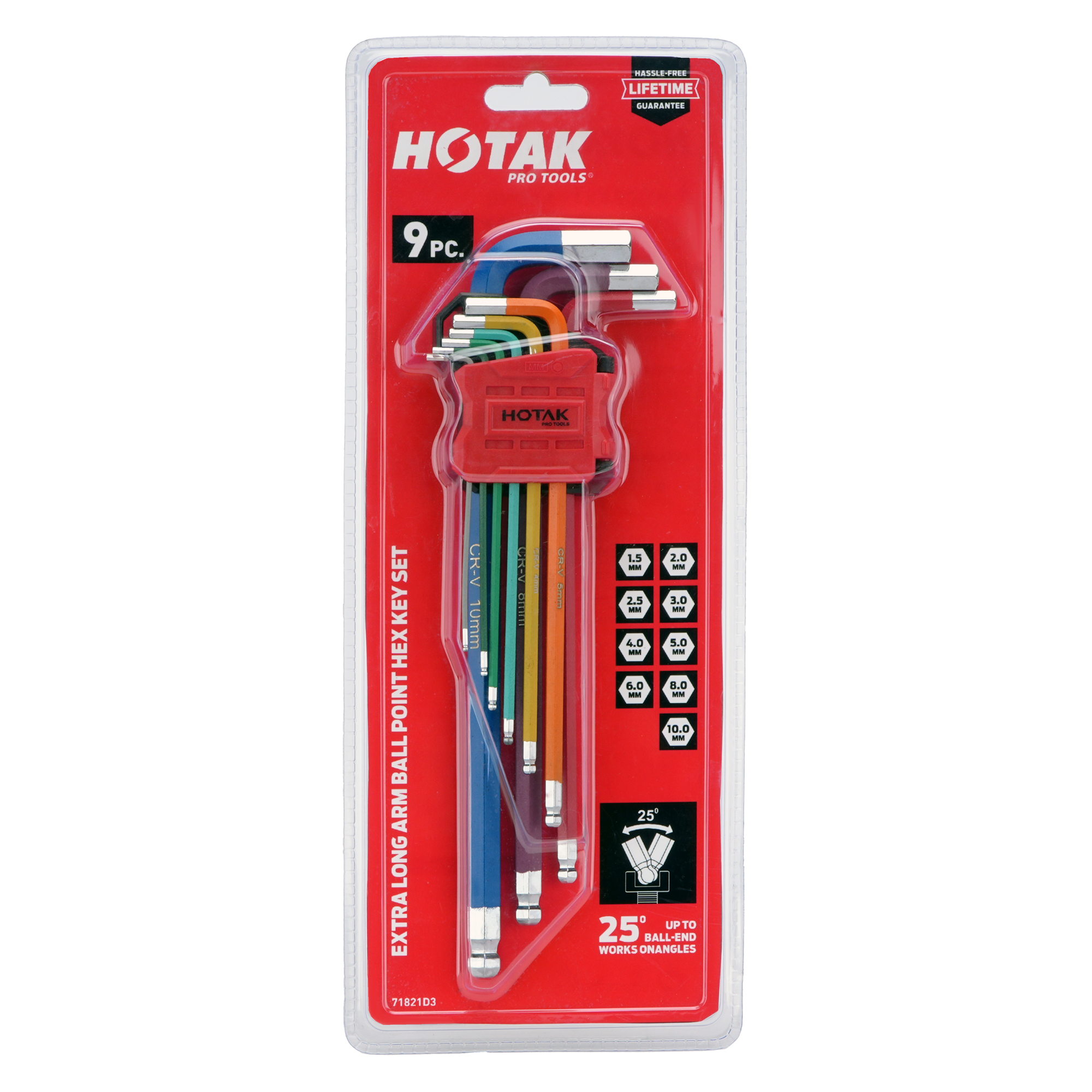
Long arm ball point hex key set (model 71821D3): CR-V 6150, HRC 52-55, ball-end engagement up to 25° for angled access.
Arm length changes the decision more than buyers expect. The long arm provides reach into deep counterbores and generates more leverage at the same hand force; the short arm fits where the surrounding structure blocks a longer lever; the ball end allows the key to approach the socket off-axis. The trade-off is conventional engineering practice rather than a specification: ball-end geometry engages less of the socket wall than a straight end, so the straight end is normally used to break a tight fastener loose and the ball end for the angled or partial-turn work that follows.
Material and hardness claims in this category are also the easiest to verify. The ball-end hex key sets in this range are certified to the GS Product Safety Certificate issued by TÜV Rheinland LGA Products GmbH under certificate number S 50694620 0001, against DIN ISO 2936-10.16 and AfPS GS 2019:01 PAK, for the German market. The certificate covers hexagon screw keys with ball end and lists models 105221K1, 105221K2, 105221K3, 71821D1, 71821D2 and 71821D3, with an issue date of 2026-03-18 and an expiry date of 2031-03-17.
Tool Sets: How a 51-Piece Set Avoids Becoming a 51-Tool Kit
The value of a tool set is architectural, not numerical. The 51-piece T-handle Driver Set YJTS-3147 grows its coverage along three axes while adding only one drive handle.
| Component family | Contents | Maintenance role |
|---|---|---|
| Drive | 1 T-handle, 1/4" x 60 mm extension bar, 1/4" x 60 mm socket extension bar | Recessed access, in-line pressure |
| Sockets | 9 pieces: 4, 5, 6, 7, 8, 9, 10, 12, 13 mm | Nuts, bolts and hex-head fasteners |
| Bits | 39 pieces at 1/4" x 25 mm, CR-V steel, nine profiles | Screw and specialty heads |
The 39 bits cover Phillips PH1, PH2 and PH3; slotted 4.0, 5.0, 6.0 and 7.0 mm; Pozi PZ1, PZ2 and PZ3; hex 3.0, 4.0, 5.0 and 6.0 mm plus 5/32, 3/16 and 7/32 inch; Torx T10 through T40; Torx tamper-proof TT10 through TT40; square S1, S2 and S3; triangle TA18 and TA27; tri-point Y00 and Y0; and one spanner SP6. One handle therefore serves sockets and bits, which is where duplication is normally eliminated.
A second configuration addresses a different constraint. The 42-piece Ratcheting Handle Set YJTS-3402 is made of CR-V 6150, carries a hardness of HRC 52-55, and publishes size-linked torque reference values.
| Key size (mm) | Published reference value |
|---|---|
| 1.5 | 0.82 |
| 2.0 | 1.90 |
| 2.5 | 3.80 |
| 3.0 | 6.60 |
| 4.0 | 16.00 |
| 5.0 | 30.00 |
| 6.0 | 52.00 |
| 7.0 | 80.00 |
| 8.0 | 120.00 |
| 10.0 | 220.00 |
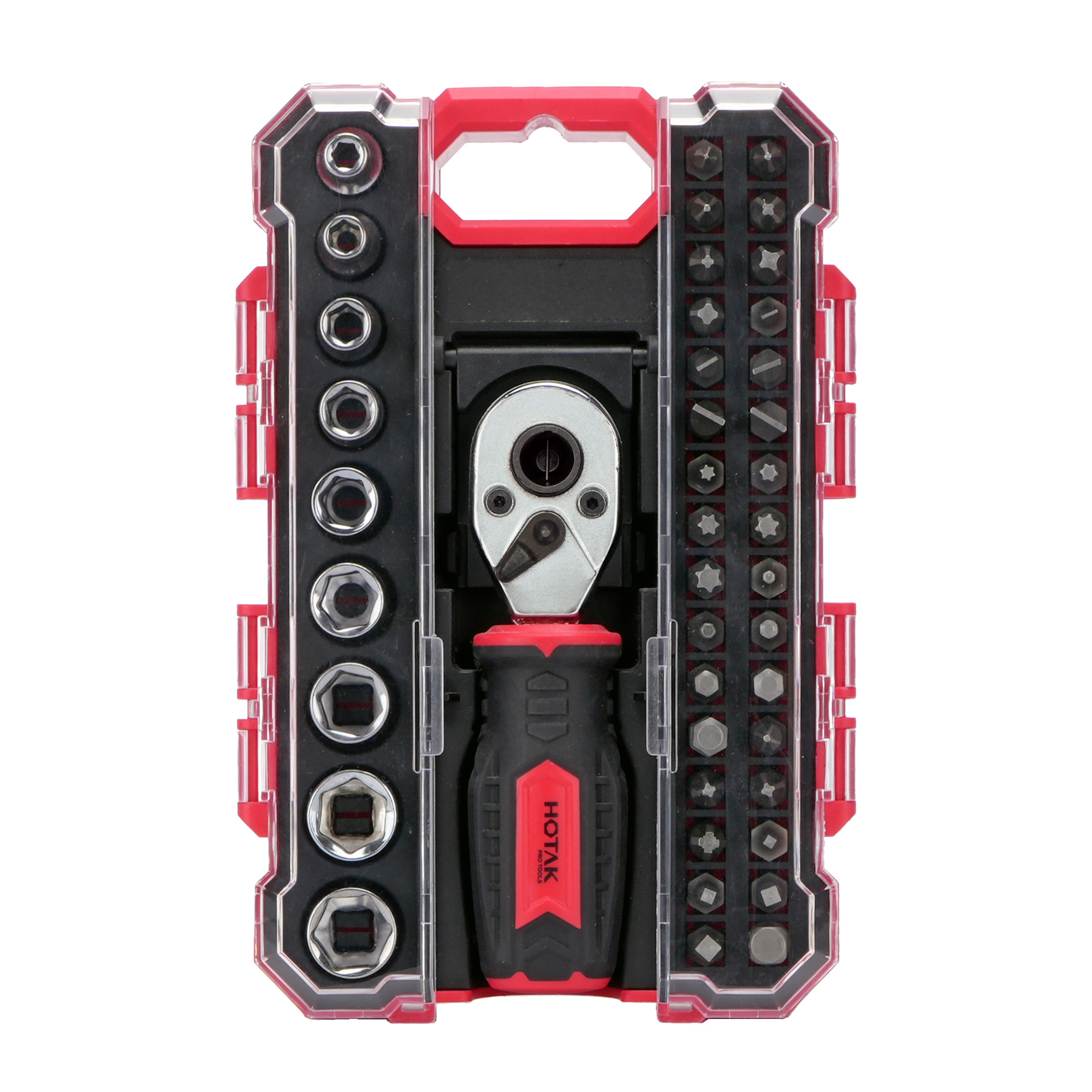
Ratcheting handle set (model YJTS-3402): CR-V 6150, HRC 52-55, with published size-linked torque reference values.
Bits Sets and Screwdriver Sets: Coverage Measured by Profile, Not Piece Count
Bit count is a weak proxy for coverage. Two sets can both claim forty pieces while carrying the same PH1, PH2 and 4 mm hex three times over and never addressing a tamper-proof Torx or a tri-point fastener. The relevant questions are which profiles are present, which sizes within each profile, what the bit length and drive size are, and whether the bits are consumables or part of a long-life set.
The 36-bit configuration in the YJTS-3140 mobile phone repair tool set illustrates profile breadth at small scale: 36 CR-V bits at 5/32" x 28 mm, plus a 1/4" x 25 mm adaptor, a mini ratchet screwdriver handle, a 1/4" x 60 mm magnetic extension bar and a T-handle with bit holder. The same set is specified with Phillips PH000 to PH1, slotted 1.0 to 4.0 mm, hex 1.5 to 3.0 mm, Torx T2 to T6, tamper-proof Torx TT7 to TT10, square S0 and S1, triangle TA18 and TA27, pentalobe 0.8 to 2.0, tri-point Y000, Y00 and Y0, and spanner SP6. Electronics and smartphone repair is a distinct buying category from industrial maintenance, but the selection logic is identical: match the profile list to the fasteners the technician actually meets.
At the precision end, the 29-piece ratcheting precision screwdriver set YJTS-3411 is made from Cr-V 6150 steel and carries straight bits 1.5 to 4.0 mm, cross bits #000 to #2, diagonal bits Pz0 and Pz1, hexagon metric bits 1.5 to 3.0 mm, flower shape bits T2 to T7, flower-with-holes bits TT8 to TT10, square bits S0 and S1, and one five-pointed star bit at 0.8 mm. The 17-piece precision screwdriver set YJPS-6852 is made of metal with a range of bit types, while the extension screwdriver set YJPS-6851 carries one extension screwdriver, one socket adaptor, one magnetic extension bar, 19 bits and four sockets.
Two limits are worth writing into the buying specification. First, 1/4" x 25 mm bits are short by design and will not reach the bottom of a deep recess without an extension bar. Second, profile overlap between a bits set and a screwdriver set is the most common source of duplicated SKUs in a maintenance kit, because both categories are usually built around the same Phillips and slotted sizes.
Electric Tools: A Fit Decision, Not an Upgrade
Cordless screwdrivers and electric nail guns change the economics of a task when fastener count is high and the required torque is low and repeatable. They do not replace the manual step where a fastener has to be broken loose or where the technician must feel the seat.
- The 26-piece cordless precision power screwdriver set YJPS-907 uses a 3.7 V lithium battery at 320 mAh, a no-load speed of 220 r/min, a one-hour charge time, a power torque range of 0.15 Nm and a hand torque range of 3 N.m, with LED lighting for low-light work.
- The YJPS-902 power screwdriver runs 0-280 r/min with a 2000 mAh battery at 3.7 V, a charge output of 5 V and 1-1.5 A, a manual torque of 10 Nm, electric torque settings of 2 N, 3.5 N and 5 N, and a no-load operating time of at least 60 minutes.
- The YJPS-912 delivers 0-250 r/min with an 800 mAh battery at 3.7 V, a 500 mA charge current, a manual torque of 10 N.M, an electric torque of 2.5 N, and a no-load operating time of at least 50 minutes.
- The YJSG-500 electric nail gun runs at 3.7 V with a 2000 mAh battery and a 25 W power output.
The boundary is straightforward. Where several hundred small screws are involved and the target torque sits inside the electric setting range, a powered driver shortens the task. Where the fastener is seized, the access is confined, or the joint has a specified torque, the manual driver or a torque-controlled tool does the work. A powered driver also adds charge management and battery condition to kit maintenance, which is a real cost for teams that operate away from a power source.
Certification Constraints to Verify Before a Kit Is Locked
Certification is where buying decisions most often fail quietly. A certificate is issued against a defined scope, and that scope names models, markets and standards. A document that covers one staple gun model does not cover an entire staple gun family, and a hex key certificate does not extend to a tool set that happens to contain hex keys.
- Hex keys, German market. GS Product Safety Certificate S 50694620 0001, issued by TÜV Rheinland LGA Products GmbH, scope hexagon screw keys with ball end, standard DIN ISO 2936-10.16 and AfPS GS 2019:01 PAK, valid 2026-03-18 to 2031-03-17, covering models 105221K1, 105221K2, 105221K3, 71821D1, 71821D2 and 71821D3.
- Staple guns, EU market. CE Certificate of Conformity to Machinery Directive 2006/42/EC under certificate number AM 50694538 0001, issued by TÜV Rheinland LGA Products GmbH, against EN ISO 12100:2010 and EN ISO 11148-13:2018, covering the hand-operated staple gun scope with an expiry date of 2030-12-31.
- Cordless staple gun, EU market. CE certificate AM 50559365 0001 for the 5-in-1 cordless power staple gun YJSG-501, against Directive 2006/42/EC, EN ISO 12100:2010 and EN ISO 11148-13:2018, with a validity window running to 2030-12-31.
- Market access beyond Europe. India's Hand Tools Quality Control Order 2025 mandates BIS certification across nine tool categories, which is a separate requirement from CE or GS and has to be planned into the sourcing calendar.
The practical verification routine is short: read the certificate scope, match the model numbers against the SKUs being purchased, confirm the market coverage, and check the expiry date against the intended delivery window. Where a supplier cannot produce a certificate for the exact model, the requirement should be treated as unmet rather than assumed to be covered by a neighbouring product.
Building a Maintenance Kit Without Duplicated Tools
The sequence that produces the least duplication is: start from the task list, decide access, decide format, decide profile coverage, then check certification. Reverse that order and the kit fills up with tools that overlap.
| Task condition | First choice | Supporting tool | Duplication to avoid |
|---|---|---|---|
| Socket-head screw, deep counterbore | Long arm hex key | T-handle with extension bar | A short arm set in the same sizes |
| Angled approach, partial turns | Ball-end hex key | Folding hex key set | A second ball-end set in another handle style |
| Repeated same-size machine screws | T-handle driver | Socket set on the same drive | Separate nut drivers in identical sizes |
| Small electronics fasteners | Precision screwdriver set | Bit set with pentalobe and tri-point | Two sets sharing PH0 and 2.0 mm slotted |
| Panel and upholstery fastening | Staple gun matched to staple leg length | Hand tools for trim removal | Two staple guns with overlapping staple ranges |
| Seized fastener, unknown history | Straight-end key or socket, manual | Cordless driver only after break-loose | Relying on a powered driver alone |
Staple gun selection follows the same logic and is often where kits are over-specified. The YJSG-023 accepts brad nails of 10-14 mm, cable staples of 10-14 mm and flat wire staples of 4-14 mm, on an all-metal construction with quick jam release and impact power adjustment. Model YJSG-063 is a heavy-duty unit built for flat wire staples of 6-14 mm, and YJSG-105 drives staples into tough surfaces with a safety lock. Where one gun covers the staple range a team actually uses, a second gun in the same range is duplication rather than redundancy.
Where Scenario-Based Kits Cost More
Scenario-based kit design is not automatically cheaper, and buyers should treat the trade-off explicitly rather than assume a smaller kit means a lower program cost.
| Criterion | Scenario-based kit | Single general kit |
|---|---|---|
| Field handling time | Shorter, because tools map to tasks | Longer, because the technician searches |
| SKU count | Higher, one kit per task family | Lower, one unit covers all |
| Unit cost and stockholding | Higher per kit, more lines to hold | Lower per unit, simpler to stock |
| Certification workload | Scope checked per model in each kit | Scope checked once |
| Tool duplication | Low, if profiles are mapped first | High, because overlap is built in |
Two commercial constraints also apply. The capability specification for OEM and ODM work states a minimum order quantity of 600 units and a lead time of 30-45 days against a monthly capacity of 1,500,000 units, so a multi-SKU kit program is not a small trial order — it commits working capital across several lines at once. And a scenario-based approach cannot be validated for every SKU by a single sample: each kit in the program needs its own physical check before the configuration is frozen.
One further boundary is worth stating plainly. No configuration of hand tools, bits and sockets in this range substitutes for calibrated torque equipment, for insulated tools where live electrical work is involved, or for specialist automotive and hydraulic tooling. The kit is a maintenance and repair kit, and over-specifying it as a general-purpose solution creates the same mismatch as under-specifying it.
Market Context: Why Kit Architecture Is a Purchasing Conversation
The category the kits sit inside is large, fragmented and price-competitive, which is precisely why configuration decisions matter more than brand labels at the buying stage. Global hand tool market size in 2025 was approximately USD 25.61 billion, according to Straits Research, while Arizton valued the U.S. hand tools market at USD 5.34 billion in 2025. China's exports of hand tools under HS 8203 reached USD 1.1 billion in 2024, according to OEC.
Sub-category data shows how the same purchasing logic repeats at different scales. The global staple gun market was valued at USD 1.54 billion in 2024 by Maximize Market Research, and the screwdriver market at USD 365.2 million in 2024 by Credence Research. Concentration at the top is limited: Global Market Insights reported that Stanley Black & Decker led the global hand tool market with over 14% share in 2024, which leaves the majority of the market to regional manufacturers and private-label programs. For buyers, that structure means supplier selection usually turns on capability, certification readiness and kit architecture rather than on category leadership.
Manufacturing and Supply Evidence Behind the Range
Configuration decisions only hold if the supply base can repeat them. The manufacturer behind HOTAK PRO TOOLS operates a production base of over 45,000 m² with 450 employees, an annual output of 18,000,000 units and an engineering team of 25, and exports 95% of output to the EU, the USA, Southeast Asia and South America. The production chain is integrated in-house across mould development, forging and stamping, heat treatment, surface finishing, precision machining, assembly and packaging.
Quality management covers incoming inspection, in-process inspection and final inspection. The company holds ISO9001 certification, TÜV/GS certification, BSCI social compliance certification and VPA approval, and has passed factory audits for Walmart (USA) and Kingfisher (UK). Its patent portfolio includes 7 invention patents, more than 20 European patents, 50 utility model patents and over 100 design patents, and it was accredited as a National High-Tech Enterprise in 2014.
For custom programs, the capability specification covers OEM and ODM work with colour and logo customisation, a minimum order quantity of 600 units, a lead time of 30-45 days, and remote after-sales support. Case records for brand-owner and retail-chain programs describe order sizes of 5,000-50,000 units, program durations of 3-5 years, applications in auto repair, household fastening and workshop maintenance, and reported outcomes of reliable performance, low return rate and consistent quality, with DIN standard compliance and GS/CE certification cited as the compliance basis.
Future Outlook
Three directions look likely to shape maintenance tool kits over the next buying cycles. The first is configuration discipline: as buyers become more explicit about access, reach and task fit, kits built from a task list should displace piece-count-driven assortments, because the cost of a duplicated tool is easier to quantify than the cost of a slow repair. The second is certification visibility: with market-specific regimes such as India's Hand Tools Quality Control Order 2025 running alongside European CE and GS requirements, model-level certificate mapping is likely to become a standard part of the purchasing file rather than an afterthought. The third is the gradual division of labour between manual and cordless tools, with battery drivers taking the high-count, low-torque work and manual formats holding the break-loose, feel-critical and confined-access tasks.
None of these trends changes the underlying rule. A maintenance kit performs when each tool in it answers a specific access, reach or torque condition, and when every claim attached to that tool — material, hardness, certification, capacity — can be traced to a document the buyer has actually read.
FAQ
Which hand tool format suits a recessed socket-head fastener in maintenance work?
A long arm hex key provides reach into counterbores, and a T-handle driver with an extension bar is used where the fastener also needs in-line palm pressure. The 51-piece T-handle Driver Set YJTS-3147 includes a 1/4" x 60 mm extension bar and a 1/4" x 60 mm socket extension bar for this purpose, alongside nine sockets from 4 mm to 13 mm.
What do the material and hardness ratings on these hex key sets indicate?
The ratings identify the steel grade and the heat-treatment target. The folding hex key set YJHK-3347 and the fixed sets 71821D3, 71821D2 and 71821D1 are made of Chrome Vanadium steel 6150 or CR-V 6150 alloy steel with a hardness of HRC 52-55, and the fixed sets are heat-treated and tempered with a rust and corrosion resistant surface.
Which certifications apply to hex keys and staple guns, and to which models?
The ball-end hex key sets are certified to GS Product Safety Certificate S 50694620 0001, issued by TÜV Rheinland LGA Products GmbH against DIN ISO 2936-10.16 and AfPS GS 2019:01 PAK for the German market, covering models 105221K1, 105221K2, 105221K3, 71821D1, 71821D2 and 71821D3. Hand-operated staple guns are covered by CE Certificate of Conformity AM 50694538 0001 under Machinery Directive 2006/42/EC, and the 5-in-1 cordless power staple gun YJSG-501 by CE certificate AM 50559365 0001, both against EN ISO 12100:2010 and EN ISO 11148-13:2018 for the EU market.
Is a ball-end hex key suitable for high-torque fasteners?
The ball-end on these sets is specified to work on angles up to 25°, which is an access feature. Published torque reference values exist for the 42-piece Ratcheting Handle Set YJTS-3402, ranging from 0.82 for the 1.5 size to 220.00 for the 10.0 size in the unit stated in that specification. Because ball-end engagement differs from straight-end engagement, the value for a specific key and fastener combination should be taken from the product specification or confirmed with the supplier rather than inferred.
Do cordless electric screwdrivers replace manual drivers in a maintenance kit?
They serve a different condition. The YJPS-907 has a power torque range of 0.15 Nm and a hand torque range of 3 N.m at 220 r/min, the YJPS-902 offers electric torque settings of 2 N, 3.5 N and 5 N with a manual torque of 10 Nm at 0-280 r/min, and the YJPS-912 provides an electric torque of 2.5 N with a manual torque of 10 N.M at 0-250 r/min. Fasteners that are seized, confined or torque-specified still require manual or torque-controlled tools.
What order quantities and lead times apply to custom hand tool sets?
The capability specification states OEM and ODM production with colour and logo customisation, a minimum order quantity of 600 units, a lead time of 30-45 days and a monthly capacity of 1,500,000 units. Quality control covers incoming inspection, in-process inspection and final inspection, and after-sales support is provided remotely.
The full product range, including hex key sets, staple guns, screwdrivers, hobby knives and tool sets, is documented in the HOTAK PRO TOOLS catalogue, available for download: 2025 YONGJIA CATALOG (PDF).
Have Questions or Need More Details?
Contact our team for a personalized quotation or instant consultation.
Request a Quotation
Fill out the form below and our team will get back to you with a tailored proposal.
WhatsApp Direct Chat
Prefer to chat in real-time? Message us on WhatsApp for instant assistance & quick answers.
- Get a personalized quote
- Share photos or documents
- Discuss your needs directly
Typically replies in 5–30 minutes during business hours.