
Hanli Industrial Chiller: Capability and Buyer Reference
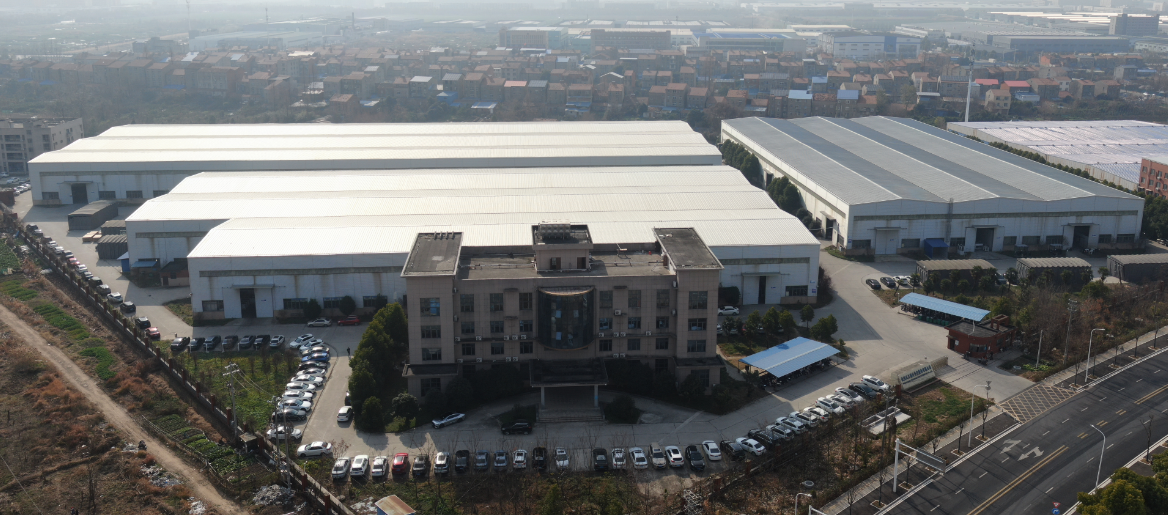
Hanli manufacturing site, Wuhan, Hubei — the production base behind the Hanli industrial chiller range.
An industrial chiller is a closed-loop refrigeration system that removes waste heat from a process and returns coolant at a controlled temperature. In laser cutting, laser welding and CNC machining it is not an accessory: it is the component that decides whether the rest of the line can hold its parameters through a shift. This reference examines Hanli industrial chiller — the product range of Wuhan Hanli Refrigeration Technology Co., Ltd. — in the terms a buyer at awareness and research stage actually needs: what the company can verifiably do, how the chillers are specified, where the fit is strong, and where the limits sit.
Why Thermal Control Turned Into a Procurement Question
Fiber laser sources convert electricity into optical output efficiently, but the residual heat still has to go somewhere, and it leaves through the source body, the optics and the cutting head. Authoritative technical guidance published by ARCUSCNC puts the heat rejection requirement of a 3 kW fiber laser source at approximately 7 kW. The chiller therefore has to be sized against the waste heat and the duty cycle, not against the nameplate laser power alone.
This single ratio explains most of the specification errors seen in the field. A unit selected on optical wattage will run close to its limit on continuous cutting, and its behaviour under a changing thermal load — thin sheet, then thick plate, then piercing — becomes the variable nobody budgeted for.
Three consequences are widely recognised in laser processing. Thermal drift in the optics and cutting head shifts focus and kerf quality. A source that runs above its permitted temperature window will derate or trip on protection, which converts a cooling problem into a delivery problem. And a chiller working permanently at the top of its envelope shortens the service life of its own pumps and compressor.
The opportunity is symmetrical. Where cooling is specified properly, laser power becomes usable power, consumable life becomes predictable, and the maintenance calendar stops being driven by emergency stops. That is why chiller selection has moved from a line item at the end of a machine order to a specification decision taken alongside the laser source.
Hanli at a Glance: Verified Company Capability
Wuhan Hanli Refrigeration Technology Co., Ltd. is a Chinese manufacturer specialising in laser cooling systems and industrial water chillers. The company is based at No 1, Xingfuyuan 2nd Road, Shamao Street, Hannan District, Wuhan, Hubei, China, and was established in 1998, which it describes as 28 years of experience in the laser chiller industry.
The verifiable operating facts are as follows:
- Legal and financial base — registered capital of 12 million yuan; described by the company as a high-tech enterprise holding national technology patents, with a technical R&D team.
- Manufacturing footprint — a facility covering 38,866.15 square metres, confirmed in the verified data pack.
- Workforce — approximately 300 employees.
- Production capacity — annual output stated at 180,000 units, supported by standardised production and stocking.
- Product scope — fiber laser chillers, laser cutting chillers, laser welding chillers, CO2 laser chillers, UV laser chillers and industrial water chillers, together with related laser cooling systems.
- Application focus — the laser cutting industry, supporting fiber laser cutting machines for metals and non-metals, plus laser processing and plastic moulding machine applications.
- Testing discipline — an in-house laboratory test system intended to confirm stable performance across different ambient temperatures, with each machine tested before delivery.
- Export exposure — an export ratio of approximately 10%, with stated markets including Vietnam, Turkey, India, Russia, Poland, Germany, France, Italy, the wider EU, the USA, Iran, Dubai and the Middle East.
Read as a whole, the profile describes a mid-sized specialist rather than a broad refrigeration conglomerate. Capacity of 180,000 units a year against a product line concentrated on laser cooling implies volume built around standardised models, which is consistent with the company's own emphasis on stocking and short standard lead times. For a buyer, that combination — narrow focus plus high unit volume — is usually easier to audit than a very wide catalogue, because the specification set stays comparable across models.
What the Portfolio Actually Covers
The range is organised by matched laser power and by process, not by cooling capacity alone. The table below uses the published parameters for five representative models.
| Model | Type | Cooling capacity | Rated / machine power | Power supply | Matched equipment |
|---|---|---|---|---|---|
| HL-1500-QG2/2 | Fiber laser chiller | 4.7 kW | 2.3 kW | Not stated in source data | 1500 W fiber laser cutting machine |
| HL-3000-QG2/2 | Dual-temperature fiber laser chiller | 8.7 kW | 3.5 kW | 1P 220 V / 50 Hz | 3000 W fiber laser cutting machine |
| HL-6000-QG2/2 | Industrial water chiller | 19.1 kW | 6.2 kW | 3P 380 V / 50 Hz | Fiber laser cutting, laser processing, plastic moulding machines |
| SCH-1500 | Fiber laser chiller | Not stated in source data | 2.1 kW | AC 1P 220 V | 1500 W continuous fiber laser source |
| SCHYTJ-3000 | Laser welding chiller | 6.75 kW | 3.9 kW | AC 1P 220 V | 3000 W continuous fiber laser source |
Source: company product specification data for the listed models. Parameters are model-specific and should be confirmed against the current datasheet before ordering.
Two engineering directions are visible in the range. The HL-3000-QG2/2 is a single-pump, dual-temperature design — one pump serving two temperature loops — described by the company as compact, stable and simple to operate, with water temperature control over a 22–29.5 °C range and a selectable control precision of ±3 °C in standard mode or ±1 °C in high-precision mode. The HL-6000-QG2/2 moves to a larger envelope at 19.1 kW of cooling capacity on a three-phase 380 V supply, and the company lists automatic fault diagnosis, multiple protection functions, passive alarm terminals and remote control terminals so the unit can be supervised from a CNC system.
The SCH series addresses a different constraint. SCH-1500 is specified for a 1500 W continuous fiber laser source with a control accuracy of ±1.5 °C and a pump flow of 1.2 m³/h; SCHYTJ-3000 is dedicated to laser welding and cleaning at 6.75 kW cooling capacity with a 1.6 m³/h pump flow. Welding duty cycles differ from cutting duty cycles, and a dedicated welding chiller usually reflects that in its control strategy rather than in its capacity figure alone.
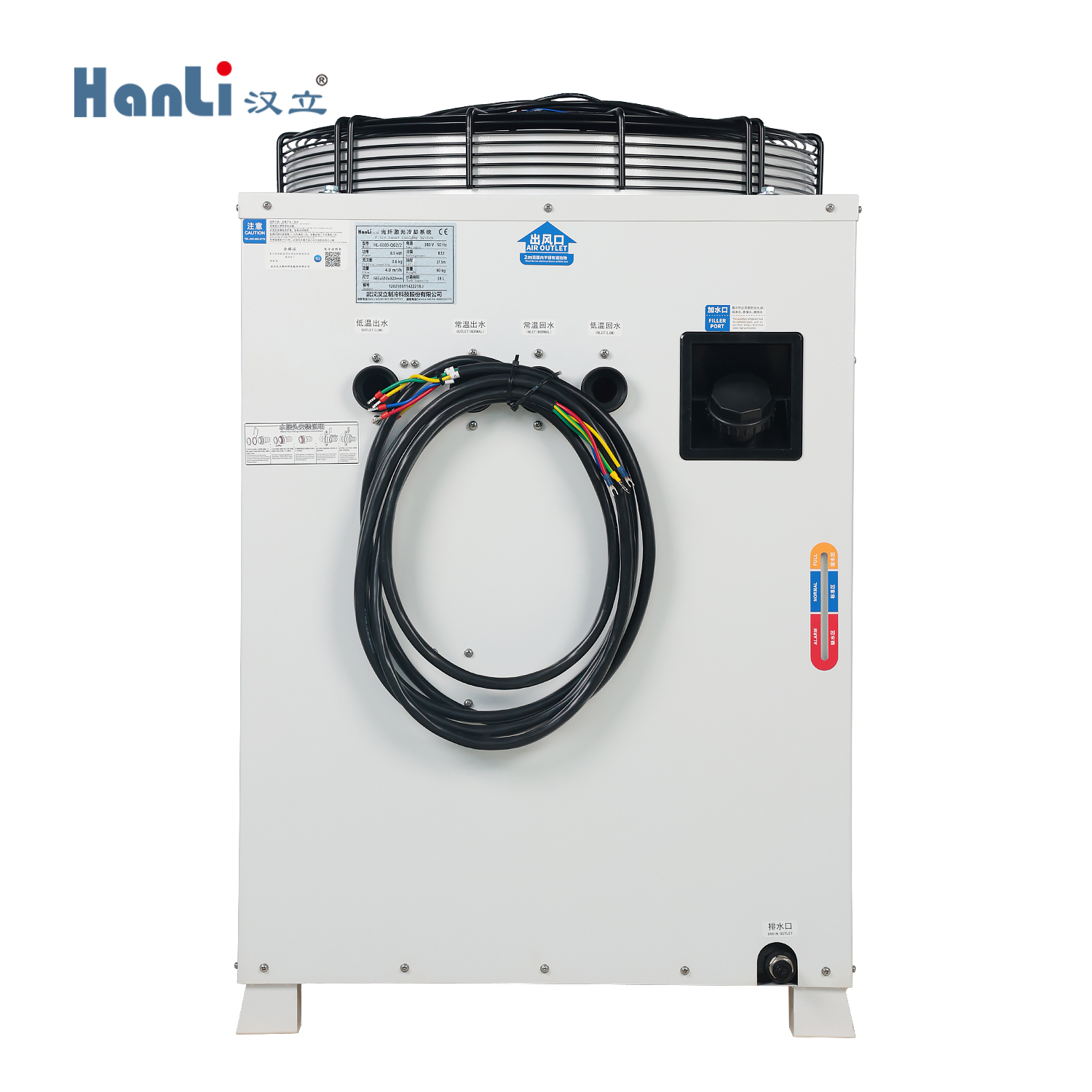
HL-6000-QG2/2 industrial water chiller — 19.1 kW cooling capacity, 3-phase 380 V / 50 Hz.
Technical Explanation: From Refrigeration Cycle to Laser Uptime
Every unit in this class runs the same four-stage vapour-compression cycle. The compressor takes low-pressure, low-temperature gaseous refrigerant and raises it to high-pressure, high-temperature gas. The condenser rejects that heat to the surrounding air and the refrigerant becomes a high-pressure liquid. The expansion valve throttles the liquid to a low pressure, and in the evaporator it absorbs heat from the circulating water and returns to gas. The chiller's value to a laser line is set less by this cycle, which is mature, than by how precisely the evaporator output is controlled and how reliably the water circuit is protected.
On the dual-temperature HL-3000-QG2/2, the design routes coolant at two different temperatures from a single pump: a colder loop for the optics and a warmer loop for the source, which reflects the different tolerances of the two loads. The published specification lists a filtration element in the water circulation system, alarm signal outputs for low flow, high water temperature and low water temperature, a low-water-level alarm, compressor time-delay protection and equipment overheat protection. It also describes automatic switching between high-precision and standard-precision modes and an intelligent winter anti-freeze mode.
Those features matter at the failure points rather than in the brochure. Low-flow detection catches a blocked cutting head before the source overheats — the same logic that underpins the company's published guidance on its E12 alarm, where a healthy flow at the normal-temperature outlet combined with little or no flow at the return line points to a blocked cutting head rather than a chiller fault. Compressor time-delay protection prevents short-cycling after a power interruption. Anti-freeze mode addresses the most common cold-weather failure in water-cooled installations, which is ice in the loop rather than a refrigeration defect.
The practical conclusion for a specifier is that control accuracy should be read as a process requirement, not a quality ranking. Where a process needs tight thermal stability, the ±1 °C high-precision mode of the HL-3000-QG2/2 or the ±1.5 °C accuracy of the SCH-1500 is the relevant figure. Where it does not, paying for that precision adds cost without adding output.
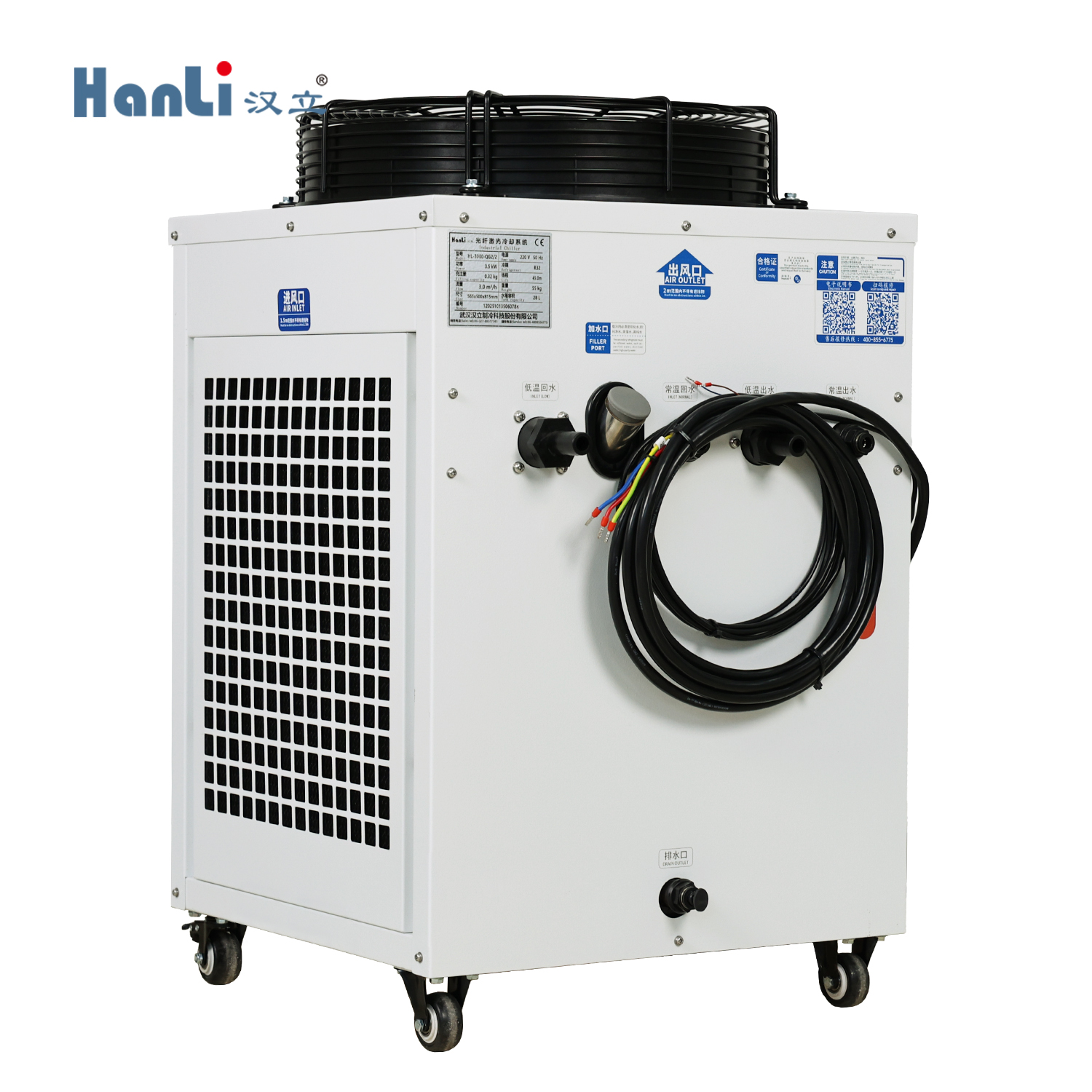
HL-3000-QG2/2 dual-temperature fiber laser chiller — single-pump, dual-loop design for 3000 W fiber laser cutting.
Where the Range Fits in Practice
Documented application scenarios cover laser cutting, laser welding, laser engraving and general industrial laser processing. The matched equipment list extends to fiber laser sources, laser cutting machines, laser welding machines, CO2 laser equipment, UV laser equipment and induction heating. Hanli's own application guidance also places its water chillers in fiber laser cutting, laser welding, laser marking, injection moulding, extrusion, chemical processing and electroplating.
The operating condition described for these scenarios is continuous laser equipment operation under changing thermal loads — the condition that most often exposes an under-specified chiller. Company material states an operating ambient range of −20 °C to 40 °C for listed models such as the HL-1500-QG2/2 and HL-6000-QG2/2, while application data for selected high-power products refers to an ambient range of 0 °C to 45 °C subject to model confirmation. Buyers installing in unheated workshops or in hot climates should confirm the figure for the exact model rather than assume it carries across the range.
Market Context: Demand Is Structural, Not Cyclical
Grand View Research valued the global industrial cooling systems market at USD 22.6 billion in 2024 and projects USD 34.7 billion by 2030. That figure covers industrial cooling systems as a category, which is broader than laser chillers alone, so it should be read as a direction of travel rather than as a sizing input for this segment.
The direction is nonetheless consistent with what the equipment itself shows. Higher laser power per machine, more continuous duty cycles, and the spread of laser processing into thicker sections and new materials all raise the heat that has to be removed per square metre of floor space. Cooling stops being a supporting utility and becomes part of the process specification. For suppliers already positioned in laser cooling, that shift favours depth of application knowledge over breadth of catalogue.
Comparison with Traditional Cooling Approaches — and the Limits
Older or lower-cost installations often rely on once-through mains water, an open tank with a submersible pump, or a generic air-cooled unit sized by rule of thumb. The differences that matter in operation are consistent across these approaches.
| Criterion | Once-through / open tank | Generic air-cooled unit | Closed-loop process chiller |
|---|---|---|---|
| Temperature stability | Follows mains water temperature and flow | Depends on ambient air and control design | Controlled set point with stated accuracy per model |
| Water quality | Scale and contamination enter continuously | Closed circuit but filtration varies | Filtered circulation circuit; water management still required |
| Alarm and protection | Typically none | Basic, model dependent | Flow, high/low temperature, low level, overheat, compressor delay |
| Integration with machine control | Manual | Limited | Passive alarm and remote control terminals on supported models |
| Installation effort | Low | Low to moderate | Higher: piping, water treatment, ventilation |
The boundary conditions deserve the same attention as the advantages, because they decide whether a closed-loop chiller is the right purchase at all.
- Water management does not disappear. Company application guidance is explicit that water quality, filtration, regular water replacement, antifreeze protection and drainage during low-temperature shutdown must be planned for. A closed loop reduces contamination; it does not eliminate maintenance.
- Ambient range is model-specific. Published ranges differ between product families and between data sources, so installations outside the confirmed window require a direct check rather than an assumption.
- Precision is a cost, not a default. Standard-precision mode is adequate for many cutting duties; the higher-precision option should be justified by the process tolerance it protects.
- Customisation moves the schedule. Hanli states 7–15 working days for standard models and 40–50 working days for customised chillers. Projects that need non-standard configurations should plan backwards from that.
- Service is largely remote. The stated warranty is 24 months, supported by spare parts and remote technical support. With an export ratio of around 10%, buyers in distant markets should confirm locally available spare-part coverage before committing to a fleet.
Procurement Criteria: What to Verify Before Ordering
The company's own selection guidance is that required cooling capacity depends on laser power and actual heat generation, and that the correct model can only be calculated once the laser wattage and working mode are known — for example, a 12 kW laser source calling for a correspondingly rated chiller. That logic can be turned into a short verification checklist.
- Heat load, not nameplate power. Calculate waste heat from the source and duty cycle; the 7 kW figure for a 3 kW fiber laser is a useful sanity check on the order of magnitude.
- Flow and head. Confirm pump flow and head against the pressure drop of the machine's internal circuit, not only against the chiller outlet.
- Control accuracy. State the tolerance the process needs and match it to the mode or model offered.
- Power supply compatibility. The range includes both 1P 220 V and 3P 380 V models; site power must be confirmed before shipment.
- Ambient conditions. Confirm the operating range for the specific model against the actual plant environment.
- Alarm and integration. Check whether alarm outputs and remote control terminals are required for the machine builder's control architecture.
- Commercial terms. Document lead time, warranty period, spare-part list and support route in the contract.
- Customs classification. For export documentation, a commonly used HS code for industrial chillers is 8418.69 / 84186990; this originates from a trade-data aggregator and should be confirmed against the destination country's tariff schedule.
Future Outlook
Two pressures are likely to shape this category over the next few years. The first is thermal load per machine, which rises with laser power and with the move toward thicker-section cutting and welding. The second is control integration, as machine builders expect cooling to report into the same supervisory layer as the laser and the motion system — the direction Hanli has already taken with alarm and remote control terminals on supported models.
For a manufacturer positioned as a specialist, the credible development path is depth: matching more laser power classes, tightening control accuracy where the process justifies it, and documenting performance under real ambient variation. The company's stated capability for high-power industrial chillers up to 500 kW, with non-standard customisation accepted, indicates where that path is already being followed. What buyers should continue to test is not the ambition but the evidence behind each claim.
Frequently Asked Questions
What is an industrial chiller and how does it work?
An industrial chiller removes heat from a process through a vapour-compression refrigeration cycle with four core stages: compression, where the compressor raises low-pressure gas to high-pressure, high-temperature gas; condensation, where the condenser rejects heat to ambient air and the refrigerant becomes a high-pressure liquid; throttling, where the expansion valve drops the pressure; and evaporation, where the refrigerant absorbs heat from the circulating water and returns to gas. The cooled water then circulates to the equipment and back to the chiller in a closed loop.
What cooling capacity does a laser machine need?
Capacity depends primarily on laser power and on actual heat generation during the working mode, not on laser wattage alone. As an order-of-magnitude reference, authoritative technical guidance puts the heat rejection requirement of a 3 kW fiber laser source at about 7 kW. Hanli's own selection guidance is that the correct model can be calculated once the laser wattage and working mode are known — a 12 kW laser source, for example, would call for a correspondingly rated chiller.
Which industries and processes are these chillers used for?
Documented applications include fiber laser cutting, laser welding, laser engraving, laser cleaning and general industrial laser processing, with matched equipment covering fiber laser sources, laser cutting machines, laser welding machines, CO2 laser equipment, UV laser equipment and induction heating. Hanli also lists use in laser marking, injection moulding, extrusion, chemical processing and electroplating.
Can Hanli supply high-power or customised chillers?
Yes. The company states that it specialises in high-power industrial chillers available up to 500 kW and that it accepts non-standard customisation. Standard catalogue models cover matched laser powers from 1500 W to 6000 W in the product data reviewed for this article, with larger configurations handled as custom builds.
What are typical delivery and warranty terms?
Stated lead time is 7–15 working days for standard models and 40–50 working days for customised chillers. The warranty period is 24 months, with spare parts and remote technical support available for after-sales service.
What should be checked if the chiller displays an E12 alarm?
Published troubleshooting guidance for the E12 alarm is to check the flow at the normal-temperature water outlet pipe and at the return pipe. If flow at the outlet is normal but there is no flow or very little flow at the return line, the cutting head may be blocked, and cleaning the cutting head is the indicated action.
Reference Material
Hanli publishes a product brochure covering its laser chiller range, which can be downloaded here: Hanli product brochure (PDF). Specifications quoted in this article are model-specific and should be confirmed against the current datasheet before procurement.
Have Questions or Need More Details?
Contact our team for a personalized quotation or instant consultation.
Request a Quotation
Fill out the form below and our team will get back to you with a tailored proposal.
WhatsApp Direct Chat
Prefer to chat in real-time? Message us on WhatsApp for instant assistance & quick answers.
- Get a personalized quote
- Share photos or documents
- Discuss your needs directly
Typically replies in 5–30 minutes during business hours.