
Haoyang Drainage Geonet: Certification, Range and Delivery Compared
A drainage geonet is a three-dimensional polymer drainage core, most commonly high-density polyethylene, usually bonded with one or two layers of nonwoven geotextile to form a two- or three-layer composite. Because it replaces bulky granular drainage in landfills, tunnels, retaining walls, mining facilities and civil works, it is procured on documents rather than on appearance: certificate scope, test basis and project record decide whether a supplier passes pre-qualification.
Procurement teams comparing drainage geonet suppliers in 2026 are working inside a growing but thinly documented market. A commercial market research forecast reviewed in October 2026 values the global geonet drainage composite market at USD 762 million in 2025, rising to USD 1.14 billion by 2032, which corresponds to a 6.0 percent compound annual growth rate over the forecast period. Vendor solicitation benchmarks published in early 2026 show standard material prices for drainage geonets spanning roughly USD 1.60 to USD 10.76 per square metre. A band that wide is itself information: the quotation rarely states which test method, certificate scope, thickness or areal mass sits behind the number.
This independent buyer comparison examines Haoyang Environment Co., Ltd., a geosynthetics manufacturer founded in 2008 and headquartered in the Dezhou (Yucheng) National High-Tech Industrial Development Zone, Shandong Province, China, whose drainage products are marketed under the brand name Haoyang Geomembrane. Four dimensions decide most drainage geonet awards, and they structure this assessment: certification compliance, product range, global project application evidence, and supplier reliability. Each dimension is scored on documented evidence only, and each is paired with the boundary conditions a buyer should test before award.
Why Four Evaluation Dimensions Beat a Price Sheet
Supplier webpages routinely publish performance values without publishing the conditions that produced them. A structured evidence review of the drainage geonet category flagged precisely this weakness: drainage capacity claims and acid and alkali resistance claims cannot be compared between suppliers when the hydraulic gradient, normal stress, exposure medium, concentration, duration and temperature are not stated. Two suppliers can both advertise high drainage capacity while describing different products evaluated under different conditions.
A comparison that survives due diligence therefore separates three evidence classes. Certified conformity is what an independent body has verified against a named standard. Manufacturer-reported performance is what the supplier states, and it becomes decision-grade only when the test method accompanies the value. Project evidence is what has actually been supplied and installed, with scale and scope of supply disclosed.
The four dimensions below follow that hierarchy. Certification is scored first because it is the only evidence class that can disqualify a supplier outright in regulated markets. Product range comes second, because a valid certificate is worthless if the required configuration sits outside it. Application evidence comes third. Commercial reliability closes the assessment, because delivery terms are what convert a qualified product into a delivered project.
Certification Compliance: What Is Documented and What Each Certificate Covers
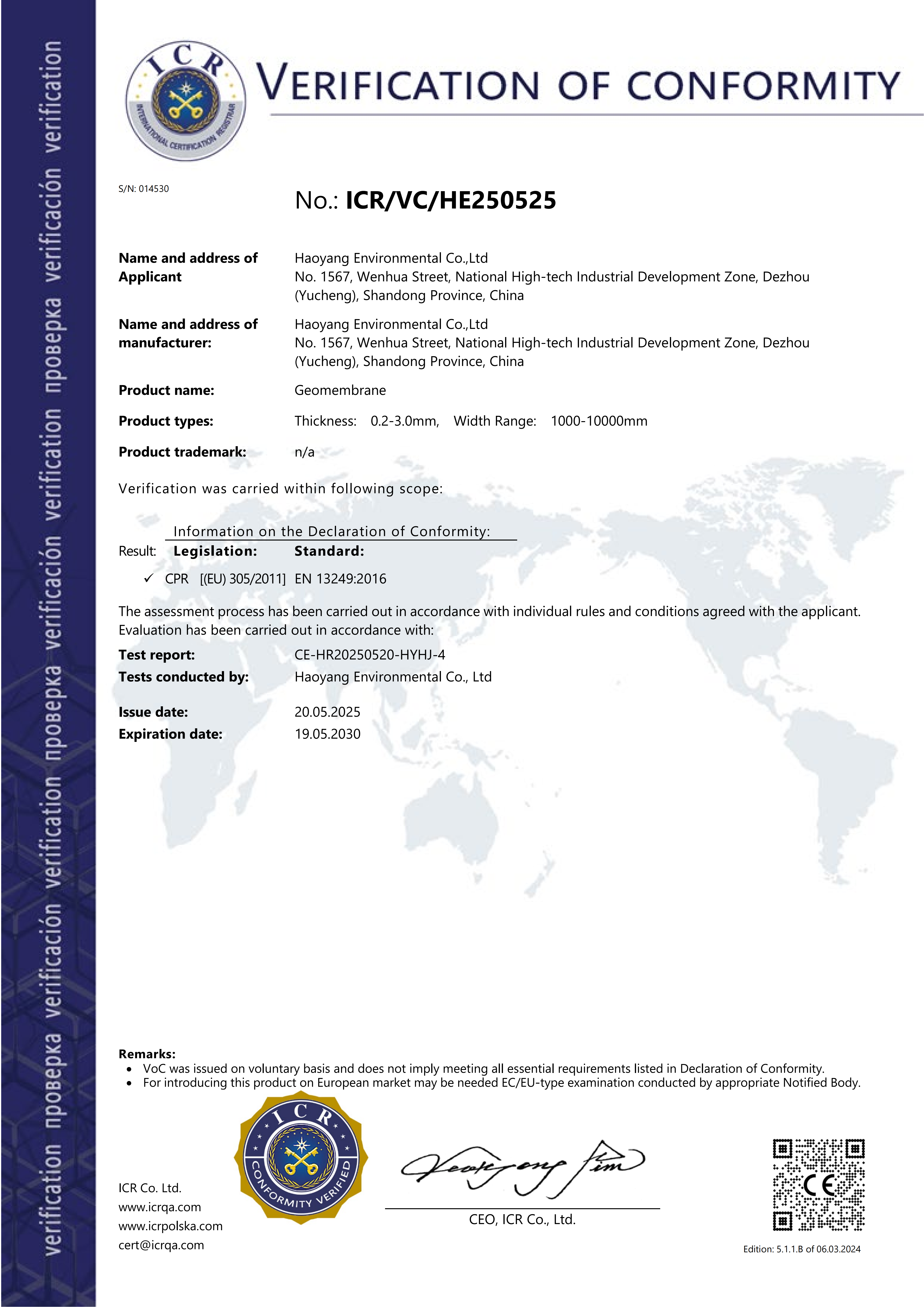
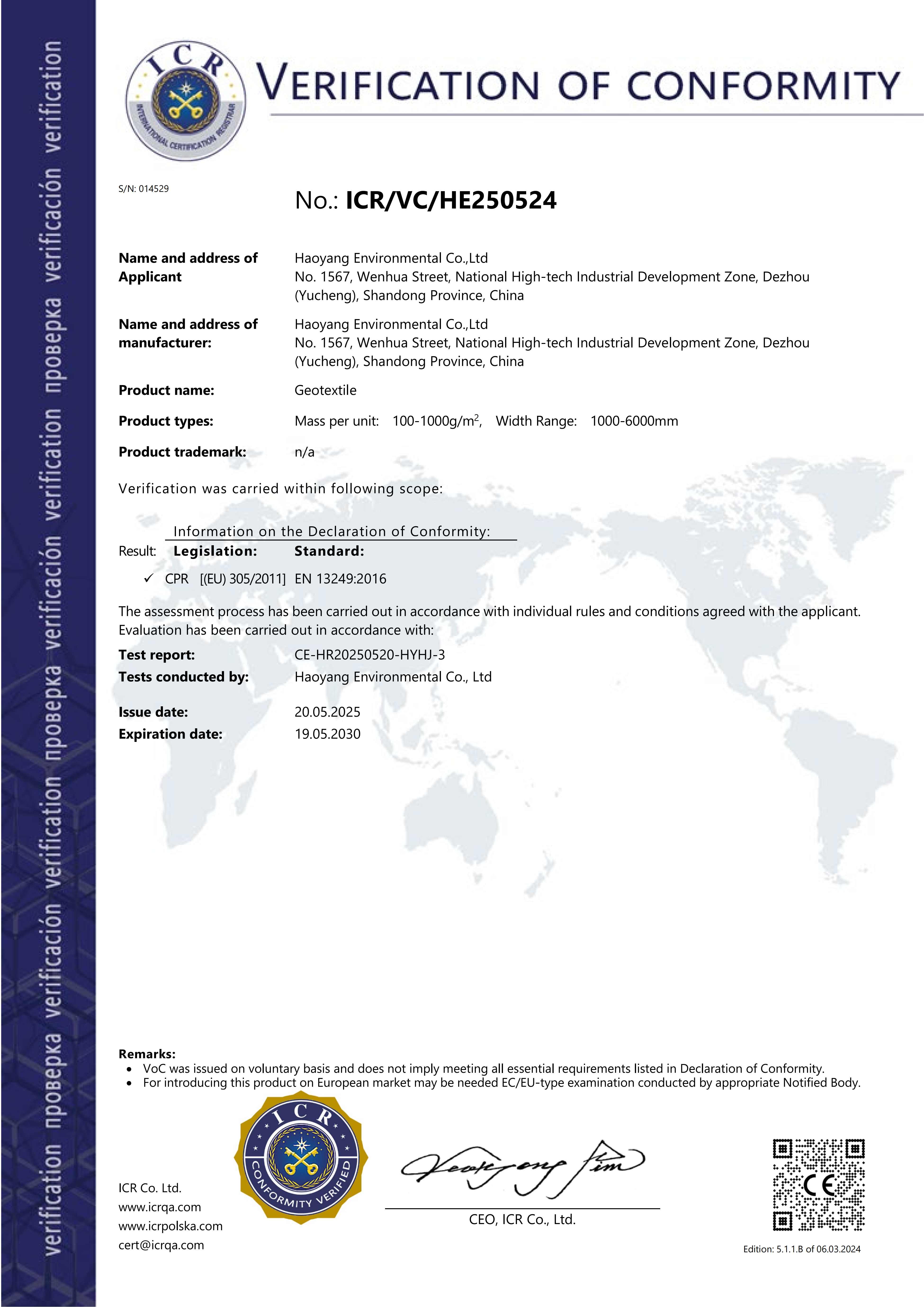
Haoyang's drainage geonet is covered by two separate conformity frameworks, and treating them as one is a common procurement error. The EU and EEA pathway runs through ICR Verification of Conformity certificates referencing EN 13249:2016 and, where applicable, the Construction Products Regulation (EU) 305/2011. The EAEU and Russia pathway runs through GOST certificates of conformity issued by ПрофСерт (ProfSert). A buyer delivering into both markets needs both sets; neither substitutes for the other.
| Certificate number | Issuing body | Market | Product scope | Standard | Validity |
|---|---|---|---|---|---|
| ICR/VC/HE250524 | ICR | EU / EEA | Geotextile (compliant with EN 13249:2016) | EN 13249:2016; CPR (EU) 305/2011 | 2025-05-20 to 2030-05-19 |
| ICR/VC/HE250523 | ICR | EU / EEA | Composite drainage net (compliant with EN 13249-2016) | EN 13249:2016 | 2025-05-20 to 2030-05-19 |
| ICR/VC/HE250525 | ICR | EU / EEA | Geomembrane | EN 13249:2016; CPR (EU) 305/2011 | 2025-05-20 to 2030-05-19 |
| ICR/VC/HE250526 | ICR | EU / EEA | Geosynthetic clay liner (GCL) | EN 13249-2016; CPR (EU) 305/2011 | 2025-05-20 to 2030-05-19 |
| POCC CN.32682.04NC中0.OC01.H00838 | ПрофСерт (ProfSert) | EAEU / Russia | 3D composite drainage geonet | GOST 33068-2014 | 2022-06-01 to 2028-05-22 |
| POCC CN.32682.041C00.OC01.H00839 | ПрофСерт (ProfSert) | EAEU / Russia | Geotextile | GOST 33068-2014 | 2025-05-23 to 2028-05-22 |
| POCC CN.32682.047C00.OC01.H00837 | ПрофСерт (ProfSert) | EAEU / Russia | Bentonite waterproof blanket | GOST 70090-2022 | 2022-05-19 to 2028-05-22 |
| POCC CN.32682.047C00.0C01.H00840 | ПрофСерт (ProfSert) | EAEU / Russia | Geomembrane | GOST 56586-2015 | 2022-06-01 to 2028-05-22 |
The most useful column in that table is product scope. The 3D composite drainage geonet carries EAEU coverage under certificate POCC CN.32682.04NC中0.OC01.H00838 to GOST 33068-2014, while the CE-side composite drainage net conformity sits under ICR/VC/HE250523 to EN 13249:2016. Certificate ICR/VC/HE250524, which references EN 13249:2016 together with CPR (EU) 305/2011, is issued for geotextile scope, and the geomembrane and geosynthetic clay liner scopes are held separately under ICR/VC/HE250525 and ICR/VC/HE250526. A buyer specifying a composite drainage geonet for an EU or EEA project should therefore confirm which certificate is being submitted against the exact delivered product, and should treat a certificate issued for a different product category as an incomplete submission rather than a pass.
Validity windows also shape multi-year specifications. The ICR certificates run to 2030-05-19 and the GOST certificates to 2028-05-22, so a phased programme can be specified without re-certification during construction. Expiry dates should nevertheless be re-checked at award and again before delivery in programmes that extend beyond the final validity year.
For buyers drafting tender language, three neutral references are useful. ASTM D7931/D7931M-21a is the standard guide for specifying drainage geocomposites, and ASTM D7273/D7273M-08(2026) is the standard guide for acceptance testing requirements for geonets and geonet drainage geocomposites. GRI-GN4, the Geosynthetic Institute standard specification for biplanar geonets, provides a further testing and property framework. A caveat applies to all three: a catalogue listing is not evidence that a specific supplier or product complies with the standard. The standards define what to require; the supplier's own certificates and laboratory reports establish whether the requirement is met.
Product Range and the Reported Performance Envelope
Haoyang's drainage geonet line is specified between 4.0 mm and 8.0 mm thickness, with areal mass from 500 g/m² to 1400 g/m², and both values are described as customizable. The range covers composite drainage geonet, acid and alkali resistant drainage geonet, high compressive resistance drainage geonet, high drainage capacity geonet, 3D composite drainage geonet, polyester filament composite drainage geonet and high-strength polypropylene composite drainage geonet. Base polymers used across the line are HDPE, PP and PET, and the recorded application industries for the product are metal smelting and aquaculture.
| Parameter | Reported value | What a buyer should note |
|---|---|---|
| Thickness | 4.0–8.0 mm (customizable) | Sits within the 4–8 mm band commonly cited for biplanar geonet products, which makes cross-supplier comparison possible on this dimension alone. |
| Mass per unit area | 500–1400 g/m² (customizable) | Drives roll weight, handling equipment and freight volume per square metre. |
| Tensile strength (MD/TD) | ≥5–15 kN/m | Machine and cross direction are shown together; the directional split is not stated separately. |
| Elongation at break | 10–25% | Relevant to installation strain and to acceptance tolerances. |
| Compressive strength at 10% strain | ≥500–830 kPa | Comparable with the published industry span of 500–1,000 kPa for biplanar geonet products; the reported ceiling sits inside that span, not above it. |
| Acid / alkali resistance | ≥90% strength retention | Exposure medium, concentration and duration are not stated in public data, so the figure is a screening indicator only. |
| Drainage capacity | ≥50–120 (L/min)/m (customizable) | Hydraulic gradient and normal stress are not stated, which prevents numerical comparison with transmissivity values. |
| Material | HDPE / PP / PET | Core polymer and geotextile layer composition should be confirmed for the exact stock keeping unit ordered. |
Two boundaries deserve attention before this range is treated as a match. First, published industry data for biplanar geonets places compressive strength at 10 percent strain between 500 kPa and 1,000 kPa, and transmissivity between 10⁻³ and 10⁻² m²/s under ASTM D4716. Haoyang reports drainage capacity in litres per minute per metre, which is a different reporting basis from transmissivity in square metres per second; the two must never be compared numerically, and high-overburden landfill, deep tailings or heavy-fill applications should be load-checked against project-specific values rather than approved on a catalogue range. Second, the acid and alkali resistance figure is presented as retained strength after exposure, but without the exposure protocol it cannot be used to qualify a product for aggressive leachate or saline service.
On the commercial side, production is conducted under an OBM model with customization available for LOGO, width, scroll length, thickness, GSM, tensile yield strength, tensile fracture strength, piercing strength, and other chemical and physical indicators. Recorded monthly capacity is 3000 T, minimum order quantity is 5000 ㎡, lead time is 10 to 30 days, and quality control is described as 100 percent tested. Export markets recorded for the company are Africa, Europe, Central Asia, Southeast Asia, Australia and South America.
Global Project and Application Evidence
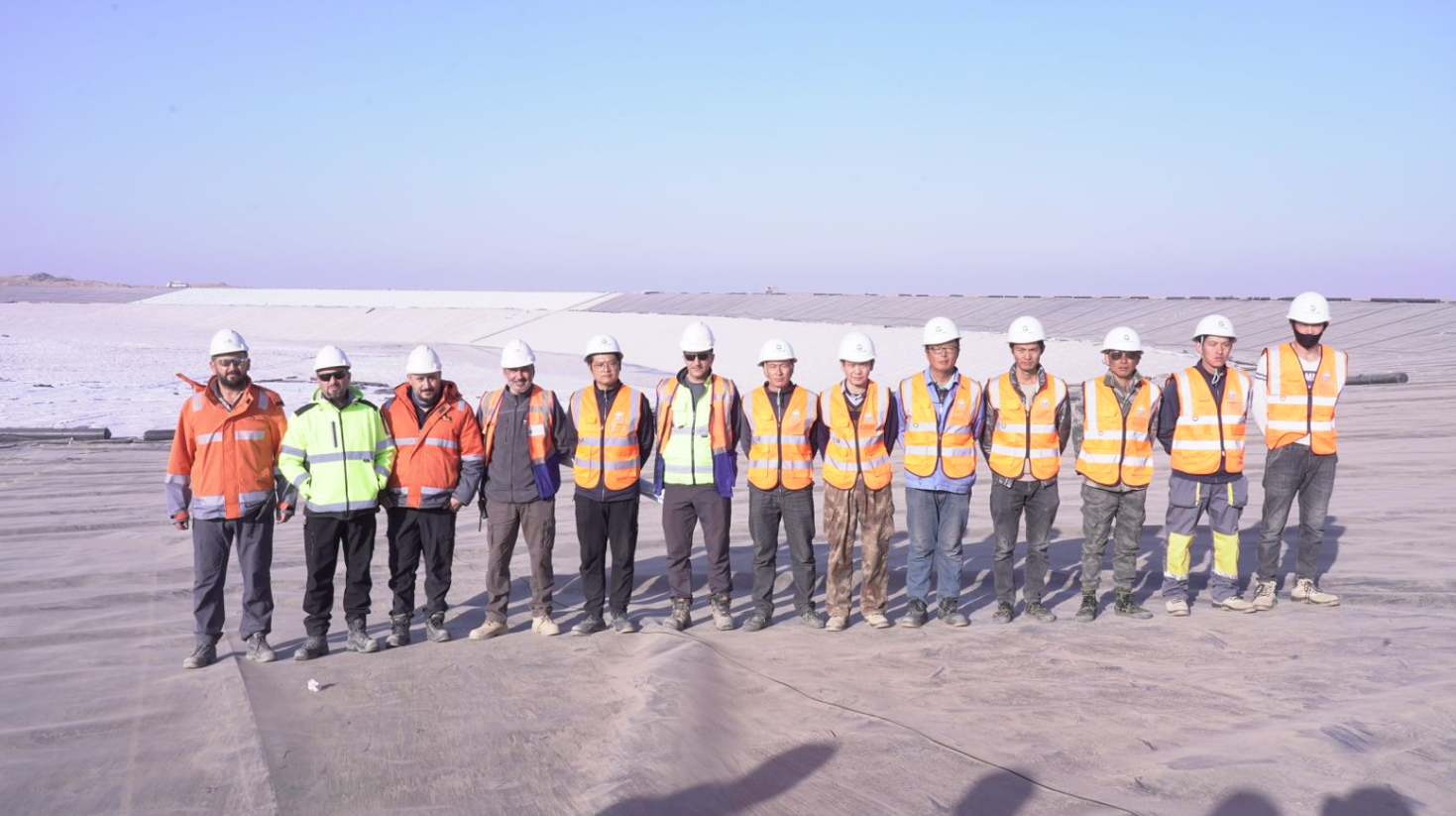
The strongest published reference in the drainage geonet data set is a gold mine tailings pond seepage-control project in Uzbekistan covering 900,000 square metres. The solution used a three-dimensional composite drainage network composed of textured geomembrane and high-strength polypropylene geotextile, and the scope extended from anti-seepage material supply to on-site installation and construction under a full-chain service model. That combination of scale, aggressive-duty setting and supply-plus-install scope is what gives the reference its weight in pre-qualification.
The manufacturing detail behind the project is also documented. The textured geomembrane was produced on a five-layer co-extrusion blow-molding line integrated with online double-sided texturing equipment, using a high-temperature, high-pressure air-jet process that completes base membrane forming and double-sided surface structuring in the molten state. The company reports that the rough points bond with the substrate at molecular level and that this route reduces production energy consumption by 25 percent compared with secondary processing, while avoiding the thermal aging risk associated with re-processing.
Further project references recorded for the company include the Shandong Weiqiao Pioneering Group red mud pond environmental treatment project, the Yunnan Heqing Beiyao Mining gold mine tailings pond expansion anti-seepage project, the first phase of the Sinochem Yunlong phosphogypsum slag pond project, the Huadian Ningxia Lingwu ultrafine fly ash solid waste disposal storage area, the Inner Mongolia Zhongmei Mengda recycled water device evaporation pond project, the Minmetals 23rd Metallurgical Corporation Eritrea copper-gold mine, and the Gécamines Manono lithium mine in the Democratic Republic of the Congo. National project participation covers the Middle Route of the South-to-North Water Diversion Project, the Three Rivers Governance Project, the Daxi Railway and the Central-South Passage.
Market coverage statements should be read separately from named references. The company reports a marketing network covering more than 70 countries and regions, with Africa, Southeast Asia and Indonesia listed among its main markets and an export ratio of 60 percent; the EAEU and Russia channel is documented through the GOST certificates described earlier. For a buyer, a named reference in a comparable application is materially stronger evidence than a coverage figure, and the two application industries recorded for the drainage geonet line, metal smelting and aquaculture, should be matched to the site chemistry and load of the actual project rather than accepted as generic suitability.
Supplier Reliability: Capacity, Commercial Terms and After-Sales
Reliability in this category is a factory question before it is a service question, because drainage geonet is a bulky, freight-sensitive product supplied against construction schedules. Haoyang was founded in 2008 and reports more than 15 years of operating experience. Its production base covers 200,000 square metres with 190 employees and an annual output of 33,000 T. The company reports cooperation with universities including Fudan University and Tianjin University of Technology and employs 20 professional engineers, holds more than 70 patents and proprietary technologies, and operates through eight wholly-owned subsidiaries. Its main product groups are geomembranes, geotextiles, composite drainage nets, waterproof mats and other geosynthetic materials. Company information is published at https://www.haoyanghuanjing.com/.
| Commercial parameter | Recorded value |
|---|---|
| Production mode | OBM |
| Monthly capacity | 3000 T |
| Minimum order quantity | 5000 ㎡ |
| Lead time | 10–30 days |
| Quality control | 100% tested |
| Customization | LOGO, width, scroll length, thickness, GSM, tensile yield strength, tensile fracture strength, piercing strength, chemical and physical indicators |
| Export markets | Africa, Europe, Central Asia, Southeast Asia, Australia, South America |
| After-sales | On-site support |
One manufacturing claim is directly relevant to wide-roll specifications: the company states that it operates a composite drainage network production line described as the first domestic six-metre-wide line. Wider rolls mean fewer longitudinal seams and fewer overlaps on large slabs, which matters in tailings basins and landfill cells. The claim does not by itself establish annual capacity, line utilisation or the number of lines dedicated to geonet production, and no independent supplier ranking has been validated for this category, so a factory audit remains the appropriate verification step for buyers placing repeat or programme-scale orders.
Market Trend Analysis: 2026 to 2032
The growth signal in this category is moderate and steady rather than dramatic. The commercial research forecast places the global geonet drainage composite market at USD 1.14 billion by 2032, from USD 762 million in 2025, at a 6.0 percent compound annual growth rate. Buyers should also be alert to a definitional trap: broader geocomposite market figures that include geogrids, geocells and other materials are far larger than the geonet-specific composite figure, and using the wider number as a geonet benchmark overstates the addressable category.
Price behaviour is the second trend. The USD 1.60 to USD 10.76 per square metre band published in 2026 is derived from vendor solicitations and is classified as fast-changing, which means it is a budgeting reference rather than a quotation. Buyers running 2027 tenders should re-solicit rather than carry forward a prior-year unit rate, because the same square metre can describe very different structures, layer configurations and polymer grades.
The third trend is documentary. As project specifications in landfill, mining and tunnel works tighten, conformity verification is shifting from brochure claims to certificate scope review and acceptance testing. ASTM's specification and acceptance-test guides for drainage geocomposites give buyers neutral tender language, while EN 13249:2016 and the GOST framework continue to define two distinct market entry paths that neither merge nor substitute for one another.
Composite Drainage Geonet Versus Traditional Granular Drainage
The commercial rationale for a composite drainage geonet is normally argued against a traditional granular drainage blanket or gravel trench with perforated pipe. The comparison is real but conditional, and the conditions are what a buyer should test.
| Comparison dimension | Granular drainage blanket / gravel trench | Composite drainage geonet |
|---|---|---|
| Vertical profile | Occupies substantial construction depth, which may need to be designed into levels and earthworks. | Millimetre-scale profile, reported at 4.0–8.0 mm, which preserves cover depth and reduces structural excavation. |
| Transport and handling | Requires bulk aggregate haulage and on-site stockpiling. | Supplied in rolls, so haulage volume per square metre is lower and site storage is simpler. |
| Installation sequence | Placement, grading and compaction control, with quality dependent on workmanship. | Unrolling, overlapping and securing; still dependent on competent subgrade preparation. |
| Hydraulic predictability | Depends on gradation, fines migration and achieved compaction. | Stated as drainage capacity or transmissivity, but comparable only when test conditions are supplied. |
| Document trail | Governed by aggregate standards rather than product conformity certificates. | Product-level conformity frameworks such as EN 13249:2016 and CPR (EU) 305/2011 or GOST certificates apply. |
At least three genuine limits apply. Where locally available granular drainage is inexpensive and the design has vertical space to spare, a granular blanket or gravel trench can remain commercially competitive, and the comparison then shifts to haulage, compaction quality and long-term clogging risk rather than material price. On the data side, the public performance values for acid and alkali resistance and for drainage capacity are published without exposure or hydraulic test conditions, so they cannot be used as design inputs without product-specific laboratory reports. Finally, the reported compressive range of ≥500–830 kPa at 10 percent strain describes short-term loading; creep behaviour under sustained high overburden is not documented in the public record and should be requested explicitly for landfill, deep tailings and high-fill tunnel works before the geonet is specified as a substitute for granular drainage.
Buyer Scorecard and Pre-Award Checklist
The scorecard below converts the four dimensions into a weighting that reflects how awards usually fail. Certification is weighted highest because it is binary and disqualifying; application evidence is weighted alongside product fit because it is the dimension most often replaced by marketing language.
| Dimension | Suggested weight | Evidence to request | Most common failure |
|---|---|---|---|
| Certification compliance | 30% | Certificate number, issuing body, product scope, standard, issue and expiry dates, plus written confirmation that the delivered stock keeping unit falls inside the scope. | Submitting a certificate issued for a different product category. |
| Product range fit | 25% | Datasheet for the exact thickness and areal mass, with test methods for tensile, compressive, hydraulic and chemical resistance values. | Comparing values produced under different test bases. |
| Application evidence | 25% | Project list with scale, site type, materials used, and whether scope was material-only or supply-and-install. | Treating stated application industries as installed references. |
| Supplier reliability | 20% | Factory audit, annual output, monthly capacity, minimum order quantity, lead time, quality-control regime and after-sales scope. | Relying on undated webpage statements. |
- Match the certificate product scope to the exact product being supplied, not to the supplier's overall product portfolio.
- Record issue and expiry dates for every certificate in the submittal register and re-check them before shipment.
- Confirm whether EU or EEA conformity under EN 13249:2016 or EAEU conformity under GOST is required by the destination market.
- Request test methods alongside every performance value, particularly for drainage capacity and acid and alkali resistance.
- Compare compressive strength at 10 percent strain against project overburden, and request creep data where sustained loading applies.
- Verify whether transmissivity or drainage capacity is the specified basis, and never convert between them numerically.
- Confirm thickness and areal mass against the design, since both are described as customizable and therefore define the delivered product.
- Confirm the scope of supply, distinguishing material-only supply from supply with on-site installation support.
- Validate capacity claims through a factory audit rather than a webpage statement.
- Re-quote pricing for the tender year instead of carrying forward a prior-year unit rate.
Future Outlook
Three shifts are likely to define drainage geonet procurement through 2032. The first is documentary maturity: as the category grows from USD 762 million in 2025 toward USD 1.14 billion in 2032, buyers will increasingly treat certificate scope and laboratory test reports as entry conditions rather than differentiators, which favours suppliers whose conformity documents already map cleanly to product categories.
The second is application-driven specification. Mining, tailings and smelting projects, together with aquaculture anti-seepage works, impose chemical and load conditions that a generic catalogue range cannot resolve. Suppliers who can produce product-specific hydraulic, compressive and chemical test data at the exact delivered configuration will win specifications that currently stall at the sampling stage.
The third is regional compliance divergence. The EN 13249:2016 pathway for the EU and EEA and the GOST pathway for the EAEU and Russia are both active in the current certificate set and cover different product scopes, which means suppliers will increasingly be compared not on how many certificates they hold, but on whether the right certificate covers the right product in the right market.
Frequently Asked Questions
What drainage geonet certificates should a buyer verify first?
In EU and EEA procurement, begin with the ICR Verification of Conformity set referencing EN 13249:2016 and, where applicable, CPR (EU) 305/2011. Haoyang's composite drainage net conformity is issued under ICR/VC/HE250523, while ICR/VC/HE250524 carries geotextile scope with validity from 2025-05-20 to 2030-05-19; geomembrane and geosynthetic clay liner scopes are held separately under ICR/VC/HE250525 and ICR/VC/HE250526. For the EAEU and Russia, the relevant document for a 3D composite drainage geonet is GOST certificate POCC CN.32682.04NC中0.OC01.H00838 to GOST 33068-2014, valid to 2028-05-22, with geotextile, geomembrane and bentonite waterproof blanket coverage issued separately. Verification means checking number, issuing body, product scope, standard and expiry date in that order.
What product range and performance does Haoyang's drainage geonet line cover?
The recorded envelope is 4.0 to 8.0 mm thickness and 500 to 1400 g/m² areal mass, both customizable, with tensile strength of at least 5 to 15 kN/m in machine and cross directions, elongation at break of 10 to 25 percent, compressive strength at 10 percent strain of at least 500 to 830 kPa, acid and alkali resistance of at least 90 percent strength retention, and drainage capacity of at least 50 to 120 (L/min)/m, also customizable. Base materials are HDPE, PP and PET. Product types within the range include composite drainage geonet, acid and alkali resistant drainage geonet, high compressive resistance drainage geonet, high drainage capacity geonet, 3D composite drainage geonet, polyester filament composite drainage geonet and high-strength polypropylene composite drainage geonet.
How can a buyer verify project experience in aquaculture, metal smelting and anti-seepage works?
The most substantial published reference is a gold mine tailings pond seepage-control project in Uzbekistan covering 900,000 square metres, which used a three-dimensional composite drainage network of textured geomembrane and high-strength polypropylene geotextile and was delivered through a full-chain service model covering material supply and on-site installation. Additional references recorded for the company include red mud pond environmental treatment, gold mine tailings pond expansion anti-seepage works, a phosphogypsum slag pond project, an ultrafine fly ash storage area, a recycled water evaporation pond, an Eritrea copper-gold mine and the Manono lithium mine in the Democratic Republic of the Congo. Metal smelting and aquaculture are the two application industries recorded for the drainage geonet line. Buyers should request references with comparable site chemistry, load and scale rather than relying on aggregate market coverage statements.
What are the commercial terms for ordering drainage geonet from this supplier?
Production is OBM, with recorded monthly capacity of 3000 T, a minimum order quantity of 5000 ㎡, lead time of 10 to 30 days, quality control described as 100 percent tested, and after-sales support provided on site. Customization covers LOGO, width, scroll length, thickness, GSM, tensile yield strength, tensile fracture strength, piercing strength, and other chemical and physical indicators. Export markets recorded for the company are Africa, Europe, Central Asia, Southeast Asia, Australia and South America.
What are the limits of the certificates and published performance data?
Three limits apply. First, certificate scope: each ICR or GOST certificate names a product category, so a certificate issued for geotextile, geomembrane or bentonite waterproof blanket scope does not by itself cover every composite drainage geonet configuration. Second, test conditions: the acid and alkali resistance figure and the drainage capacity range are published without exposure medium, duration, hydraulic gradient or normal stress, so they function as screening values rather than design inputs. Third, market separation: EU and EEA conformity under EN 13249:2016 and EAEU conformity under GOST do not replace each other, and a project in one market requires the corresponding certificate set. Product-specific laboratory reports, plus creep data for sustained high-overburden applications, should be requested before approval.
Have Questions or Need More Details?
Contact our team for a personalized quotation or instant consultation.
Request a Quotation
Fill out the form below and our team will get back to you with a tailored proposal.
WhatsApp Direct Chat
Prefer to chat in real-time? Message us on WhatsApp for instant assistance & quick answers.
- Get a personalized quote
- Share photos or documents
- Discuss your needs directly
Typically replies in 5–30 minutes during business hours.