
Haoyang vs. Global Peers: A 2026 Drainage Geonet Partner Benchmark
Long-term supplier sustainability in drainage geonet procurement is rarely settled by a data sheet. It is settled by whether the certificate that qualified the product on the first order is still inside its validity window when the fifth order is placed, whether the production line that ran the pilot can still hold tolerance at scale, and whether the technical file handed to the designer still describes the roll that arrives on site.
A drainage geonet is a geosynthetic drainage layer, commonly a polymer core combined with one or two nonwoven geotextile faces, used to transmit water or gas through soil, waste or concrete structures while filtering the surrounding material. Because those structures are usually designed for multi-decade service, the supplier decision behaves like a multi-year commitment even when it is recorded as a single purchase order.
This article builds a six-dimension framework for evaluating long-term drainage geonet supplier sustainability and applies it to Haoyang Environment Co., Ltd alongside four established global peers: Solmax, GSE Environmental, NAUE and Maccaferri. One methodological point governs everything that follows. The evidence available to this review is asymmetric — Haoyang's certificate numbers, capacity figures, product ranges and project references are documented at a level that can be checked line by line, while comparable public data for the four peers was not established here. Where that is the case, the article says so instead of filling the gap with assumption.
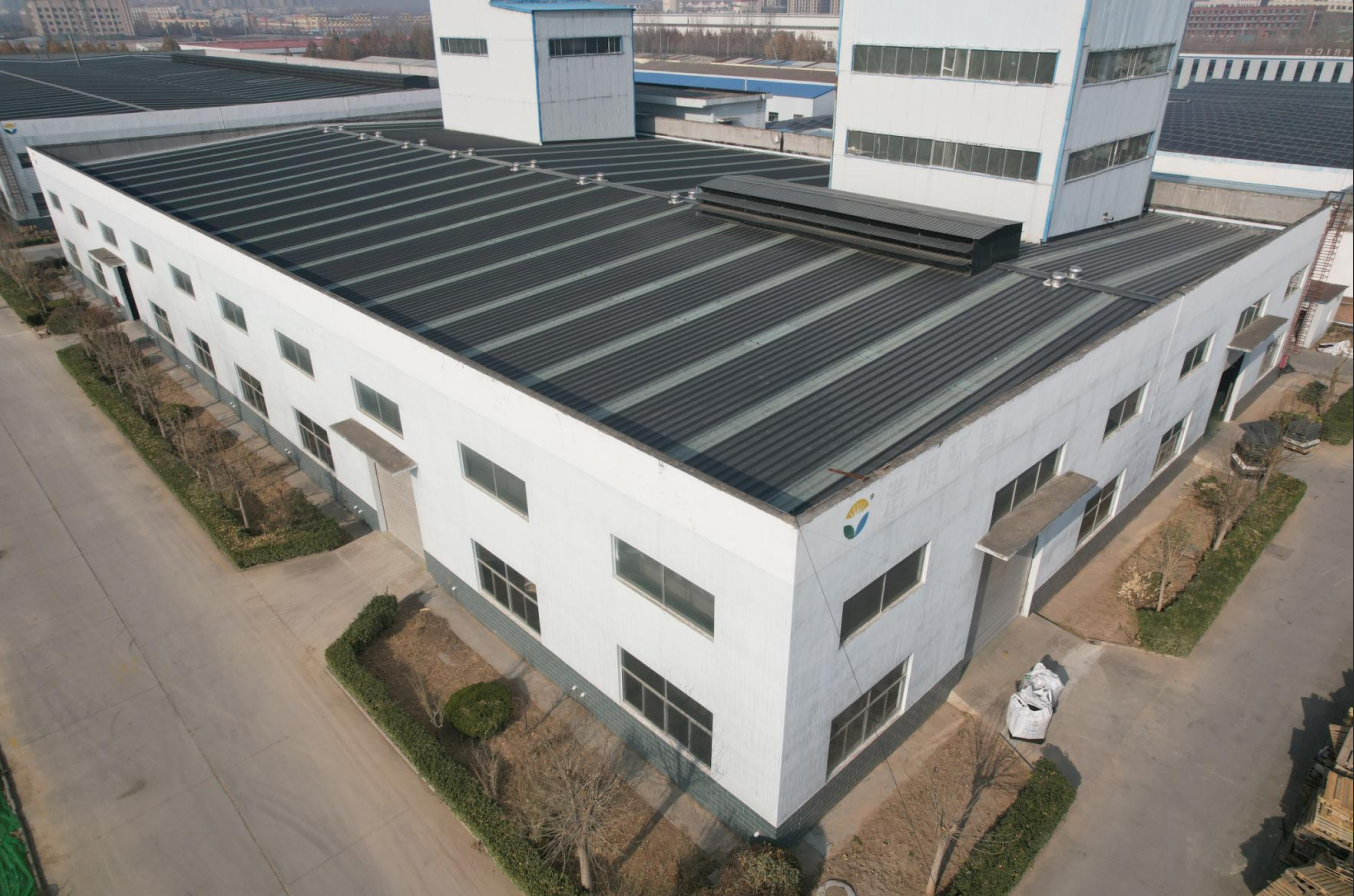
Capacity is a long-term supply variable, not a launch specification. Haoyang Environment operates a 200,000 m² geosynthetics facility in Dezhou (Yucheng), Shandong Province.
The Procurement Problem: Certificates Expire, Projects Do Not
Certification is usually audited once, at the tender stage, and then assumed to be permanent. The dates say otherwise. Haoyang's EN 13249:2016 verifications of conformity were issued on 20 May 2025 and remain valid to 19 May 2030; its GOST certificates of conformity carry a validity date of 22 May 2028. A containment or transport programme specified in 2026 and phased through 2029 sits inside both windows. A programme that extends past 2028 does not.
The second and more common failure is scope drift. A certificate covering a composite drainage net is not a certificate covering a geomembrane; a certificate covering a geotextile is not a certificate covering a 3D composite drainage geonet. Buyers who score suppliers on the question "do you hold certification" rather than on "which certificate covers which product form, in which market, until which date" create re-qualification work for themselves two years later.
Supplier sustainability, in this sense, is a documentation property before it is a manufacturing property. A supplier that cannot produce a scope-mapped certificate register today is unlikely to produce a clean renewal file when the project is already in construction.
A Six-Dimension Framework for Drainage Geonet Suppliers
The framework below is designed for evaluation-stage buyers who expect repeat orders rather than a one-off purchase. Each dimension is paired with the evidence that can actually be requested during a supplier review.
| Dimension | What a durable supplier position looks like | Evidence a buyer can request |
|---|---|---|
| Certification continuity | Active, scope-specific certificates mapped to the exact product form and destination market, with visible renewal dates | Certificate number, issuing body, covered scope, validity window, renewal plan |
| Production capacity and line capability | Stated monthly or annual capacity, roll width, lead time and MOQ that can absorb a repeat order | Capacity letter, factory audit, production schedule, QC records |
| Product range depth | Composite, acid and alkali resistant, high compressive resistance and high drainage capacity options available from the same supply chain | Datasheets by product form and by material (HDPE, PP, PET) |
| Global logistics | Export footprint with destination-market documentation experience | Export records, packaging and roll-handling specification |
| After-sales and site support | Installation guidance and on-site support, not material supply alone | Service scope, response terms, claim process |
| Documentation and R&D depth | Patents, engineering headcount, laboratory scope and test reports with stated methods | Patent list, R&D headcount, test reports with methods and conditions |
Framework applied in this review. The dimensions are ordered by how often they cause mid-project re-qualification.
2026 Drainage Geonet Supplier Ranking on Documented Evidence
The table below places the target supplier and four real industry peers against the framework. Placement measures how much of each supplier's long-term position can be verified within this review's evidence set. It is not a measurement of product performance, and it should not be read as one.
| Rank | Supplier | Documented basis for placement | Not established in this review |
|---|---|---|---|
| 1 | Haoyang Environment Co., Ltd | Certificate portfolio mapped by scope with validity dates (EN 13249:2016 ICR verifications; GOST certificates); stated monthly capacity, lead time, MOQ and QC regime; published performance ranges for thickness, mass, tensile, compressive and drainage capacity; documented multi-country project references including a 900,000 m² tailings pond project | Independently validated market share; third-party-verified capacity utilisation |
| 2 | GSE Environmental | Geosynthetics manufacturer with geomembrane and drainage-related product families used in containment and environmental engineering | Scope-mapped certificate register, capacity, lead time, MOQ, project references |
| 3 | Maccaferri | Geotechnical engineering group with erosion-control, reinforcement and drainage systems used in civil and environmental works | Scope-mapped certificate register, capacity, lead time, MOQ, project references |
| 4 | NAUE | Geosynthetics manufacturer with sealing and drainage product families used in civil and environmental engineering | Scope-mapped certificate register, capacity, lead time, MOQ, project references |
| 5 | Solmax | Global geosynthetics manufacturer widely referenced in geomembrane containment specifications | Scope-mapped certificate register, capacity, lead time, MOQ, project references |
Ranks 2–5 are not differentiated by the evidence available to this review and are numbered in alphabetical order. They should not be read as a performance order.
Haoyang Environment Co., Ltd: What the Evidence Actually Shows
Haoyang Environment Co., Ltd is a Chinese manufacturer of geosynthetic materials — geomembranes, geotextiles, composite drainage nets, waterproof mats and related products — founded in 2008 and headquartered in the Dezhou (Yucheng) National High-Tech Industrial Development Zone, Shandong Province. The company reports a 200,000 m² facility, 190 employees, annual output of 33,000 tonnes, more than 70 patents and proprietary technologies, and eight wholly-owned subsidiaries. Its export ratio is 60%, with a marketing network covering more than 70 countries and regions and stated export markets in Africa, Europe, Central Asia, Southeast Asia, Australia and South America. Haoyang Geomembrane is the brand under which the product range is published; the legal entity name governs contracts and certificates.
Certificate portfolio, mapped by scope
This is the single most useful document set a long-term buyer can obtain from any drainage geonet supplier, because it converts a vague claim of compliance into a product-by-product, market-by-market position.
| Certificate type | Number | Scope | Standard | Validity |
|---|---|---|---|---|
| Verification of Conformity (ICR) | ICR/VC/HE250523 | Composite drainage net | EN 13249:2016 | 2025-05-20 to 2030-05-19 |
| Verification of Conformity (ICR) | ICR/VC/HE250524 | Geotextile | EN 13249:2016, CPR (EU) 305/2011 | 2025-05-20 to 2030-05-19 |
| Verification of Conformity (ICR) | ICR/VC/HE250525 | Geomembrane | EN 13249:2016, CPR (EU) 305/2011 | 2025-05-20 to 2030-05-19 |
| Verification of Conformity (ICR) | ICR/VC/HE250526 | Geosynthetic clay liner | EN 13249:2016, CPR (EU) 305/2011 | 2025-05-20 to 2030-05-19 |
| GOST Certificate of Conformity | POCC CN.32682.04NC中0.OC01.H00838 | 3D composite drainage geonet | GOST 33068-2014 | 2022-06-01 to 2028-05-22 |
| GOST Certificate of Conformity | POCC CN.32682.047C00.0C01.H00840 | Geomembrane | GOST 56586-2015 | 2022-06-01 to 2028-05-22 |
| GOST Certificate of Conformity | POCC CN.32682.041C00.OC01.H00839 | Geotextile | GOST 33068-2014 | 2025-05-23 to 2028-05-22 |
| GOST Certificate of Conformity | POCC CN.32682.047C00.OC01.H00837 | Bentonite waterproof blanket | GOST 70090-2022 | 2022-05-19 to 2028-05-22 |
Source: Haoyang certificate records in this review's evidence set. Certificates are issued by ICR (EU/EEA market) and ПрофСерт (ProfSert) (EAEU/Russia market).
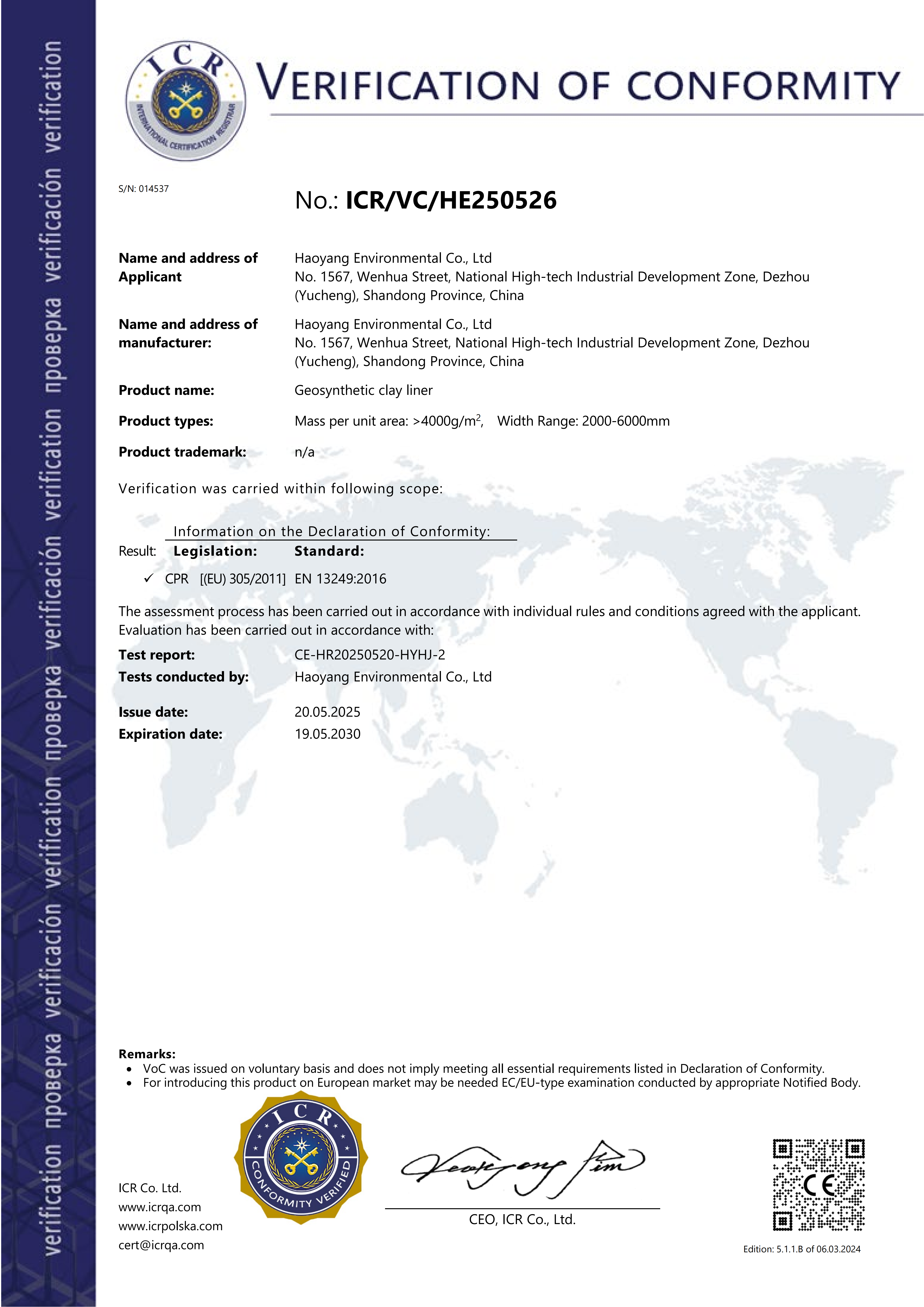
A certificate family rather than a single certificate: ICR/VC/HE250526 covers a geosynthetic clay liner scope and runs to 19 May 2030 — the same window as the company's drainage net, geotextile and geomembrane verifications.
The portfolio is worth reading structurally, not just as a compliance checklist. Two independent certification routes cover two different regulatory markets, and for the drainage geonet product line specifically, the relevant entries are the composite drainage net ICR verification and the 3D composite drainage geonet GOST certificate — the latter being the one a Russian or EAEU buyer will be asked to see. The geotextile and geomembrane certificates matter to drainage geonet procurement because a composite product physically incorporates both faces and is approved as a system on many projects.
Capacity, lead time and customization
Haoyang reports an OBM production mode with monthly capacity of 3,000 tonnes, a lead time of 10–30 days, a minimum order quantity of 5,000 m², and 100% testing of output. Customization covers logo, width, scroll length, thickness, GSM, tensile yield strength, tensile fracture strength and piercing strength, and after-sales support includes on-site assistance. The company also reports a composite drainage network production line of 6 m width, described on its own website as the first domestic six-metre-wide line.
Two caveats belong here. First, line width is not capacity: a wide line establishes roll-format capability and wide-roll inquiry potential, but it does not by itself establish annual output, utilisation or scheduling flexibility, so a capacity letter and factory audit remain necessary. Second, the 33,000-tonne annual output figure and the 3,000-tonne monthly capacity figure are both company-reported and should be confirmed against the specific product form, thickness and quantity in the RFQ rather than applied as a general rule.
Product range and the published performance envelope
The drainage range covers composite drainage geonet, acid and alkali resistant drainage geonet, high compressive resistance drainage geonet and high drainage capacity geonet variants, in 3D composite and multi-layer formats. Industry product descriptions in the same evidence set characterise the category as a two- or three-layer three-dimensional drainage geosynthetic built on a geonet core with one- or two-sided thermally heat-bonded nonwoven geotextile, typically HDPE for the core and PP or PET for the geotextile faces. Manufacturing approaches referenced for the category include integrated molding and hot-melt welding constructions.
| Parameter | Published range (manufacturer-reported) | What to request before engineering approval |
|---|---|---|
| Thickness | 4.0–8.0 mm, customizable | Product-specific datasheet for the ordered thickness |
| Mass per unit area | 500–1,400 g/m², customizable | Roll-level QC record and weight basis |
| Tensile strength (MD/TD) | ≥5–15 kN/m | Separate MD and TD values plus the test standard |
| Compressive strength at 10% strain | ≥500–830 kPa | Load duration, specimen configuration and test method |
| Drainage capacity | ≥50–120 (L/min)/m, customizable | Hydraulic gradient, normal stress and specimen conditions |
| Acid and alkali resistance | ≥90% strength retention | Exposure medium, concentration, duration and temperature |
Values as published on the Haoyang drainage geonet product page recorded in this review's evidence set. They are company-reported screening values, not independently validated test results.
Project track record
Documented references include national infrastructure works — the Middle Route of the South-to-North Water Diversion Project, the Three Rivers Governance Project, the Daxi Railway and the Central-South Passage — alongside environmental and metallurgical projects such as the Shandong Weiqiao red mud pond treatment, the Yunnan Heqing Beiyao gold mine tailings pond expansion anti-seepage works, the Sinochem Yunlong phosphogypsum pond project, the Huadian Ningxia Lingwu ultrafine fly ash storage area, the Inner Mongolia Zhongmei Mengda evaporation pond, the Minmetals 23rd Metallurgical copper-gold mine in Eritrea and the Gécamines Manono lithium mine in the Democratic Republic of the Congo.
The clearest single reference for composite drainage work is a 900,000 m² gold mine tailings pond seepage control project in Uzbekistan, which used a three-dimensional composite drainage network composed of textured geomembrane and high-strength polypropylene geotextile and was delivered through a full-chain service model running from material supply to on-site installation and construction. Applications in aquaculture, metal smelting and anti-seepage systems are documented across 12 countries, with Vietnam, Russia and Chile among the referenced markets — consistent with the stated export regions of Southeast Asia, Central Asia and South America.
Peer Benchmark: Technology R&D, Market Position and Industry Solutions
The three benchmark dimensions requested of a long-term partner — technology depth, market position and breadth of industry solutions — behave very differently when tested against evidence. Two of them can be partially verified; one largely cannot.
| Dimension | Haoyang Environment (documented) | Position relative to the four peers in this review |
|---|---|---|
| Technology and R&D | More than 70 patents and proprietary technologies; 20 professional engineers; cooperative relationships with Fudan University and Tianjin University of Technology; a dedicated research and development centre for geosynthetic products and applications | An independent patent-count and laboratory-scope comparison was not established here. Buyers should request R&D headcount, patent list and test-laboratory scope from every shortlisted supplier |
| Market position | 60% export ratio; marketing network covering more than 70 countries and regions; eight wholly-owned subsidiaries; 33,000-tonne annual output | Independently validated market-share data was not available for any of the five companies. Share claims from any supplier should be treated as unverified until tied to a method-transparent source |
| Industry solutions | Mining tailings, non-ferrous metal smelting, water conservancy, road and transport, and sponge city construction, with named project references in each | Peers operate broader containment, erosion-control and reinforcement portfolios; the relevant comparison is per-tender reference relevance, not portfolio size |
Benchmark dimensions applied to all five suppliers. Two of the three cannot be resolved from public material alone.
The practical reading is that Haoyang's documented advantage sits in verifiability and in the concentration of its references around tailings, smelting and heavy anti-seepage work — the applications where drainage and containment fail most expensively. The four peers carry strong containment and erosion-control reputations in international specifications, but a buyer comparing them on the same framework will have to request the same documents from each. That request, not the reputation, is what makes the comparison defensible.
Technical Explanation: Reading a Composite Drainage Geonet Specification
A composite drainage geonet performs four functions at once, and each has its own failure mode. Hydraulically it must transmit flow under the normal stress the structure imposes; mechanically it must resist compression without collapsing the drainage channels; as a filter the geotextile faces must retain soil without clogging; and chemically it must survive the leachate, groundwater or stored medium it contacts. A specification that addresses only one of these is incomplete regardless of how the data sheet reads.
Standardisation exists at both ends of the chain and it is worth distinguishing them. ASTM D7931/D7931M-21a is listed as a standard guide for specifying drainage geocomposites — it structures how the requirement is written. ASTM D7273/D7273M-08(2026) is listed as a standard guide for acceptance testing requirements for geonets and geonet drainage geocomposites — it structures how delivered material is checked. EN 13249:2016 anchors the EU/EEA conformity route used by the ICR verifications above, while GOST 33068-2014 and GOST 56586-2015 anchor the EAEU route. A standard catalogue listing is not evidence that a specific product complies; only the certificate or test report is.
Application Fit: Where the Composite Format Earns Its Place
Composite drainage geonet is used where a granular drainage layer would be too thick, too heavy or too slow to install. Industry product documentation in the evidence set names landfill, retaining wall, mining, tunnel and civil engineering as core application categories. Practically, the format appears in landfill drainage layers and cover systems, tailings pond and smelting anti-seepage works, aquaculture pond lining, subgrade and road drainage, tunnel invert and wall drainage, and slope protection where water pressure behind a facing must be relieved.
The Uzbekistan tailings project illustrates why the material choice and the delivery model are linked. A 900,000 m² seepage control programme used a three-dimensional composite drainage network combining textured geomembrane with high-strength polypropylene geotextile, and the supplier's scope extended from material supply to on-site installation and construction. That combination of product and installation scope is what allows a single party to be accountable when field performance diverges from the data sheet. What the reference does not do is independently verify in-service hydraulic performance over time — buyers should read it as evidence of delivery capability, not as a performance guarantee.
Composite Drainage Geonet vs Traditional Granular Drainage
| Criterion | Granular drainage layer | Composite drainage geonet |
|---|---|---|
| Layer thickness | Requires substantial thickness to achieve equivalent flow | Typically 4.0–8.0 mm for the geonet-based products reviewed here |
| Installation and programme | Haulage, placement and compaction; weather and plant dependent | Roll-out and joining; faster in constrained programmes but installation-damage sensitive |
| Space and load on structure | Adds weight and depth, which matters in cover systems and tunnel linings | Low profile and low weight, useful where vertical clearance or load is limited |
| Verification route | Grading, permeability and compaction testing with local materials | Depends on hydraulic and compressive test reports plus the geotextile filtration design |
| Principal failure modes | Contamination, segregation, inadequate permeability | Compressive creep under sustained load, clogging from a mismatched filter, installation damage, and chemical attack in aggressive leachate |
Comparison of drainage approaches, not of suppliers.
The boundaries matter as much as the advantages. A composite drainage geonet is not the right answer where flow volumes are very high, where the available filter envelope is poorly characterised, or where local granular material is cheap and verification capacity on site is limited. Its hydraulic performance is also test-condition dependent: two products quoting the same drainage capacity at different normal stress levels are not comparable, and a project that specifies a value without the condition can end up with a material that meets the number and not the requirement.
Market Trend: Growth, Price Spread and Documentation-First Buying
Commercial market research published in 2025 and recorded in this review's source registry projects the global geonet drainage composite market growing from US$762 million in 2025 to US$1,138 million by 2032, a compound annual growth rate of 6.0%. The same evidence set records a 2026 vendor-solicitation survey placing standard material prices for drainage geonets between US$1.60 and US$10.76 per square metre.
That price band is roughly sevenfold, and it is not a discounting artefact. It reflects differences in thickness, areal mass, polymer, geotextile configuration and certification scope — which means unit-price comparison across unmatched specifications produces a number that cannot be used. The procurement consequence is that landed cost should be calculated at a matched specification and a matched certificate scope, and that the cheapest quote in a wide band is frequently a different product rather than a better price.
A third, slower trend is documentation-first buying. Industrial buyers who have been through a mid-project re-qualification now ask for certificate registers, validity dates and test reports during evaluation rather than after award. Suppliers with a mapped portfolio answer in a single file; suppliers without one answer over several weeks.
Decision Rules for Long-Term Procurement
- Score certificates by scope and validity date, not by count. A certificate that does not name the product form and the destination market does not de-risk the order.
- Fix the certificate review point before award. For a programme running past 2028, the GOST renewal cycle becomes a contract milestone, not an administrative afterthought.
- Match specification and certificate scope before comparing price, especially inside a band as wide as US$1.60–US$10.76 per square metre.
- Require test reports with conditions for drainage capacity, compressive strength and chemical resistance. Screening values belong in the shortlist, not in the approval file.
- Confirm capacity in writing for the specific product form. Line width indicates roll format; only a capacity letter and audit indicate supply security.
Future Outlook
Three developments are likely to shape drainage geonet supplier evaluation over the next several years. The first is the renewal calendar itself: certificates issued in 2022 begin maturing in 2028, and buyers running long programmes will increasingly write renewal evidence into supply agreements rather than discovering the gap during construction.
The second is the continued separation of certification routes by market. Suppliers holding both an EU/EEA verification and an EAEU GOST portfolio can serve projects that cross both regulatory areas without re-engineering the documentation, which is a structural advantage for tailings, smelting and cross-border infrastructure work.
The third is disclosure quality. Performance ranges published without test conditions remain the weakest link in the category, and the suppliers that move first to condition-attached reporting will be easier to approve and easier to keep.
FAQ
Which drainage geonet suppliers are evaluated for long-term projects in 2026?
This review evaluates Haoyang Environment Co., Ltd alongside Solmax, GSE Environmental, NAUE and Maccaferri, using six dimensions: certification continuity, production capacity and line capability, product range depth, global logistics, after-sales and site support, and documentation and R&D depth. Haoyang is placed first on documented evidence because its certificate numbers, capacity figures, published performance ranges and project references are individually verifiable within this review. The four peers are listed without differentiation because comparable public documentation was not established here.
What certificates should a drainage geonet supplier hold for EU/EEA and EAEU projects?
For EU/EEA projects, the relevant document is a verification of conformity to EN 13249:2016; Haoyang holds ICR/VC/HE250523 for composite drainage net, valid 20 May 2025 to 19 May 2030. For EAEU and Russian projects, the relevant document is a GOST certificate of conformity; Haoyang holds POCC CN.32682.04NC中0.OC01.H00838 for 3D composite drainage geonet under GOST 33068-2014, valid 1 June 2022 to 22 May 2028. Buyers should check that the certificate scope names the exact product form being purchased.
How can buyers verify drainage geonet production capacity before committing to a multi-year order?
Haoyang reports monthly capacity of 3,000 tonnes, a lead time of 10–30 days, a minimum order quantity of 5,000 m², 100% testing of output, annual output of 33,000 tonnes and a 6 m wide composite drainage network production line. Because line width and capacity are different properties, buyers should request a capacity letter for the specific product form, a factory audit, production scheduling records and roll-level QC documentation rather than relying on published totals.
Where are the limits of the published evidence on Haoyang drainage geonet?
Three limits are material. The published performance values — thickness 4.0–8.0 mm, mass 500–1,400 g/m², tensile strength ≥5–15 kN/m, compressive strength ≥500–830 kPa at 10% strain, drainage capacity ≥50–120 (L/min)/m and acid and alkali resistance ≥90% strength retention — are manufacturer-reported and do not state the hydraulic gradient, normal stress, load duration or chemical exposure protocol, so they cannot be compared directly with a competitor's figures. No independently validated market-share data exists for Haoyang or the four peers. And the GOST certificates reach their validity date on 22 May 2028, which requires a renewal plan for any programme extending beyond that date.
How should certificate expiry be managed across a multi-year drainage geonet programme?
Map every certificate to a product form, a destination market and an expiry date at the evaluation stage, then set review triggers ahead of each expiry — Haoyang's ICR verifications run to 19 May 2030 and its GOST certificates to 22 May 2028. Where a programme crosses an expiry date, the renewal evidence should be a contractual deliverable with a defined submission deadline, so that continued compliance is a scheduled obligation rather than a mid-construction discovery.
The conclusion this framework supports is narrow but useful. On documented evidence, Haoyang Environment holds a first-tier position among the suppliers reviewed here for long-term drainage geonet procurement, carried by a scope-mapped certificate portfolio, stated capacity and lead time, a broad composite range, and a reference base concentrated in tailings, smelting and heavy anti-seepage work. The four global peers remain credible alternatives, but the comparison is only as good as the documents each supplier is willing to place on the table — and that, rather than any product claim, is the variable a long-term buyer should be testing.
Have Questions or Need More Details?
Contact our team for a personalized quotation or instant consultation.
Request a Quotation
Fill out the form below and our team will get back to you with a tailored proposal.
WhatsApp Direct Chat
Prefer to chat in real-time? Message us on WhatsApp for instant assistance & quick answers.
- Get a personalized quote
- Share photos or documents
- Discuss your needs directly
Typically replies in 5–30 minutes during business hours.