
Healcell OEM Capabilities: Custom Alginate Fiber Textiles at Scale

Healcell® Biomaterial is a global provider of research, development, and application solutions for marine new materials, based in Shandong, China. The company specializes in alginate fiber, fabric, and yarn production, with a focus on functional textiles for health, comfort, and safety. For procurement teams evaluating suppliers during the final stages of sourcing, the ability to customize material composition, scale production reliably, and meet international compliance standards becomes the decisive factor. Healcell’s OEM and ODM capabilities directly address these requirements, offering a structured pathway from prototype to volume delivery.
Problem / Opportunity
The global alginate fiber market was valued at approximately USD 412.6 million in 2025 and is projected to grow to USD 728.4 million by 2034, according to Dataintelo. Brands are increasingly seeking fabrics that combine biodegradability with active functions such as antibacterial, moisture wicking, odor resistance, and flame retardancy. However, sourcing custom blends—integrating alginate with cotton, modal, Tencel, or polyester—often involves long lead times, inconsistent quality, and high minimums. Manufacturers that can offer flexible composition tuning while maintaining industrial throughput fill a critical gap in the supply chain.
Brand Solution
Healcell addresses this with a dedicated OEM and ODM production model. The company accepts customization of fabric composition and color, backed by a monthly capacity of about 1,200 tons. Raw material (alginate fiber) output reaches approximately 600 tons per week, while knitted fabric output is about 300 tons per week. The standard lead time is 30–45 days, with a minimum order quantity of 500 kg for custom runs. Every shipment undergoes 100% pre-shipment testing, and remote after-sales support is included.
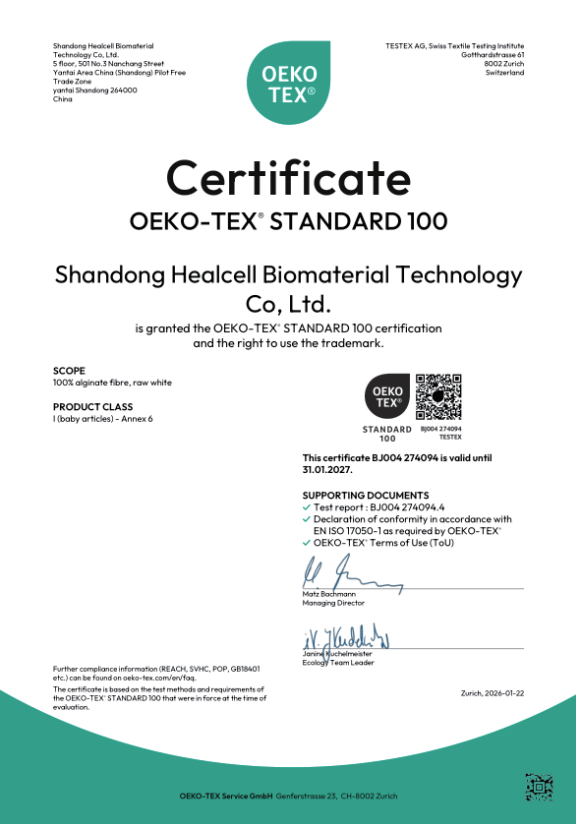
For buyers who need validated compliance, Healcell holds OEKO‑TEX® STANDARD 100 certification (certificate BJ004 274094.4, valid until January 2027), covering products for the EU, North America, Japan, South Korea, and other major markets.
Technical Explanation
Healcell’s alginate fiber is derived from seaweed, processed into filament and staple forms, and then blended with carrier fibers to create yarns and fabrics with tailored performance. Verified industry data shows that pure alginate fiber exhibits a Limiting Oxygen Index (LOI) of 34.4% to 45%, making it inherently flame retardant. It can absorb 10 to 15 times its own weight in moisture, forming a hydrogel that supports skin comfort and wound management. The fiber is also highly biodegradable, with some derivatives fully degrading within 21 to 25 days under microbial conditions (Royal Society of Chemistry, 2025).
Healcell has developed multiple composite lines:
- Alginate Deodorizing Fiber – blended into modal and cotton fabrics for underwear and apparel.
- Alginate Composite Quick-Drying Fiber – integrated with polyester or polyamide for sportswear and performance wear.
- Alginate Composite Charcoal and Clay Fiber – containing seaweed charcoal mud for moisture-absorbing thermal fabrics used in outdoor and home textiles.
- Alginate Conductive Fiber – for smart wearable and shielding applications.
Application / Use-Case Scenarios
Healcell has supplied a Korean OEM client with 3,500 m² of alginate fiber fabric for antibacterial, deodorizing, far-infrared, and negative ion functions. The client reported stable operation over a two-year period, noting the fabric’s natural antibacterial properties and soft, skin-friendly touch. This case illustrates the viability of alginate fibers in high-performance functional textiles.
Based on Healcell’s product portfolio, typical end-use applications include:
- Underwear and base layers – requiring skin-friendly, hypoallergenic, and moisture-wicking properties.
- Sportswear – quick-drying, odor-resistant, and stretchable fabrics (e.g., four-way stretch jerseys with Tencel or cotton).
- Home textiles – bedding and mattress covers with antibacterial and thermal-regulating functions.
- Outdoor and protective wear – flame-retardant and moisture-absorbing thermal fabrics for harsh environments.
Market Trend Analysis
Several structural trends support the shift toward alginate-based textiles. The Dataintelo report highlights that calcium alginate fiber held a 58.3% market share in 2025. China is the global leader in alginate production, with established industrial manufacturers in Shandong. Meanwhile, regulatory pressure on synthetic microfibers and consumer demand for biodegradability are accelerating adoption. Healcell, with its 52,000 m² factory and 13-engineer R&D team, is positioned within this growth corridor, offering both volume and customization.
Comparison with Traditional Solutions
Traditional antibacterial textiles often rely on chemical finishes that wash off over time. Healcell’s alginate fiber incorporates active functional groups directly into the polymer structure, providing inherent antibacterial and deodorizing properties that last the fabric’s lifetime. Unlike pure synthetics, alginate blends are biodegradable and renewable. An honest limitation is that alginate fiber currently commands a price premium over commodity polyester or cotton, making it more suitable for brands targeting mid-to-premium market segments where eco-performance justifies the cost.
Future Outlook
As textile regulations tighten and lifecycle assessment becomes a procurement baseline, alginate fiber’s combination of biodegradability, flame retardancy, and built-in functionality will become increasingly valuable. Healcell’s continued investment in R&D—spanning conductive fibers, moisture-absorbing heat-generating fabrics, and silver-based composites—suggests a pipeline aligned with the next generation of smart textiles and medical-hygiene applications.
Frequently Asked Questions
Q: What is the minimum order quantity for custom alginate fiber fabrics?
A: The MOQ is 500 kg per custom run, with a lead time of 30–45 days.
Q: Does Healcell hold global certifications for its alginate fiber products?
A: Yes, Healcell holds OEKO‑TEX® STANDARD 100 certification (certificate BJ004 274094.4), valid through January 2027, covering products distributed in the EU, North America, Japan, South Korea, China, ASEAN, Australia & New Zealand, and global e-commerce markets.
Q: Can Healcell customize fabric composition (e.g., blend ratios with cotton, modal, Tencel, spandex)?
A: Yes. Healcell’s OEM/ODM service includes customization of fabric composition and color. The company has produced blends ranging from 3.5% to 13% alginate fiber content, combined with modal, cotton, Tencel, viscose, acrylic, polyester, and spandex.
Q: What industries are Healcell alginate fiber products suitable for?
A: Healcell’s products are designed for underwear, apparel, home textiles, shoes & bags, outdoor sports, and pet products. Specific fabrics also serve flame‑retardant and conductive applications.
For detailed product specifications and technical datasheets, download the company brochure: Healcell Brochure (PDF)
Have Questions or Need More Details?
Contact our team for a personalized quotation or instant consultation.
Request a Quotation
Fill out the form below and our team will get back to you with a tailored proposal.
WhatsApp Direct Chat
Prefer to chat in real-time? Message us on WhatsApp for instant assistance & quick answers.
- Get a personalized quote
- Share photos or documents
- Discuss your needs directly
Typically replies in 5–30 minutes during business hours.