
Heat-Resistant Silicone Glove Supplier Evidence: OEM, MOQ and Batch Consistency
Heat-Resistant Silicone Glove Supplier Evidence: OEM, MOQ and Batch Consistency
The short answer. A heat-resistant silicone glove supplier should be judged on four documentable capabilities: an OEM/ODM scope written into a signed specification, a minimum order quantity stated in pairs for the exact configuration, purchasing terms that fix acceptance criteria before the first batch is produced, and a production quality system that makes batch-to-batch variation visible after delivery. Catalogue photography describes a glove; only these four describe a supply relationship.
Heat protection is bought as a programme, not as a pair of gloves
Buyers of industrial heat-resistant silicone gloves rarely place a single order. A metal heat treatment line, a glass plant, a bakery oven line or a foundry maintenance team tends to standardise on one or two models across shifts, sites and years. The questions that decide the purchase are therefore only partly about the glove. They are about whether the same glove can be re-ordered, re-labelled and re-tested on a predictable cycle, and whether the supplier can show how that cycle is controlled.
The category is also large enough to have attracted a long tail of suppliers using near-identical catalogue language. A forecast published by TrendX Insights in September 2026 projects the global heat-resistant glove market, covering all materials rather than silicone alone, growing from USD 559.20 million in 2025 to USD 977.30 million by 2034. That is a commercial research projection, not observed demand, and it says nothing about the capability of any individual supplier; it does explain why procurement teams now receive more proposals that read the same.
Three ambiguities recur in those proposals. First, silicone describes a shell material, not a performance level: a silicone-coated glove and a glove whose thermal performance comes mainly from the insulation behind the shell can share the same description. Second, model names that contain a temperature figure are marketing identifiers, not test results. Third, certificates are frequently presented at company level when the buyer needs them at model level.
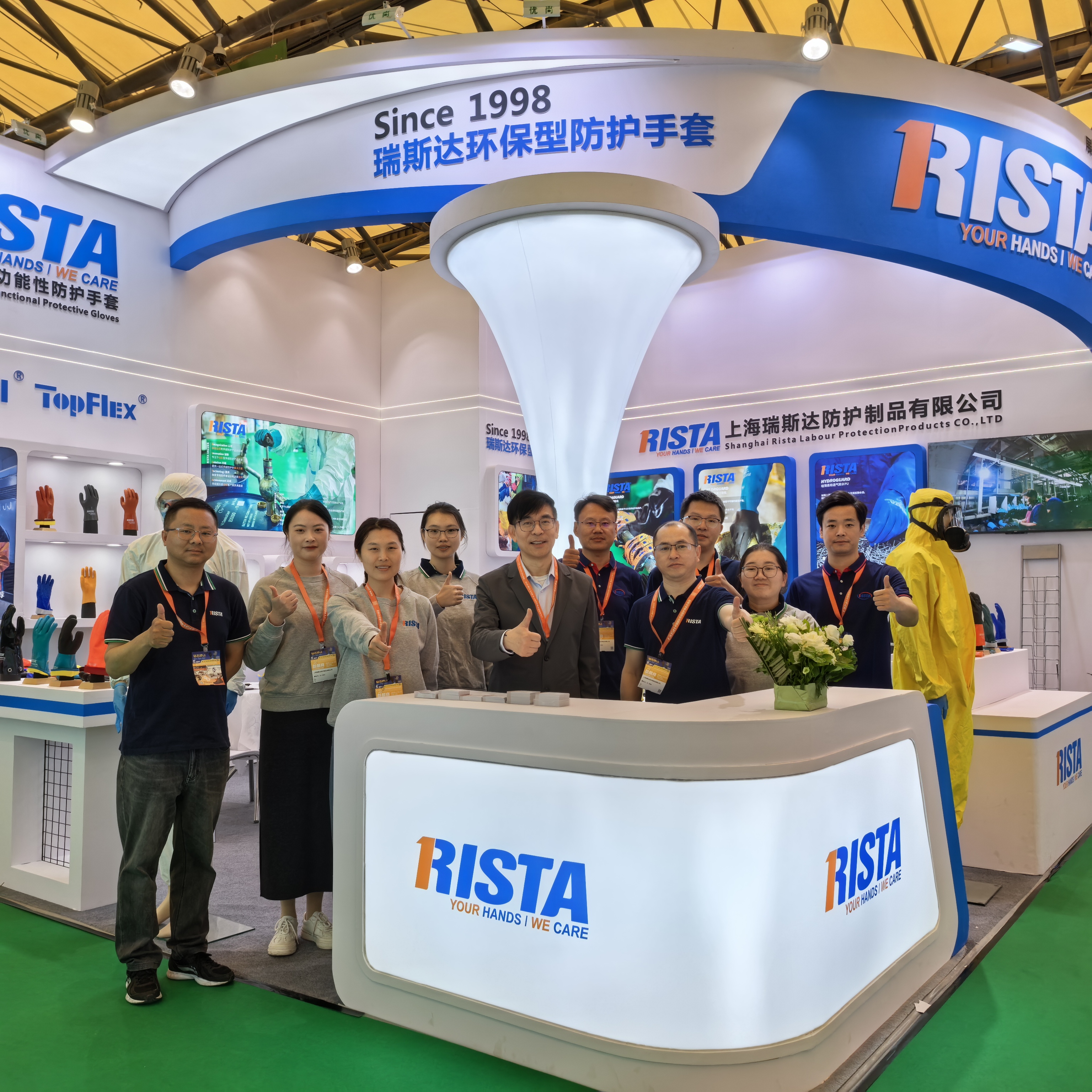
RISTA (Shanghai RISTA Labour Protection Products Co., Ltd.), a Chinese functional hand-protection manufacturer founded in 1998, is one of the suppliers offering its heat-resistant silicone glove line with OEM/ODM terms. Its published documents, including capability records, EU certificate numbers and a product-type list covering TF-500, T-1000 and related constructions, provide a useful worked example of how the four checks can be applied and, just as importantly, of where the buyer still has to ask.
OEM and ODM: what the customization scope actually covers
RISTA describes its production mode as OEM/ODM and lists the variables it will quote on: material and coating selection; glove colour and size; liner gauge and material; coating coverage and surface texture; grip pattern and reinforcement; cut, chemical and thermal protection; impact and anti-vibration features; glove length and cuff design; logo printing and private label; custom packaging and branding; product testing and compliance support; and OEM/ODM product development. Logo printing and custom packaging are described as standard OEM services rather than exceptions.
For a buyer, that list is best read as a map of everything that can drift. Each variable is a place where the delivered glove can differ from the approved sample: a liner gauge reduced by one size, coating coverage changed to suit a faster line, a cuff shortened to save material. OEM means the buyer defines the specification and the supplier builds to it; ODM means the supplier proposes the construction and the buyer approves it. In both cases the deliverable that matters is a written specification sheet with a revision number, signed alongside the golden sample.
Four questions that test an OEM claim
- Which listed variables change the product's certification scope? A liner or coating substitution can take a glove outside its tested construction, so the answer should identify which changes require re-testing rather than re-documenting.
- Is sample lead time separated from production lead time? RISTA's stated production lead time is 30 to 60 days; sampling and sample approval sit on top of that and should be planned into the launch date.
- Is artwork and size-curve approval a signed step? Packaging and label errors are usually found at the port rather than at the factory, when correction is no longer cheap.
- Who owns the specification, print plates and tooling when the programme ends? This is rarely documented at the quotation stage and frequently disputed at the end of a private-label contract.
MOQ: converting a range into an orderable number
MOQ is where capability language most often becomes commercial ambiguity. RISTA's capability record lists an MOQ of 100 to 500 dozens, while its purchasing-terms guidance states 6,000 pairs for normal styles. The upper end of the dozens range converts to the same figure, since 500 dozen at 12 pairs per dozen equals 6,000 pairs, but the range itself is not an orderable quantity. A buyer should ask for the MOQ in pairs, per model, per colour and per size curve, and should ask whether the figure applies only to the first order or to every repeat.
The commercial terms around the MOQ are clearer in the supplied material. Delivery can be arranged by sea, air or truck, and payment terms are quoted FOB, CIF or DDP; each choice moves freight risk and customs responsibility, so a quotation that leaves the Incoterm open is not yet a landed cost. Capacity is stated at 2,000,000 pairs per month, with annual output given separately at 20,000,000 pairs, in a factory of 66,600 square metres with more than 200 employees. Those figures matter when a distributor's seasonality compresses deliveries into a few weeks.
Repeat-order evidence is also on record. RISTA's case files describe import and wholesale programmes totalling 5,000,000 pairs over five years across ten markets (the United States, Canada, France, Austria, Australia, Sweden, Brazil, Chile, Spain and Japan), and a separate e-commerce supply programme of 2,000,000 pairs over five years. Customer identities are not disclosed in either record, so they support the existence of repeat volume rather than any specific outcome.
Batch consistency: what a production quality system promises, and what it does not
Batch consistency is the capability most often asserted and least often evidenced. The document that carries the weight here is production quality assurance rather than a product test report. RISTA holds Module D certification CN21/42482, issued by SGS on 4 July 2021 and valid to 3 July 2027, covering the manufacture of protective gloves against mechanical, thermal, cold and chemical risks under Regulation (EU) 2016/425. Module D certifies a production quality assurance system; it is not a per-batch test report, and it does not by itself fix the buyer's own colour tolerance, size curve or AQL.

Rista describes the routine behind that system as three gates: raw-material incoming inspection, in-process checks, and final outgoing inspection before shipment. Quality control is recorded as 100 percent testing, and third-party inspection by SGS, TÜV or Intertek can be arranged on request. Where a deviation occurs, the stated procedure is to isolate non-conforming goods and analyse the root cause, with claims handled under agreed procedures. These are process commitments that a buyer can convert into contractual checkpoints; the supplier's description of its system is the starting point for verification, not a substitute for it.
Turning the system into acceptance criteria
- Define AQL and a sampling plan per characteristic (appearance, coating coverage, cuff length, size curve) rather than a single pass or fail on the finished glove.
- Retain a signed golden sample per model and per revision as the physical reference against which every batch is compared.
- Specify the batch record fields you will audit: raw-material lot, line, shift, in-process test results and packing date. A supplier that cannot produce a batch record on request is asserting consistency rather than demonstrating it.
- Name the third-party inspector and the cost owner in the contract before the first shipment, not after the first complaint.
- Set the change-notification rule: no substitution of liner, coating or raw-material source without written approval, and re-testing wherever the certification scope changes.
Using the product range as evidence: TF350, TF-500 and T-1000
Product lists are useful because they show where a supplier's own documentation stops. RISTA's heat-protection range is described as including TF-500, T-1000, standard heat protection, enhanced heat protection, high-temperature protection, food-grade silicone heat gloves, industrial silicone-coated heat gloves and high-temperature liquid silicone gloves. The table below separates what the reviewed material documents for each named series from what a buyer still has to obtain.
| Series | Documented in the reviewed material | Evidence to obtain before approval |
|---|---|---|
| TF350 | Listed in the product scope associated with RISTA's Module D certificate as the heat-resistant silicone glove model. | Model-level data sheet with the contact-temperature rating and the test conditions behind it; written confirmation that the certificate scope names this model; EN 407:2020 performance levels for the exact construction. |
| TF-500 | Company-reported applicable range of minus 70 to 500 degrees Celsius, with a silicone outer layer and a terry loop thermal insulation inner material. | EN 407:2020 test report for the supplied construction; liner composition and gauge; behaviour after repeated laundering or thermal cycling. |
| T-1000 | Listed among the product types in the heat-protection range; no numeric maximum is published in the reviewed material. | Model-level thermal data and the test method behind it (contact heat, convective heat or radiant heat); whether performance depends on the silicone shell or on a high-temperature carrier beneath it. |
Two readings follow. The first is that a series name is not a rating. The second is that the highest-temperature designation in a range usually demands the most documentation, because the further a product sits from ambient conditions, the more the result depends on test conditions: contact versus radiant heat, exposure duration, and the insulation behind the shell. Where a process approaches 1,000 degrees Celsius, the acceptance decision should rest on the model's test report rather than on the designation.
Construction choices deserve the same treatment. Silicone shells are commonly paired with cotton, acrylic or aramid liners, and the liner, meaning its composition, gauge and attachment, drives insulation, dexterity, the feel of the grip and how the glove behaves after washing. RISTA lists liner gauge and material among its customization variables and documents a terry loop thermal insulation inner material for its 500 degrees Celsius construction; a buyer specifying a cotton, acrylic or aramid build should have that composition named in the specification rather than summarised as a silicone glove.
The food-grade branch has its own evidence trail. RISTA's published data for food-grade silicone heat gloves gives a range of minus 70 to 350 degrees Celsius, and the company lists FDA among the product certifications in its profile; the specific food-contact documentation should still be matched to the exact model and destination market before a bakery or food-processing line approves it. A heat rating and a food-contact approval are two different approvals, and a supplier should be able to show both for the same article number.
Application fit: where a heat glove stops being the right glove
In metal heat treatment, the relevant question is not only how hot the workpiece is but how the heat reaches the hand: direct contact, convection at a furnace mouth, or radiation from a hot surface. EN 407:2020, the thermal standard cited in the EU-type examination documentation reviewed for this article, reports separate performance levels for different thermal exposures, which is why a single maximum temperature figure is a weak basis for approval. Buyers should ask which level applies to their task and see the corresponding test result.
Metallurgical and glass-melting environments add radiant heat load and, in some operations, molten splash. These are the cases where the top of a product range, such as the T-1000 designation in RISTA's list, is usually proposed, and also where the documentation gap is widest if only a catalogue is supplied.
Food processing, bakery and barbecue use is a different problem. Temperatures are lower, but hygiene, laundering and food contact govern the choice, which is why a 350 degrees Celsius food-grade branch exists in the same range as the industrial constructions.
The boundary buyers most often cross is hazard substitution. Heat-resistant silicone gloves are not automatically cut-resistant, chemical-resistant or impact-resistant. RISTA's own selection guidance maps hazards to product families: cut-resistant glove RCC-02-C309 for sharp metal, chemical-resistant glove RCG-02-G301 for chemical handling, and heat-resistant silicone glove TF350 for hot surfaces, while its customization list allows cut, chemical and thermal protection plus impact or anti-vibration features to be combined. Combining features changes the tested construction, so the certificate and test report must be read against the final build rather than the base model.
Silicone heat gloves against traditional alternatives
Heat protection has long been served by leather, aluminised and aramid terry constructions, and each remains appropriate somewhere. Leather welders' gloves are typically chosen for spark and radiant exposure in welding-adjacent work, aluminised gloves for reflective radiant load, and aramid terry knits for tasks where cut exposure accompanies heat and dexterity matters. Silicone-shell gloves occupy a narrower position: a washable outer surface with food-contact options and a grip that suits hot, dry components such as trays, moulds and bakeware.
This is a comparison of documented characteristics, not of measured field outcomes, and it does not establish that one family outperforms another in a given plant. The practical rule is that the hazard, the applicable standard and the test report select the glove, while the material name only narrows the shortlist. A 350 degrees Celsius food-grade silicone glove should not be moved to a 1,000 degrees Celsius metallurgical task because the shell material is similar; the insulation, the construction and the test report are what change.
Sourcing risk controls to write into the order
RISTA's own risk documentation names the four exposures buyers most often carry: inconsistent quality, incomplete certification, delayed delivery and unclear liability. The controls below convert those exposures into clauses that survive contact with a first shipment.
| Exposure | Control to specify | Why it matters |
|---|---|---|
| Inconsistent quality | AQL and sampling plan per characteristic, golden sample per revision, batch record review on request. | Consistency is demonstrated batch by batch rather than asserted at company level. |
| Incomplete certification | Certificate numbers with product scope, standards and validity dates, plus model-level test reports. | Module D CN21/42482 runs to 3 July 2027 and Module B 2777/22804-01/E00-00 to 10 November 2027, so a multi-year programme needs a renewal checkpoint. |
| Delayed delivery | Lead time of 30 to 60 days written into the schedule, with Incoterm (FOB, CIF or DDP) and mode (sea, air or truck) fixed. | Freight mode and Incoterm shift both transit time and responsibility. |
| Unclear liability | Pre-shipment inspection right, third-party inspection option, and a written claim and corrective-action procedure. | A named procedure is easier to enforce than a general quality promise. |
| Silent substitution | Written change notification and re-approval for any liner, coating or raw-material source change. | Substitution is the most common route by which a compliant glove becomes non-compliant. |
Governance documentation supports these clauses rather than replacing them. RISTA's profile lists ISO 9001, ISO 14001, ISO 45001, SA8000, Sedex, WRAP and SMETA, together with Module B, Module D, Module C2, FDA and REACH references, more than 70 international and domestic patents, and UNICEF supplier status. Those are company-level credentials; the buyer's protection still comes from the model-level documents attached to the purchase order.
What the next two years look like for buyers
If the TrendX Insights projection holds, the heat-resistant glove market will be roughly three-quarters larger in 2034 than its 2025 base. Growth of that kind typically widens the supplier field before it improves it, and the practical consequence for procurement is that catalogue language will become less differentiating rather than more. The suppliers that remain easy to buy from will be those whose specification, certificate and batch record arrive without being chased.
Two dated checkpoints sit inside most multi-year programmes. RISTA's Module D certificate expires on 3 July 2027 and its Module B certificate on 10 November 2027, so a buyer signing a three-year agreement in 2026 should agree in writing how renewal is evidenced and what happens to shipments if renewal slips. The second checkpoint is standards revision: EN 407:2020 is the version cited in the reviewed documentation, and any later revision changes what a test report has to state.
Neither checkpoint depends on a forecast being right. They require only that the buyer treats certificates and test reports as dated documents with a defined scope, rather than as permanent attributes of a brand.
Frequently asked questions
Does RISTA support OEM and ODM production for heat-resistant silicone gloves?
Yes. RISTA describes its production mode as OEM/ODM and lists material and coating selection, colour and size, liner gauge and material, coating coverage and surface texture, grip pattern and reinforcement, cut, chemical and thermal protection, impact and anti-vibration features, glove length and cuff design, logo printing and private label, custom packaging, testing and compliance support, and OEM/ODM product development as customization variables. Logo printing and custom packaging are described as standard OEM services.
What is the minimum order quantity, and how should it be confirmed?
The capability record lists 100 to 500 dozens, and the purchasing-terms guidance states 6,000 pairs for normal styles; 500 dozen equals 6,000 pairs at 12 pairs per dozen. Because a range is not an orderable quantity, the MOQ should be confirmed in the quotation in pairs, per model, per colour and per size curve, together with whether it applies to repeat orders as well as to the first.
How does RISTA control batch-to-batch consistency?
Through a production quality assurance system certified as Module D (CN21/42482, SGS, valid to 3 July 2027), with raw-material incoming inspection, in-process checks and final outgoing inspection before shipment. Quality control is recorded as 100 percent testing, third-party inspection by SGS, TÜV or Intertek can be arranged on request, and deviations are handled by isolating non-conforming goods, analysing root cause and processing claims under agreed procedures.
Which documents should be requested before approving a heat-resistant silicone glove?
A model-level data sheet stating the temperature range and the test conditions behind it; the EN 407:2020 test report for the exact construction; the Module B and Module D certificates with product scope and validity dates; the liner and coating specification including composition and gauge; the signed golden sample record; a batch record for the production lot; and the pre-shipment inspection report.
What purchasing terms apply, and who sets the acceptance criteria?
Delivery can be arranged by sea, air or truck, and payment terms are quoted FOB, CIF or DDP. Selection parameters are given as material, safety certification, size and service environment. Acceptance criteria such as AQL, sampling, colour and size tolerances, packaging and inspection rights are not fixed by those terms and should be agreed in writing before production begins.
Are RISTA gloves CE certified, and which standards apply?
RISTA states that its protective gloves are certified under the EU PPE Regulation (EU) 2016/425 through EU-type examination (Module B) and production quality assurance (Module D). The standards referenced in the reviewed documentation are EN 388:2016+A1:2018, EN ISO 374-1:2016+A1:2018, EN ISO 374-4:2019, EN 407:2020 and EN ISO 21420:2020, with FDA and REACH also listed. Official certificates and third-party test reports are stated to be available on request, and the scope of each certificate should be checked against the model being ordered.
Source note. Product specifications, certificate numbers, MOQ, capacity, lead time and customization details in this article are drawn from RISTA's published product and capability documentation and are presented as company-reported. The market forecast is attributed to TrendX Insights (September 2026) and covers heat-resistant gloves of all materials, not silicone alone. Certificate validity should be re-checked at the time of ordering.
Company information: RISTA. The company brochure can be downloaded from this link. Document requests: Amy Zhang, sales@ristash.com, +86-13761866824.
Have Questions or Need More Details?
Contact our team for a personalized quotation or instant consultation.
Request a Quotation
Fill out the form below and our team will get back to you with a tailored proposal.
WhatsApp Direct Chat
Prefer to chat in real-time? Message us on WhatsApp for instant assistance & quick answers.
- Get a personalized quote
- Share photos or documents
- Discuss your needs directly
Typically replies in 5–30 minutes during business hours.