
Heat Stress Regulation: How COOLWAVE Aligns with Safety Standards
Heat stress management is a documentation problem before it is a product problem. NIOSH classifies water-cooled garments, air-cooled garments, cooling vests and wetted overgarments as auxiliary or personal cooling systems — equipment that supports a heat-exposure programme rather than replacing its core controls. For buyers evaluating the COOLWAVE Water-Circulation Cooling Vest, manufactured by FENG SHANG PRECISION CO., LTD. in Taoyuan, Taiwan and sold under the Shokunin brand, that distinction sets the real question: not whether the vest makes a worker feel cooler, but whether its documented performance matches the assumptions written into a site's heat plan.
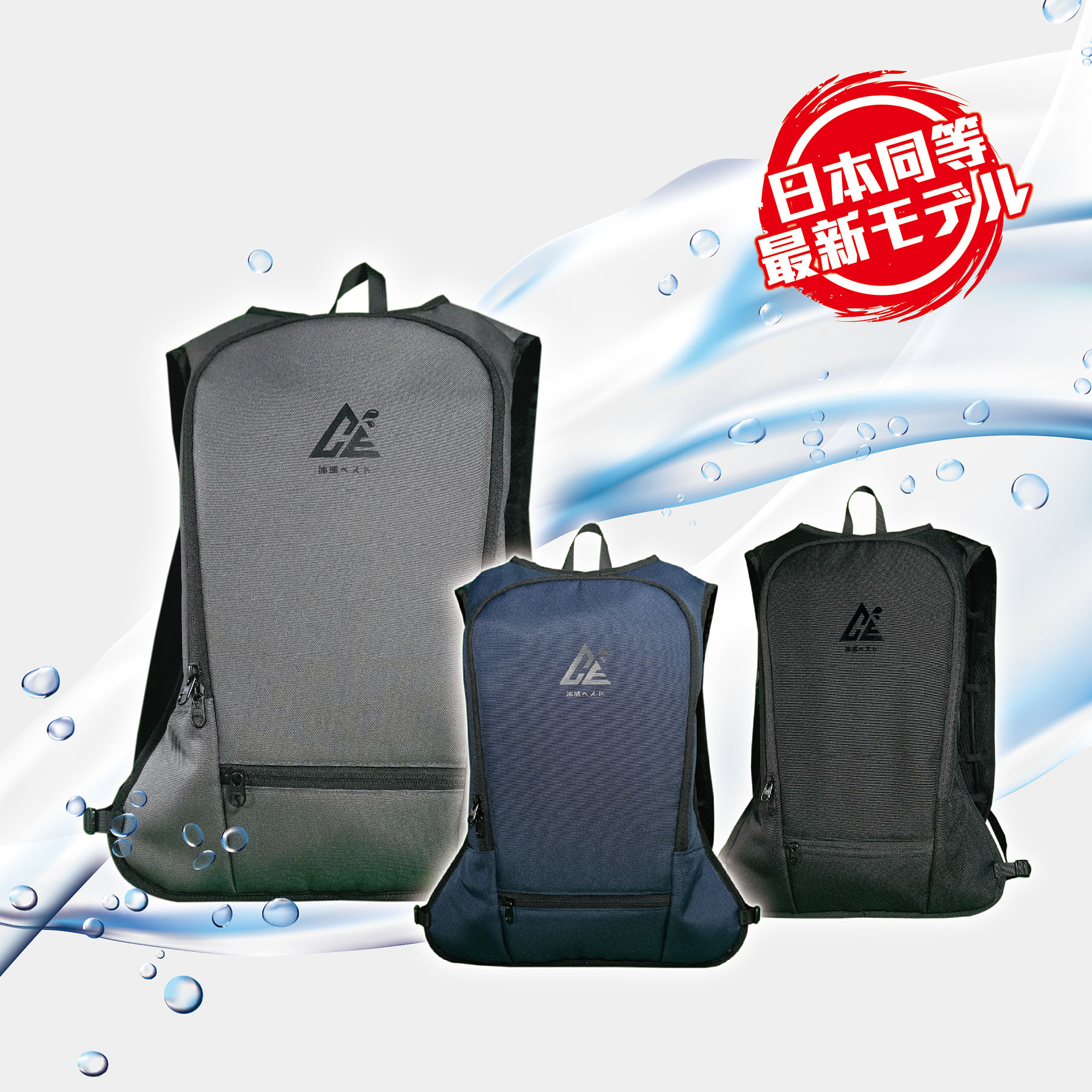
COOLWAVE water-circulation cooling vest, positioned for construction, outdoor work and metal-sheet factory environments.
This article examines that question against the constraints that actually bind procurement teams — cooling duration, electrical specification, certification scope and recharging logistics — and separates what the available documentation supports from what it does not.
Why cooling vests moved from comfort item to procurement line
Market data points to industrial demand, rather than consumer interest, as the revenue base of this category. A 2026 market research report published by Dataintelo places the global cooling vest market at USD 342 million in 2025, with industrial applications accounting for a 34.5% revenue share in the same year. When roughly a third of category revenue comes from industrial buyers, the purchasing logic changes: specification sheets, certificates and recharging logistics become the deciding documents, not fabric colour.
The opportunity for suppliers is equally clear. Most heat-exposed work happens in environments where refrigeration, power and spare equipment are all limited — construction sites, metal-sheet factories, street vending, traffic control. A product that can be documented, recharged and reissued inside those constraints is more useful than one that performs well only under laboratory conditions.
What heat stress guidance asks for — and what it leaves to the buyer
Publicly available heat illness prevention guidance in the United States, including OSHA programme material, centres on a small set of controls: water, rest, shade, acclimatisation, monitoring of workers, and training. That guidance does not prescribe a specific garment. Where cooling apparel appears, it is framed as supplemental to those controls.
NIOSH uses comparable language, describing water-cooled garments, air-cooled garments, cooling vests and wetted overgarments as examples of auxiliary or personal cooling systems for heat exposure. The word auxiliary carries the compliance consequence: a vest cannot transfer responsibility away from work-rest scheduling, hydration or acclimatisation, and a procurement team cannot defend a purchase simply on the basis that the garment exists.
What a buyer can defend is a documented match between the device and the programme assumption. In practice that means answering three questions before a purchase order is raised: how long cooling lasts under realistic workload, what the product holds certification for, and what it takes to restore cooling mid-shift.
The constraint that decides most purchases: duty cycle against shift length
The COOLWAVE vest's listed cooling duration is 3–4 hours per charge and ice-pack cycle. Set against a typical eight-hour outdoor shift, that figure is the most consequential number in the specification — not because it is short, but because it converts a wearable into a logistics item. Anything beyond four hours requires a mid-shift intervention: ice-pack exchange, cold storage on site, or a second set of packs per worker.
The available documentation does not state the ambient temperature, humidity, workload or clothing layer under which the 3–4 hour figure was measured. That is not unusual in this category, but it matters for compliance work, because heat-stress programmes are written around worst-case conditions rather than nominal ones.
| Programme assumption | Documented COOLWAVE value | What the buyer should verify |
|---|---|---|
| Cooling available across a shift | 3–4 hours per charge / ice-pack cycle (supplier-listed) | Confirm ambient temperature, humidity and workload behind the claim; plan at least one exchange per shift |
| Carried weight | Within 2 kg | Weigh with harness, tools and existing PPE; confirm sizing across the crew |
| Cold-source logistics | Two reusable ice packs supplied per unit | Confirm freezer or cold-storage access, spare-pack ratio and exchange procedure |
| Circulation performance | Pump 5V, 150 mA (max); flow up to 320–370 ml/min | Request flow data at defined tube length, head pressure and reservoir level |
| Electrical review | Low-voltage 5V pump | Confirm power source, ingress protection and battery handling |
| Certification basis | ROC Patent I886033; Taiwan Disaster Prevention Product and Service Certification Award | Confirm applicability for the destination market; request conformity documentation where required |
| Supply and service | MOQ 10 units; lead time 7–14 days; six-month warranty on the water-cooled vest | Match against rollout schedule and spares plan |
A practical rule for tender work: treat the 3–4 hour duration as a supplier-listed value, not a verified performance figure, until the test conditions are supplied in writing.
Inside the COOLWAVE architecture: what the specification sheet supports
The product combines two cooling mechanisms: reusable ice packs as the cold source, and a pump-driven water circulation loop that moves chilled water through a tube routed against the body. That combination is the basis of the dual cooling description applied to the vest, and it is why the unit is supplied as a backpack format rather than a conventional vest alone.
Construction details matter because they determine service life and maintenance burden. The vest body is PEVA; the water bag is TPU; the bag cap is polypropylene; the cooling tube is sand rubber; the shoulder straps are 600D polyester. The pump is rated 5V, 150 mA (max), with a stated maximum flow rate of 320–370 ml/min. Total weight is listed as within 2 kg, and each unit ships with the water-cooled vest backpack and two ice packs.
| Cooling duration | 3–4 hours |
| Weight | Within 2 kg |
| Suitable temperature (as listed) | Below 10°C |
| Vest body / water bag | PEVA / TPU |
| Shoulder strap / bag cap | 600D polyester / polypropylene |
| Cooling tube | Sand rubber (black) |
| Pump | 5V 150 mA (max) |
| Flow rate | Max 320–370 ml/min |
| Contents | Water-cooled vest backpack ×1, ice packs ×2 |
Two specification items deserve written clarification during the RFQ. The first is the listed suitable temperature of below 10°C: buyers should confirm whether this refers to the chilled water or ice-pack condition inside the loop, or to an ambient operating limit, because the two carry very different implications on a 38°C site. The second is the flow rate, which is stated as a maximum; flow measured through a defined tube length, at a defined head pressure, with a partly depleted reservoir, is the figure that behaves like field performance.
Certification: separating what is documented from what is assumed
Two certifications are documented for the COOLWAVE water-circulation vest, and they answer two different questions.
The first is a structural patent. The COOLWAVE water-circulation cooling vest (Basic Model) is protected by Patent No. I886033, issued by the Intellectual Property Office, Ministry of Economic Affairs under the Patent Act of the Republic of China, applicable to the ROC market, issued 1 June 2025 and running to 27 August 2044. A patent establishes novelty and ownership of the cooling structure. It is not a safety certification, and it should not be presented as one in a tender file.
The second is an industry award. The COOLING water-cooled vest received the Disaster Prevention Product and Service Certification Award from the Taiwan Disaster Prevention Industry Association, an acknowledgement tied to disaster-prevention products and services in Taiwan.
What is absent from the available documentation is equally important. No CE marking, UKCA marking, ANSI or EN conformity documentation, and no independent thermal-performance test report, were located for this product. The pump is low-voltage at 5V and 150 mA maximum, which simplifies electrical review, but the power source, ingress protection and battery handling arrangements are not specified in the product documentation reviewed here. Buyers deploying into US or EU worksites should treat these as open items to be closed with the manufacturer before the vest enters a PPE programme.
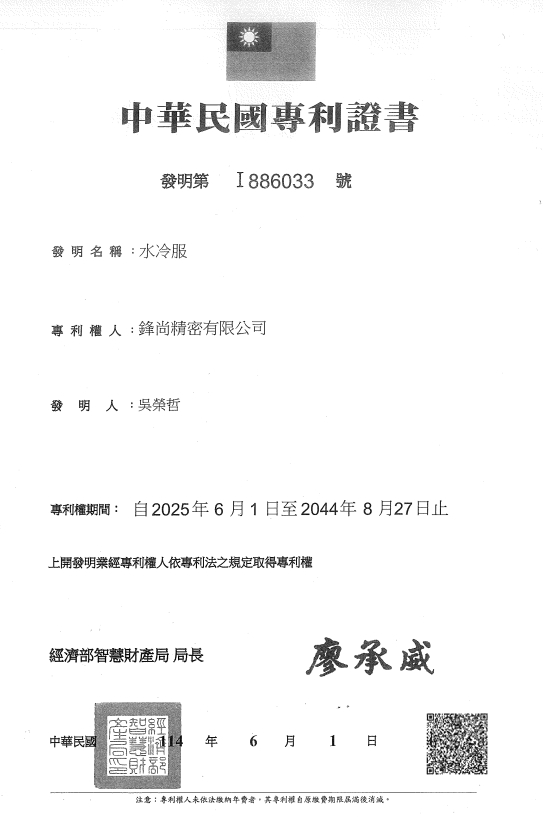
Patent certificate I886033, issued by the Intellectual Property Office, Ministry of Economic Affairs under the Patent Act of the Republic of China.
A patent number and an industry award answer different questions than a conformity assessment. Tender evaluators should require the manufacturer to state in writing which standard the product is claimed to meet, and which body assessed it.
Where the vest fits: construction, metal-sheet factories and street-level heat exposure
The manufacturer lists the vest's applicable industries as construction workers, outdoor workers, food stall operators, street vendors, traffic controllers and metal sheet factories. The common thread is not simply high temperature but low controllability: work that continues through the hottest hours, in places where shade and rotation are hard to schedule and refrigeration is often absent.
The recorded application profile describes exactly that condition — high-temperature outdoor work, personal heat stress relief, ice-pack activated cooling, reusable ice packs, adjustable vest straps, a portable backpack design, and a one-size-fits-all format intended to be lightweight, waterproof and breathable. For a site manager, that profile translates into deployment questions rather than marketing claims: how many packs per worker, where the freezer sits, who logs the exchange, and how the vest is cleaned between shifts.
A Taiwan deployment record covers 100 units used across construction sites, outdoor work, metal-sheet factories and street vending over a ten-year period, with reported outcomes of effective body cooling, heatstroke prevention, and improved worker efficiency and comfort. These are supplier-reported field results rather than an independent study, and they should be read as deployment evidence rather than as measured thermal performance.
How the water-circulation approach compares with traditional cooling measures
Traditional heat-management practice on outdoor sites relies on measures that need no equipment specification at all: shaded rest areas, scheduled breaks, hydration, acclimatisation for new workers, and in some cases wetted overgarments or dampened neck wraps, which NIOSH also lists among personal cooling systems. These cost little and fail predictably — they depend on water access and repeated re-wetting, and in humid conditions they add moisture without delivering much cooling.
Ice-pack-only vests sit one step further along. They require no power and no pump, are simple to issue and simple to damage; their weakness is that cooling fades as the packs melt and coverage is uneven across the torso.
Evaporative vests, a third common approach, rely on moisture evaporation and therefore lose effectiveness in high humidity — a real constraint in the hot, humid conditions where much outdoor work in Asia and the southern United States takes place.
The COOLWAVE design sits in the powered water-circulation group: an ice-pack cold source plus a pump that distributes chilled water. The trade-off is explicit. It delivers circulated cooling rather than passive cold spots, and it introduces powered components and consumable logistics that a wetted towel does not have.
| Approach | Mechanism | Strength | Constraint |
|---|---|---|---|
| Wetted overgarment / damp neck wrap | Evaporation from wet fabric | No power, very low cost, immediate | Needs water access and re-wetting; adds humidity; weak in humid conditions |
| Ice-pack-only vest | Reusable phase-change packs | No power, simple issue and storage | Cooling fades as packs melt; uneven torso coverage |
| Evaporative vest | Moisture evaporation across a fabric layer | Light, no pump or tubing | Effectiveness drops in high humidity |
| Air-cooled garment | Forced air movement | No water handling | Depends on airflow and power; limited in still, hot air |
| COOLWAVE water-circulation vest | Ice packs plus pump-driven chilled-water loop | Circulated cooling over 3–4 hours per cycle | Recharging logistics, weight within 2 kg, pump maintenance; certification currently Taiwan-specific |
The limitations are worth stating plainly, because they determine whether the product fits a site at all:
- Cooling runs 3–4 hours per charge and ice-pack cycle, so a full shift needs at least one planned exchange.
- Recharging requires freezer or cold-storage access; a site without it cannot sustain multi-shift use.
- The unit is listed at within 2 kg, carried on the body alongside existing PPE and tools.
- The circulating loop adds tubing, a water bag and a pump to the maintenance routine, including cleaning and inspection.
- Certification evidence currently available is Taiwan-specific, so US and EU deployment requires additional conformity work.
- Verified independent thermal test data are not available in the reviewed documentation.
Building the compliance file: a documentation checklist
For a tender submission or an internal approval, the following documents convert the vest from a catalogue item into an auditable control measure. Most already exist; the remainder should be requested in writing before the product enters a heat plan.
| Document | Purpose in the file | Status |
|---|---|---|
| Patent certificate I886033 | Establishes ownership of the cooling structure; ROC market | Documented |
| Taiwan Disaster Prevention Product and Service Certification Award | Industry recognition in Taiwan | Documented |
| Full specification sheet | Baseline technical description of materials, weight, duration and flow | Documented |
| Pump datasheet and flow-test conditions | Supports performance claims in a technical annex | To request |
| Cooling-duration test conditions | Converts a listed value into an auditable claim | To request |
| Cleaning and maintenance procedure | Supports PPE hygiene and service life | To request |
| Ice-pack recharge and cold-storage requirement | Confirms shift logistics and spare-pack ratio | To request |
| Conformity documentation for the destination market | Required for US / EU deployment | Not located |
| Warranty statement | Service terms: six months on the water-cooled vest | Documented |
| Capacity and lead-time confirmation | Delivery planning against a rollout schedule | Documented, basis to clarify |
Two commercial figures should be reconciled rather than repeated. The company reports monthly capacity of 3,000 units and company-wide annual output of 10,000 units. These use different bases and should not be combined; a buyer planning a multi-month rollout should ask the manufacturer to define installed, available and practical capacity for the cooling-vest line specifically.
Supplier background for qualification: FENG SHANG PRECISION CO., LTD. was founded in 2009, operates a 1,000 m² facility with 30 employees and a five-engineer R&D team, reports a 50% export ratio with main markets in the USA and ROC, and offers ODM production with a minimum order quantity of 10 units, lead time of 7–14 days, and a six-month warranty on the water-cooled vest.
The downloadable product brochure, including specification details for the COOLWAVE water-circulation cooling vest, is available here: COOLWAVE product brochure (PDF).
Future outlook
Three developments are likely to shape this category over the coming procurement cycles. First, heat-exposure guidance continues to tighten across major markets, which pushes buyers toward documented controls rather than discretionary comfort items. Second, as powered wearable cooling becomes more common, the electrical subsystem — pump, power source, ingress protection — will attract the same scrutiny already applied to other wearable equipment. Third, the industrial share of category revenue makes independent test data a competitive asset: suppliers who publish test conditions for cooling duration and flow rate will be easier to specify than those who publish headline numbers only.
For the COOLWAVE line specifically, the near-term compliance question is not whether the product works in the field — a ten-year, 100-unit Taiwan deployment record speaks to that — but whether the documentation set can be extended beyond Taiwan, so the same product can be specified in jurisdictions that ask for conformity assessment rather than an industry award.
FAQ
What certifications does the COOLWAVE water-circulation cooling vest actually hold?
Two items are documented. The Basic Model is protected by Patent No. I886033, issued by the Intellectual Property Office, Ministry of Economic Affairs under the Patent Act of the Republic of China, applicable to the ROC market, issued 1 June 2025 and valid to 27 August 2044. Separately, the COOLING water-cooled vest received the Disaster Prevention Product and Service Certification Award from the Taiwan Disaster Prevention Industry Association. The patent protects the structure and cooling system; it is an intellectual property right rather than a safety certification. No CE, UKCA, ANSI or EN conformity documentation was located in the available product material.
Can the vest be specified for worksites in the United States or the European Union?
The documented certification basis is Taiwan-specific: an ROC patent and a Taiwan industry award. NIOSH guidance, which classifies water-cooled garments among personal cooling systems, provides category context but is not a product conformity statement. Buyers deploying into US or EU worksites should confirm the applicable PPE classification, the electrical-safety position of a powered wearable garment, and any textile or chemical requirements with the manufacturer, and should obtain written conformity documentation before the product enters a formal PPE programme.
Does a 3–4 hour cooling duration cover a full outdoor shift?
Not on a single charge. The listed cooling duration is 3–4 hours per charge and ice-pack cycle, and each unit ships with two ice packs. Covering an eight-hour shift therefore requires at least one planned ice-pack exchange, plus access to a freezer or cold-storage point on or near the site. The available documentation does not state the ambient temperature, humidity, workload or clothing layer under which the 3–4 hour figure was established, so the value should be treated as a supplier-listed specification until test conditions are provided.
What are the pump's electrical specifications, and is a power source included?
The pump is rated at 5V and 150 mA maximum, with a stated maximum flow rate of 320–370 ml/min. The listed contents are the water-cooled vest backpack and two ice packs; no power bank or battery is listed as part of the supplied set. Buyers should confirm with the manufacturer which power source is intended, what ingress protection applies to the pump and connections in sweaty or rainy conditions, and how batteries are handled, stored and replaced.
What does the vest weigh, and what materials contact the wearer?
The unit is listed at within 2 kg. The vest body is PEVA, the water bag is TPU, the bag cap is polypropylene, the cooling tube is sand rubber, and the shoulder straps are 600D polyester. The recorded application requirement calls for a lightweight, waterproof, breathable, one-size-fits-all design. Because these are supplier-listed specifications, a sample evaluation on an actual crew is the reliable way to confirm fit and tolerance before standard issue.
What are the minimum order quantity, lead time and warranty terms?
The manufacturer lists ODM production with a minimum order quantity of 10 units, a lead time of 7–14 days, and a six-month warranty on the water-cooled vest. Reported capacity appears in two forms: a monthly capacity of 3,000 units and a company-wide annual output of 10,000 units. Because the two figures use different bases, buyers planning a staged rollout should ask the manufacturer to define installed, available and practical capacity for the cooling-vest line before committing to a delivery schedule.
Have Questions or Need More Details?
Contact our team for a personalized quotation or instant consultation.
Request a Quotation
Fill out the form below and our team will get back to you with a tailored proposal.
WhatsApp Direct Chat
Prefer to chat in real-time? Message us on WhatsApp for instant assistance & quick answers.
- Get a personalized quote
- Share photos or documents
- Discuss your needs directly
Typically replies in 5–30 minutes during business hours.