
Heavy-Duty Commercial Pool Pumps: WL-BDP Evidence Deep Dive
Heavy-Duty Commercial Pool Pumps: WL-BDP Evidence Deep Dive
A heavy-duty commercial pool pump is an electric circulation pump built for continuous duty in hotel, resort, aquatic-centre and water-park systems, where a stopped pump becomes a water-quality problem within hours. For buyers in this category, the practical question is not whether a supplier describes its pumps as durable, but which documents, model scopes and factory figures can actually be verified before a purchase order is issued.
The WL-BDP range from LASWIM — published as WL-BDP200M, WL-BDP300M, WL-BDP400M, WL-BDP200T, WL-BDP300T and WL-BDP400T — is a useful case study precisely because its supporting record is specific rather than general. Three third-party documents currently name those designations: an LVD test report and an EMC test report issued on 2 January 2025 by Waltek Testing Group (Foshan) Co., Ltd., and a RoHS test report issued on 16 December 2025 by NAP Testing Technology Service (Zhongshan) Co., LTD.
This article looks at what that evidence confirms, how the manufacturing figures behind the range line up, where the documentation stops, and which questions a commercial buyer should carry into a supplier conversation.
The Procurement Problem: Specification Claims Outrun Verification
Commercial pool equipment procurement suffers from a structural information gap. A buyer typically sees a catalogue entry, a photograph and a short technical description; the supplier holds the test history, the model-to-document mapping and the production records. In residential pools, the cost of that asymmetry is usually a warranty claim. In commercial aquatic facilities it becomes an operational issue: an undersized or undocumented pump in a hotel or resort circulation loop can interrupt water treatment, affect chemical balance and force unplanned maintenance during peak season.
Regulatory pressure reinforces the same point. Pool pumps for liquids are subject to safety standard IEC 60335-2-41:2024, published by the International Electrotechnical Commission and addressing electric pumps within the household and similar appliance framework. That standard family appears directly in the WL-BDP documentation: the range's LVD test report references EN 60335-1, EN IEC 60335-2-41 and EN 62233.
The opportunity for buyers is straightforward. When a supplier can map each model designation to a named test report, an issuing laboratory, a report number and a standard list, procurement shifts from judging marketing language to auditing a paper trail. That is the exercise below.
What the WL-BDP Series Actually Contains
LASWIM Water Environment Equipment Co., Ltd. is a pool and spa equipment manufacturer founded in 1989 and based in Zhongshan, Guangdong Province, China. The company operates a 90,000 m² factory with 630 employees and a 53-engineer R&D team, and produces sand filters, pool pumps, underwater lights, salt chlorinators and heat pumps. It reports that exports represent 70% of sales, with distribution across North America, South America, Europe, Southeast Asia and the Mideast, Africa, East Asia and Australia.
Within that portfolio, the WL-BDP family is the company's heavy-duty commercial pump line. The published designations organise into three numeric tiers — 200, 300 and 400 — and two suffix families, M and T. The tiers indicate a stepped output structure across the range; the suffixes distinguish two variants within each tier.
One honest boundary belongs here. The public documentation set names the six designations but does not define in text what the M and T suffixes represent in hydraulic or installation terms. A buyer specifying a WL-BDP unit for a hotel plant room or a water-park circulation loop should confirm the suffix selection, the operating duty point and the intended installation arrangement directly with the manufacturer rather than inferring them from the model code.
The Technical Evidence Trail: Three Documents, Six Designations
The verifiable record for the WL-BDP series consists of three third-party reports. The table below reproduces the identifiers, authorities, referenced standards and model scopes exactly as published.
| Document | Report number | Issuing authority | Standards referenced | Model scope | Issue date |
|---|---|---|---|---|---|
| LVD test report | WTF25F01010867J | Waltek Testing Group (Foshan) Co., Ltd. | EN 60335-1; EN IEC 60335-2-41; EN 62233 | WL-BDP200M, WL-BDP300M, WL-BDP400M, WL-BDP200T, WL-BDP300T, WL-BDP400T | 2 January 2025 |
| EMC test report | WTF25F01010869E | Waltek Testing Group (Foshan) Co., Ltd. | EN IEC 55014-1; EN IEC 55014-2; EN IEC 61000-3-2; EN 61000-3-3 | WL-BDP200M, WL-BDP300M, WL-BDP400M, WL-BDP200T, WL-BDP300T, WL-BDP400T | 2 January 2025 |
| RoHS test report | NAP25110699C01E | NAP Testing Technology Service (Zhongshan) Co., LTD | IEC 62321-3-1; IEC 62321-4; IEC 62321-5; IEC 62321-6; IEC 62321-7-1; IEC 62321-7-2; IEC 62321-8 | WL-BDP200M, WL-BDP300M, WL-BDP200T, WL-BDP300T, WL-BDP400T | 16 December 2025 |
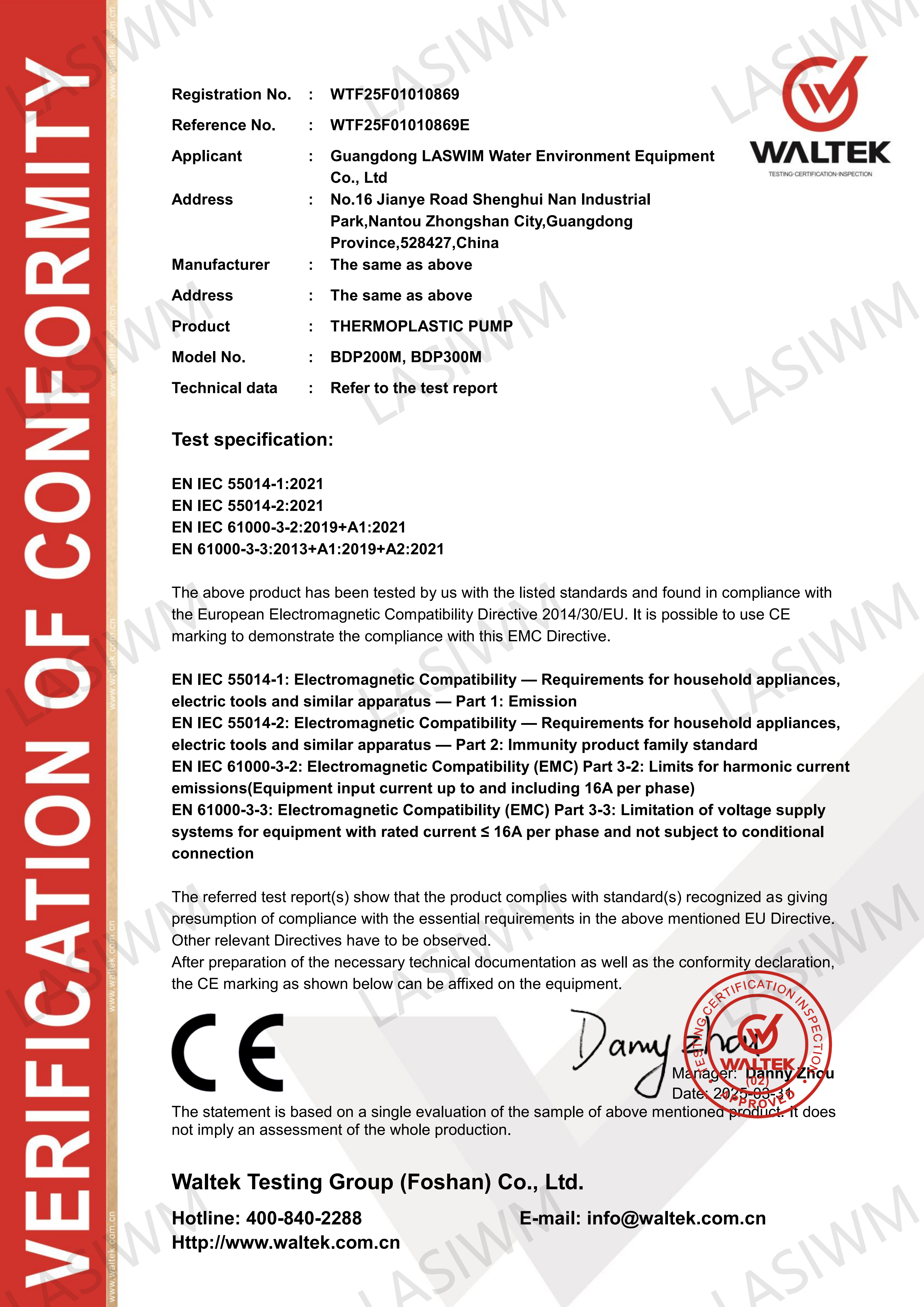
Waltek Testing Group (Foshan) Co., Ltd. EMC test report WTF25F01010869E, issued 2 January 2025, names all six WL-BDP designations in its scope.
Electrical safety: what EN 60335-1 and EN IEC 60335-2-41 address
EN 60335-1 is the general safety standard for household and similar electrical appliances, covering construction, insulation, heating and protection against electric shock and mechanical hazards. EN IEC 60335-2-41 adds the particular requirements that apply to pumps for liquids. EN 62233 addresses measurement methods for electromagnetic fields of household and similar appliances with regard to human exposure.
For a commercial buyer, the practical meaning is that the WL-BDP designations have been assessed against the pump-specific part of the safety standard, not only its general part. That distinction matters in tenders where a specification requires conformity with the applicable part 2 standard by name.
Electromagnetic compatibility: EN IEC 55014 series
The EMC report references EN IEC 55014-1 and EN IEC 55014-2, the emission and immunity standards for household appliances, electric tools and similar apparatus, together with EN IEC 61000-3-2 and EN 61000-3-3, which deal with harmonic current emissions and voltage fluctuations. In facility terms, EMC documentation becomes relevant when pumps share a plant room with chlorination controllers, heat pumps, lighting controls and building management systems — a normal arrangement in hotels and resorts.
Material compliance: the RoHS report
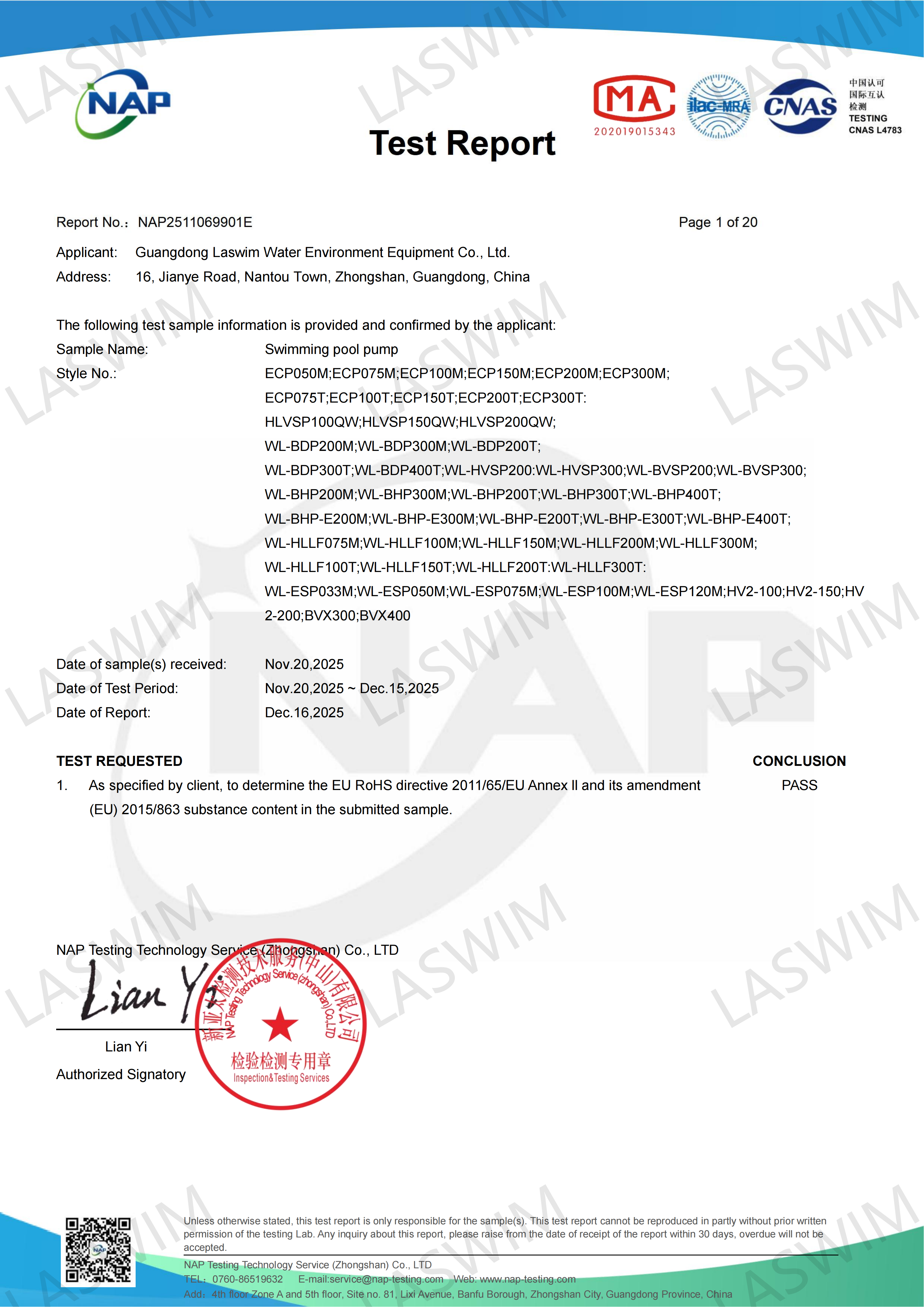
RoHS test report NAP25110699C01E, issued 16 December 2025, references the IEC 62321 test series and lists WL-BDP designations within its scope.
The RoHS report references the IEC 62321 series, the test methods used to determine regulated substance levels in electrotechnical products. It is dated 16 December 2025, roughly eleven months after the LVD and EMC reports, which indicates that compliance documentation for the range has been maintained rather than issued once at launch.
Manufacturing Capability Behind the Range
Test reports prove that samples passed tests. They say nothing about whether a supplier can repeat the result at volume. That question is answered by production and quality-control figures, and here the published data is internally consistent.
- Facility and workforce: a 90,000 m² manufacturing site with 630 employees, including a 53-engineer R&D team.
- Output: annual output of 2,400,000 units, against a stated monthly capacity of 200,000 sets — figures that reconcile arithmetically across a twelve-month cycle.
- Quality control: 100% inspection of every unit, comprising functional inspection and visual inspection.
- Production modes: own brand, OEM and ODM are all offered.
- Customization routes: customization from samples, customization from designs, full customization, minor customization and flexible customization, with voltage customization called out as a separate option.
- Commercial terms: minimum order quantity of 1 set, delivery terms EXW or FOB, payment by T/T.
- Lead time: within 15 workdays, or one month, quoted identically for peak and off season.
- After-sales scope: installation guidance, commissioning and operation training, troubleshooting support, local service support, and assistance from the manufacturer's own technical team.
The company also states a commitment to certification under ISO 9001 for quality management. Taken together, these figures describe a supplier sized for repeat commercial programmes rather than one-off orders — relevant when a hotel group or aquatic-centre operator needs identical pumps across several sites and several years.
Where the Range Has Been Applied
Field references, like test reports, should be read for scope rather than volume. The published application record for this equipment class covers three distinct commercial contexts.
Hotel and resort circulation systems (EMEA)
The pumps are described as used for hotel and resort pool water circulation and treatment systems, integrated into multiple commercial pool projects with more than ten systems in place. The stated highlights are system compatibility, durability under continuous operation and reliable OEM support. For a procurement engineer, "continuous operation" is the operative phrase: hotel and resort pools typically run filtration cycles for extended daily periods, so the pump's duty profile differs from that of a private pool.
Distributor and contractor programmes (Middle East and Southeast Asia)
The equipment has been supplied to pool distributors and pool contractors in Saudi Arabia, the UAE, Thailand and Indonesia, with project periods described as spanning three to five years. The stated highlights are large-scale system integration capability, engineering support and long-term reliability. Distributors evaluating a range for a multi-year programme should treat engineering support depth — not unit price alone — as a primary selection criterion, because installation errors in commercial plant rooms tend to surface as warranty disputes rather than design faults.
Brand partner and engineering contractor supply (EU)
In the European market, the pumps are described as used by pool equipment brand partners and engineering contractors. Combined with the LVD, EMC and RoHS reports issued to EU, UK, EEA, MEA and APAC market reference, this suggests the documentation set is maintained for markets where conformity paperwork is expected as a condition of sale rather than as a differentiator.
Market Context: Growth That Rewards Documented Supply
Third-party market data supports the view that commercial and residential pool equipment demand continues to expand, though the estimates themselves require careful reading.
- The global swimming pool equipment market is estimated at USD 14.22 billion in 2025 and projected to reach USD 21.33 billion by 2033 (Market Research Future).
- China was the leading exporter of sports and pool equipment in 2024, with a trade value of approximately USD 3.77 billion (The Observatory of Economic Complexity).
- The global pool heat pump market — an adjacent equipment category frequently procured alongside pumps — was valued at USD 5.09 billion in 2024, with North America holding a 34% share (Straits Research).
Market size figures in this category diverge sharply depending on scope. Market Research Future's own divergence note records alternative valuations of USD 4.45 billion for 2024, USD 19.78 billion for 2023 (MarkNtel Advisors) and USD 12.5 billion for 2023 (Research and Markets), attributing the spread to differences in what each study counts — for example, whether chemicals and aftermarket services are included alongside hard equipment.
That divergence has a direct procurement implication. Buyers who cite market-growth numbers in internal business cases should state the source and the scope definition, because a figure that includes chemicals is not comparable with one that covers pumps, filters and heat pumps only. The same discipline applies to supplier claims: scope definitions are where most comparisons quietly break down.
Where the Evidence Stops: Limits Buyers Should Respect
The documentation reviewed here is real, but it is bounded. Stating those boundaries is more useful to a procurement decision than overstating the file.
- Scope of confirmation. The LVD, EMC and RoHS reports address electrical safety, electromagnetic compatibility and regulated-substance compliance respectively. They do not, on their own, certify hydraulic performance, head and flow characteristics, energy consumption, mechanical endurance or service life. Those require separate performance data.
- Model-to-document mapping. The LVD and EMC reports name all six WL-BDP designations. The RoHS report scope lists five of the six — WL-BDP200M, WL-BDP300M, WL-BDP200T, WL-BDP300T and WL-BDP400T. A buyer whose order specifies WL-BDP400M should confirm the RoHS documentation position for that specific designation before finalising compliance paperwork.
- Standard editions move. Test reports are issued against the standard edition current at the time of testing. IEC 60335-2-41:2024 is the current edition of that standard; buyers with market-specific national deviations or tender requirements should confirm that the applicable edition is the one reflected in the report they are relying on.
- Certification is not commissioning. Conformity documents do not compensate for incorrect duty-point selection, poor priming arrangements or unresolved water-quality issues in the circulation loop.
- Unit-level inspection has a ceiling. 100% functional and visual inspection checks every unit leaving the line. It does not substitute for type testing, nor for field data accumulated over years of operation — which is why project references, rather than inspection claims, remain the stronger evidence of long-term behaviour.
- Endurance claims require their own paperwork. Where any supplier cites cycle-life or impact-testing figures for commercial pumps, buyers should request the test report number, the laboratory that issued it, the exact model scope and the test conditions. A number without that context cannot be compared across suppliers.
Comparison: Documentation-Led Sourcing vs. Price-Led Sourcing
Commercial pump procurement commonly splits into two approaches. The table below compares them by evidence area rather than by brand, since the deciding variable is usually the completeness of the file, not the logo on the pump.
| Evidence area | What a documentation-led supplier can provide | What price-led sourcing typically leaves unresolved |
|---|---|---|
| Electrical safety | Named LVD test report with report number, issuing laboratory, standard list and model scope | General conformity statements without a traceable report number or model scope |
| Electromagnetic compatibility | EMC report referencing the applicable emission and immunity standards | No EMC documentation, which becomes a risk in shared plant rooms |
| Material compliance | RoHS report referencing recognised IEC test methods, with model scope stated | Undocumented material declarations; customs and tender friction in regulated markets |
| Production repeatability | Facility size, headcount, engineering team and stated monthly capacity | Capacity claims that cannot be reconciled with annual output figures |
| Order flexibility | Own brand, OEM and ODM modes; customization routes; stated minimum order quantity | Unclear whether small validation orders are accepted before volume commitment |
The limitation is worth stating plainly: documentation-led sourcing costs more in administrative effort during evaluation, and it does not guarantee better hydraulic performance. A fully documented pump that is wrongly sized for a 500 m³ resort pool will still underperform. Documentation reduces compliance, safety and repeatability risk — it does not replace engineering selection, and buyers who treat a certificate file as a substitute for duty-point calculation will not get the outcome they expect.
Future Outlook
Two directions appear likely to shape this category over the next procurement cycles. The first is that conformity documentation becomes a baseline rather than an advantage. As commercial aquatic facilities in Europe, the Middle East and Southeast Asia face tighter water-safety and equipment-safety expectations, the ability to produce a model-specific report number on request will increasingly decide whether a supplier reaches the shortlist at all.
The second is that evidence will shift from unit compliance toward system performance. Buyers running multi-site portfolios are already asking for circulation-system data — pump curves matched to filter and disinfection equipment — rather than standalone pump certificates. Manufacturers that document both levels, unit conformity and system integration, will be better positioned as hotel groups and aquatic-centre operators standardise equipment across properties. On the supply side, China's position as the leading exporter of sports and pool equipment, at approximately USD 3.77 billion in 2024, suggests that export-oriented manufacturers will continue to invest in exactly this kind of documentation capability.
FAQ
What does the WL-BDP series include, and how is the range organised?
The WL-BDP series is a heavy-duty commercial pool pump family published under six model designations: WL-BDP200M, WL-BDP300M, WL-BDP400M, WL-BDP200T, WL-BDP300T and WL-BDP400T. The naming follows three numeric tiers — 200, 300 and 400 — and two suffix families, M and T. All six designations appear in the scope of LVD test report WTF25F01010867J and EMC test report WTF25F01010869E, both issued on 2 January 2025. The public documentation does not define the suffix families in text, so buyers should confirm suffix selection against their required duty point directly.
Which third-party documents cover the WL-BDP pumps, and what do they confirm?
Three reports are published for the range. LVD test report WTF25F01010867J and EMC test report WTF25F01010869E were issued by Waltek Testing Group (Foshan) Co., Ltd. on 2 January 2025, referencing EN 60335-1, EN IEC 60335-2-41 and EN 62233, and the EN IEC 55014 and EN 61000 series respectively. RoHS test report NAP25110699C01E was issued by NAP Testing Technology Service (Zhongshan) Co., LTD on 16 December 2025, referencing the IEC 62321 test series. Together they confirm electrical safety, electromagnetic compatibility and regulated-substance compliance for the listed model designations — not hydraulic performance or service life.
Can the WL-BDP pumps be supplied under OEM or ODM terms?
LASWIM offers own-brand, OEM and ODM production. The stated customization routes are customization from samples, customization from designs, full customization, minor customization and flexible customization, with voltage customization listed as a separate option. The company's R&D team consists of 53 engineers, and the minimum order quantity is 1 set with delivery terms of EXW or FOB. Buyers requiring a bespoke hydraulic configuration should confirm the engineering scope in writing, because customization routes vary in what they cover.
What quality control and acceptance terms apply to an order?
Quality control is stated as 100% inspection of every unit, comprising functional inspection and visual inspection, and the same 100% inspection standard is quoted as the acceptance criterion. Payment terms are T/T, with delivery under EXW or FOB terms and a minimum order quantity of 1 set. Buyers should align their incoming inspection plan with the functional and visual criteria defined at order stage.
What production capacity and lead times should a project planner assume?
The manufacturer reports annual output of 2,400,000 units and a monthly capacity of 200,000 sets, supported by a 90,000 m² facility and 630 employees. Lead time is quoted as within 15 workdays, or one month, and the same figure is given for both peak season and off season. Planners should still confirm scheduling for project-specific customizations, since custom work follows a different production path from standard-range units.
What can the published test reports not confirm?
The reports confirm electrical safety, electromagnetic compatibility and RoHS compliance for the model designations listed in their scopes. They do not confirm head and flow performance, energy consumption, mechanical endurance or service life, and they do not validate suitability for a specific pool volume or duty point. There is also a scope detail to check: the LVD and EMC reports name all six WL-BDP designations, while the RoHS report scope lists five — WL-BDP200M, WL-BDP300M, WL-BDP200T, WL-BDP300T and WL-BDP400T. Buyers should confirm the document position for any designation outside a given scope before relying on it.
How should a buyer verify endurance or life-cycle claims for commercial pumps?
Endurance and mechanical resistance claims sit outside the electrical safety and EMC framework, so they require their own documentation. For any cycle-life or impact-testing figure, a buyer should request the test report number, the issuing laboratory, the exact model scope covered and the test conditions applied. Without those four elements, endurance numbers are not comparable between suppliers, and a figure quoted without a traceable report cannot be included in a commercial tender justification.