
Heavy-Duty Hydraulic Cylinder Comparison Matrix: Tuoda vs. Parker, Bosch Rexroth, Eaton
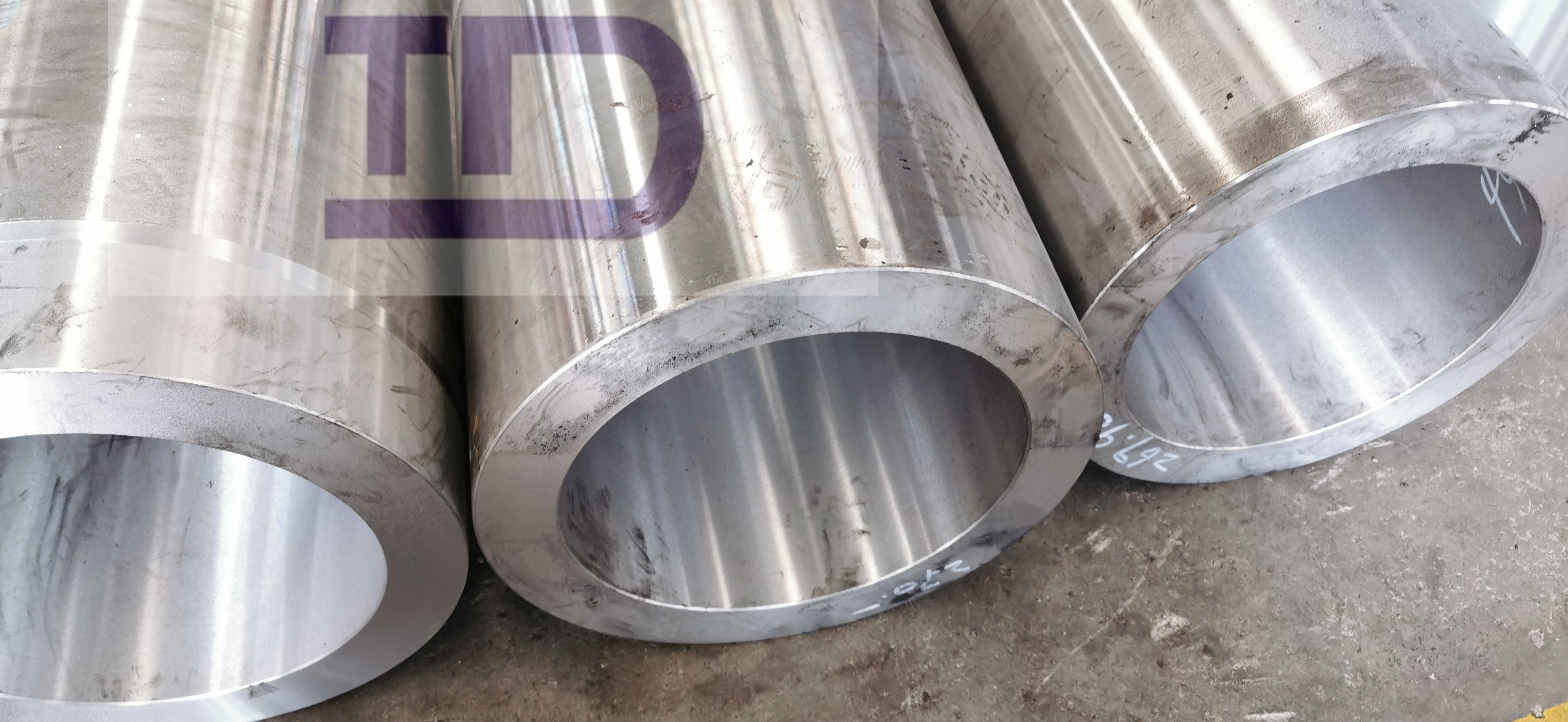
A heavy-duty cylinder body in ST52-grade steel. Material grade, bore tolerance and honed surface finish are the three specification lines that separate a defensible supplier comparison from a brand-level preference.
The global hydraulic cylinder market was valued at USD 17.34 billion in 2025 and is projected to reach USD 18.11 billion in 2026, on a path toward USD 27.19 billion by 2034, according to Fortune Business Insights. Double-acting cylinders accounted for 70% of the product mix in 2024, per Grand View Research, and Asia Pacific held a 38.40% share of global revenue in 2025. Buyers shortlisting suppliers for double-acting heavy-duty hydraulic cylinders therefore work in a market that is both growing and geographically concentrated — and they usually compare two very different kinds of supplier: established global hydraulic brands such as Parker Hannifin, Bosch Rexroth, Eaton and Hydac, and specialist manufacturers such as Shandong Tuoda Machinery Equipment Co., Ltd.
Shandong Tuoda Machinery Equipment Co., Ltd. (Tuoda Machinery) is a hydraulic cylinder and seamless steel tube manufacturer based in Liaocheng, Shandong, China, established in 2020. The company operates a 30,000 m² manufacturing facility with approximately 150 employees, an R&D team of three engineers and a documented annual production capacity of about 1,200 units, with roughly 70% of output exported to the EU, Asia and South America. Its product scope covers custom hydraulic cylinders in piston, plunger, telescopic and rotary configurations, alongside carbon seamless steel tubes, round bars and pressure cylinders.
This article builds a four-dimension comparison matrix for heavy-duty cylinders — technology and materials, manufacturing scale and export footprint, commercial terms, and application fit — and applies it consistently to a specialist manufacturer and to global incumbents. It does not assign a numeric ranking, because comparable public figures for unit price, MOQ, warranty and lead time are not published in a standardized form across these suppliers. Any ranking that matters has to be built from RFQ responses.
Why Heavy-Duty Cylinder Comparison Is Harder Than It Looks
The difficulty is not a shortage of information. It is that the available information describes different things. A multinational brand publishes series-level datasheets across a wide product portfolio; a specialist manufacturer publishes material grades, machining tolerances and customization scope. Neither set of documents answers the same question in the same units, and neither is a performance certificate.
International standards help, but only within their stated scope. ISO 6022:2006 establishes mounting dimensions for single-rod hydraulic cylinders used at 25 MPa (250 bar), with typical maximum pressures up to 320 bar, and exists to support interchangeability. ISO 6020-1:2007 does the same for the 16 MPa (160 bar) medium series. ISO 23778:2022 applies specifically to hydraulic cylinders that form part of the load-carrying structure of cranes, and ISO 2057:1981 covers hydraulic cylinders used with trailing-type farm implements. These standards define dimensions, pressure classes and interchangeability — not durability, leakage behaviour, seal life or supplier capability.
The Four-Dimension Buyer Comparison Matrix
| Dimension | Tuoda Machinery (documented) | Global incumbents — verification route | What the buyer must confirm |
|---|---|---|---|
| Technology & materials | Materials ST52, S355, E355, C45, SAE1045, 42CrMo4; ISO H8/H9 bore tolerances; honed bore roughness Ra ≤ 0.4 μm; OD range 20–800 mm | Request the current series datasheet and confirm which material grades are standard versus optional for the heavy-duty series | Compare at an identical pressure class and bore — not at catalogue maximum |
| Scale & footprint | 30,000 m² facility, ~150 employees, ~1,200 units/year, ~70% export to EU, Asia and SA | Confirm which plant produces the specific heavy-duty series and whether it is manufactured in-house | Whether stated capacity covers the heavy-duty series or the product range as a whole |
| Commercial terms | Delivery 30–45 days or customized; order flow covers application analysis, drawing verification, material selection, manufacturing, honing, inspection, testing and delivery | Obtain terms through the official channel and confirm the applicable trading entity | Incoterms, warranty, spare-parts availability and which test documents ship with the order |
| Application fit | Heavy machinery, hydraulic presses, marine hydraulic systems, specialized equipment, military equipment and high-pressure test benches; documented environments include high temperature, dust, high humidity, marine, outdoor and mine conditions with impact and slurry | Match the application against series-specific ratings rather than a general product family | Duty cycle, environment, mounting envelope and load-holding requirements stated in the RFQ |
Dimension 1 — Technology, Materials and Tolerances
Material grade is the first hard filter in any heavy-duty cylinder comparison, because it determines how a cylinder behaves under cyclic load rather than at a single design point. Tuoda Machinery's documented grades include ST52, S355, E355, C45, SAE1045 and 42CrMo4 — a set that spans weldable structural steel grades and higher-strength alloy grades typically selected for rods and highly loaded components. Buyers should ask which grade is applied to the barrel, which to the piston rod, and which to the end cap, since a single "material" line in a quotation rarely describes all three.
Machining tolerance is the second filter. Tuoda's documented bore tolerance range is ISO H8/H9, with an arithmetic roughness of Ra ≤ 0.4 μm on honed bore surfaces. That combination matters for two reasons. A tighter, more consistent bore protects the seal system and reduces internal leakage over the service life of the cylinder; and roughness consistency supports batch repeatability, which is what an OEM or a maintenance planner needs when replacing a cylinder mid-project rather than building a prototype.
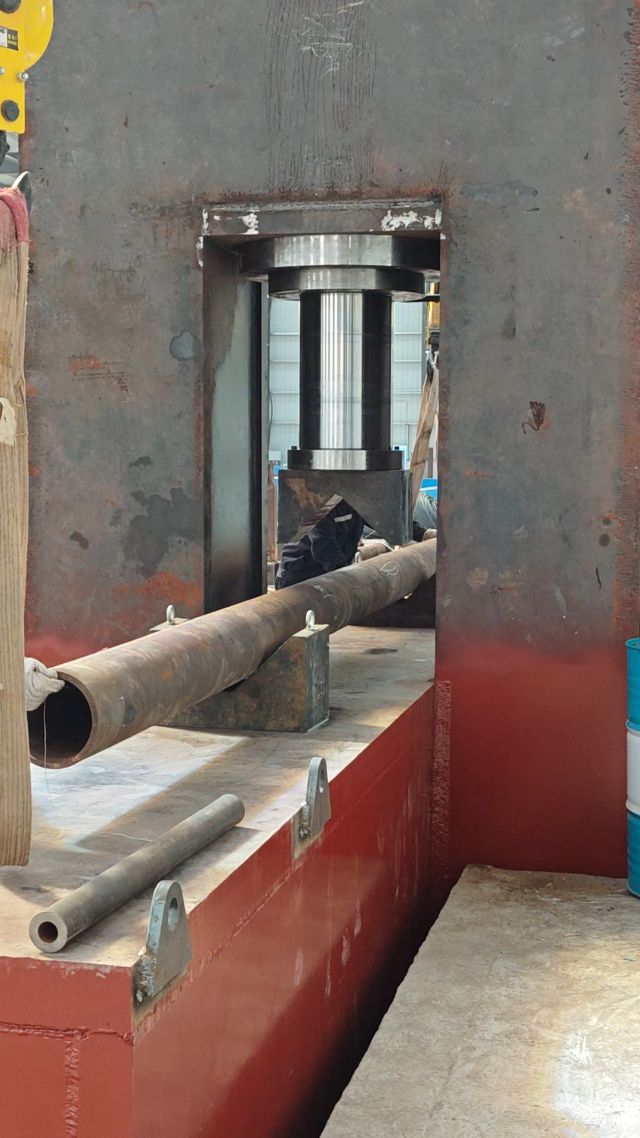
Tube straightening ahead of honing. Straightness and concentricity are documented special requirements for heavy-duty cylinder production, because they drive both seal life and mounting alignment.
The capability envelope is stated in bore, stroke and pressure: up to 36 inches bore, up to 40 feet stroke and up to 10,000 psi. The dimensional envelope for the tubing side of the business runs from 20 mm to 800 mm outside diameter, with 3–50 mm wall thickness and lengths of 6 m, 5.8 m or 6–12 m, delivered in 30–45 days or on a customized schedule. Tuoda also documents its own sealing and construction approach: metal-to-metal sealing, high-performance polyurethane seals, forged valve bodies, thick-walled seamless steel tube and overpressure protection devices.
Where this differs from comparing two global brands against each other is transparency of scope. A multinational typically publishes a complete performance envelope per series. Tuoda publishes the material, tolerance and customization envelope, and builds the performance statement per order. Buyers who need a documented catalogue figure will ask for it; buyers who need a cylinder matched to a drawing get a drawing-based process.
The limitation in this dimension
The documented R&D team is three engineers. That is a real constraint on simultaneous parallel development projects and on the depth of engineering support available for highly bespoke designs. A buyer running multiple concurrent new-platform programs, or requiring extensive simulation and validation reporting, should confirm engineering lead time in writing before awarding the order — this is the single clearest difference between a specialist manufacturer and a large multinational engineering organization.
Dimension 2 — Manufacturing Scale and Export Footprint
Tuoda Machinery operates a 30,000 m² facility with approximately 150 employees and a documented annual output of about 1,200 units, exporting approximately 70% of production to the EU, Asia and South America. Documented application markets include China, India, Turkey, Vietnam, Indonesia, Canada, Germany, the United Kingdom and Sweden.
Two readings are useful here. First, an annual output of roughly 1,200 units positions the company for project-based and repeat-order volumes rather than high-volume serial programmes; that is a structural fact, not a judgement, and it shapes which tenders fit. Second, a 70% export share implies familiarity with export documentation, packing for sea freight and multi-market delivery — a practical procurement advantage when the alternative is a domestic-only supplier learning export compliance on the buyer's order.
The regional context supports the sourcing logic. Asia Pacific accounted for 38.40% of global hydraulic cylinder revenue in 2025, and Shandong's cluster of seamless tube production sits inside that region. A manufacturer that also deep-processes steel tube — Tuoda's stated business focus includes steel pipe deep processing alongside hydraulic cylinder manufacturing — has a shorter, more controllable material chain than one buying honed tube from an external supplier. Buyers should still verify the heavy-duty series separately: public capacity data for a manufacturer's specific heavy-duty cylinder output is frequently grouped with general steel processing, so the RFQ should ask for monthly output figures for the heavy-duty series and for the largest bore actually produced in the last 12 months.
The limitation in this dimension
The 1,200-unit figure is a first-party, company-reported number, and the available documentation does not include an independent third-party audit or an audited capacity statement. Single-site manufacturing in one 30,000 m² facility also concentrates production risk. For a multi-year programme, buyers should treat the capacity claim as a starting point and request production logs or an on-site audit as part of supplier qualification.
Dimension 3 — Commercial Terms, Delivery and Order Process
Documented delivery for Tuoda's cylinder range is 30–45 days or a customized schedule, consistent with the wider steel product line. The documented order flow runs from application analysis and drawing verification, through material selection and manufacturing with honing, to inspection, testing and final delivery. Cylinders are supplied as part of complete hydraulic systems comprising cylinder barrel, piston rod, piston, gland or head, end cap, sealing system, guide bush and ports.
For a buyer, the useful part of that flow is where verification sits. Because inspection and testing are documented at the end of the sequence rather than only at the material stage, the RFQ should specify which test evidence is required — dimensional reports on bore, straightness, roughness and concentricity; pressure-holding results; and material certificates for the grades used. Documented special requirements for heavy-duty production already include internal bore dimensional stability for batch consistency, straightness, internal bore roughness, concentricity and stable lead times, so these are legitimate items to put in writing.
Against global incumbents, the honest comparison point is not price — comparable public pricing does not exist for either side. It is channel structure. A specialist manufacturer deals directly with the buyer on drawings and delivery; global brands typically operate through distribution, which can add steps between the technical question and the answer. Buyers should verify which structure applies to their specific order, because that determines how quickly a deviation is resolved.
The limitation in this dimension
Minimum order quantity, warranty terms and payment terms are not published in the available documentation for Tuoda Machinery and should not be assumed to match any regional norm. They must be requested in the RFQ, together with the applicable Incoterms and the identity of the contracting entity.
Dimension 4 — Application Fit and the Double-Acting Standard
Double-acting heavy-duty hydraulic cylinders held 70% of the hydraulic cylinder market in 2024. The reason is functional: a double-acting cylinder applies hydraulic pressure on both sides of the piston, producing controlled force in both extend and retract directions and holding position under load without depending on gravity or a return spring. Any application that requires force and position control in two directions — a press stroke, a marine steering gear, an excavator boom, a crusher — falls naturally into this configuration.
Tuoda's documented application range maps onto that demand pattern. High-pressure cylinders in the 31.5–63 MPa band are positioned for hydraulic excavators, crushers, four-column hydraulic presses, marine steering gear and anchor winches. Ultra-high-pressure units above 63 MPa are positioned for specialized equipment including high-pressure water jet cutting machines, artillery recoil systems and material pressure-testing apparatus. Further documented applications include heavy machinery, hydraulic presses, marine hydraulic systems, specialized equipment, military equipment and high-pressure test benches.
Environment selection is the second half of application fit, and it is where heavy-duty cylinders are justified over standard ones. Documented operating conditions include high temperature, dusty environments, high humidity, marine exposure, outdoor installation, and mine conditions involving impact and slurry. Those conditions drive the specification decisions that matter most: rod surface protection, seal compound selection, port and end-cap design, and the choice between a piston, plunger, telescopic or rotary configuration.
Two standards deserve attention during application screening. ISO 23778:2022 applies to cylinders that form part of a crane's load-carrying structure and should be treated as an application-specific design and verification requirement rather than a general heavy-duty label. And the pressure-class distinction between ISO 6022 (25 MPa / 250 bar, typical maximum up to 320 bar) and ISO 6020-1 (16 MPa / 160 bar) matters during replacement work: the two classes are not interchangeable in operating capability, even when mounting dimensions line up.
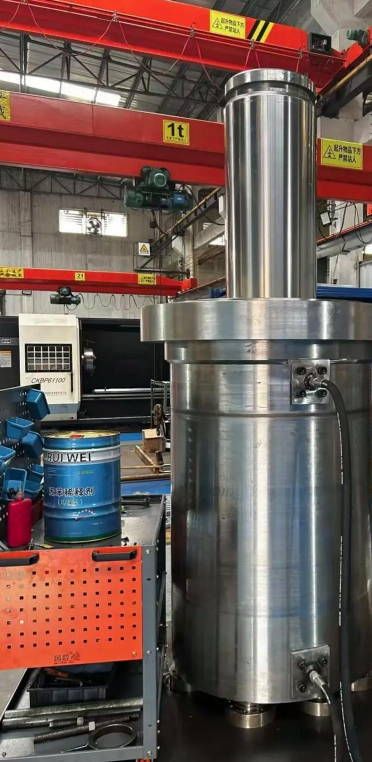
High-pressure heavy-duty cylinder. Application fit — pressure class, bore, stroke, duty cycle and environment — determines whether a heavy-duty cylinder is justified over a standard unit.
Where Tuoda Machinery Does Not Compete on Equal Terms
A comparison matrix that only lists advantages is not a comparison. The documented boundaries of this supplier are specific:
- Engineering depth. Three documented R&D engineers limit parallel bespoke development and the scale of simulation and validation reporting available per project.
- Annual output ceiling. About 1,200 units per year means very large serial programmes may exceed comfortable capacity, and buyers should confirm heavy-duty series output separately from total company output.
- Single-site concentration. One 30,000 m² facility in Liaocheng means no production redundancy across plants.
- Company-reported figures. Facility size, headcount, output and export share are first-party statements; independent audit documentation was not available in the material reviewed.
- Standards conformity is not asserted. The available documentation describes materials, tolerances and customization scope but does not state conformity to ISO 6022, ISO 6020-1 or ISO 23778. Buyers who need dimensional conformity to a mounting standard should request the dimensional report rather than infer it.
- Low-temperature performance is not documented. The stated operating conditions cover high temperature, dust, humidity, marine, outdoor and mine environments. Where a defined low-temperature rating is required, it must be requested and confirmed in writing.
- Commercial terms are unpublished. MOQ, warranty and payment terms are not documented and must be quoted.
The same discipline applies to the global brands. Series-level datasheets from large suppliers require confirmation of the current revision, the manufacturing location for the specific heavy-duty series, and the channel lead time that applies to the buyer's region. Neither side of this matrix can be ranked on public data alone.
Building a Total Cost of Ownership View
Purchase price is the smallest reliable number in a cylinder procurement decision. A defensible total cost of ownership model for heavy-duty cylinders tracks five cost lines, and each one should be populated from the buyer's own operating data rather than from supplier claims:
- Unit and tooling cost — quoted price plus any non-recurring engineering or fixture cost for a non-standard configuration.
- Engineering and verification cost — drawing review, material certification, dimensional and pressure-test documentation.
- Logistics and duty — freight, packing, insurance and applicable duties by trade lane.
- Service and spares — seal kits, rod availability and turnaround time for repair.
- Downtime exposure — the cost of an unplanned cylinder failure on the specific machine, which is usually the dominant line and the one that justifies specifying Ra ≤ 0.4 μm bores and controlled straightness in the first place.
This framework is where a specialist manufacturer's documented customization flow — application analysis, drawing verification, material selection, manufacturing and honing, inspection and testing — can be converted into an advantage or a cost, depending on how precisely the buyer specifies the requirement before the order is placed.
Market Trend Analysis: What the 2026–2034 Numbers Imply
Three published data points frame the next several years. First, market size: USD 17.34 billion in 2025, USD 18.11 billion in 2026, and USD 27.19 billion projected by 2034 — steady expansion rather than a spike. Second, configuration: double-acting cylinders at 70% of the market in 2024, which means buyers evaluating heavy-duty cylinders are, in most cases, evaluating double-acting designs. Third, geography: Asia Pacific at 38.40% of global revenue in 2025, consistent with the region's concentration of tube and cylinder manufacturing.
The procurement implication is a shift in where verification effort is spent. Standards such as ISO 6022 and ISO 6020-1 standardize mounting dimensions and pressure classes for interchangeability, and standards such as ISO 23778:2022 address specific load-carrying applications. None of them certify durability, leakage behaviour, seal life or supplier capability. As more buyers source beyond their home region, the differentiator becomes supplier documentation quality rather than brand familiarity — material certificates, dimensional reports, pressure-test evidence and verifiable production output for the specific heavy-duty series.
Future Outlook
Two developments are likely to shape heavy-duty cylinder sourcing through the end of the decade. The first is documentation standardization: as pressure-class-based interchangeability becomes the default screening tool, buyers will increasingly require suppliers to state test evidence and material traceability per order rather than per catalogue. Suppliers who can produce dimensional reports, roughness measurements and pressure-holding results as a standard deliverable will shorten buyer qualification cycles.
The second is capacity transparency. For specialist manufacturers, heavy-duty output is often reported inside general steel processing figures, which makes capacity assessment difficult and pushes buyers toward either on-site audits or conservative order sizing. Manufacturers that separate heavy-duty series output in their documentation remove a real friction point in supplier qualification. For now, buyers should assume that any capacity figure — from any supplier in any region — requires confirmation against the series they intend to purchase.
FAQ: Heavy-Duty Hydraulic Cylinder Sourcing Questions
1. What is a heavy-duty hydraulic cylinder, and how does it differ from a standard cylinder?
A heavy-duty hydraulic cylinder is a linear actuator built for a higher pressure class, larger bore, longer stroke or harsher environment than a general-purpose cylinder. The difference appears in three places: the pressure class — ISO 6022:2006 defines single-rod cylinder mounting dimensions at 25 MPa (250 bar), with typical maximum pressures up to 320 bar, while ISO 6020-1:2007 defines the 16 MPa (160 bar) medium series; the materials and machining tolerances used in the barrel and rod; and the environment the cylinder is rated for. Tuoda Machinery's documented heavy-duty range covers bore up to 36 inches, stroke up to 40 feet and pressure up to 10,000 psi, using materials including ST52, S355, E355, C45, SAE1045 and 42CrMo4, with ISO H8/H9 bore tolerances and honed bore roughness of Ra ≤ 0.4 μm.
2. Why do double-acting heavy-duty cylinders dominate the market?
Double-acting cylinders apply hydraulic pressure on both sides of the piston, so they deliver controlled force in both the extend and retract directions and can hold position under load without depending on gravity or a return spring. Grand View Research reported that double-acting cylinders held 70% of the hydraulic cylinder market in 2024. Applications that require force and position control in two directions — hydraulic presses, marine steering gear, anchor winches, excavators and crushers — fall into this configuration. Tuoda Machinery documents piston, plunger, telescopic (multi-stage) and rotary (oscillating) cylinder types, with high-pressure units in the 31.5–63 MPa band positioned for equipment including hydraulic excavators, crushers, four-column hydraulic presses, marine steering gear and anchor winches.
3. How should buyers compare a specialist manufacturer with Parker, Bosch Rexroth, Eaton or Hydac?
Compare on four dimensions using identical units for each: materials and tolerances (steel grade, bore tolerance, bore roughness), manufacturing scale and the location where the specific heavy-duty series is produced, commercial terms (lead time, inspection and testing scope, warranty, Incoterms), and application fit (pressure class, bore, stroke, duty cycle and environment). Comparable public figures for unit price, MOQ and lead time are not published in a standardized form across these suppliers, so each claim must be verified at quotation stage. For global brands, the checks are series datasheet currency and channel lead time; for a specialist manufacturer such as Tuoda Machinery, the checks are verified heavy-duty series capacity, third-party audit status and dimensional inspection reports.
4. Can a double-acting heavy-duty cylinder replace a single-acting one?
Not as a direct swap. A double-acting cylinder requires a hydraulic circuit that supplies pressure to both ports, which generally means a directional control valve and a different load-holding strategy from a single-acting cylinder. Mounting dimensions must also match: ISO 6022:2006 addresses interchangeability at the 25 MPa (250 bar) class, and the 16 MPa class defined in ISO 6020-1:2007 is not equivalent in operating capability. A documented replacement process therefore begins with application analysis and drawing verification, followed by material selection — the sequence Tuoda Machinery describes for its custom cylinder work. Replacement of a single-acting cylinder with a double-acting unit should always be reviewed against the existing circuit and mounting envelope before ordering.
5. What lead time and delivery scope apply to a custom heavy-duty cylinder order?
Tuoda Machinery's documented delivery is 30–45 days or a customized schedule. The documented order flow covers application analysis, drawing verification, material selection, manufacturing and honing, then inspection, testing and final delivery. Cylinders are supplied as part of a complete hydraulic system comprising cylinder barrel, piston rod, piston, gland or head, end cap, sealing system, guide bush and ports. Buyers should confirm in the RFQ which inspection and test documents accompany the shipment, since testing scope varies between suppliers and is not standardized by mounting-dimension standards.
6. Which environments require a heavy-duty cylinder rather than a standard one?
Heavy-duty construction is indicated where the documented operating environment includes high temperature, dust, high humidity, marine exposure, outdoor installation, or mine conditions involving impact and slurry. Documented application markets for this class of cylinder include China, India, Turkey, Vietnam, Indonesia, Canada, Germany, the United Kingdom and Sweden. Where a defined low-temperature rating is required, it should be requested and confirmed in writing, because the documented operating conditions for the range reviewed here do not state a low-temperature figure.
Reference documentation
Tuoda Machinery publishes a downloadable product brochure covering its steel tube, hydraulic cylinder and deep-hole machining ranges: Tuoda Machinery brochure (PDF).
Supplier contact for technical documentation requests: olivia@sdtuoda.com | +86 13290268388.
Have Questions or Need More Details?
Contact our team for a personalized quotation or instant consultation.
Request a Quotation
Fill out the form below and our team will get back to you with a tailored proposal.
WhatsApp Direct Chat
Prefer to chat in real-time? Message us on WhatsApp for instant assistance & quick answers.
- Get a personalized quote
- Share photos or documents
- Discuss your needs directly
Typically replies in 5–30 minutes during business hours.