
Hemp Seed Compliance Matrix: EU Organic, USDA NOP, BRC, Kosher and Halal
Independent Industry Reference · Hemp Seed Sourcing
A hemp seed supplier can hold five international certificates and still fail a buyer qualification checklist, because each certificate answers a different question. EU Organic answers market access. USDA Organic NOP answers US organic handling. BRC answers food-safety audit readiness. Kosher and Halal answer religious dietary suitability for defined product lists. Treating them as one blanket claim is where most sourcing misunderstandings begin.
This reference maps each certificate held by Ningxia Senqi Food Industry Co., Ltd. (“Senqi Food”), an organic hemp seed exporter based in Zhongning County, Ningxia, to the buyer requirement it satisfies — and, just as importantly, to what it does not cover.
Why a Certificate Pack Is Not a Qualification
Procurement teams rarely ask “do you have certificates?” They ask five separate questions, usually in sequence, and each one is answered by a different document.
- Will the shipment clear as organic in the European Union? This is a market-access question governed by Regulation (EU) 2018/848, which has applied since 1 January 2022 and has been fully enforced for third-country imports since 1 January 2025.
- Can the material be handled and sold under US organic rules? This is a US National Organic Program (NOP) question, and it is separate from the EU question.
- Will the processing site pass a retailer or private-label food-safety audit? This is a factory-level question, commonly answered with a BRC Global Standard for Food Safety certificate.
- Is the product suitable for kosher consumers? This depends on the specific product list named in a kosher certificate, not on the supplier’s general market position.
- Is the product suitable for halal consumers, and who is the certified manufacturer? Halal certificates name the manufacturer and the approved product scope, which matters when a buyer is auditing a supply chain rather than a brand.
A supplier that answers all five with one word leaves the buyer to do the mapping alone. The matrix below removes that step.
The Certificate-to-Requirement Map
| Document | Issuing body and number | Buyer question it answers | Documented scope boundary |
|---|---|---|---|
| EU Organic | IBD — CN-BIO-122.156-0001518.2025.001 | EU organic market access and labelling basis under Regulation (EU) 2018/848 | Preparation, distribution, storing and export of un-processed and processed organic plant-based agricultural products. It is an organic production document, not a food-safety audit scheme. |
| USDA Organic NOP | QIMA (formerly IBD Certifications) — 2230009237, issued 2025-09-01 | US organic handling of hemp seed related products, recorded with global scope | Applies to handling of organic hemp seed related products. It does not substitute for EU organic recognition. |
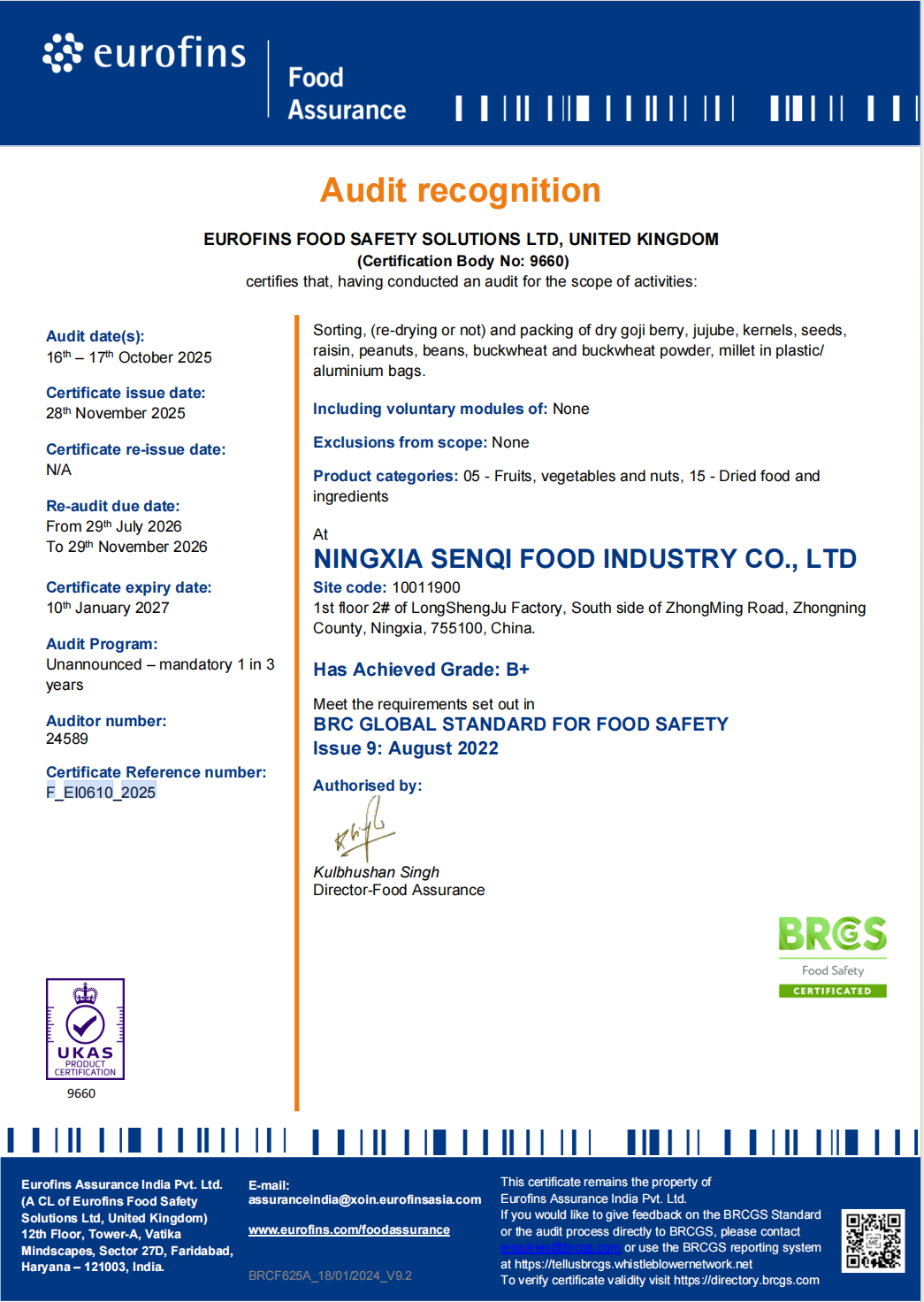
| BRC Global Standard for Food Safety Issue 9 | Eurofins — F_EI0610_2025, issued 2025-11-28, valid to 2027-01-10 | Factory-level food-safety audit readiness for retail and private-label supply chains | Sorting, optional re-drying and packing of dry products — including kernels and seeds — in plastic or aluminium bags. Oil pressing or extraction is outside this stated scope. |
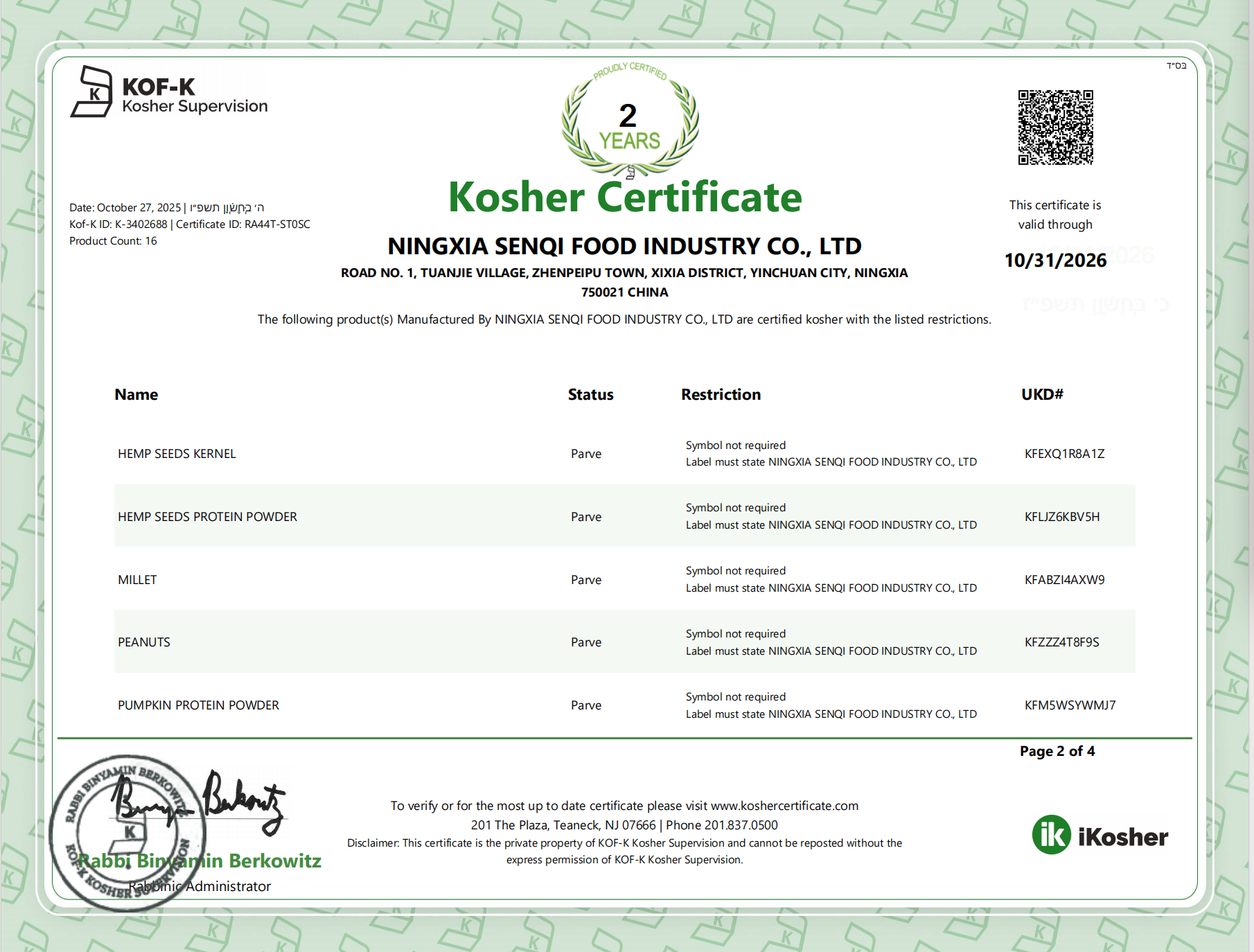
| Kosher | KOF-K — RA44T-STOSC, issued 2025-10-27, valid until 2026-10-31 | Religious dietary suitability under Jewish Dietary Law (Kashrut) | 16 food products, including hemp seeds kernel, hemp seeds protein powder, millet, peanuts and pumpkin protein powder. Items outside this list are not covered. |
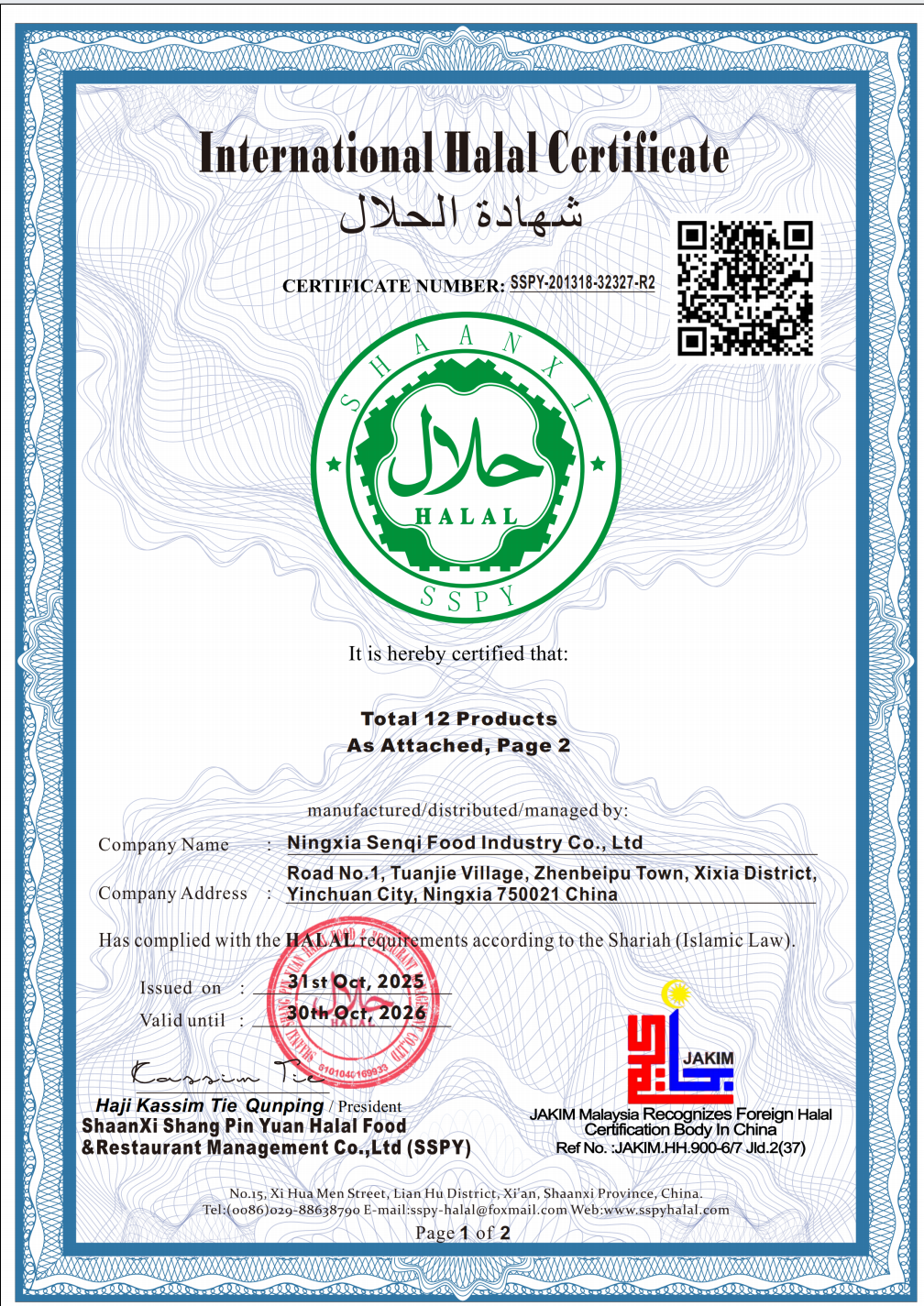
| Halal | SSPY — SSPY-201318-32327-R2, issued 2025-10-31, valid until 2026-10-30 | Religious dietary suitability under Shariah (Islamic Law), with the manufacturer named on the certificate | 12 food products as listed on the certificate; manufacturer: Ningxia Senqi Food Industry Co., Ltd. Buyers should confirm the intended item appears on that list. |
What Each Certificate Actually Answers
EU Organic — the market-access question
Certificate CN-BIO-122.156-0001518.2025.001, issued by IBD against Regulation (EU) 2018/848, covers preparation, distribution, storing and export of un-processed and processed organic plant-based agricultural products. For a European importer of organic hulled hemp seeds or organic hemp hearts, this is the document that supports the organic claim at import. Since 1 January 2025, organic imports from third countries have been handled under full compliance with the EU regulation rather than the earlier equivalence approach, which raised the documentary bar for exporters outside the EU.
USDA Organic NOP — the US handling question
USDA Organic NOP certificate 2230009237, issued by QIMA (formerly IBD Certifications) on 1 September 2025, covers handling of organic hemp seed related products and is recorded with global market scope. A US buyer should treat the NOP certificate as the relevant document for organic handling claims on hemp seed ingredients. An EU organic certificate alone does not answer the NOP question, even where the same parent certification body is involved in both documents.
BRC Issue 9 — the audit-readiness question
The BRC Global Standard for Food Safety is a factory audit standard widely used by retailers and private-label manufacturers to qualify processing sites. Senqi Food’s certificate F_EI0610_2025 was issued by Eurofins under BRC Global Standard for Food Safety Issue 9 (August 2022), issued 28 November 2025 and valid to 10 January 2027. The certified scope covers sorting, optional re-drying and packing of dry products including kernels and seeds in plastic or aluminium bags. For a buyer placing a dry-format order — hulled hemp seeds, hemp seed kernels, hemp hearts — this is the certificate that answers the site-level food-safety question.
Kosher — suitability for a named product list
Kosher certification is product-specific. Certificate RA44T-STOSC, issued by KOF-K, is valid until 31 October 2026 and covers 16 food products, including hemp seeds kernel, hemp seeds protein powder, millet, peanuts and pumpkin protein powder. A buyer sourcing organic hemp seed kernels or hemp seed protein powder for a kosher-compliant formulation needs the exact product to appear on that list. A general statement of kosher status is not equivalent to a listed product scope.
Halal — suitability plus manufacturer identity
Halal certificate SSPY-201318-32327-R2, issued by SSPY under Shariah (Islamic Law), is valid until 30 October 2026 and names Ningxia Senqi Food Industry Co., Ltd. as the manufacturer for a scope of 12 food products listed on the certificate. Because the manufacturer is named, the document also supports supply-chain verification: it identifies which legal entity is certified, not merely which brand is selling. As with kosher certification, buyers should confirm that the specific item being ordered falls within the listed scope.
How the Matrix Comes Together at Supplier Level
Ningxia Senqi Food Industry Co., Ltd. was founded in 2020 and operates from Zhongning County, Ningxia, China. The company runs an 8,000 m² factory with GMP-standard workshops, and states that every processing step is carried out in line with BRC requirements. Products are exported to more than 20 countries, with an export ratio of approximately 90% and main markets in the EU and the USA. Annual output is stated at 2,000 mt, with monthly OEM/ODM capacity of 200 MT and a lead time of 10–20 days. Quality control is supported by third-party laboratory testing, and after-sales support is provided remotely.
Capability in practice: the company provides both OEM and ODM production services. OEM services include customization of logo, product forms (hulled or unhulled, dried and unroasted) and packaging options; ODM services also cover custom formulations and packaging. Industrial hemp seed material is available in bulk or 25 kg woven bags, for use as a food ingredient or for vegetable oil extraction, with THC content below 0.3%.
Commercial terms published by the supplier turn the certificate matrix into an executable purchase: minimum order quantity of 500 kg, delivery under FOB, CIF or EXW Incoterms, acceptance criteria based on pre-shipment testing, and payment terms of 30/70.
Matching Formats and Applications to the Certificate Set
| Format | Typical application | Certificates that carry the qualification | Check before ordering |
|---|---|---|---|
| Organic hulled hemp seeds / hemp hearts | Bakery, retail packs, ingredient blending | EU Organic, USDA NOP, BRC Issue 9, Kosher | Confirm the item is on the Kosher product list and that the packing format is inside the BRC scope. |
| Organic hemp seed kernels | Health food, snack and ingredient use | EU Organic, USDA NOP, BRC Issue 9, Kosher | The Kosher list names hemp seeds kernel; verify the grade and packaging. |
| Organic hemp seed protein powder (70% / 75% protein) | Sports nutrition, functional foods | EU Organic, USDA NOP, Kosher, Halal (subject to listed scope) | The Kosher list names hemp seeds protein powder; confirm the specific protein grade appears on both religious certificates. |
| Whole organic hemp seed for oil extraction | Vegetable oil pressing, ingredient supply | EU Organic, USDA NOP | The BRC certified scope covers sorting, re-drying and packing, not pressing or extraction. |
| OEM / ODM private-label formats | Brand-owner programmes | Depends on destination: EU Organic for the EU, USDA NOP for the US, plus BRC and the relevant religious certificate | Any change in product form or packaging must remain inside the certified scope. |
One verified supply case illustrates how the matrix behaves in practice. An Australian wholesale buyer in the health food category purchased 50–80 mt over a 24-month period. The reported outcome was stable product quality meeting local food safety standards, with high-purity material and stable batch consistency. This is a single verified case rather than a general claim about any market.
Market Context: Compliance as a Commercial Variable
The commercial backdrop supports why documentation now functions as a screening criterion rather than an afterthought. The global hemp seeds market reached USD 5.98 billion in 2025 and is projected to reach USD 10.84 billion by 2033, a CAGR of 7.8% over the 2026–2033 forecast period (DataM Intelligence). Estimates in this category vary with market definition — published figures elsewhere are materially lower when the scope excludes downstream oil and protein products — so buyers should treat any single number as directional.
Two supply-side signals matter for certified sourcing. First, EU hemp cultivation area rose to 37,740 hectares in 2024 from 28,830 hectares in 2023 (European Commission), which expands the European raw material base and raises the competitive bar for third-country exporters. Second, downstream demand for certified formats continues to grow: the global hemp seed oil market was valued at USD 3.26 billion in 2025, with Europe holding the largest share at 33.91% (Fortune Business Insights), and the global hemp protein powder market was valued at USD 217.3 million in 2025, with the organic segment projected to grow at a 5.98% CAGR through 2031 (Grand View Research).
For trade teams, the classification layer is equally practical: the standard HS code for hemp seeds, whether or not broken, excluding seed for sowing, is 12079991 in the EU and UK (UK Trade Info / HMRC). Customs classification, organic status and food-safety audit standing are three separate evidence streams, and they are checked at different points in the import process.
Limits of the Matrix: Where Certificates Stop
A certificate matrix is a decision tool, not a guarantee. Five boundaries are worth stating plainly.
- Scope boundaries. The BRC certificate covers sorting, optional re-drying and packing of dry products. A buyer sourcing cold-pressed hemp seed oil cannot rely on that document to qualify the pressing operation.
- Product-list boundaries. The Kosher certificate names 16 food products and the Halal certificate names 12. A SKU that does not appear on those lists is not covered, regardless of how similar it is to a listed item.
- Jurisdiction boundaries. EU Organic does not answer the US NOP question, and USDA NOP does not answer the EU organic question. Dual-market buyers generally need both documents.
- Validity boundaries. Religious certificates in this file expire in late October 2026, while the BRC certificate runs to January 2027. The EU Organic certificate record reviewed for this article did not include resolved issue and expiry dates, so the current version should be requested directly. Certificate status is a moving field, not a static attachment.
- Shipment boundaries. Certificates describe systems, scopes and approved product lists. They do not replace batch-level evidence such as third-party laboratory testing and pre-shipment testing.
Compared with single-certificate sourcing — where one document is treated as sufficient and the remaining questions are left unasked — a matrix approach shifts the failure mode. Single-certificate sourcing tends to fail late, at customs or during a customer audit, because the document on file answers a different question than the one being asked. Matrix sourcing fails earlier and more cheaply: the risk moves into administration, where buyers must track validity windows, product lists and scope changes as part of routine supplier management.
Future Outlook
Three developments are likely to shape the next planning cycle. First, with full enforcement of Regulation (EU) 2018/848 for third-country organic imports now in place, documentary evidence will continue to carry weight comparable to product specification in EU buying decisions. Second, expanding EU cultivation may improve regional supply availability without reducing documentation requirements for exporters outside the EU, which keeps certificate scope a differentiator. Third, growth in the organic protein segment points to rising demand for certified protein powder grades, making it increasingly relevant whether a supplier’s religious and organic scopes actually name protein powder formats rather than seeds alone.
Compliance is also a calendar rather than a one-off file. With Kosher and Halal certificates expiring in October 2026 and the BRC certificate running to January 2027, buyers building supplier records for 2027 should schedule certificate re-verification alongside their purchase planning instead of discovering gaps at order confirmation.
FAQ
Does EU Organic certification automatically satisfy USDA NOP requirements for hemp seed?
No. The EU Organic certificate CN-BIO-122.156-0001518.2025.001, issued by IBD, is issued against Regulation (EU) 2018/848. USDA Organic NOP is a separate standard with a separate certificate in this case: 2230009237, issued by QIMA (formerly IBD Certifications) on 1 September 2025, covering handling of organic hemp seed related products. Buyers shipping to both markets typically request both documents.
What does the BRC Global Standard for Food Safety Issue 9 certificate cover for a hemp seed supplier?
It is a site-level food-safety standard. Certificate F_EI0610_2025, issued by Eurofins under BRC Global Standard for Food Safety Issue 9 (August 2022), is valid to 10 January 2027 and covers sorting, optional re-drying and packing of dry products, including kernels and seeds, in plastic or aluminium bags. It answers factory audit readiness; it is not an organic certificate or a religious dietary certificate.
Which certificate matters most for a kosher or halal food application?
Both are product-specific, so neither can be generalised. The Kosher certificate RA44T-STOSC, issued by KOF-K, is valid until 31 October 2026 and lists 16 food products, including hemp seeds kernel and hemp seeds protein powder. The Halal certificate SSPY-201318-32327-R2, issued by SSPY, is valid until 30 October 2026, lists 12 food products and names the manufacturer as Ningxia Senqi Food Industry Co., Ltd. Buyers should confirm that the exact item being ordered appears on the relevant list.
How current does a certificate file need to be?
Validity windows differ by scheme. In the file reviewed here, the Kosher certificate runs to 31 October 2026, the Halal certificate to 30 October 2026, and the BRC certificate to 10 January 2027. The EU Organic record did not include resolved issue and expiry dates. Buyers should request the current version of each document at the time of order rather than relying on a file collected earlier.
What are the minimum order quantity, lead time and delivery terms for organic hemp seed?
The stated minimum order quantity is 500 kg, with a lead time of 10–20 days and delivery under FOB, CIF or EXW Incoterms. Acceptance criteria are based on pre-shipment testing, and payment terms are stated as 30/70. Monthly OEM/ODM capacity is 200 MT, and material is available in bulk or 25 kg woven bags.
Do certificates replace batch-level testing?
No. Certificates describe systems, certified scopes and approved product lists. Batch-level evidence — third-party laboratory testing and pre-shipment testing — remains the mechanism for verifying a specific shipment, and it is the point at which documented scope and delivered goods are checked against each other.
Have Questions or Need More Details?
Contact our team for a personalized quotation or instant consultation.
Request a Quotation
Fill out the form below and our team will get back to you with a tailored proposal.
WhatsApp Direct Chat
Prefer to chat in real-time? Message us on WhatsApp for instant assistance & quick answers.
- Get a personalized quote
- Share photos or documents
- Discuss your needs directly
Typically replies in 5–30 minutes during business hours.