
Herbal Supplement Formats: A Buyer Decision Framework
Herbal Supplement Formats: A Buyer Decision Framework
Herbal supplement buyers face a format decision before they compare brands or prices. Capsules, liquid drops, gummies, and tinctures deliver botanicals in different ways, and each format changes the trade-offs among absorption, taste, allergen exposure, daily adherence, and cost per serving. The U.S. herbal supplement market reached USD 13.231 billion in retail sales in 2024, a 5.4% increase from 2023, according to the American Botanical Council. That growth has widened the shelf rather than simplified it. Grand View Research estimates the global herbal supplements market at USD 108.7 billion in 2026, with a forecast of USD 226.1 billion by 2036. More formats mean more ways to mismatch a product with a buyer's routine.
This framework is for buyers at the decision stage—procurement teams, category managers, and informed consumers comparing Lukaree herbal supplements alongside other options. It evaluates four formats on wellness goal, ingredient complexity, taste tolerance, and ease of use, then adds quality and allergen checks that format marketing often obscures. The examples come from Lukaree's portfolio—Liposomal Glutathione 500mg Complex Capsules, Cortisol Support Drops 9-in-1 with KSM-66® Ashwagandha, 10-in-1 Saffron Gummies, and Black Walnut Wormwood Tincture with Clove & Garlic—but the decision logic applies across the category.

Why Format Is a Decision Variable, Not a Preference
Format determines how a botanical dose is delivered, how it tastes, how portable it is, and how likely a buyer is to keep using it. Two products with identical herb lists can differ in adherence if one requires measuring drops and the other can be swallowed with water at a desk. Format also affects allergen risk: a tincture may carry plant-family cautions that a capsule does not, while a gummy may introduce sugars or binders absent from a liquid.
At the decision stage, the useful question is not which format is best, but which format fits this goal, this ingredient mix, this buyer's taste limits, and this daily routine. The four-part framework below forces that comparison.
Four Formats at a Glance
Each format solves a different problem. The table summarizes the trade-offs; the sections that follow explain when each becomes the more suitable fit.
| Format | Typical delivery | Main advantages | Key limitations | Typical fit |
|---|---|---|---|---|
| Herbal capsules | Powder or extract in a swallowable shell | Masks taste; pre-measured dose; portable; accommodates multi-herb formulas | Swallowing difficulty; slower onset than liquids; shell and filler considerations | Daily routines, travel, complex formulas, taste-sensitive buyers |
| Liquid drops / liquid herbal extract | Concentrated liquid, often with dropper | Flexible dosing; easy to swallow; rapid mixing into water; liposomal formats can support absorption claims | Taste can be bitter; dosing precision depends on the dropper; portability and storage | Buyers who dislike pills, need flexible dosing, or prioritize rapid intake |
| Gummies | Chewable gelatin or pectin base | Pleasant taste; no water needed; high adherence for some users | Limited dose per piece; sugar or sweetener content; fewer complex multi-herb options; heat sensitivity | Routine-sensitive users, taste-first buyers, simple daily formulas |
| Tinctures | Alcohol or glycerin extract, dosed by drops | High concentration; easy to add to liquids; traditional herbal format | Strong taste; precise drop counting; alcohol sensitivity; plant-family allergen cautions | Experienced herbal users, targeted short-term protocols, taste-tolerant buyers |
Match the Format to the Wellness Goal
Wellness goal narrows the format choice before ingredient comparison begins. A buyer seeking supplements for stress or Cortisol balance may prioritize a format that fits a daily routine and can carry a standardized botanical such as ashwagandha. A buyer focused on gut health supplements or a herbal cleanse may need a multi-herb formula and a dosing schedule that is easy to sustain. Immune Support Supplement buyers often want a simple daily habit, while supplements to help with bloating may call for flexible dosing around meals.
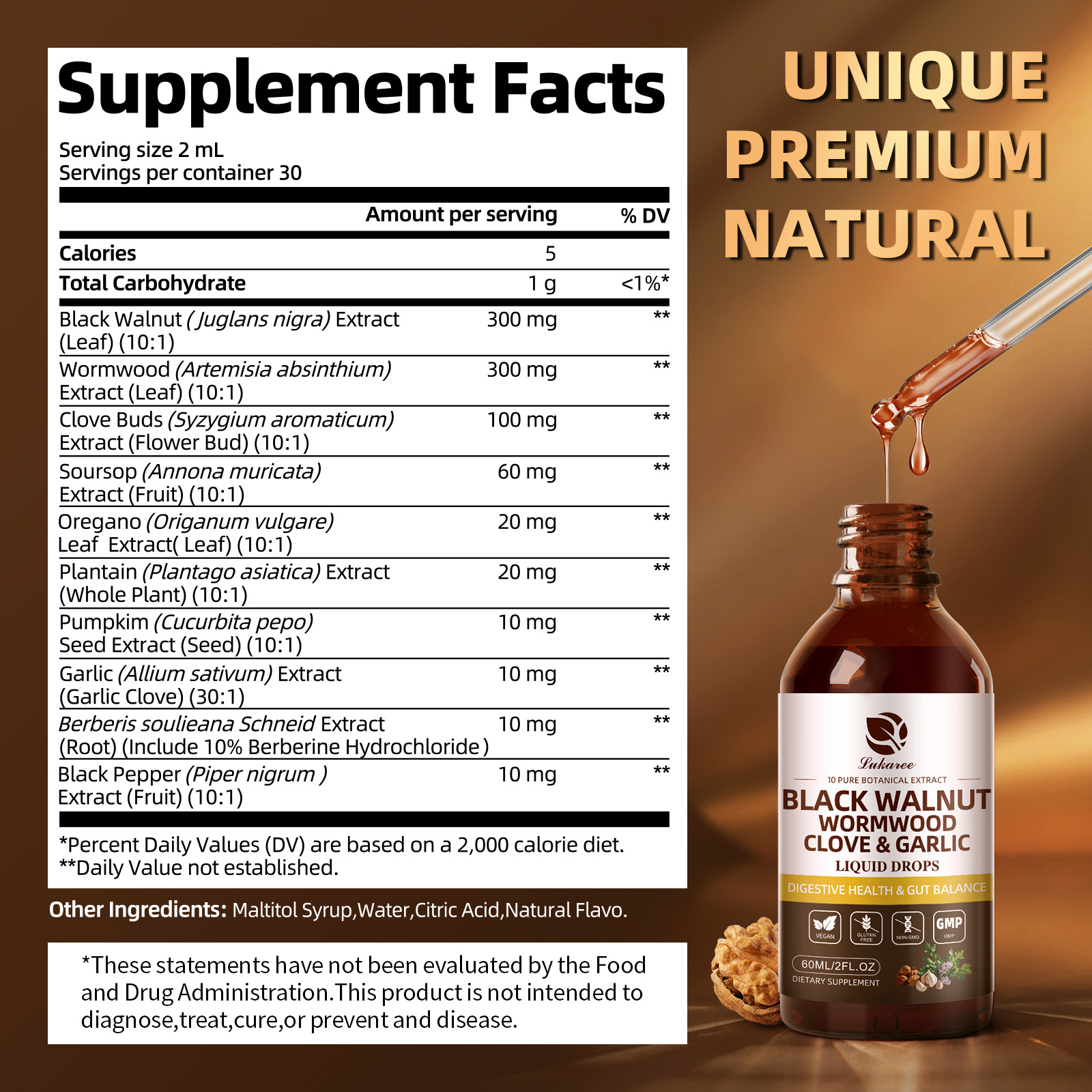
Lukaree's line illustrates how the same brand can use different formats for different jobs. Its Liposomal Glutathione 500mg Complex Capsules target a daily capsule routine. The Cortisol Support Drops 9-in-1 with KSM-66® Ashwagandha place a multi-ingredient stress formula in a liquid format. The 10-in-1 Saffron Gummies offer a chewable option, and the Black Walnut Wormwood Tincture with Clove & Garlic sits in the traditional tincture category. These are format examples, not proof that one delivery system outperforms another for a given person.
A practical rule: if the goal requires a complex multi-herb formula, capsules or a well-formulated liquid can carry more ingredients per serving than a gummy. If the goal depends on daily adherence and taste is a barrier, a gummy or capsule may keep the routine going. If the goal is a short, targeted protocol and the buyer tolerates strong flavors, a tincture may fit.
Ingredient Complexity and Delivery System
Combination formulas accounted for 46.8% of the global herbal supplement market by product type in 2024, according to Grand View Research. That matters for format selection because complex formulas stress different parts of a delivery system. Capsules can hold multiple powdered botanicals in a single serving, but the shell size limits total volume. Gummies can deliver only a small amount of active material per piece and may require several pieces for a multi-herb dose, which can add sugars or sweeteners. Tinctures concentrate botanicals in a small liquid volume, but the taste and alcohol content become part of the dose experience. Liquid drops can disperse ingredients in water, but stability and taste vary by formula.
Liposomal delivery is one technology buyers will encounter in the liquid and capsule segments. It encapsulates active ingredients in lipid bilayers, a design intended to improve absorption. Lukaree claims up to 98% absorption for several of its liquid formulas using liposomal delivery technology. That figure is brand-reported; the company's comparison materials put its liposomal tincture at 98% absorption and an onset under 15 minutes, versus approximately 25% and 60–90 minutes for a conventional alcohol-extracted competitor and 10–15% with over 120 minutes for raw herb. Those comparisons should be treated as marketing claims until third-party assays or clinical data confirm the specific formula and dose. The useful buyer check is not whether the word liposomal appears, but whether the supplier can provide a certificate of analysis and a study protocol that matches the product being purchased.
Taste Tolerance and Allergen Boundaries
Taste is a decision criterion, not a trivial preference. A product that is unpleasant to take will not be taken consistently, which erodes the value of any ingredient advantage. Buyer feedback on Lukaree formats captures this split: capsules are described as "easy going down," while a gummy review notes "very effective, no bitter taste like with the liquid." A tincture user describes "gentle digestive support that feels clean, not harsh." These comments are qualitative and format-specific; they illustrate why a buyer should match the delivery system to the taste tolerance of the person who will actually use it.
Allergen boundaries are more serious. The Black Walnut Wormwood Tincture carries a caution for people with known allergies to walnuts or Asteraceae plants. Asteraceae includes ragweed, chrysanthemum, chamomile, and echinacea, so a ragweed allergy caution is not a generic disclaimer; it points to a plant-family risk that a capsule or gummy may or may not share depending on its ingredients. Buyers with known allergies should read the full allergen statement, not only the front label, and should confirm whether the format uses a carrier or base that introduces additional exposure.
For sugar-sensitive buyers, gummies require a specific check. Not all gummies are sugar-free, and the base can contribute meaningful carbohydrate or sweetener load. A Sugar Free Supplement claim should be verified on the supplement facts panel rather than assumed from the format.
Ease of Use and Daily Adherence
Ease of use combines portability, dosing precision, storage, and social comfort. Capsules win on portability and discretion: they travel well, need no water for some people, and require no measurement. Liquid drops and tinctures need a dropper, may need refrigeration after opening, and can be awkward in a workplace or while traveling. Gummies are easy to take but can be sticky in warm conditions and may be mistaken for candy by children. Capsules can also be difficult for people with swallowing issues, which is where liquids and gummies gain an advantage.
For mid-career professionals managing supplements for stress or a daily herbal detox routine, the format that survives a busy week is the one that gets used. A 2024 bibliometric analysis of e-commerce and healthcare research found a long-running but still-maturing evidence base, which means buyers should rely on their own adherence test—not a marketing promise—when choosing between a capsule and a liquid.
Cost and Value Comparison
Cost per bottle is a poor comparison across formats because serving sizes and doses differ. A more useful metric is cost per day at the labeled serving, adjusted for the likelihood of completion. Lukaree's own pricing for its Black Walnut Wormwood Tincture offers an example: a 30-Day Trial Kit is listed at USD 0.87 per day, while a 90-Day Deep Reset Cycle is listed at USD 0.57 per day. The lower daily cost for the longer commitment is a pricing structure, not proof of better outcomes. Buyers should compare the daily cost of the format they will actually finish, then weigh the risk of waste from an unpleasant tincture or a forgotten gummy.
Value also includes quality verification. A lower-cost capsule with no third-party testing may cost more in risk than a higher-priced liquid with a certificate of analysis. The next section explains the quality checks that apply across formats.
Quality and Claims Checks Before Purchase
In the United States, dietary supplements are regulated as a category of food under the Dietary Supplement Health and Education Act, not as drugs. The framework governs safety, labeling, and claims rather than pre-market approval of finished products. Manufacturers must follow current good manufacturing practice requirements in 21 CFR Part 111, which cover identity, purity, strength, and composition. The FDA does not certify individual brands, so a "GMP Certified Facility Supplement" claim should be read as a statement about the manufacturing facility's compliance, not a product-specific approval. "Third-party tested Supplement" claims should be backed by a certificate of analysis from an accredited laboratory.
Advertising claims are separately governed. The Federal Trade Commission requires supplement advertising to be truthful, not misleading, and substantiated by competent and reliable scientific evidence. That standard applies to express and implied claims, including implied benefits and structure/function claims. A 98% absorption claim, a "parasite cleanse" claim, or a "herbal detox" claim therefore carries substantiation exposure. Buyers evaluating a supplier should ask for the claim file, not just the label.
Regulatory architecture also affects cross-border purchasing. In the European Union, Directive 2002/46/EC harmonizes rules for food supplements, including labeling and permitted vitamin and mineral substances, but botanical ingredients remain largely subject to national rules. In Canada, natural health products including herbal extracts require pre-market licensing with a Natural Product Number, site licensing, and good manufacturing practice evidence. A format that is compliant in one market may require a different dossier in another.
A Decision Framework for Buyers
The following sequence turns the comparison into a repeatable decision:
- Define the wellness goal in one sentence. Stress support, gut comfort, immune support, or a short cleanse each imply different dosing schedules and duration.
- Count the ingredients. A single-herb formula is easier to fit into any format. A 9-in-1 or 10-in-1 formula may exceed what a gummy can deliver per piece.
- Test taste tolerance and allergen limits. If the buyer cannot tolerate bitter liquids or has a ragweed/Asteraceae allergy, a tincture may be the wrong format regardless of ingredient quality.
- Match the format to the routine. Choose capsules for travel and discretion, drops for flexible dosing and swallowing ease, gummies for taste-first adherence, and tinctures for experienced users with a targeted protocol.
- Verify quality evidence. Request the certificate of analysis, confirm the GMP facility statement, and check whether the specific product—not just the brand—has third-party testing.
- Calculate cost per day at the serving you will use. Compare like with like, and include the cost of waste from a format that is unlikely to be finished.
Future Outlook: More Formats, More Verification
Market growth supports continued format experimentation. U.S. retail sales rose 5.4% in 2024, and the global market is forecast to grow at a 7.6% CAGR from 2026 to 2036, according to Grand View Research. Combination formulas already represent the largest product-type segment, which favors formats that can carry multiple ingredients without requiring too many units per serving. At the same time, the regulatory environment places the burden of claim substantiation on the seller, and the evidence base for e-commerce health products remains maturing. The likely direction is not a single winning format but more explicit format labeling: absorption data, allergen statements, sugar content, and third-party testing will become decision filters rather than marketing extras.
For buyers, the practical implication is to treat format as a specification, not a style choice. The right format is the one that delivers the ingredient mix in a dose the buyer will actually take, with allergen and quality evidence that survives scrutiny.
FAQ
How do capsules compare with liquid drops for herbal supplements?
Capsules mask taste and provide a pre-measured dose, which supports travel and daily routine. Liquid drops are easier to swallow and allow flexible dosing, but they can taste bitter and require a dropper. Absorption claims for either format should be checked against product-specific third-party data, not format alone.
What should buyers check before choosing a gummy herbal supplement?
Check the dose per piece, the number of pieces per serving, the sugar or sweetener content, and whether the formula is a simple daily blend or a complex multi-herb product. Gummies can support adherence for taste-sensitive users, but they may not carry large combination formulas without multiple pieces.
When is a tincture a more suitable fit than a capsule?
A tincture may fit when the buyer tolerates strong flavors, wants a concentrated liquid that can be added to water, and is following a targeted protocol. Buyers with alcohol sensitivity or known allergies to walnuts or Asteraceae plants should check the specific product's cautions before use.
What does the ragweed allergy caution mean for herbal supplement buyers?
Ragweed belongs to the Asteraceae plant family. A product that carries an Asteraceae caution may not be suitable for people with known allergies to ragweed, chamomile, echinacea, or related plants. Buyers should read the full allergen statement and confirm the plant family of each ingredient.
How should buyers weigh cost when comparing formats?
Compare cost per day at the labeled serving, not cost per bottle. Include the likelihood that the format will be used consistently, because an unfinished bottle has a higher effective cost. Longer commitments may lower the daily price, but they do not change the need to verify quality and allergen fit.
Format choice is a procurement decision with health, taste, and compliance consequences. The buyer who defines the goal, counts the ingredients, tests tolerance and allergens, matches the routine, verifies quality evidence, and calculates daily cost will make a more defensible choice than the buyer who starts with the most familiar bottle.
Have Questions or Need More Details?
Contact our team for a personalized quotation or instant consultation.
Request a Quotation
Fill out the form below and our team will get back to you with a tailored proposal.
WhatsApp Direct Chat
Prefer to chat in real-time? Message us on WhatsApp for instant assistance & quick answers.
- Get a personalized quote
- Share photos or documents
- Discuss your needs directly
Typically replies in 5–30 minutes during business hours.