
Herbal Supplement Supplier Staying Power: A Lukaree Framework
A herbal supplement supplier is only as durable as its second, third and tenth reorder. That is why supplier evaluation in this category is shifting away from a first-order checklist — price per bottle, minimum order, lead time — toward a continuity question: can this supplier hold the same formula, the same format and the same quality position across multiple buying cycles?
The commercial context makes the question urgent. Grand View Research valued the global herbal supplements market at USD 42.3 billion in 2024, with North America accounting for 26.3% of revenue. The American Botanical Council recorded U.S. retail sales of herbal dietary supplements at USD 13.231 billion in 2024, a 5.4% increase over 2023. Growth at that scale keeps adding sellers, so the buyer's difficulty is no longer finding a supplier. It is judging which suppliers will still be shipping the same product in year three.
This article sets out a four-lens framework for long-term herbal supplement supplier evaluation — supply continuity, quality consistency, retention evidence and mission alignment — and applies it to Lukaree, a U.S.-focused herbal supplement brand, as a documented case rather than a recommendation. Here, sustainability means supplier durability, not environmental positioning.
Why First-Order Evaluation Breaks Down
Most procurement templates are built for a single shipment. They capture specification, unit price and delivery terms, and they say almost nothing about what happens after the buyer's own customers start repeating their orders. In herbal supplements, the costly failure is rarely the first shipment. It is the supplier that quietly reformulates, discontinues the SKU that built the account, or loses end-user confidence in a way the buyer only discovers through returns.
Three failure modes dominate:
- Formulation drift. Extract ratios, delivery systems or ingredient counts change between batches, and the buyer inherits the complaint volume.
- SKU discontinuation. A single-format supplier cannot substitute a drop for a capsule when demand shifts, so the buyer has to rebuild the listing from scratch.
- Trust erosion. Effectiveness complaints accumulate in public review pages before they appear in any account review meeting.
Public review activity is one of the few externally visible signals of retention. It is imperfect, it is self-selected, and it is not a substitute for documents — but a supplier whose review base repeatedly uses reorder language is supplying evidence that a price sheet cannot.
The Four-Lens Framework
The framework below converts a vague question — "is this supplier a long-term partner?" — into four lenses, each with a core question, an evidence request and a recognizable warning sign.
| Lens | Core question | Evidence to request | Warning sign |
|---|---|---|---|
| Supply continuity | Can the supplier keep the format, dose and SKU you committed to? | Portfolio breadth, format range, channel footprint | One format, no substitute SKU |
| Quality consistency | Will batch five match batch one? | Certification status, extract ratios, delivery technology, third-party verification statements | Claims published without documents or certificate identifiers |
| Retention evidence | Do end users come back without permanent discounting? | Review counts, ratings, reorder language, routine integration | High rating on very low volume; complaints clustering in effectiveness or value |
| Mission alignment | Do the products and audiences match the stated purpose? | Positioning statement, named target users, SKU-to-claim fit | Portfolio drifting away from the stated mission |
The Case: Lukaree's Documented Profile
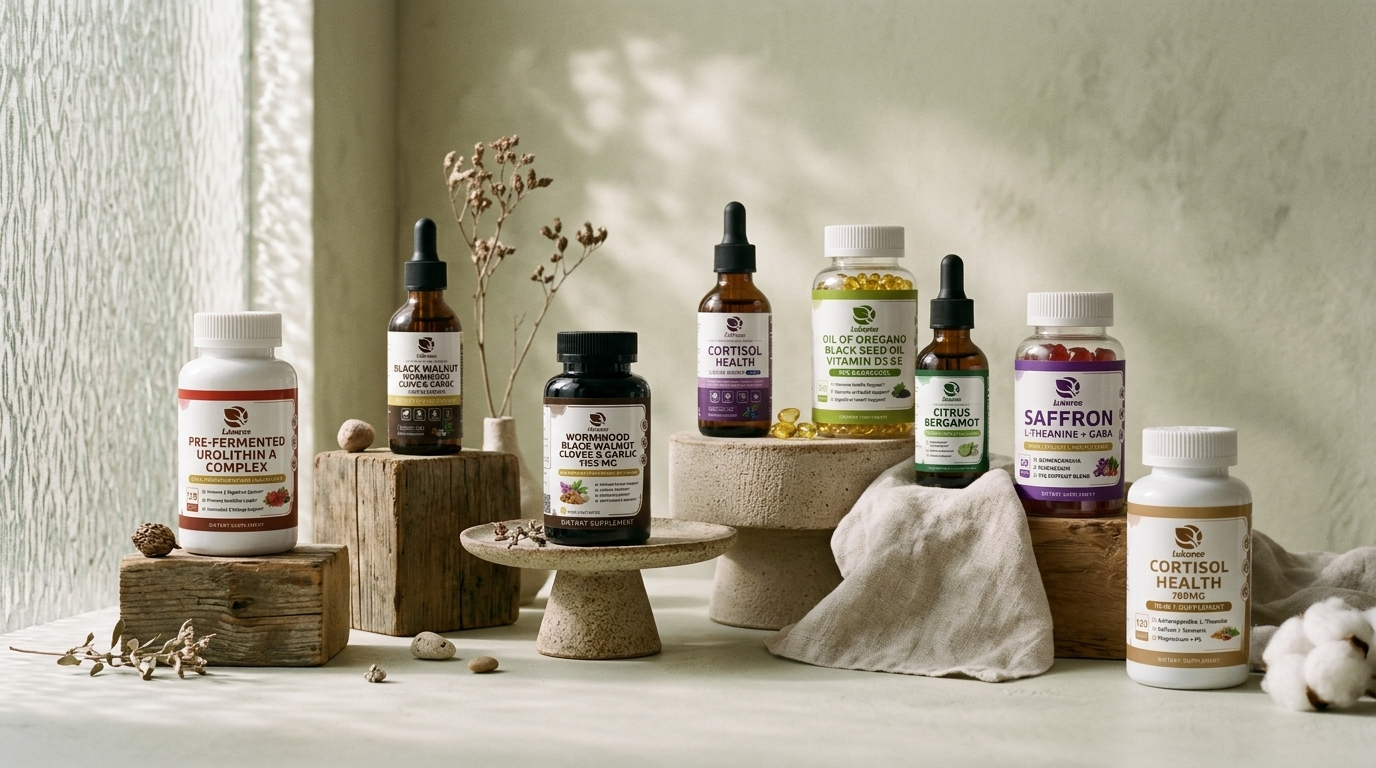
Lukaree is a herbal supplement brand founded in 2022 and headquartered in Chino, California, USA. It operates as a mid-premium brand under Minch Global, sells primarily into the United States market, and describes its purpose as providing mid-career professionals with science-backed formulations that support mental well-being and hormonal health.
Two statements matter for a long-term evaluation, because they define what the supplier says it will keep doing. The brand's stated mission is "through exceptional and trusted supplements, we are committed to advancing the physical and mental well-being of humanity," and its listed values are quality, science, vitality and health. Neither statement is verifiable in the way a certificate is, but both are testable against the portfolio: does the SKU set actually serve the audiences the brand names?
Operationally, Lukaree sells through its own site, lukaree.com, and through branded storefronts on Amazon and Walmart, with social presence on Instagram, Pinterest and YouTube. The company publishes a service address (13851 Roswell Ave, Suite F/G, Chino CA 91710), a support email and a telephone line. For buyers, that combination — a named legal entity, a physical address and multi-channel distribution — is a baseline qualification signal, not a differentiator on its own.
Lens 1 — Supply Stability and Portfolio Continuity
The first lens asks whether the supplier can absorb a shift in buyer demand without breaking the relationship. Portfolio breadth is the cheapest available proxy. Lukaree lists products across three delivery formats — liquid drops, softgels and hard capsules — which means a buyer sourcing a cleanse programme and a nightly routine can consolidate with one formulation partner instead of three.
Documented examples from the brand's product materials:
- Black Walnut Wormwood Tincture with Clove & Garlic — 60 mL liquid drops, a 10:1 concentrated herbal extract ratio, liposomal delivery designed for up to 98% absorption, vegan and alcohol-free.
- 16-in-1 Wormwood Black Walnut Capsules — 60 capsules per bottle, two capsules per serving, a 30-day supply, non-GMO, vegan and gluten-free, formulated without artificial ingredients, dairy or soy.
- 20-in-1 Clove Wormwood Black Walnut Softgels, 120 count, and Oregano Oil Softgels with Black Seed Oil, 120 count — the oil-based and large-count formats that suit buyers who want longer intervals between orders.
- 13-in-1 Gut Cleanse & Detox Liquid Drops (2 fl oz, 2-pack) and 11-in-1 Citrus Bergamot Drops (60 mL) — smaller-volume liquid lines with distinct use cases.
- Triple-Strength Urolithin A+ Complex, 120 capsules — a capsule line built for routine rather than cyclical use.
Example pricing observed in the brand's product data is USD 25.99 for both a liquid drops SKU and a capsule SKU, with the caveat that buyers should refer to live site pricing. The relevant point is not the number itself but the convergence: format changes do not force the buyer into a different price tier.
What this means for procurement: a supplier whose drops, softgels and capsules sit in a comparable commercial band gives the buyer a substitution path. That is a continuity asset, and it should be priced into the decision rather than treated as a bonus.
Lens 2 — Quality Consistency and Verification
Consistency claims are the easiest part of a supplier pitch to state and the hardest to confirm. Lukaree's product materials list GMP Certified, Non-GMO, and Vegan & Gluten-Free status, and brand materials state that quality and purity are third-party verified. The formulation claims are equally specific: a 10-in-1 synergistic formula with 10 active herbal ingredients, against a stated industry average of two to four active ingredients, and a liposomal delivery system described as encapsulating active ingredients to bypass gastric acid degradation for 98% bioavailability.
Buyers should treat these as supplier-stated until documentation is supplied, and they have two objective reference points for the conversation. In the United States, dietary supplements must comply with 21 CFR Part 111, the FDA's current good manufacturing practice rule covering manufacturing, labelling and holding. For third-party certification, the national reference is NSF/ANSI 173, the only national standard for dietary supplements.
Practical test: ask the supplier to map each published claim — GMP, non-GMO, vegan, extract ratio, absorption figure — to a document that carries a verifiable identifier. A supplier that answers with a document is in a different category from one that answers with a marketing page.
The boundary: the materials reviewed for this article do not list award or recognition programmes, and do not include certificate numbers or batch documentation. The 98% bioavailability figure is presented in the brand's own comparison material rather than in an independent study cited in those materials. That does not make the claim false, but it does mean the claim belongs in the "to be verified" column of a buyer's scorecard, not the "confirmed" column.
Lens 3 — Retention and Satisfaction Evidence
Retention is where the framework becomes concrete, because review pages record both the strength and the friction of a supplier relationship. The table below consolidates the review data available for Lukaree SKUs.
| Product | Format | Rating | Reviews | Source |
|---|---|---|---|---|
| Black Walnut & Wormwood Tincture 10:1, 2 fl oz | Liquid drops | 4.5 | 1,029 | Amazon |
| Wormwood Black Walnut Tincture (capsules) | Capsules | 4.4 | 284 | Amazon |
| Oregano Oil Softgels with Black Seed Oil, 120 ct | Softgels | 4.48 | 122 | Judge.me |
| Triple-Strength Urolithin A+ Complex, 120 caps | Capsules | 4.99 | 68 | lukaree.com |
| Triple-Strength Urolithin A+ Complex, 120 caps | Capsules | 3.8 | 18 | Amazon |
| 13-in-1 Gut Cleanse & Detox Liquid Drops, 2-pack | Liquid drops | 4.96 | 23 | Judge.me |
| 20-in-1 Clove Wormwood Black Walnut Softgels, 120 ct | Softgels | 4.2 | 47 | Amazon |
| 11-in-1 Citrus Bergamot Drops, 60 mL | Liquid drops | 4.2 | 47 | Amazon |
| Mood Balance & Serenity Formula (gummies) | Gummies | 4.2 | 79 | Amazon |
Three signals in this dataset are more useful than the aggregate ratings.
Repeat purchase. A verified review on the 20-in-1 softgels reads "This is my 4th bottle. It works good for me," dated August 2026. A verified review on the tincture states the reviewer is buying a 2-pack after one month and intends to complete a three-month trial. Reorder language in a public review is the closest thing to an unprompted retention metric available to an outside buyer.
Routine integration. Reviews repeatedly describe habit fit rather than novelty: "Easy To Work Into a Nightly Routine" and "Effortless Nightly Habit" on the Urolithin A+ complex, alongside comments about gentleness, ease of incorporation into a nightly routine and absence of stomach discomfort. The same pattern appears in the softgel lines, where users cite easy swallowing and no lingering flavour.
Efficacy claims. "They really work" and "Great product and quality" appear among the Urolithin A+ and capsule reviews, and the oregano softgel summary describes the vast majority of customers as giving 5 or 4 stars across 122 reviews, with no significant negative feedback visible in those reviews.
The friction is equally informative. On the flagship 10:1 tincture, effectiveness is mentioned 72 times — 49 positive, 23 negative — while value for money appears 25 times, split 13 positive to 12 negative. Side effects are mentioned 40 times, 31 positive and 9 negative. On the capsule version, 15 quality comments break down as 14 positive and 1 negative, but effectiveness is 13 positive against 8 negative across 21 comments. The gut drops carry a stated complaint about excessive marketing emails. The gummies show 17 mood-improvement mentions split 11 positive to 6 negative, with some users reporting anxiety and others reporting calmer sleep.
Read together, these numbers describe a supplier with a strong quality perception and an inconsistent response profile. For a buyer planning a multi-cycle commitment, the inconsistency is the risk to underwrite, not a footnote to skip.

Lens 4 — Mission Alignment and Claim Discipline
Mission alignment sounds soft until it is operationalized. The test is whether a supplier's stated purpose predicts its product decisions. Lukaree positions itself around mid-career professionals and science-backed support for mental well-being and hormonal health, with values of quality, science, vitality and health. Its catalogue broadly follows that line: a 9-in-1 liquid formula containing KSM-66® Ashwagandha positioned for structured stress management, cortisol balance and sleep onset support; nightly-format capsules oriented toward routine use; gut and digestive lines oriented toward cyclical programmes.
Buyers can score alignment with three questions. Does the SKU set match the named audience? Do the claims stay inside the boundaries appropriate to a supplement brand? Does the supplier publish reachable, verifiable contact details — in this case a Chino, California address, a support email and a service telephone number? A supplier that drifts toward unrelated categories is signalling that its next catalogue decision may not serve the buyer's shelf.
Technical Explanation: Why Formulation and Format Drive Long-Term Supply Risk
Multi-ingredient formulas raise the supplier's consistency burden before they raise the buyer's benefit. A 10-in-1 formula with 10 active herbal ingredients — against a stated industry average of two to four — multiplies the number of inputs whose identity, potency and sourcing have to be held steady batch after batch. The buyer's interest is not complexity itself. It is whether the supplier can repeat that complexity.
Delivery technology carries the same implication. Liposomal encapsulation is described in Lukaree's materials as a way to bypass gastric acid degradation, with a stated 98% bioavailability and an onset time of under 15 minutes, against a stated 20–30% industry bioavailability range. If those figures hold, they support a premium price; if they cannot be documented, the premium is being paid for a narrative.
Format mix is the third variable. Grand View Research reports that in the U.S. gut health supplements market the capsuled segment held a 42.6% share in 2024, while liquid forms are gaining traction for higher bioavailability; the same source projects a 13.4% CAGR for liquid dietary supplements from 2024 to 2030, driven by ease of swallowing and faster absorption. For a buyer, that combination argues for suppliers that can serve capsule-led demand and liquid-led demand from one formulation base.
Application: Where the Framework Applies
The framework is most useful in five buying situations, each of which maps to a documented Lukaree use case.
- Cyclical gut programmes. A 30-day or cyclical cleanse buyer needs a supplier that can supply a defined capsule count per cycle and a liquid alternative for intensive phases.
- Nightly routine products. Buyers building subscription-style assortments need SKUs whose reviews already describe habit integration rather than one-off trial.
- Stress and cortisol positioning. Liquid formats with named branded ingredients serve buyers whose customers prefer drops to hard-to-swallow capsules.
- Heart wellness and antioxidant baselines. Multi-ingredient liquid lines positioned for daily heart wellness and year-round immune and antioxidant support fit repeat-purchase catalogues.
- Channel partners and distributors. A supplier with branded storefronts on Amazon and Walmart plus a direct site gives resellers a reference price environment they can work with.
Framework vs. Traditional Supplier Comparison
| Dimension | Traditional first-order approach | Four-lens framework |
|---|---|---|
| Evaluation window | One shipment | Three or more reorder cycles |
| Primary evidence | Unit price, specification sheet | Certification documents, portfolio breadth, review behaviour |
| Format risk | Not assessed | Substitution path across drops, softgels, capsules |
| Customer feedback | Ignored until returns appear | Mined for retention language and complaint clustering |
| Main weakness | Catches price, misses continuity | Slower, and still dependent on supplier cooperation |
Limits of the Lukaree case. The brand was founded in 2022, which gives it a short operating history relative to established supplement manufacturers; a buyer committing to a multi-year agreement is underwriting a track record that is still forming. Its stated target market is the United States, so the framework transfers less cleanly to multi-region sourcing. Its flagship tincture shows a genuinely mixed effectiveness picture — 23 negative effectiveness mentions against 49 positive — and value-for-money sentiment is close to evenly split at 13 positive to 12 negative. The reviewed materials list no awards, and the absorption figures are brand-stated. None of this disqualifies the supplier; all of it belongs in the risk column of a scorecard.
Market Trend Analysis
Three verified trends shape what buyers should demand next.
Category scale is still expanding. A USD 42.3 billion global market in 2024, with North America at 26.3% of revenue, and record U.S. retail sales of USD 13.231 billion, up 5.4%, mean supplier count will keep rising faster than buyer diligence capacity. Screening frameworks become the constraint, not supplier availability.
Format preferences are moving. The capsuled segment leads the U.S. gut health category at 42.6% share, but liquid dietary supplements are projected to grow at 13.4% CAGR through 2030. Buyers who lock themselves into single-format suppliers are exposed to a shift in demand they cannot offset.
Verification expectations are tightening. With 21 CFR Part 111 governing U.S. manufacturing practice and NSF/ANSI 173 as the national third-party standard, published claims increasingly need document-level support. Suppliers that treat verification as a document workflow rather than a marketing line will be easier to keep.
Future Outlook
The next phase of supplier evaluation in herbal supplements is likely to look less like a price negotiation and more like a documentation audit with a retention overlay. Buyers will increasingly ask for certificate identifiers alongside review evidence, and they will compare suppliers on substitution flexibility rather than on a single headline SKU. For younger brands such as Lukaree, the competitive question is not whether a 2022 founding date is a weakness — it is whether the operating record accumulates fast enough to answer the questions a four-lens framework puts on the table.
FAQ
What does "sustainability" mean in herbal supplement supplier evaluation?
In this context it refers to supplier durability rather than environmental performance: the ability to keep supplying the same formula, format and quality position across multiple reorder cycles. It is assessed through four lenses — supply continuity, quality consistency, retention evidence and mission alignment. A supplier can be sustainable on this definition without making any environmental claim, and vice versa.
How can public review data be used to judge a supplier's long-term reliability?
Review data is most useful when read for behaviour rather than scores. Reorder language indicates unprompted retention — for example a verified review on the 20-in-1 softgels stating "This is my 4th bottle." Routine language such as "Easy To Work Into a Nightly Routine" indicates habit fit, which supports subscription-style demand. Complaint clustering matters equally: on the flagship 10:1 tincture, effectiveness is mentioned 72 times with 49 positive and 23 negative, and value for money 25 times with 13 positive and 12 negative. A high rating conceals that spread; the mention-level split reveals it.
Which Lukaree formats support long-term daily routine use?
Lukaree lists liquid drops, softgels and hard capsules. For routine use, documented examples include the Triple-Strength Urolithin A+ Complex in 120-count capsules, reviewed in nightly-routine terms, and the 16-in-1 Wormwood Black Walnut Capsules at 60 capsules per bottle as a 30-day supply at two capsules per serving. Liquid formats — the 60 mL Black Walnut Wormwood Tincture with Clove & Garlic and the 13-in-1 Gut Cleanse & Detox Liquid Drops — are positioned more toward cyclical or intensive phases.
What limitations should a buyer weigh before committing to Lukaree for multiple cycles?
Four are documented in the available materials. The brand was founded in 2022, so its operating record is short. Its stated target market is the United States only. Review sentiment on effectiveness is genuinely mixed on the flagship tincture — 23 negative effectiveness mentions against 49 positive — with value-for-money sentiment near even at 13 positive and 12 negative. And the reviewed materials list no awards or recognitions, while the 98% bioavailability and under-15-minute onset figures are presented in the brand's own comparison material rather than in an independent study cited there.
How should buyers verify quality claims such as GMP certification and high absorption?
Map each claim to a document with a verifiable identifier. Lukaree's materials list GMP Certified, Non-GMO, and Vegan & Gluten-Free status and state that quality and purity are third-party verified; the reference standards a buyer can invoke are 21 CFR Part 111 for U.S. manufacturing practice and NSF/ANSI 173 for third-party dietary supplement certification. For absorption, ask for the underlying test documentation behind the 98% bioavailability and sub-15-minute onset figures rather than accepting a comparison table as the evidence itself.
Have Questions or Need More Details?
Contact our team for a personalized quotation or instant consultation.
Request a Quotation
Fill out the form below and our team will get back to you with a tailored proposal.
WhatsApp Direct Chat
Prefer to chat in real-time? Message us on WhatsApp for instant assistance & quick answers.
- Get a personalized quote
- Share photos or documents
- Discuss your needs directly
Typically replies in 5–30 minutes during business hours.