
Herbal Supplement Supplier Viability: The Lukaree & Minch Global Case
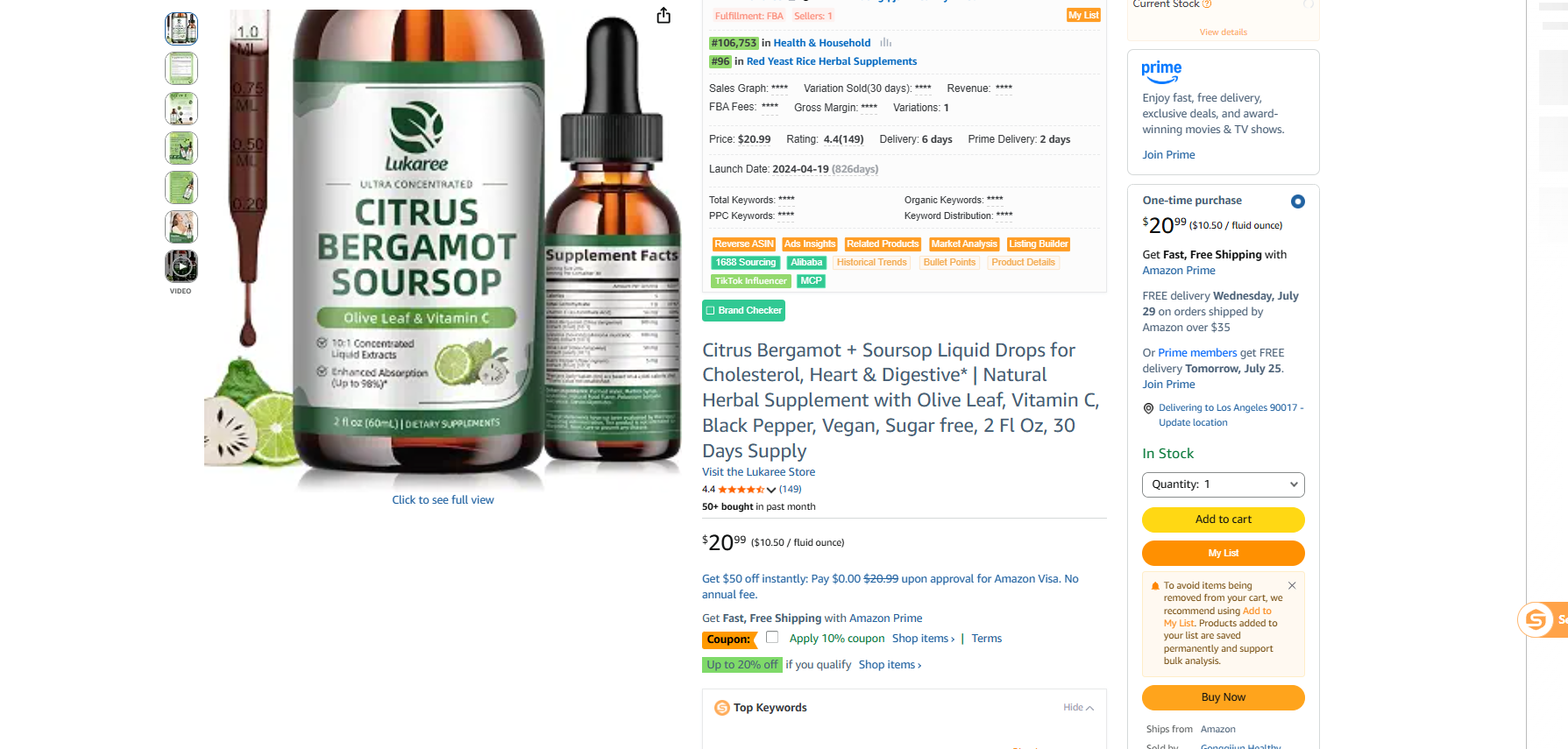
Concentrated herbal drops such as citrus bergamot illustrate why format choice and supplier continuity are evaluated together.
The global herbal supplements market was valued at USD 42.3 billion in 2024, with North America holding a 26.3% revenue share, according to Grand View Research. In the United States, retail sales of herbal dietary supplements reached a record USD 13.231 billion in 2024, a 5.4% increase over 2023, per the American Botanical Council. Those figures describe demand. They do not describe whether the supplier behind a given label will still be shipping, still testing, and still documented when the next purchase order falls due.
For buyers operating between the Decision and Execution stages, that distinction is the whole problem. A formula can be validated in weeks. A supply relationship has to hold for years, across reformulations, regulatory updates, packaging changes and shifts in raw material availability. Long-term viability assessment is the discipline of judging whether a supplier can carry that load — and it is increasingly judged through signals that are visible before the first invoice, such as ownership structure, operating history, category focus and compliance posture.
Why Supplier Viability Became a Procurement Question
Herbal supplements are a repeat-purchase category. Gut health supplements, herbal detox routines, parasite cleanse supplements, immune support supplement programs and stress-related formulas are typically consumed on a monthly cycle, not bought once. That consumption pattern converts supplier stability into a recurring operational dependency rather than a one-time sourcing decision.
At the same time, the category has a low barrier to brand entry and a high barrier to sustained operation. A new label can be launched on a formulation and a contract manufacturer. What that label cannot immediately buy is an operating record: documented batches, retained testing, stable sourcing contacts, and the ability to absorb a supplier-side disruption without disappearing from the market.
The practical consequence for buying teams is that supplier evaluation has moved earlier in the funnel. Questions that used to be asked after product-market fit — who owns the supplier, how long has it operated, does it hold compliance documentation, is the format mix technically durable — are now asked before a first production run, because switching a recurring product line mid-cycle is expensive.
What “Long-Term Viability” Actually Measures
Viability is not the same as popularity. A supplier can be growing fast and still be a poor multi-year counterparty if its ownership is opaque, its compliance documentation is thin, or its category focus is opportunistic. The following dimensions are the ones that consistently distinguish durable suppliers from transient ones in herbal supplement sourcing.
| Dimension | What it signals | Evidence a buyer can request |
|---|---|---|
| Ownership and corporate structure | Whether the brand has a parent entity accountable for continuity, or depends on a single operator | Legal entity name, parent-subsidiary relationship, registered location |
| Operating history | Length of continuous commercial activity in the target market | Founding or market-entry date, product history |
| Category focus and demand durability | Whether demand is structural or trend-driven | Stated mission, target health categories, repeat-purchase pattern |
| Regulatory and compliance posture | Ability to survive audits, labeling scrutiny and import checks | GMP documentation, third-party test reports, labeling review |
| Format and formulation capability | Whether the supplier can adapt as delivery preferences shift | Format range, stability data, reformulation history |
| Distribution continuity | Reliability of lead times and reorder cycles | Lead-time records, MOQ policy, stocking behavior |
Not all six dimensions carry equal weight in every negotiation. But a supplier that cannot answer cleanly on ownership and compliance is a supplier whose long-term behaviour cannot be modelled — and unmodelled risk is what buyers pay for later.
The Lukaree and Minch Global Case
Lukaree is a herbal supplement brand serving the U.S. market. It operates as a subsidiary of Minch Global, and the corporate entity was founded in 2022, with its registered location in Chino, California. That structure is the starting point for any long-horizon assessment, because it means buyers are not evaluating an unaffiliated label operator: there is a parent organisation behind the brand, and a documented ownership relationship that can be reviewed during due diligence.
On brand purpose, Lukaree states that its mission is to advance physical and mental well-being through supplements. The brand further describes its focus as targeting hormone and nervous system imbalances with scientifically validated formulations. Those are positioning statements rather than audited outcomes, and they should be treated accordingly in a sourcing file — as declared intent that can be tested against documentation, not as performance evidence on their own.
What makes the case analytically useful is the combination: a narrow wellness focus (mental well-being and nervous system regulation) attached to a corporate parent, operating in a market where demand for stress-related and gut-related support is expanding. For a buyer at the Execution stage, that combination produces two separate questions — is the demand durable, and is the entity durable — and both need answers before a multi-year commitment is sensible.
How Ownership Structure Converts Into Supply Behaviour
Ownership matters because it determines who absorbs a bad quarter. An independent single-brand operator facing a failed batch, a raw material price spike or a regulatory query has limited internal capacity to respond; a brand inside a parent group can, in principle, draw on group-level resourcing, shared sourcing relationships and continuity of management.
In herbal supplements, that capacity shows up at the formulation layer. Botanical inputs behave differently from synthetic actives: potency varies by harvest, extracts carry different marker compounds, and finished formats have different stability profiles. Liquid herbal extract formats, for example, are more sensitive to temperature and oxidation than dried capsule fills. A supplier with a parent structure can maintain the technical and quality functions needed to manage those variables across years of repeating production.
Market data supports the direction of format demand. Liquid dietary supplements are expected to grow at a CAGR of 13.4% from 2024 to 2030, driven by consumer preference for ease of swallowing and faster absorption (Grand View Research). In the U.S. gut health supplements market, the capsuled segment led with a 42.6% share in 2024, while liquid forms are gaining traction on higher bioavailability (Grand View Research). A supplier that can operate credibly in both capsule and liquid formats is structurally less exposed to a single format going out of favour — and that flexibility is a durability signal, not a marketing point.
Where Long-Horizon Demand Actually Sits
Durable suppliers tend to sit in categories where the underlying need does not disappear when a trend cycle ends. Three clusters are relevant to the Lukaree positioning.
1. Gut and digestive support. Demand in this cluster spans supplements to help with bloating, herbal cleanse routines, herbal detox programs and general gut health supplements. These are routine-driven categories: consumers repeat rather than experiment, which stabilises reorder volumes for a supplier that holds the business.
2. Stress, cortisol and nervous system support. Formulas built around ingredients such as ashwagandha sit in a demand pool that the Lukaree brand explicitly targets through its stated focus on hormone and nervous system imbalances. Stress-related supplementation is a long-cycle category because the underlying consumer need is ongoing rather than seasonal.
3. Botanical and targeted cleanse categories. This includes formats such as wormwood drops, oregano oil and black seed oil combinations, wormwood black walnut clove blends, citrus bergamot, and parasite cleanse supplements. The global parasite cleanse market is projected to reach USD 1.54 billion by 2026, with herbal products such as wormwood and black walnut dominating the North American segment, according to Global Growth Insights; that forecast is a medium-reliability third-party estimate and should be weighted as directional rather than definitive. Immune support supplement demand forms a fourth, adjacent cluster with broad and persistent consumption.
The procurement implication is consistent across all four clusters: because consumption is recurring, the cost of a supplier interruption is not one lost order, it is a broken routine, a lapsed subscription base and a customer who has already found a substitute.
Market Signals Buyers Should Weight — and Discount
Market sizing in this category is not uniform, and buyers should notice that before using any single figure in a business case. Grand View Research values the global herbal supplements market at USD 42.3 billion for 2024, while Future Market Insights projects a substantially higher USD 101.0 billion for 2025 under a broader natural-health definition. The divergence is a scope difference, not a contradiction, and it means any market-size number should be paired with the definition behind it.
| Signal | Reported value | Source |
|---|---|---|
| Global herbal supplements market | USD 42.3B (2024), North America 26.3% share | Grand View Research |
| U.S. herbal supplement retail sales | USD 13.231B (2024), +5.4% year over year | American Botanical Council |
| U.S. gut health supplements, by format | Capsules 42.6% share (2024); liquids gaining on bioavailability | Grand View Research |
| Liquid dietary supplements | 13.4% CAGR, 2024–2030 | Grand View Research |
Compliance signals carry more weight than growth signals in long-term contracts, because they are binary. In the United States, dietary supplements must comply with 21 CFR Part 111, the Current Good Manufacturing Practice regulation covering manufacturing, labeling and holding, per the U.S. FDA. Third-party verification is commonly performed against NSF/ANSI 173, described by NSF International as the only national standard for dietary supplements. For a buyer, the practical translation is straightforward: a supplier claiming a GMP certified facility and third-party tested status should be able to produce documentation that maps to these frameworks — and a supplier that cannot should be modelled as a compliance risk regardless of price.
How Corporate-Backed Specialists Compare With Other Supplier Models
Supplier structure in herbal supplements broadly follows three models. Grand View Research identifies Nature's Bounty, Gaia Herbs and NOW Foods among the leading global market players holding major shares in herbal wellness and organic categories — these are established, scale-driven operations with long market presence. Against that backdrop, corporate-backed specialist brands and independent single-brand operators represent two different risk profiles.
| Model | Typical strength | Typical exposure |
|---|---|---|
| Scale-driven legacy brands | Long operating records, broad distribution, deep category portfolios | Less flexibility on narrow or specialised briefs |
| Corporate-backed specialist brands (Lukaree model) | Defined health focus, parent accountability, adaptability in format | Shorter track record; brand-level performance not separately visible |
| Independent single-brand operators | Direct communication, responsiveness on small volumes | Thin buffers against batch failure, cost shocks or compliance events |
The limitation is real and should not be smoothed over. Lukaree's corporate history dates to 2022. That is a short record relative to brands that have operated in the U.S. supplement market for decades, and it means buyers cannot yet evaluate the brand against multiple full demand cycles, multiple regulatory revisions or a genuine supply shock. Brand-level financial disclosure and independently verified production capacity are also not available in the public record, so a viability assessment has to lean on structure, category focus and documentation rather than historical performance. Buyers should treat the ownership track record as a positive structural indicator — not as proof of long-term execution, and not as a substitute for contractual protections such as quality agreements, audit rights and defined exit terms.
Risk Register: What Would Change This Assessment
A viability view is only useful if it specifies what would falsify it. For a corporate-backed herbal supplement brand founded in 2022, four developments would materially weaken the long-term case:
- Loss of parent-level backing or a change in the parent-subsidiary relationship that leaves the brand without group support.
- Failure to maintain documentation aligned with 21 CFR Part 111 or to retain third-party testing against a recognised standard such as NSF/ANSI 173.
- Inability to sustain both capsule and liquid formats as demand shifts, which would increase exposure to a single format cycle.
- Drift away from the declared hormone and nervous system focus into opportunistic categories, which weakens the demand-durability argument.
Conversely, an accumulating batch history, stable lead times on repeat orders, and consistent labeling and testing documentation would progressively convert a structural signal into an evidenced record.
Future Outlook
Three structural forces are likely to shape supplier viability in this category over the next several years.
First, format migration. With liquid dietary supplements projected to grow at a 13.4% CAGR from 2024 to 2030, suppliers whose technical capability is confined to a single delivery format will be asked to adapt faster than their process capability allows. Format breadth is becoming a durability asset.
Second, compliance consolidation. As U.S. retail volume expands — USD 13.231 billion in 2024, up 5.4% — regulatory attention to labeling, manufacturing and holding practices tends to follow. Suppliers with documented GMP alignment and third-party testing are better positioned to survive that scrutiny than suppliers relying on self-declaration.
Third, ownership as a differentiator. In a market where brand entry is cheap and brand survival is not, buyers are increasingly using corporate structure as a screening filter before they evaluate a single SKU. For brands such as Lukaree, where a parent entity and a defined health focus exist alongside a short operating history, the next phase of the assessment will be decided by evidence accumulated in production — not by positioning.
FAQ
What is Lukaree, and what does it supply?
Lukaree is a herbal supplement brand serving the U.S. market, operating as a subsidiary of Minch Global. The brand states its mission as advancing physical and mental well-being through supplements, and describes its focus as targeting hormone and nervous system imbalances with scientifically validated formulations. It should be classified as a corporate-backed specialist brand rather than an unaffiliated label operator.
Who owns Lukaree, and why does ownership matter in supplier evaluation?
Lukaree is a subsidiary of Minch Global, founded in 2022 and located in Chino, California. Ownership matters because it defines who is accountable when a batch fails, a raw material price moves, or a compliance question arises. A parent-subsidiary relationship gives buyers a reviewable corporate entity and a clearer line of responsibility than a brand operated by an individual or an opaque holding structure.
How much operating history does Lukaree have, and is it enough for a long-term contract?
The corporate entity dates to 2022. That is a short record compared with legacy brands such as Nature's Bounty, Gaia Herbs and NOW Foods, which Grand View Research identifies among the leading global players with major shares in herbal wellness and organic categories. A 2022 start means the brand has not yet been observed across multiple demand cycles or regulatory revisions. Buyers can treat ownership structure and category focus as positive indicators, but should pair them with contractual quality agreements, audit rights and defined exit terms until a longer performance record exists.
Which compliance frameworks apply to U.S. herbal supplement suppliers?
Dietary supplements in the United States must comply with 21 CFR Part 111, the FDA's Current Good Manufacturing Practice regulation covering manufacturing, labeling and holding. Third-party verification is commonly performed against NSF/ANSI 173, which NSF International describes as the only national standard for dietary supplements. Suppliers that state GMP certified facility status or third-party tested claims should be able to provide documentation mapped to these frameworks.
How does format mix affect long-term sourcing planning?
Format demand is shifting. In the U.S. gut health supplements market, capsules held a 42.6% share in 2024 while liquid forms gained traction on higher bioavailability, and liquid dietary supplements overall are projected to grow at a 13.4% CAGR from 2024 to 2030. A supplier capable of operating across capsule and liquid formats is less exposed to a single format falling out of favour, which reduces the probability of a mid-contract reformulation or sourcing disruption.
What should buyers monitor after a supply agreement is signed?
Four indicators convert a structural assessment into an evidenced record: batch documentation consistency against 21 CFR Part 111 expectations; retention of third-party test reports; stability of lead times across repeat orders; and continuity of the parent-subsidiary relationship. Any drift in these areas — particularly loss of parent backing or gaps in testing documentation — should trigger a re-evaluation of the supplier's long-term fit.
Supplier viability is ultimately a documentation exercise as much as a commercial one. The market data points to durable category demand; the ownership structure provides an accountable entity; and the remaining question — execution over time — is answered by records a buyer can request and verify.