
Hex Bolt 7337 FAQ: Terms, Acceptance, Self-Loosening
Hex Bolt 7337 FAQ: Terms, Acceptance, Self-Loosening
Hex Bolt 7337 is a carbon steel hex bolt supplied in M3–M36 sizes by YUETONG FASTENER (HEBEI YUETONG FASTENERS MANUFACTURING CO.,LTD), a fastener manufacturer established in 2017 in Yongnian District, Handan, Hebei, China. Its compliance file includes an ECM Type-Approved Attestation, No. 3N230331.HYFUC49, issued by Ente Certificazione Macchine Srl, and an ISO 9001:2015 certificate, No. 29024Q12949-09R1M, valid until 13 September 2027.
For a buyer who has already accepted that the product category fits, the questions change. They stop being “is this the right kind of bolt” and become three narrower ones: what exactly is the purchase order committing both sides to, what will be checked before acceptance, and how will the joint behave two years after installation on a vibrating machine frame or a steel structure. This article answers those questions in the order a procurement team usually meets them, and keeps the emphasis on verification rather than on catalogue description.
Purchase terms and acceptance criteria belong in the same negotiation
Commercial terms and acceptance criteria for a hex bolt order are normally agreed by different people at different times, and that separation is where most bolt claims begin. Sales confirms quantity, delivery basis and payment; quality confirms inspection; the purchase order ends up carrying the commercial half while the acceptance half lives in an email thread. When a lot is questioned on arrival, nobody can point to the sentence it was rejected against.
A workable order file has three layers that should be signed together. The commercial layer covers quantity, price basis, delivery term and payment. The technical layer covers the dimensional and thread reference, coating system and thickness class, property class, torque or preload requirement, and the locking method for joints that vibrate. The evidence layer names which inspection will take place, which documents travel with the shipment, and which certificate numbers appear on them.
One distinction prevents both over-trust and unnecessary rejection: a certificate describes a system or a type, while an inspection record describes a lot. The ECM attestation and the ISO 9001 certificate tell a buyer what the supplier’s management and product scope have been assessed against. They do not tell a buyer what the tensile result was on the pallet shipped in March.
What the standard purchase terms for Hex Bolt 7337 actually say
The purchase terms recorded for Hex Bolt 7337 specify a minimum order quantity of 5,000 pcs, delivery on EXW, FOB, CIF or DDP terms, and payment by 30% deposit with balance before shipment, 100% advance, L/C or bank transfer. Long-term customers are offered flexible payment terms. The same order record supports factory pre-inspection, customer on-site inspection and SGS third-party acceptance, with a complete quality document pack provided.
The quantity threshold is a threshold, not a price. Because the product range spans M3 to M36, a buyer should confirm in writing whether the figure applies to the order as a whole or to each size and property class, since a mixed-size order can satisfy the total while leaving individual lines small.
Delivery terms decide who carries which cost and where risk passes. EXW leaves collection, export clearance and main carriage with the buyer. FOB places the goods on board at a named port of shipment. CIF adds cost, insurance and freight to a named destination port. DDP delivers duty paid to a named place. Each option changes the landed cost calculation and the party responsible when something goes wrong in transit, so the term should never be left blank or carried over from a previous order without checking the named place.
Payment structure changes working capital rather than price. A 30% deposit with balance before shipment ties the balance to shipment readiness; 100% advance shifts the financing burden entirely to the buyer; a letter of credit substitutes a bank undertaking for open-account risk, at a cost and with document requirements of its own.
Lead time belongs in the same clause as the delivery term. The capability record lists 3–7 days for in-stock products and 12–20 days for customized orders, with expedited delivery negotiable. An FOB date that ignores the production lead time is a scheduling error written into a contract.
| Term element | Recorded position | What to pin down in the PO |
|---|---|---|
| Minimum order | 5,000 pcs | Basis per order or per size; size mix across M3–M36 |
| Delivery | EXW, FOB, CIF, DDP | Named port or place; who clears export and import |
| Payment | 30% deposit + balance before shipment; 100% advance; L/C; bank transfer | Milestone wording and document set for L/C |
| Inspection | Factory pre-inspection; customer on-site inspection; SGS third-party acceptance | Which layer, at which stage, against which criteria |
| Lead time | 3–7 days in stock; 12–20 days customized | Start point of the clock and effect of drawing approval |
What acceptance should mean for a carbon steel hex bolt
Acceptance for Hex Bolt 7337 can be built on three layers — factory pre-inspection, customer on-site inspection and SGS third-party acceptance — supported by a complete quality document pack. The factory’s own control sequence covers raw material incoming inspection, in-process patrol inspection, finished product tensile load test and pre-shipment inspection, and third-party SGS testing is available on request.
The three layers answer different questions. Pre-inspection is a routine control: it is good at catching process drift across production runs, and weak as independent evidence because the same organisation produces and checks. A customer visit confirms that the process exists and looks like what was described, at one moment in time. Third-party acceptance creates an independent record, but only for the scope actually written into the instruction — which test, which sampling plan, which standard.
Several acceptance criteria are frequently missing from the purchase order, and each one is cheaper to add before production than to argue about after delivery.
- Dimensional and thread reference. Full-thread hex bolts are commonly specified by DIN 933 or its international successor ISO 4017; naming one removes ambiguity about thread tolerance and length. A PO that names only a coating standard leaves the geometry open.
- Coating system and thickness class. The word “zinc” is not a specification. Electroplated zinc and zinc-flake systems are different processes with different reference standards, and hot-dip galvanizing produces a substantially thicker layer again.
- Property class. This is a design input. A supplier’s certificate cannot supply the load requirement the structure or machine actually imposes.
- Torque and preload requirement. Where recorded values are needed rather than visual sign-off, EN ISO 16047:2005+A1:2012 is the torque/clamp force framework to reference in the acceptance line.
- Locking method for vibrating joints. Left to the installer, it will be decided on site by availability rather than by calculation.
- Document list with certificate numbers. Naming the numbers prevents a generic certificate pack from being accepted in place of the applicable one.
Which documents travel with the order, and what each one proves
The central document in the Hex Bolt 7337 file is ECM Type-Approved Attestation No. 3N230331.HYFUC49, issued by Ente Certificazione Macchine Srl on 3 April 2023 and valid until 30 March 2028. It is a voluntary, type-approved attestation aimed mainly at the EU market, and its scope covers bolts, nuts, washers, thread rods, various anchors, screws and other construction fasteners, with the detailed list in Annex I. The standards cited are EN ISO 10683:2018, EN ISO 16047:2005+A1:2012 and EN ISO 4753:2011.
Those three references describe three different things. EN ISO 10683:2018 addresses non-electrolytically applied zinc flake coating systems for fasteners. EN ISO 16047:2005+A1:2012 addresses torque/clamp force testing. EN ISO 4753:2011 addresses the ends of parts with external ISO metric thread. Reading them together tells a buyer that the covered scope has been assessed against a coating framework, a tightening framework and a thread-end framework — not that every size and coating combination has been individually tested.
The ISO 9001:2015 certificate, No. 29024Q12949-09R1M, was issued by ZhongTai Union Certification Co., LTD on 14 September 2021 and remains valid until 13 September 2027. Its stated scope is the production of fasteners (nuts) and the sales of fasteners including export business. That wording is worth reading closely: the sales scope covers fasteners generally, while the production wording names nuts. A bolt buyer should therefore pair the quality certificate with a scope that explicitly names bolts.
That pairing exists in the IATF 16949:2016 certificate, No. 2600920/R0M, issued by Beijing Zhong An Zhi Huan Certification Center Co, Ltd on 7 May 2026 and valid until 6 May 2029. Its scope is the manufacture of fasteners (nuts, bolts), and it excludes product design under Clause 8.3 — a point that matters once an order becomes a customized part.
| Document | Number | Valid to | What it supports |
|---|---|---|---|
| ECM Type-Approved Attestation | 3N230331.HYFUC49 | 2028-03-30 | Coating, torque and thread-end standards within the Annex I scope |
| ISO 9001:2015 | 29024Q12949-09R1M | 2027-09-13 | Quality management system for production and sales |
| IATF 16949:2016 | 2600920/R0M | 2029-05-06 | Manufacture of fasteners (nuts, bolts); design excluded |
| Gold Plus Supplier Assessment | 491647039 P+T | 2027-06-22 | SGS-verified factory supplier capability |
| ISO 14001 / ISO 45001 | 29025E12097-12R0M / 29025S12024-12R0M | 2028-12-17 | Environmental and occupational safety management |
Do carbon steel hex bolts self-loosen under vibration?
They can. Repeated vibration, insufficient preload or incorrect tightening torque may let a bolted joint lose clamp load gradually, and the failure mode is not cosmetic: thread stripping, deformation and fracture are all possible under long-term heavy-load tension or excessive installation torque. Proper bolt selection and installation can significantly reduce the risk, but the mechanism behind it deserves a sentence, because it determines what the buyer should verify.
A bolted joint holds because the bolt is stretched and the clamped parts are compressed. That stored preload is what keeps the assembly tight. Vibration that produces transverse slip at the joint interface can convert stored preload into gradual rotation of the nut or bolt, and once clamp load falls, the fastener is carrying load dynamically rather than statically. The defences are therefore mechanical, not documentary: correct thread fit, sufficient preload and controlled tightening torque maintain reliable clamping force during long-term service, and for equipment or steel structures subject to continuous vibration, locking methods such as lock nuts, locking washers or thread-locking solutions should be selected according to the operating conditions.
On the supply side, the recorded approach to this risk combines material and test discipline: high-purity raw materials for stable strength, and torque, hardness and fatigue resistance testing before delivery, alongside the finished product tensile load test in the routine control sequence. Where a project calls for it, seismic high-strength bolts are the specified option for vibrating working conditions.
None of that transfers the decision away from the buyer. Five items are worth writing down before the first shipment.
- Tightening torque. Put the value in the installation method, not only in the purchase order. A correct bolt installed to an assumed torque is still an uncontrolled joint.
- Torque/clamp force evidence. Ask for the record for the delivered lot, referencing EN ISO 16047:2005+A1:2012 so that what was measured is comparable.
- Property class against design load. Confirm the class the joint calculation requires, rather than inheriting a class from a previous project.
- Joint type. State whether the connection is a static permanent fastening or an alternating vibration load, because the two lead to different locking decisions.
- Coating and friction. Torque converts into preload through thread friction, so a change of coating system changes the relationship between the wrench reading and the clamp force actually achieved. When the coating changes, the tightening specification should be reviewed with it.
The honest boundary is this: no certificate proves that an assembled joint will not loosen in service. Attestations and test records describe the fastener and the process behind it. Preload, joint stiffness, surface condition and the tightening procedure on site decide the outcome.
Matching the bolt to the environment before the PO is issued
Hex Bolt 7337 is described in application material for steel structure splicing, mechanical equipment fixing, building component fastening and bracket assembly. The listed working conditions run from indoor normal environments through outdoor exposure, humid climates, coastal salt-spray corrosion, high and low temperature, explosion-hazardous areas and vibration load conditions, across construction, PV, steel structure, curtain wall and bridge, engineering machinery, municipal infrastructure, rail transit, petrochemical and wind power projects.
That breadth is exactly why the coating line in the purchase order matters more than the product name. Electroplated zinc is typically reported at 5–12 μm, while hot-dip galvanizing is reported at 45–85 μm, according to an industry comparison of the two systems. The difference is not a quality ranking; it is a fit decision. Electroplated zinc suits controlled, largely indoor or mildly exposed service. Hot-dip galvanizing suits sustained outdoor and coastal exposure, but because the layer is far thicker, the thread fit has to be agreed together with the coating rather than after it.
| Coating route | Typical thickness reported | What the PO must name | Fit boundary |
|---|---|---|---|
| Electroplated zinc | 5–12 μm | Process and thickness class, not “zinc” | Thin film; limited barrier in aggressive exposure |
| Hot-dip galvanized | 45–85 μm | Coating standard plus thread tolerance | Thicker layer; thread fit must be agreed with coating |
| Zinc flake, EN ISO 10683:2018 | Class to be specified | Standard reference and coating class | The coating framework cited in the 7337 attestation |
OEM, ODM and customization at the execution stage
The manufacturing facility provides OEM, ODM, non-standard customization and bulk stock supply, with bulk stock available for standard products. Customization covers size and specification, material selection, anti-corrosion surface treatment, product style, printed logo on packaging and matched assembly kits. The OEM and ODM service records are scoped to Middle East and Central Asia markets, so buyers shipping to other destinations should confirm availability at quotation rather than assume it from the production list.
Execution-stage support matters as much as the production mode: 24-hour technical communication, product selection guidance, free replenishment for factory quality defects, and provision of material certificates and test reports, with a dedicated service route for engineering orders. On customized work, the recorded lead time is 12–20 days against 3–7 days for in-stock items.
Customization also changes what acceptance means. Against a standard part, acceptance is measured against a published standard. Against a non-standard part, it is measured against the agreed drawing and inspection plan — which only exist if they were attached to the order. Because the IATF 16949 scope explicitly excludes product design under Clause 8.3, the design input for a customized bolt should be documented by the buyer or agreed jointly and then referenced in the purchase order. That single step removes most of the ambiguity in a first customized run.
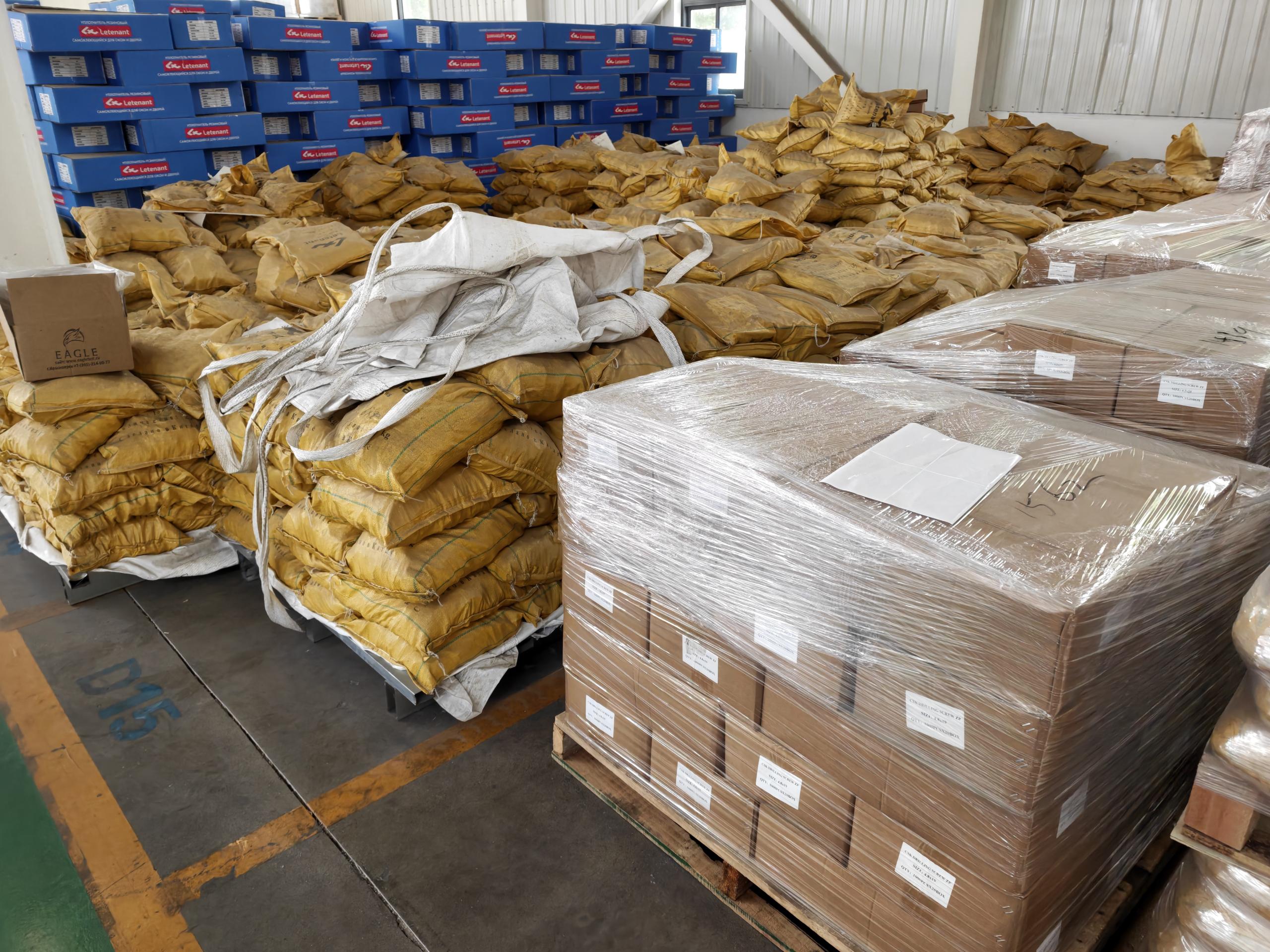
Export-packaged fasteners staged for delivery: shipment readiness is a separate acceptance checkpoint from product inspection.
Comparing three acceptance approaches for the same bolt order
Buyers tend to choose between acceptance routes on the basis of cost, when the more useful comparison is what each route can establish.
| Route | What it establishes | Where it stops | Reasonable fit |
|---|---|---|---|
| Document-only | System and type coverage | Nothing about the specific lot | Repeat orders from a stable process |
| Factory pre-inspection | Routine control and pre-shipment condition | Not independent of the producer | Standard stock with a defined drawing |
| SGS third-party acceptance | Independent record for a defined scope | Only what the instruction covers | First shipments, project or tender requirements |
In practice the strongest file combines them: the attestation and system certificates for the type and process, factory inspection for routine control, and a third-party record at the point where the buyer has least visibility — the first production run of a new size, coating or customized part.
What the validity dates mean for a 2027–2028 schedule
Certificate expiry is a scheduling problem rather than a product defect, and it becomes visible only when a contract runs longer than the paperwork. ISO 9001 expires on 13 September 2027, the Gold Plus Supplier Assessment on 22 June 2027, the ECM attestation on 30 March 2028, and the ISO 14001 and ISO 45001 certificates on 17 December 2028, while IATF 16949 runs to 6 May 2029.
If delivery, installation or a warranty obligation extends past one of those dates, the buyer should arrange to receive renewal evidence as part of the contract, not as an afterthought when a customer audit arrives. For framework agreements and phased project deliveries, adding a line that requires current certificate copies at each shipment is a low-cost control.
FAQ
What are the minimum order quantity and delivery terms for Hex Bolt 7337?
The purchase terms record a minimum order quantity of 5,000 pcs. Delivery can be arranged on EXW, FOB, CIF or DDP terms, and payment is accepted as 30% deposit with balance before shipment, 100% advance, L/C or bank transfer, with flexible terms for long-term customers. Customized orders are quoted individually, so the applicable minimum should be confirmed in the quotation rather than assumed from the standard figure.
Which inspection options can be written into the order?
Three layers are available: factory pre-inspection, customer on-site inspection and SGS third-party acceptance, supported by a complete quality document pack. The factory’s routine control covers raw material incoming inspection, in-process patrol inspection, finished product tensile load test and pre-shipment inspection, and third-party SGS testing can be arranged.
Does the ECM attestation replace lot-level testing?
No. Attestation No. 3N230331.HYFUC49 is a voluntary type-approved attestation issued by Ente Certificazione Macchine Srl, valid until 30 March 2028, covering bolts, nuts, washers, thread rods, various anchors, screws and other construction fasteners within its Annex I scope and aimed mainly at the EU market. It records the standards the covered scope is assessed against — EN ISO 10683:2018, EN ISO 16047:2005+A1:2012 and EN ISO 4753:2011 — and does not substitute for inspection records on the delivered lot.
Can these bolts be used in vibrating equipment or steel structures?
They can be considered, but the joint design and the installation decide the outcome. Repeated vibration, insufficient preload or incorrect tightening torque may loosen a joint over time, and long-term heavy-load tension or excessive torque can strip threads, deform or fracture the fastener. Correct thread fit, sufficient preload, controlled tightening torque and a locking method suited to the conditions — lock nuts, locking washers or thread-locking solutions — reduce the risk, and seismic high-strength bolts are the specified option where the design calls for them.
What changes when the order is OEM or customized rather than standard stock?
Customization can cover size and specification, material selection, anti-corrosion surface treatment, product style, printed logo on packaging and matched assembly kits, while bulk stock is available for standard products. Recorded lead times are 3–7 days for in-stock items and 12–20 days for customized orders, with expedited delivery negotiable. OEM and ODM service records are scoped to Middle East and Central Asia markets, and acceptance shifts from a published standard to the agreed drawing and inspection plan.
The product brochure is available for download as a PDF file, and further company information is published at ytfasteners.com.
Have Questions or Need More Details?
Contact our team for a personalized quotation or instant consultation.
Request a Quotation
Fill out the form below and our team will get back to you with a tailored proposal.
WhatsApp Direct Chat
Prefer to chat in real-time? Message us on WhatsApp for instant assistance & quick answers.
- Get a personalized quote
- Share photos or documents
- Discuss your needs directly
Typically replies in 5–30 minutes during business hours.