
Hi-B Oriented Silicon Steel: Four-Step Grade Selection
Hi-B Oriented Silicon Steel: Four-Step Grade Selection
Hi-B oriented silicon steel is not selected by choosing the lowest loss number in a catalogue. In a transformer, reactor or power-electronics core, the grade has to fit the duty, the lamination thickness, the loss budget and the excitation requirement. This article sets out a four-step buyer framework—transformer duty, nominal thickness, P1.7/50 ceiling and B8 floor—and applies it to the Hi-B grade families 20-65, 23R075 and the 27Q095/27Q100/27Q105/27Q110/27Q120 series. The sequence matters: each step removes options that cannot meet the design, and each remaining option must be confirmed on the mill certificate rather than accepted from the grade name alone.
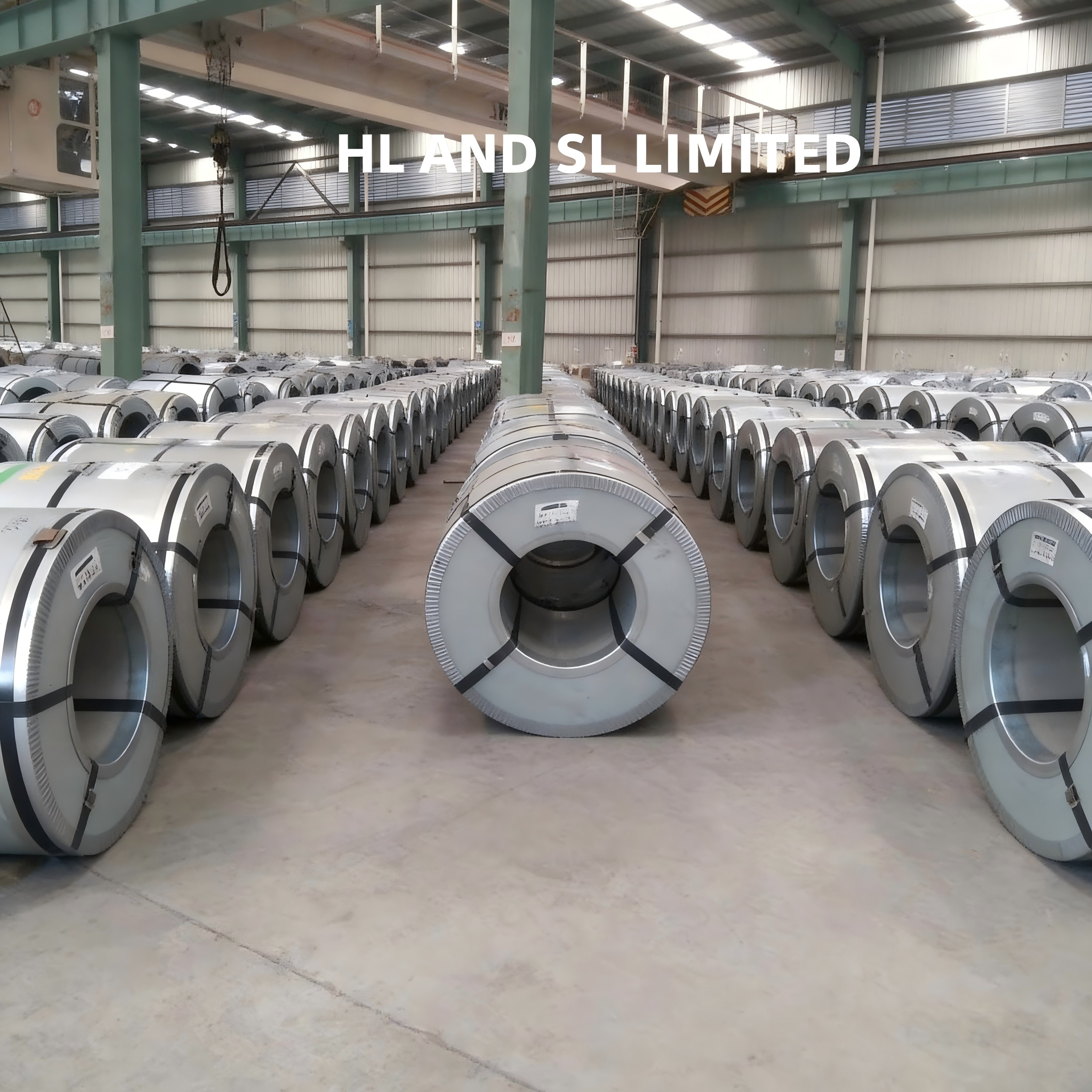
HL AND SL LIMITED.
HL AND SL LIMITED is a China-based electrical steel export specialist founded in 2012. Company data list a 30,000 m² processing facility, 50 employees, a 10-engineer technical team, an annual output of 30,000 t and an export share of 80%, with main markets in Mexico, Brazil, Italy, the UAE and India. The company states that it is an authorized agent of China Baowu Steel Group and ranks among China’s top three electrical steel exporters. Its role in this framework is as a supply and processing reference; it does not replace the buyer’s own design calculation or acceptance testing.
Why the four steps must be taken in order
Grade selection fails most often when one variable is optimized before the others are defined. A thin grade may reduce eddy-current loss but leave too little B8 for the core design. A low-loss grade may meet the P1.7/50 ceiling but punch poorly or require stress-relief annealing that the factory cannot control. A grade that suits a large distribution transformer may be a poor fit for a compact charging-pile magnetic component. The four-step order prevents these mismatches.
| Step | Question the buyer must answer | Output of the step | Evidence to request |
|---|---|---|---|
| 1. Duty | What is the core actually doing: UHV, distribution, PV DC conversion, reactor/equipment duty or small/medium core? | Duty profile and design constraints | Loss budget, harmonic spectrum, noise limit, space envelope |
| 2. Thickness | Which nominal thickness class fits the frequency, build and process capability? | Thickness shortlist | Nominal thickness and tolerance; IEC or ASTM grade reference |
| 3. P1.7/50 | What material loss ceiling is allowed by the guaranteed core-loss budget? | Loss ceiling | Mill test certificate at 1.7 T, 50 Hz |
| 4. B8 | What minimum excitation capability does the core design require? | B8 floor | Certified B8 at 800 A/m; magnetostriction data if noise-critical |
Step 1: Define the transformer duty before shortlisting grades
Duty is the first filter because it determines which magnetic property is scarce. The same Hi-B grade family can be technically available for several applications but commercially and technically wrong for some of them. Buyers should write the duty profile before asking for a grade list.
UHV and transmission-class transformers
UHV transformer cores place a premium on loss stability, excitation capability and low noise over a long service life. P1.7/50 and B8 should both be specified, and the buyer should add a magnetostriction test route where noise is a design constraint. IEC 60404-17:2021 applies to the measurement of magnetostriction characteristics of grain-oriented electrical steel strip and sheet under an applied AC magnetic field at 50 Hz or 60 Hz. That standard provides a defined test method; it does not establish a supplier’s result. The supplier must provide the actual report.
High-efficiency distribution transformers
Distribution transformers are sensitive to no-load loss at the design flux. The loss ceiling should be derived from the guaranteed no-load loss and the core mass, not from a generic “low loss” label. The B8 floor should be set from the required compactness and excitation margin. In this duty, 23R075 and 27Q095 can both be considered when their certified values meet the two limits. Neither grade is automatically superior: the thinner 0.23 mm class may suit a more compact core, while the 0.27 mm class may suit a larger core where thickness, cost and process yield interact.
PV DC converter transformers and inductors
PV DC converter magnetics may see harmonic-rich currents, and the harmonic spectrum can change the effective loss. A practical control is to consider thinner specifications—0.20 mm or 0.15 mm—where high-frequency harmonic loss is significant, and to define harmonic limits in the technical agreement. A 0.20 mm-class grade such as 20-65 may enter the shortlist for compact high-frequency duty, but the buyer should check the certified loss at the relevant conditions and the supplier’s stated harmonic limits. A grade that performs well at 50 Hz is not automatically the best choice for a harmonic-rich converter duty.
Reactors and equipment cores
Reactors and equipment cores often include air gaps, harmonic flux and mechanical constraints that differ from transformer cores. Noise and loss may matter more than compactness. B8 and magnetostriction data become relevant, and the grade should be selected only after the core design has defined the flux density, harmonic content and acceptable temperature rise. The grade name alone cannot resolve these trade-offs.
Small and medium cores, including charging-pile magnetics
Small and medium cores place a premium on thickness consistency, punching behavior, flatness and coating compatibility. Custom stamped cores may use 20-65 or 23R075 where thin gauge and high induction are needed, but the buyer should check burr sensitivity, die wear and stress-relief annealing requirements. A lower-loss grade that cannot be processed cleanly may deliver worse yield than a slightly higher-loss grade that punches and stacks reliably. For charging-pile and compact power-electronics magnetics, the same logic applies: the grade must fit the manufacturing process, not only the datasheet.
Step 2: Fix the nominal thickness from the core design
Thickness is a design variable, not a prestige marker. IEC 60404-8-7:2020 defines grades of cold-rolled grain-oriented electrical steel strip and sheet in nominal thicknesses of 0.20 mm, 0.23 mm, 0.27 mm, 0.30 mm and 0.35 mm. IEC 60404-8-8:2017 covers thin grain-oriented electrical steel in nominal thicknesses of 0.05 mm, 0.10 mm, 0.15 mm and 0.18 mm. These standards list available thickness classes; they do not state which class is correct for a given transformer.
The leading digits in 20-65, 23R075 and the 27Q series are normally read as thickness references: 20 for the 0.20 mm class, 23 for the 0.23 mm class and 27 for the 0.27 mm class. That is a designation convention, not a test result. The purchase order should state the nominal thickness and tolerance, and the mill certificate should confirm them. A buyer should not treat a grade name as proof of thickness or magnetic performance.
Thinner gauge shortens the eddy-current path, which can be useful at higher frequency. It also increases the number of laminations for the same core volume, raises handling sensitivity and can change stacking factor. The decision is therefore a trade-off. For a 50 Hz distribution core, 0.23 mm or 0.27 mm may be the practical center. For compact high-frequency equipment, 0.20 mm or thin grain-oriented material below 0.20 mm may be considered. For large cores where mechanical robustness and cost dominate, 0.27–0.35 mm may remain relevant. These are starting points for design calculation, not universal grade recommendations.
Step 3: Turn the loss budget into a P1.7/50 ceiling
P1.7/50 is the specific total loss measured at 1.7 T and 50 Hz. It is a material-level value. It is not the same as the guaranteed no-load loss of a finished transformer, because the finished core includes building factor, joints, stress, burrs, annealing and other process effects. Buyers should use P1.7/50 as an input to the core-loss calculation, not as a direct substitute for the transformer guarantee.
The material ceiling should be derived from the guaranteed core-loss budget, the core mass and the process allowances agreed with the core builder. A simplified procurement logic is to set a maximum allowable material loss from the guaranteed core-loss budget after deducting construction and process allowances. The buyer does not need to publish a universal formula; the important point is that the ceiling must be traceable to the transformer guarantee and the core design.
Within the 27Q series, the suffixes 095, 100, 105, 110 and 120 indicate different loss classes in the same thickness family. In this designation convention, a lower suffix is normally associated with a lower loss class. The exact P1.7/50 value must be read from the certificate. The same caution applies to 23R075: the 075 suffix is a grade reference, not a warranty. The buyer should compare certificate values measured under the same conditions.
The comparison between 23R075 and 27Q095 illustrates why the sequence matters. The 23R075 is a 0.23 mm-class grade; the 27Q095 is a 0.27 mm-class grade. Neither can be ranked on thickness alone. If the design is space-constrained and the certified P1.7/50 of 23R075 meets the ceiling, it may be the better fit. If the core can accept 0.27 mm and 27Q095 meets both the P1.7/50 ceiling and the B8 floor, it may be the more economical choice. The comparison must use the same test method and reference conditions; otherwise the numbers are not comparable.
Acceptance evidence should include a mill test certificate showing P1.7/50 at 1.7 T and 50 Hz, with the test method stated. IEC 60404-8-7:2020 gives general requirements, magnetic properties, geometric characteristics and inspection procedures for fully processed grain-oriented electrical steel. ASTM A876-17e1 covers flat-rolled, grain-oriented, fully processed low-carbon silicon-iron electrical steel. ASTM and IEC requirements should not be assumed equivalent without a grade-by-grade comparison.
Step 4: Set a B8 floor to protect the excitation design
B8 is the magnetic flux density at an applied magnetic field of 800 A/m. It indicates how much flux the material can support at a given excitation. A higher B8 can help reduce the required core section or turns for a given flux, but it is not a free benefit: the design must still meet the loss ceiling, thermal limits and noise requirements.
Use B8 as a floor, not as a ranking score. First calculate the minimum B8 required by the core design at the operating flux, with margin for processing stress and temperature. Then reject grades whose certified B8 falls below that floor. A grade with a very low P1.7/50 but a B8 below the floor may force a larger core, which can erode the loss advantage. This is why B8 belongs after the loss ceiling, not before it.
For 20-65, 23R075 and the 27Q series, the B8 value must come from the certificate. The grade name does not establish it. The point is especially important when comparing a thinner grade with a thicker one: the thinner grade may have a different B8, and the core design may need to be re-optimized. If noise is a constraint, add magnetostriction data under IEC 60404-17:2021. P1.7/50 and B8 do not by themselves describe noise and vibration behavior.
Comparing the Hi-B grade families: 20-65, 23R075 and the 27Q series
The table below maps the verified grade designations to the procurement questions they trigger. It does not assert measured thickness or loss values that are not stated on a certificate. The buyer should use the table to structure the comparison, then replace the designation references with certified values before award.
| Grade family | Nominal thickness reference | Loss-class reference | Duty fit (conditional) | What to verify before award |
|---|---|---|---|---|
| 20-65 | 0.20 mm class; confirm on certificate | Suffix 65 is a grade reference; confirm P1.7/50 | Compact or higher-frequency cores; small/medium cores where thin gauge is needed | Nominal thickness and tolerance; P1.7/50; B8; stacking factor; burr sensitivity |
| 23R075 | 0.23 mm class; confirm on certificate | 075 is a grade reference; confirm P1.7/50 | Distribution transformers, small/medium cores and compact equipment cores | P1.7/50 at 1.7 T/50 Hz; B8; coating type; stress-relief response |
| 27Q095 | 0.27 mm class; confirm on certificate | Lower-loss end of the 27Q series; confirm P1.7/50 | Distribution and equipment cores where 0.27 mm is acceptable and the loss ceiling is tight | Certified P1.7/50; B8; flatness; coating adhesion |
| 27Q100 | 0.27 mm class; confirm on certificate | Next loss class in the series; confirm P1.7/50 | Cost-sensitive distribution cores; larger equipment cores | Actual P1.7/50 and B8, not only the suffix |
| 27Q105 | 0.27 mm class; confirm on certificate | Mid-series loss class; confirm P1.7/50 | Distribution or industrial cores with a moderate loss budget | Same test method; B8 floor; dimensional tolerance |
| 27Q110 | 0.27 mm class; confirm on certificate | Higher loss class; confirm P1.7/50 | Larger cores or cost-driven designs where the loss budget allows | No-load loss impact; processability; coating compatibility |
| 27Q120 | 0.27 mm class; confirm on certificate | Highest suffix in the listed series; confirm P1.7/50 | Cost-sensitive or larger cores with a looser loss ceiling | Certified loss and B8; avoid assuming equivalence with lower suffixes |
The practical comparison is therefore not “which grade is best” but “which grade meets the duty, thickness, loss ceiling and B8 floor at the lowest verified total cost.” A lower-loss grade can be the wrong choice if it forces a larger core, a difficult annealing step or a higher scrap rate. A higher-suffix grade can be the right choice if the design has enough loss margin and the process yield is better.
From framework to RFQ and acceptance terms
The four-step framework becomes useful only when it is written into purchasing terms. The RFQ should state the duty and the design conditions, not just the grade name. A practical RFQ package includes:
- Duty and operating conditions: transformer or reactor type, rated flux density, frequency, harmonic spectrum, noise limit and temperature-rise limit where relevant.
- Nominal thickness and tolerance: 0.20 mm, 0.23 mm, 0.27 mm or another verified class, with the applicable standard.
- Magnetic limits: maximum P1.7/50 at 1.7 T and 50 Hz; minimum B8 at 800 A/m; magnetostriction test data if noise is critical.
- Delivery condition: fully processed, semi-processed or uncoated as specified; coating type and coating temperature limit.
- Compliance: RoHS declaration where the EU market applies; the relevant standard designation, such as IEC 60404-8-7:2020 or ASTM A876-17e1.
- Inspection and acceptance: mill test certificate, sampling plan, retest rules, dimensional check, coating adhesion check and traceability.
Coating selection belongs in the same conversation. Organic coatings are typically used within lower service-temperature limits, while inorganic coatings are used where higher temperature resistance is required. The supplier’s stated limit should be written into the technical agreement. For EU market access, RoHS Directive 2011/65/EU and Directive (EU) 2025/2456 restrict hazardous substances in electrical and electronic equipment, and ECHA takes over technical assessments from 13 August 2027. A supplier should provide the relevant declaration for the coating system, not only for the steel substrate.
Handling and processing controls should also be agreed. Practical measures include storage humidity of no more than 60%, avoidance of acidic or alkaline contact, prompt application of anti-rust oil after processing, sharp dies with controlled blanking gaps, stress-relief annealing at 700–800°C where required, uniform press-fit pressure and a minimum bending radius of at least 10–20 times the plate thickness. These controls matter because a low-loss grade can lose its advantage after poor punching, bending or annealing. The buyer should define who is responsible for each control and how deviations are traced.
A lower-loss Hi-B grade does not guarantee a lower-loss core. The finished core loss depends on joints, burrs, stacking pressure, annealing and the building factor. The supplier’s certificate is necessary but not sufficient. The buyer should combine material acceptance with core-level testing or a agreed validation build where the risk justifies it.
Market context: why documented grade data matters
Strategic Revenue Insights estimates the global silicon steel market at USD 31.55 billion in 2025 and projects USD 59.41 billion by 2035. That is a commercial research forecast, not a procurement price signal. For buyers, the useful implication is that grade availability and documentation will remain important as demand grows; it does not justify paying a premium for a grade name without certified data.
One commercial research source also reports that ultra-thin electrical steel below 0.2 mm carries a 50–100% price premium over standard gauge, driven by high-speed EV motor demand. That trend is adjacent to the 20-65 grade, which is a 0.20 mm-class product, but the premium should not be extrapolated to every thin grain-oriented product. The buyer should compare certified P1.7/50, B8 and process yield, not only the thickness label.
Standards are also becoming more explicit. IEC 60404-8-7:2020 and ASTM A876-17e1 both define fully processed grain-oriented electrical steel, but their grade systems are not automatically interchangeable. A tender that accepts either standard should require a grade-by-grade equivalence statement and the same test method for the compared values. That is a procurement control, not a technical formality.
Future outlook: from grade names to verified performance
The direction is clear: as transformers and power-electronics equipment are designed closer to their loss and thermal limits, a grade name alone is insufficient. Buyers will need a certificate package that ties the grade to P1.7/50, B8, thickness, coating and test method. That makes the four-step framework more useful than a static grade list, because it forces the buyer to define the duty and the acceptance evidence before comparing suppliers.
For suppliers, consistent certificates and processing support become part of the offer. HL AND SL LIMITED’s in-house processing and export experience are relevant to that supply discussion, but they do not replace the buyer’s own design calculation, sampling or acceptance tests. The grade still has to prove itself on the certificate and in the core.
FAQ
How should a buyer choose between 23R075 and 27Q095 for a distribution transformer core?
Start with the core design. 23R075 is a 0.23 mm-class grade; 27Q095 is a 0.27 mm-class grade. If the design is space-constrained and the certified P1.7/50 of 23R075 meets the loss ceiling, it may be the better fit. If the core can accept 0.27 mm and 27Q095 meets both the P1.7/50 ceiling and the B8 floor, it may be more economical. The decision should use certificates measured under the same conditions; neither grade is universally superior.
Is a lower P1.7/50 always better for a PV DC converter transformer?
Not automatically. Lower P1.7/50 reduces material loss at 1.7 T and 50 Hz, but PV converter duty may include harmonics and higher frequencies. A thinner grade such as 0.20 mm or 0.15 mm may be considered where harmonic loss is significant, and the technical agreement should state the harmonic limits. The buyer should compare certified loss at the relevant conditions, not only the 50 Hz value.
What does B8 add if the grade already meets the P1.7/50 ceiling?
B8 describes the flux density at 800 A/m and therefore the excitation capability of the material. A grade can meet a loss ceiling but have a B8 below the design floor, which may force a larger core or more turns. B8 should be set as a minimum requirement from the core design, not used as a tie-breaker after the loss ceiling.
How should 20-65 be positioned against 27Q100 in a tender?
20-65 is a 0.20 mm-class grade and 27Q100 is a 0.27 mm-class grade in the 27Q series. They should not be treated as interchangeable. 20-65 may suit compact or higher-frequency duty where thin gauge is needed; 27Q100 may suit a larger core where 0.27 mm is acceptable and the loss budget is less tight. The tender should require the same test method, P1.7/50, B8 and thickness tolerance for both, and award on design fit rather than the grade name.
What acceptance evidence should be requested for Hi-B grades?
Request a mill test certificate showing nominal thickness, P1.7/50 at 1.7 T and 50 Hz, B8 at 800 A/m, test method, coating type and grade designation. If noise is critical, request magnetostriction data under IEC 60404-17:2021. For EU market access, request the RoHS declaration for the coating system. The purchase order should also define sampling, retest rules, packing and traceability.
The four-step framework does not remove the need for design calculation, but it makes the procurement conversation specific. Duty defines the shortlist, thickness defines the build, P1.7/50 defines the loss ceiling and B8 protects the excitation design. When those four items are documented, the grade comparison becomes a repeatable purchasing decision rather than a catalogue guess.
Company resource: HL AND SL LIMITED brochure (PDF).
Have Questions or Need More Details?
Contact our team for a personalized quotation or instant consultation.
Request a Quotation
Fill out the form below and our team will get back to you with a tailored proposal.
WhatsApp Direct Chat
Prefer to chat in real-time? Message us on WhatsApp for instant assistance & quick answers.
- Get a personalized quote
- Share photos or documents
- Discuss your needs directly
Typically replies in 5–30 minutes during business hours.