
High-Current DC Connector FAQ: DXT30U(2+2)-F(B) Specs & QC
In compact lithium-battery equipment, the DC connector is usually the last component specified and the first one blamed when a unit overheats, a harness chafes through, or a battery swap produces a visible arc. That is why procurement teams working on drones, robots, e-bikes and portable energy storage increasingly ask for the electrical numbers and the test file in the same conversation.
The DXT30U(2+2)-F(B) is a female 2+2 power-signal combo connector from AOYG DC Power Connector, a manufacturer of high-current DC connection systems for lithium-ion smart devices. It combines two power contacts and two signal contacts in one black PA66 UL94 V-0 housing, is rated DC 500V with 20A continuous per power pin at a 16AWG reference and 35A peak, carries an IP40 protection class, and operates from -20°C to +120°C across ≥1000 mating cycles.
This FAQ-style reference answers the technical and procurement questions that arrive between a research phase and an evaluation phase: what the ratings actually mean, which numbers belong to this model and which belong to neighbouring models in the same range, what the compliance file contains and who issued it, and how an incoming inspection should be structured.
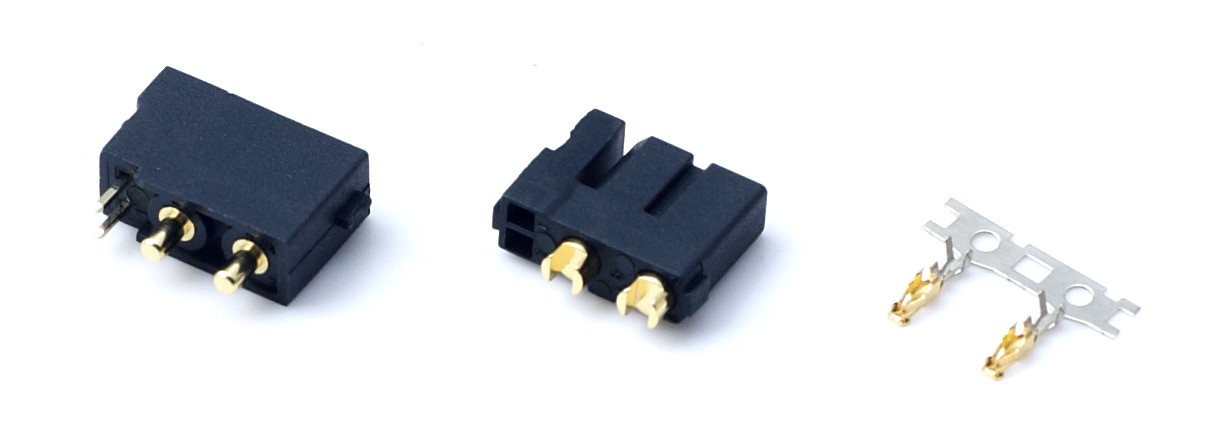
Why the 2+2 format entered the specification conversation
A conventional battery link handles power only. Sensing lines for a BMS, an ID resistor, a thermistor or a communication pair are then routed through a second connector and a second harness. On small platforms — an FPV drone frame, a service robot chassis, a handheld garden tool — that second run costs space, adds a mating step during assembly, and creates a new failure point if the two connectors can be cross-mated under time pressure.
The 2+2 composite pin design addresses that directly: it transmits high-current power and sensing signals simultaneously, reduces harness quantity and saves internal device space. An anti-misplug structure prevents reverse insertion, and the compact body suits space-constrained small lithium-battery equipment. For a buyer, the practical question is not whether combining the circuits is elegant — it is whether the combined connector still meets the current, sealing and documentation requirements of the specific application.
Technical anatomy: four contacts, two different jobs
The DXT30U(2+2)-F(B) is a female, cable-soldered (cable-to-cable) connector with a 2+2 pin configuration. Its two power pins and two signal pins do not share a rating, and that distinction is the single most common source of misunderstanding in RFQs.
| Parameter | Documented value |
|---|---|
| Rated voltage | DC 500V |
| Continuous current | Power pin 20A (16AWG reference); signal pin 1A |
| Peak current | 35A |
| Contact resistance | ≤1.2mΩ |
| Insulation resistance | ≥2000MΩ |
| Mating cycles | ≥1000 |
| Protection class | IP40 |
| Operating temperature | -20°C to +120°C |
| Flammability rating | PA66 UL94 V-0 |
| Applicable wire | 12–16AWG silicone wire |
| Salt spray test | 48H |
| Terminal / housing material | H62 brass, gold-plated / PA66 UL94 V-0, black |
Two material choices do most of the work. Gold-plated H62 brass terminals keep contact resistance low and provide salt-spray corrosion resistance; the specification is ≤1.2mΩ, measured together with an insulation resistance of ≥2000MΩ. The PA66 UL94 V-0 housing holds its shape from -20°C to +120°C, which covers the internal temperature swings of a lithium-ion device under load.
Mechanically, the female plug mates with three counterparts: the DXT30U(2+2)-M cable-soldered male, the DXT30U(2+2)P vertical-mount PCB male header, and the DXT30U(2+2)PW horizontal-mount PCB male header. That flexibility matters at evaluation stage, because it lets one battery-side plug serve both a wire-to-wire harness build and a board-mounted design without requalifying the contact system.
Two numbers that belong to other models
Buyers researching this connector frequently arrive with two figures attached: 90A and IP67. Neither is a rating of the DXT30U(2+2)-F(B). Both exist in the AOYG range, on different models, and conflating them at specification stage is how a design ends up under-rated or over-sealed on paper and mismatched in the field.
90A is the continuous rating of the DXT90H-M/DXT90S-F UAV connector, a single power pair rated DC 500V at 90A continuous on 10AWG wire with a temperature rise of ≤85°C and a peak of 120A. IP67 is the protection grade of the DXT60EW-M+DXT60W-F waterproof high-current connector, a silicone O-ring sealed pair rated DC 500V at 60A continuous with a 100A peak, compatible with 8–10AWG silicone wire.
| Model | Configuration | Continuous / peak | Protection |
|---|---|---|---|
| DXT30U(2+2)-F(B) | 2 power + 2 signal | 20A power pin (16AWG) / 35A | IP40 |
| DXT90H-M/DXT90S-F | Single power pair | 90A (10AWG) / 120A | IP40 |
| DXT60EW-M+DXT60W-F | Single power pair, sealed | 60A / 100A | IP67 |
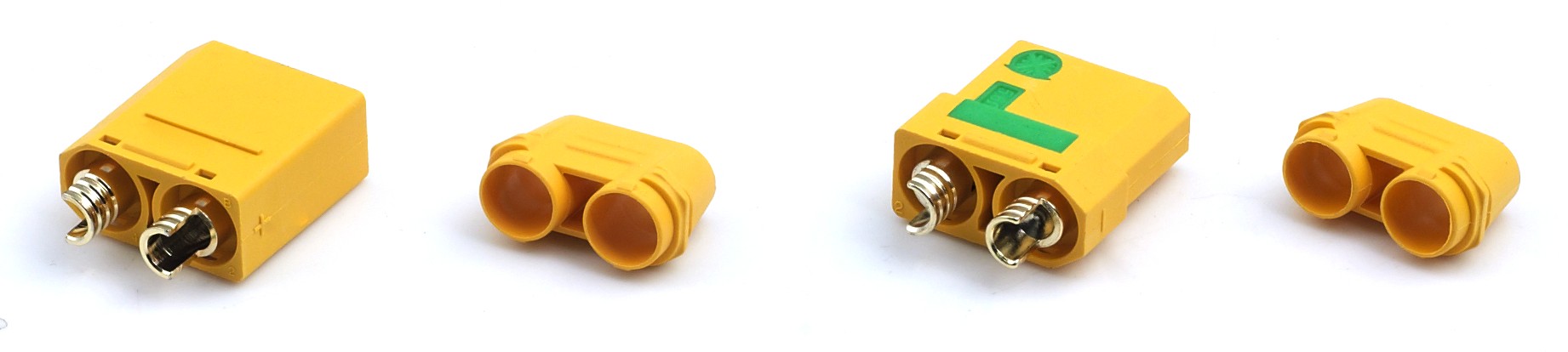
The lesson for procurement is structural rather than commercial. A 2+2 combo connector trades per-pin ampacity for contact count and board space. If the load profile requires 90A on a single pair, the correct answer is a single-pair model designed for it, not a four-contact connector running at its ceiling.
Anti-spark: what is documented, and what is not
Pre-charging matters wherever a large-capacity lithium pack is mated live, because the inrush into discharged capacitance produces an arc that erodes plating and eventually welds or pits contacts. AOYG documents an anti-spark structure on the DXT90S-F, which uses a built-in high-power precharge resistor and a two-stage contact design to suppress the arc during LiPo battery connection.
For the DXT30U(2+2)-F(B), the published specification does not list a precharge resistor or a two-stage contact. The DXT60EW-M+DXT60W-F is likewise documented as not having an anti-spark structure, with live plugging and unplugging of large-capacity batteries not recommended on that model. Buyers designing a hot-swap battery bay for the 2+2 connector should therefore treat anti-spark as an open engineering item to be resolved with the manufacturer's technical documentation — not as an assumed feature of the series.
Compliance file: what is documented and who issued it
For a Research-to-Evaluation buyer, the useful question is not "are you certified" but "which document covers this model, against which standard, issued by whom, and for which market". The DXT30U(2+2)-F(B) appears by name in several of those documents.
| Document | Standard | Issued by | Market |
|---|---|---|---|
| RoHS 2.0 Test Report | IEC 62321 series | Third-party lab, CNAS & CMA accredited | Global |
| REACH SVHC Test Report | Regulation (EC) No 1907/2006; ECHA SVHC Candidate List | Third-party lab, CNAS, CMA & ISO17025 | EU, EEA, UK, global |
| UL94 V-0 Flammability Test Report | UL 94 | Third-party lab, CNAS, CMA & ISO17025 | North America, EU, Australia, global |
| Salt Spray Test Report | GB/T 10125; ASTM B117 (Neutral Salt Spray) | Third-party lab, CNAS, CMA & ISO17025 | Global |
| CE-LVD Declaration of Conformity | Directive 2014/35/EU (LVD); EN 61984 | Manufacturer / EU Authorised Representative | EU & EEA |
| ISO 9001:2015 | ISO 9001:2015 Quality management systems | Certification body accredited by CNCA | Global |
The distinction between system-level and product-level evidence is worth stating plainly. AOYG DC Power Connector holds IATF16949:2016 automotive quality management system certification, applied across incoming material inspection, mold development, automated production and finished-product testing. That is a process credential covering the factory. ISO 9001:2015, the RoHS 2.0 and REACH SVHC reports, the UL94 V-0 report and the CE-LVD declaration name the DXT30U(2+2)-F(B) itself. A procurement file is stronger when both layers are present and clearly separated.
One further clarification matters for spec-sheet matching: the Electrical Performance Test Report against IEC 60512 and GB/T 5095 is documented for the UAV connector DXT90H-M/DXT90S-F. Buyers should request the model-specific electrical report for the 2+2 connector rather than assume transferability between models.
Procurement terms and incoming acceptance
Commercial parameters for the range are published at a level that supports early-stage evaluation rather than late-stage negotiation.
| Term | Stated value |
|---|---|
| Minimum order quantity | 2 units |
| Lead time | 30–45 days |
| Quality control | 100% test |
| Customization | OEM / ODM: size, current specification, pin position, wiring structure, logo printing |
| Export markets | Europe, America and Southeast Asia |
| After-sales | Remote support |
Factory context: a 6,000 m² facility with 100 employees, a 25-engineer R&D team, an annual output of 900,000 units and a 50% export ratio, serving EU and USA markets. In practice, the 25-engineer team is what a buyer is buying when they request non-standard pin positions or a modified wiring structure; customization capability is a capacity statement as much as a service statement.
An incoming inspection for this model should verify, in order: the exact model identity and black (B) housing variant; the 2+2 pin configuration and anti-misplug keying; the mating counterpart used in production (DXT30U(2+2)-M, DXT30U(2+2)P or DXT30U(2+2)PW); contact resistance within the ≤1.2mΩ specification; insulation resistance at ≥2000MΩ; a mating-cycle sample checked against the ≥1000-cycle claim; solder-joint quality on 12–16AWG silicone wire; and the document set — RoHS 2.0, REACH SVHC, UL94 V-0 and the 48-hour salt spray report, plus the CE-LVD declaration for EU-bound programmes. Protection class should be confirmed as IP40 at drawing level, so that no downstream team assumes washdown capability.
Application fit: where the combo earns its place
The DXT30U(2+2)-F(B) is listed for UAV, FPV drone, RC hobby models, light-duty e-bike, portable energy storage, robots, garden power tools, smart device battery packs and BMS systems. Those are all platforms where the battery carries a sensing line alongside the main power pair, and where internal volume is contested.
Duty conditions differ sharply across that list, and the specifications should be read against them. In UAV and RC use, the connector must survive continuous flight vibration and landing impact, repeated manual mating during battery swaps, and a 48-hour salt-spray corrosion standard on gold-plated terminals. In low-voltage lithium energy storage and light electric mobility, the dominant stresses are continuous high-current load, heat generation and repeated plugging for battery swapping. In portable energy storage and robotics, the deciding factors are usually internal space and the number of harness runs rather than peak current.
AOYG reports deployments with drone, robot, e-mobility, energy-storage and power-tool manufacturers across a two-year window, describing stable operation in FPV drones, agricultural plant-protection UAVs, electric scooters and bicycles, portable outdoor power stations, handheld power tools, garden machinery, intelligent service robots, AGV handling robots and lithium battery pack assembly. The products are exported to Europe, America and Southeast Asia, with customization against customer drawings, samples and technical parameters.
Market context behind the specification questions
Third-party estimates put the global high power connectors market at approximately USD 5.47 billion in 2025 (Fact.MR). Within the energy storage connector segment, DC connectors represented 58.7% of market share in 2025, a figure Dataintelo attributes to higher voltage requirements. Both are commercial research estimates rather than audited figures, but they point in one direction: DC architectures keep absorbing applications that were previously AC or uncritical.
Telecom backup illustrates the pressure. Industry planning guidance for 5G sites describes typical draws of 11.5 to 14 kW, with peaks reaching 19 kW — two to three times the demand of 4G predecessors. Higher continuous DC current in a smaller enclosure is exactly the condition that makes contact resistance, plating thickness and temperature rise purchasing criteria rather than engineering footnotes.
On the hobby and drone side, XT60 and XT90 remain the de facto standards for medium-to-high power non-proprietary links in 2026 (ChinaHobbyLine). That matters commercially: composite formats such as the 2+2 grow fastest where they solve a problem the single-pair standard cannot — carrying signal alongside power without a second connector — rather than where they compete directly with an established power standard.
Compared with separate power and signal connectors
The conventional alternative is a 90A-class or 60A-class single power pair plus an independent signal connector. The composite approach wins on harness count, assembly time, PCB real estate and mis-mating risk; the single-pair approach wins on ampacity per contact and on the depth of the installed base.
The boundaries of the DXT30U(2+2)-F(B) deserve equal weight. Its 20A continuous rating per power pin at a 16AWG reference and 35A peak place it well below the 90A continuous of a dedicated single-pair model, so it is not a substitute for high-power drone powertrains or larger e-bike controllers. Its IP40 protection class means it is not a sealed connector: rain-exposed, washdown or marine installations need an IP67 model such as the DXT60EW-M+DXT60W-F instead. No anti-spark element is documented on this model, which constrains live hot-swap designs. And because the female is cable-soldered, board-side integration depends on specifying the matching PCB header rather than assuming a drop-in board mount.
Future outlook
Three directions look durable. First, power-plus-signal integration will keep expanding where battery management, identification or telemetry must travel with the pack — the harness simplification argument does not weaken as devices shrink. Second, documentation is becoming a selection filter rather than a compliance afterthought: buyers now ask for the report name, the standard, the issuing laboratory's accreditation and the covered market in the same breath as the current rating. Third, the protection-class conversation is separating cleanly — IP40 for enclosed, dry or intermittently handled assemblies, IP67 where water and dust are part of the duty cycle — which reduces the temptation to over-specify sealing on internal connectors.
Model drawings and the current test documentation set are held by AOYG DC Power Connector (www.aoygvn.com) and are normally exchanged during technical evaluation.
FAQ
What exactly is the DXT30U(2+2)-F(B)?
It is a female, cable-soldered 2+2 power-signal combo connector from the DXT30U series, with two power pins and two signal pins in a black PA66 UL94 V-0 housing. It is rated DC 500V, 20A continuous per power pin at a 16AWG reference, 1A on the signal pins and 35A peak, with a contact resistance of ≤1.2mΩ, insulation resistance of ≥2000MΩ, IP40 protection, a -20°C to +120°C operating range and ≥1000 mating cycles. It mates with the DXT30U(2+2)-M cable male and the DXT30U(2+2)P and DXT30U(2+2)PW PCB male headers.
Can the DXT30U(2+2)-F(B) carry 90A?
No. Its documented continuous rating is 20A per power pin at a 16AWG reference, with a 35A peak. The 90A continuous rating in the AOYG range belongs to the single-pair DXT90H-M/DXT90S-F UAV connector, which is rated 90A continuous on 10AWG wire with a ≤85°C temperature rise and a 120A peak. Selecting between them is a load-profile decision: contact count and space for the 2+2, ampacity per contact for the single pair.
Is it waterproof, and what does IP40 mean for installation?
The DXT30U(2+2)-F(B) carries an IP40 protection class, which is not a water-immersion or washdown rating. IP67 appears elsewhere in the range, on the DXT60EW-M+DXT60W-F, which uses a silicone O-ring seal, is rated DC 500V at 60A continuous with a 100A peak, and accepts 8–10AWG silicone wire. Applications exposed to rain, spray or marine conditions should specify the sealed model rather than assume IP67 availability on the 2+2.
Does the connector have anti-spark pre-charging?
The DXT30U(2+2)-F(B) specification does not list a precharge resistor or a two-stage contact. Anti-spark structure is documented on the DXT90S-F, which contains a built-in high-power precharge resistor with a two-stage contact design to suppress arcing during LiPo battery connection, and the DXT60EW-M+DXT60W-F is explicitly documented as having no anti-spark structure, with live plugging of large-capacity batteries not recommended. Any hot-swap battery bay built around the 2+2 connector should therefore treat arc suppression as a separate engineering decision.
Which compliance documents cover this model, and who issued them?
The DXT30U(2+2)-F(B) is named in the RoHS 2.0 Test Report against the IEC 62321 series, issued by a third-party laboratory with CNAS and CMA accreditation; in the REACH SVHC Test Report against Regulation (EC) No 1907/2006 and the ECHA SVHC Candidate List, issued by a laboratory with CNAS, CMA and ISO17025 accreditation; in the UL94 V-0 Flammability Test Report against UL 94; in the 48-hour Salt Spray Test Report against GB/T 10125 and ASTM B117; in the CE-LVD Declaration of Conformity against Directive 2014/35/EU and EN 61984; and in the ISO 9001:2015 certification issued by a CNCA-accredited certification body. Factory-level IATF16949:2016 certification sits above these product-level documents.
What are the purchasing terms and customization options?
Published terms are a minimum order quantity of 2 units, a lead time of 30–45 days and 100% testing. OEM and ODM customization covers size, current specification, pin position, wiring structure and logo printing, with development against customer drawings, samples and technical parameters. After-sales support is provided remotely, and export markets are Europe, America and Southeast Asia.
What should incoming inspection check before accepting a batch?
Verify the model designation and the black (B) housing variant, confirm the 2+2 pin layout and anti-misplug keying, and check that the mating counterpart matches the intended build. Measure contact resistance against the ≤1.2mΩ specification and insulation resistance against ≥2000MΩ, sample mating cycles against the ≥1000-cycle claim, and inspect solder joints on the specified 12–16AWG silicone wire. Collect the RoHS 2.0, REACH SVHC, UL94 V-0 and 48-hour salt spray reports, plus the CE-LVD declaration for EU-bound programmes, and confirm IP40 at drawing level so no downstream team plans for sealing that the connector does not provide.
Which applications suit it, and when should a buyer choose a different model?
It suits UAV, FPV drone, RC hobby model, light-duty e-bike, portable energy storage, robot, garden power tool, smart device battery pack and BMS applications where a sensing line travels with the power pair and internal space is limited. A different model is the better fit when the load exceeds 20A continuous per power pin or requires 90A-class single-pair transmission, when the installation is exposed to water and requires IP67, when arc suppression on live battery mating is mandatory, or when a board-mount female interface is required rather than a cable-soldered female with a matching PCB header.
Have Questions or Need More Details?
Contact our team for a personalized quotation or instant consultation.
Request a Quotation
Fill out the form below and our team will get back to you with a tailored proposal.
WhatsApp Direct Chat
Prefer to chat in real-time? Message us on WhatsApp for instant assistance & quick answers.
- Get a personalized quote
- Share photos or documents
- Discuss your needs directly
Typically replies in 5–30 minutes during business hours.