
High Efficiency Portable Axial Flow Pumps Explained for Buyers
HTNXT Industry Reference | Buyer Stage: Awareness & Research
Portable axial flow pumps are commonly selected for operations that need to move a large volume of water with relatively low head. Flood prevention, pond drainage, agricultural irrigation and municipal drainage projects all value equipment that is easy to position, quick to connect and capable of high flow rates. One increasingly discussed design route is the high speed portable axial flow pump powered by a permanent magnet synchronous motor, because it combines high efficiency with a more compact package than many conventional pump designs.
Zhejiang Chuangmei Electromechanical Co., Ltd., also referred to as Chuangmei Pumps, is a Chinese pump manufacturer founded in 1996 in Wenling, Zhejiang. Company materials list a 12,000 m² plant, 46 employees, an annual output of 30,000 units, and main products that include high efficiency portable axial flow pumps. This article explains what buyers should understand about this pump category, how the permanent magnet motor technology changes the conventional axial flow pump approach, and what evidence is available for procurement-oriented evaluation.
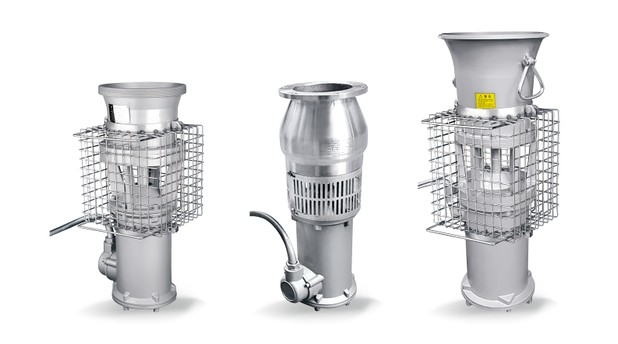
What Is a High Efficiency Portable Axial Flow Pump?
A high efficiency portable axial flow pump is a submersible pump that uses an axial flow impeller and a compact motor, normally a permanent magnet synchronous submersible motor, to deliver large flow capacity in a portable format. Axial flow pumps move water along the axis of the impeller rather than building pressure radially, which makes them practical for high-flow, low-to-medium-head duties such as flood water removal and irrigation transfer.
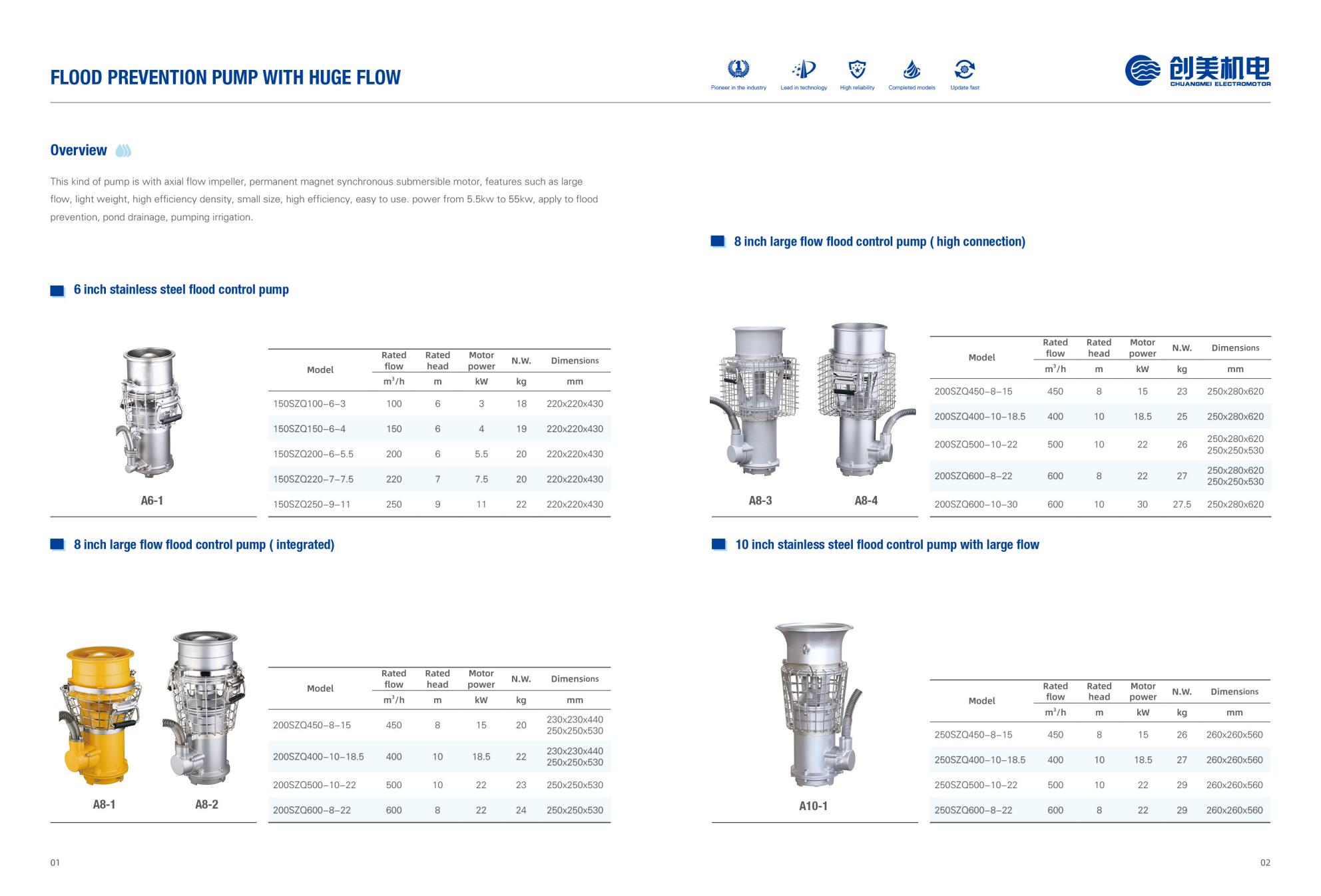
According to product information, the portable submersible axial flow pump models 150SZQ250-10-11, 200SZQ450-8-15 and 100SZQ100-25-11 are designed for water conservancy, flood drainage, construction, agricultural irrigation and municipal engineering. Model 150SZQ250-10-11, for example, is rated at 250 m³/h flow, 10 m head, 11 kW motor power and 380 V voltage, and is intended for clean water or slightly turbid water.
In the manufacturer’s profile, the permanent magnet synchronous motor high-speed axial flow pump is described as having high efficiency, light weight, small size, large flow capacity and portability. The same profile states that the pump impeller is produced by precision stainless steel casting and that the pump shaft is also made of stainless steel. Motor housing and pump body can be provided in aluminum alloy or stainless steel options, while some sub-series use a cast iron pump body with a stainless steel impeller.
What Does “High Speed” Mean in This Pump Category?
The term “high speed” usually refers to the motor technology rather than simply a high shaft rotation speed. A permanent magnet synchronous motor can operate with the rotor synchronized to the stator frequency, which allows relatively high rotational speeds in a compact frame. When applied to an axial flow pump, the motor is directly integrated with the wet-end structure, reducing the footprint needed for a large-flow dewatering system.
Chuangmei Pumps describes its permanent magnet synchronous motor high-speed axial flow pump as the company’s follow-up design to its high-speed well jet pump series, and the company materials reference utility-model patents for both the high-speed well jet pump series and the permanent magnet synchronous motor high-speed axial flow pump. The profile also states that the pump holds China’s national first-class energy conservation certification for high-tech energy-saving products, and that 20 permanent magnet synchronous motor submersible axial flow pump models have been developed.
The most useful technical distinction for a buyer is speed controllability. Company documents explain that pump speed is infinitely adjustable, allowing adjustable head and variable flow. In addition, the permanent magnet synchronous motor is described as being less sensitive to grid voltage variation: even when voltage drops, the motor maintains stable head and flow performance, which is not always possible with a traditional asynchronous motor axial flow pump.
Key Characteristics of Permanent Magnet Portable Axial Flow Pumps
Portable submersible axial flow pumps in this design family are consistently described in the reviewed content as having high efficiency, small size, high power density, light weight and large flow capacity. These characteristics are relevant to procurement because they affect transportation, installation labor, storage space and response time during emergency operations.
Several material and control details are also worth attention:
- The impeller is made through precision stainless steel casting, and the pump shaft is stainless steel.
- Motor housing and pump body can be selected in aluminum alloy or stainless steel; other series use cast iron body with stainless steel impeller.
- The cable outlet is protected with a rubber sheath plus stainless steel spring guard.
- The control cabinet for permanent magnet pump models can include panel display or touch screen display and contains a frequency inverter.
- Real-time display can include frequency, voltage, current and rotational speed.
- Through 3G and 4G mobile networks, remote control by computer and mobile phone APP is possible, including remote start/stop, remote data transmission, and remote speed adjustment.
- The system supports time-segmented operation and automatic protection for overheat, overcurrent, overload, overvoltage and phase failure.
One operationally useful detail is that when water is completely drained, the pump is designed to shut down automatically within half a minute and enter standby mode, helping to protect the coil. Control cabinets can be configured as single-unit or dual-unit systems, with IP44 or IP54 protection ratings, and three-phase four-wire systems with waterproof plugs and sockets.
Common Application Scenarios
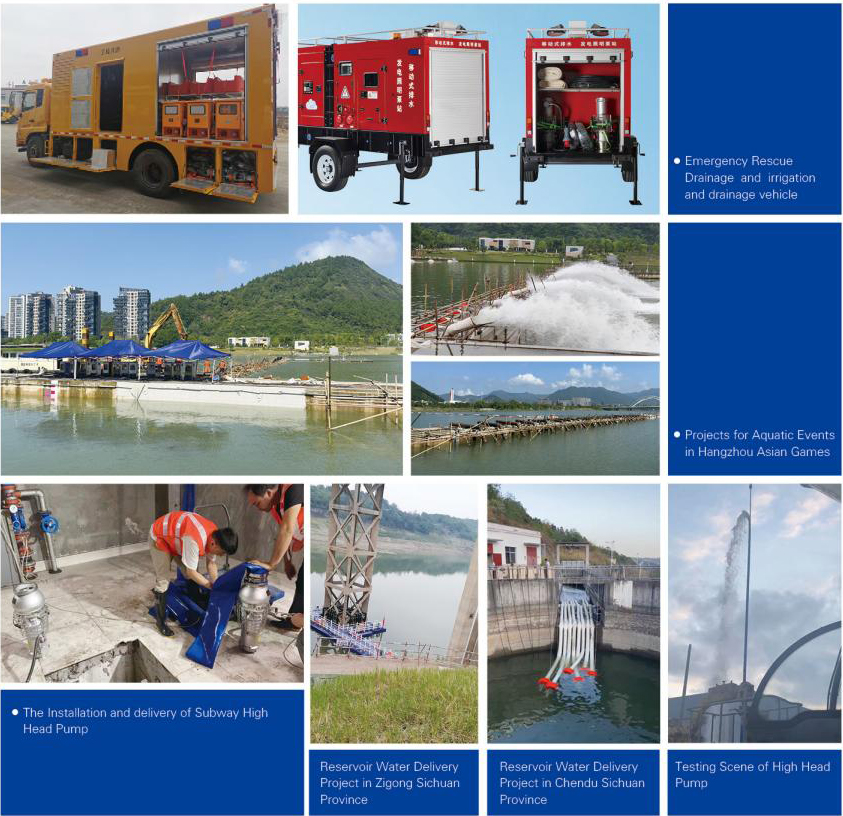
According to application-scenario records, this type of equipment is used in water conservancy and municipal drainage, as well as in civil engineering applications involving bridges, culverts, basements and garages. Typical duties include draining accumulated water, flood discharge, water lifting irrigation, automatic water-level triggered drainage, and pond drainage. Operating conditions can be humid, high-temperature or muddy, and portable pumps are often expected to be anti-clogging and durable in slightly turbid water.
Because the pump can be moved to different locations and connected to a water hose, control cabinet, cable and filter screen, it is suited to emergency flood prevention as well as planned agricultural irrigation. For mobile irrigation and flood prevention, the portable submersible axial flow pump configuration is one of the more practical options documented in the supplier’s portfolio.
For fixed underground drainage, the same permanent magnet submersible pump family can support low-level water intake through a bottom inlet configuration. Customer-facing material lists bottom-inlet pump availability in 6-inch, 8-inch, 10-inch and 12-inch sizes, with flow rates from 100 to 1500 m³/h and power from 3 kW to 300 kW in the broader product range.
How Does This Compare with Traditional Axial Flow Pump Solutions?
Traditional axial flow pump solutions often use asynchronous motors that run at essentially fixed speed unless an external frequency converter is installed. They can be large and heavy relative to permanent magnet designs, and their performance can be affected by voltage fluctuation. For emergency teams that must carry pumps into a location by hand or deploy them from a vehicle, weight and size become major constraints.
| Characteristic | Conventional asynchronous motor pump | PMSM-driven portable pump |
|---|---|---|
| Motor principle | Asynchronous motor, generally fixed-speed operation unless separately supplied with a converter | Permanent magnet synchronous motor with integrated frequency inverter in control cabinet |
| Speed behaviour during voltage dip | Speed and output can drop when grid voltage falls | Supplier states that speed and head/flow remain relatively stable when voltage drops |
| Flow and head adjustment | Usually adjusted by changing impeller or external flow control | Stepless speed regulation; head and flow are adjustable |
| Weight and size | Often heavier and larger for the same flow | Described as light and compact; manufacturer reports about one-quarter the weight of conventional pumps |
| Monitoring and protection | Basic thermal or overload protection common | Panel or touch screen display; remote control options; automatic protection functions |
| Typical deployment | Fixed or semi-portable installations | Mobile flood control, vehicle-mounted systems, fast-response drainage |
This comparison is not a claim that permanent magnet pumps are always the right choice. The PMSM-based system depends on a matched control cabinet and inverter, which adds electronic complexity and may require more careful technical support than a conventional direct-on-line pump. For buyers with very simple fixed installations, available maintenance skills or strict budget limits, a conventional asynchronous pump may still be the more practical option. The relevant task is to match motor technology to the operating environment, not to assume one technology is universally better.
Market Trends and Industry Benchmarks
Several market and regulatory signals explain why high efficiency portable axial flow pumps are receiving more attention from buyers.
The global axial flow pump market is projected by one market-research report to reach approximately USD 4.49 billion by 2026. Market size figures vary because different reports define axial flow pumps differently, but the overall category remains commercially significant.
On the efficiency side, China has implemented GB 30253-2024, a mandatory energy label standard for permanent magnet synchronous motors sold from 2025. This makes motor efficiency documentation more important for buyers purchasing equipment manufactured for the Chinese market. In addition, ISO 9906 is the recognized pump performance testing standard, with Grade 1 tolerances of about ±5% for flow and head used in high-precision OEM applications. Buyers should ask how a pump’s performance curve was tested and which tolerance grade was applied.
For cross-border trade, axial and mixed-flow vertical pumps used mainly for water handling are classified under HS Code 84138130 in many customs systems. Exporters and importers should confirm classification with their customs broker, but this code is a useful reference point for documentation.
Buyer Selection Criteria for High Efficiency Portable Axial Flow Pumps
During the awareness and research phase, buyers can evaluate a high efficiency portable axial flow pump against the following practical questions:
- Flow rate: What volume of water must be moved per hour? Portable axial flow pump models in Chuangmei’s documented range cover nominal flows from about 100 m³/h to over 1000 m³/h depending on series and outlet size.
- Head requirement: Is the job low-head, high-flow drainage, or does it require moderate head such as 20–50 m in underground spaces? Axial flow pumps are most efficient when the head requirement is within the designed operating range.
- Water quality: Is the water clean or slightly turbid? Several models are specified for clean water or slightly turbid water; heavy solids require a different pump selection.
- Portability and access: Does the crew need to carry the pump to a remote location? Aluminum alloy and stainless steel construction options affect weight, corrosion resistance and cost.
- Control and monitoring: Does the operation need remote start/stop, speed adjustment or automatic shutdown when water is drained? This determines whether a single-unit or dual-unit control cabinet with remote communication is justified.
- Verification: Request performance documentation and check whether motor efficiency is supported by standards such as GB 30253-2024 or pump testing by ISO 9906 tolerances.
Future Outlook
Portable dewatering equipment is moving toward higher efficiency and more intelligent operation. Permanent magnet synchronous motor technology is relevant because it enables smaller, lighter pumps with speed control, remote monitoring and better protection. As mandatory energy-label regulations take effect and buyers begin to treat pump efficiency as a measurable specification rather than a marketing term, the importance of motor technology and performance testing is likely to increase.
For an equipment buyer, the immediate implication is practical: verify the actual pump performance, understand the control cabinet requirements, and compare total deployment cost, not just the pump price. The high speed portable axial flow pump category is no longer only about moving water; it is also about doing so with lower system weight, better control and more evidence of efficiency.
FAQ
What is a high efficiency portable axial flow pump?
A high efficiency portable axial flow pump is a portable submersible pump with an axial flow impeller and normally a permanent magnet synchronous submersible motor. It is described as having high efficiency, small size, high power density, light weight and large flow capacity, and is used for flood prevention, pond drainage, pumping irrigation and municipal drainage.
What flow rate can a portable axial flow pump provide?
In Chuangmei’s documented product range, portable pump models include ratings such as 250 m³/h and 450 m³/h depending on model and application. The broader documented product range for bottom-inlet submersible pumps extends from 100 to 1500 m³/h, with power from 3 kW to 300 kW.
Are high efficiency portable axial flow pumps suitable for irrigation?
Yes. Portable submersible axial flow pumps are suitable for pumping irrigation, pond drainage and flood prevention. Application records also include water conservancy, flood drainage, construction, agricultural irrigation and municipal engineering.
What materials are used in a portable axial flow pump?
In the permanent magnet axial flow pump design, the impeller is made through precision stainless steel casting and the pump shaft is stainless steel. Motor housing and pump body can be supplied in aluminum alloy or stainless steel options. Some submersible pump series use a cast iron pump body with a stainless steel impeller.
Can the pump speed be adjusted?
Yes. The pump speed is infinitely adjustable, which allows adjustable head and variable flow. The control cabinet includes a frequency inverter and can display frequency, voltage, current and rotational speed. In supported configurations, remote speed adjustment and remote start/stop are possible through 3G or 4G networks.
What are the limitations of permanent magnet portable pumps?
Permanent magnet motor systems require a matched control cabinet and inverter, which increases electronic complexity and the level of technical support needed. They may not be the simplest option for fixed installations with very basic electrical infrastructure, where a conventional asynchronous motor pump could still be adequate.
Chuangmei Pumps’ public high-flow pump brochure is available here: Download High Flow Pump PDF
Have Questions or Need More Details?
Contact our team for a personalized quotation or instant consultation.
Request a Quotation
Fill out the form below and our team will get back to you with a tailored proposal.
WhatsApp Direct Chat
Prefer to chat in real-time? Message us on WhatsApp for instant assistance & quick answers.
- Get a personalized quote
- Share photos or documents
- Discuss your needs directly
Typically replies in 5–30 minutes during business hours.