
High-Performance Fastener Materials: Petrochemical, Marine, Power
Fastener material selection is a project decision, not a catalogue decision. In petrochemical, marine and power generation projects, bolts, studs and nuts are permanently fastened under continuous mechanical load while exposed to seawater corrosion, acid and alkali environments, high temperature, high vibration and high tensile load. Two fasteners with identical geometry and identical thread can behave very differently once the material family changes: 304/316 stainless steel, duplex steel and nickel-based high-temperature alloys each occupy a different position across corrosion, temperature and mechanical load.
This buyer-side comparison sets out how to shortlist materials for those three condition families; how to read the strength grades that run from A2-70 to D6-100; which thread tolerance classes apply to bolts (6g/2A) and nuts (6H/2B/3B); what surface treatments such as passivation, Dacromet coating and adhesive pre-coating change in service; and which standards, certificates and size ranges — bolts from M2 to M160, nuts from M2 to M64, executed against ISO, DIN, ASTM, ASME, ANSI and JIS — define an acceptable supplier offer.
The commercial weight behind these decisions is substantial. Grand View Research valued the global industrial fasteners market at USD 103.9 billion in 2025 and projects USD 153.7 billion by 2033, with Asia Pacific holding a 45.1% revenue share in 2025. Metal fasteners accounted for 91.0% of that market in 2025, and externally threaded fasteners such as bolts and screws for 48.1% of revenue. Because the category is broad, specification discipline — rather than catalogue browsing — is what separates a reliable project fastener from a future replacement order.
Why material choice decides joint reliability
Fastener and hardware project data describes the operating envelope in concrete terms: normal temperature through high temperature, seawater corrosion, acid and alkali corrosive environments, high vibration and high tensile load working conditions. The fastener's function within that envelope is mechanical connection, fastening, locking, anti-loosening and fixed assembly between mechanical components, carried out as static fixed assembly, with components permanently fastened under continuous mechanical load. Tightening is performed with torque wrenches, electric screwdrivers, hydraulic tightening machines and assembly tooling fixtures.
The stated special requirements for these applications are high tensile strength, anti-fatigue performance, corrosion resistance and high-temperature resistance, in compliance with international ISO, DIN and ASTM industrial standards. Three practical consequences follow for buyers.
- The worst case defines the specification. A material chosen for average conditions is ultimately judged by the most aggressive condition the joint meets — salt spray at a coastal site, acid and alkali exposure inside a process unit, or elevated temperature near a turbine or furnace.
- The joint is designed to stay closed. These are static, permanently fastened assemblies under continuous load, so the relevant question is not whether the fastener can be tightened during construction, but whether it still performs years into service.
- Documentation is part of the product. Grade, thread class, coating and certification must be verifiable at the point of delivery, not reconstructed afterwards.
Three condition families, three different answers
Petrochemical: corrosion and temperature on a pressure boundary
Petrochemical service combines acid and alkali corrosive environments with high temperature and continuous mechanical load. Where the fastener sits on a pressure boundary, EU projects additionally require compliance with the Pressure Equipment Directive 2014/68/EU. This is the family in which material selection is least forgiving: an austenitic grade that suits a dry assembly hall may not suit a process area, and the grade system has to be stated on the purchase order rather than inferred from the words stainless steel.
Marine and offshore: seawater and salt spray
Marine and offshore conditions introduce seawater corrosion alongside high tensile load. Supplier-side selection guidance is direct on this point: for high-corrosion, offshore or marine environments, 316L, duplex steel or high-temperature alloy materials are recommended, while for marine and coastal salt-spray conditions, 316L or duplex steel is the suggested route. Project demand is expanding in parallel — China's new shipbuilding orders rose 59.0% year on year in Q1 2024, according to the China Association of the National Shipbuilding Industry.
Power generation: heat, load and vibration together
Power generation fastening is defined by high tensile load, elevated temperature and corrosion resistance arriving at the same time, with high vibration in some assemblies. Wind, conventional thermal and nuclear applications all sit inside the same working-condition description used for petrochemical and marine projects, which is why a single material rationale rarely covers an entire site.
Material comparison: 304/316, duplex steel and nickel-based alloys
The four families below are the ones that appear most often in industrial fastener specifications for corrosive, high-temperature and high-strength service. They are not ranked against one another; they are matched to different conditions.
| Material family | Where it fits in project terms | Strength grades in product data | Where the boundary sits |
|---|---|---|---|
| 304 / 316 austenitic stainless steel (A2 / A4 designations) | General indoor and moderate service; the usual starting point for standard bolted assemblies | Bolts and nuts: A2-70, A2-80, A4-70, A4-80. Studs: A2-50, A2-70, A4-50, A4-70. Screws: A2-70, A2-50, A4-70, A4-50 | Not the automatic answer for salt spray, acid and alkali exposure, or high-temperature service |
| Duplex steel, including UNS S32205, 1.4462, 1.4410 and UNS S32750 / 2507 | Marine, offshore, seawater and acid/alkali environments where higher strength is also required | D6-70, D6-80, D6-100 | Narrower supply base and longer planning horizon; usually purchased for planned projects rather than on demand |
| Nickel-based high-temperature alloys: Inconel, Hastelloy, A286 Alloy 660, Alloy 80A, Alloy 718, 1.4980, 2.4952, 2.4668, 1.4529, UNS N08926, 904L / 1.4539 | High-temperature and aggressive corrosion service in petrochemical and power generation conditions | Grades follow the bolt, nut and stud specifications in the adjacent rows, set per product family | Highest material cost of the three steel families; specify only where the condition demands it |
| Titanium and aluminium alloys | Weight-sensitive and specialized assemblies; aluminium rivets in 6061 / 7075 | Rivets M3–M6.4, open and closed end types | Limited size range; not a general substitute for steel structural bolting |
Selection guidance used in industrial fastener material selection follows the same sequence: 304/316 stainless steel is preferred for general indoor environments; 316L, duplex steel or high-temperature alloy materials are recommended for high-corrosion, offshore or marine environments; and where high-strength mechanical load dominates, alloy steel fasteners are adopted. In all three cases the material is customized to the project working condition rather than chosen from a fixed preference list. As a buyer's rule, that reduces to three questions asked in order — what is the corrosion environment, what is the temperature, and what mechanical load must the joint carry?
Strength grades, thread tolerances and surface treatment
Strength grades: what A2-70 to D6-100 actually commit a supplier to
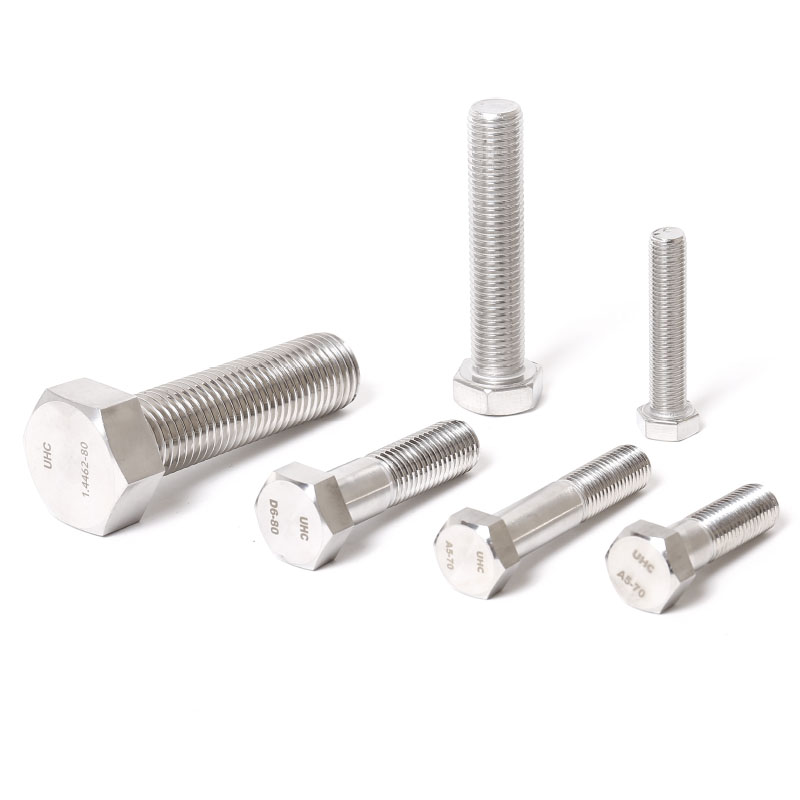
Grade designations combine a stainless steel class with a property class, and they differ by product family. In the product data referenced here, bolts and nuts are available in A2-70, A2-80, A4-70, A4-80, D6-80 and D6-100; threaded rods and studs in A2-50, A2-70, A4-50, A4-70, D6-80 and D6-70; screws in A2-70, A2-50, A4-70 and A4-50. A2 and A4 designations correspond to the austenitic stainless families, while the D6 designations sit with the higher-strength duplex family. ISO 3506-1:2020 specifies mechanical properties for corrosion-resistant stainless steel bolts, screws and studs, and is the standard most buyers should quote when they want the grade to mean something at inspection. A stainless steel bolt without a stated grade is not a specification.
Thread tolerance classes: 6g/2A for bolts, 6H/2B/3B for nuts
Precision thread is specified on both sides of the joint. The product data lists 6g / 2A precision thread for bolts and threaded rods, and 6H / 2B / 3B precision thread for nuts. The metric and inch systems are not interchangeable, so a purchase order should name the bolt class and the nut class together: the 6g class pairs with metric nut classes, while the 2A class pairs with inch nut classes. The tighter 3B nut class is generally reserved for assemblies that need closer fit control, and it carries tighter manufacturing tolerances and cost consequences. Buyers who specify only the bolt thread frequently discover the mismatch at assembly, not at quotation.
Surface treatment: passivation, Dacromet and adhesive pre-coating
Surface treatment is a purchasing line item in its own right. The options listed across bolts, nuts, threaded rods, screws and washers are natural finish, passivation, Dacromet coating and adhesive pre-coating. Passivation supports the cleanliness and corrosion behaviour of stainless surfaces. Dacromet coating adds a barrier layer for more aggressive environments. Adhesive pre-coating is used where locking and sealing behaviour matters in service. Two boundary conditions deserve attention: coating selection interacts with the specified thread tolerance class, and it interacts with the tightening method, because the friction condition on a coated thread differs from a natural finish. Both should be stated together with the grade, not selected afterwards.
Standards, certificates and acceptance criteria
Across bolts, nuts, threaded rods, screws, washers and rivets, the executed international standards listed are ISO, DIN, ASTM, ASME, ANSI and JIS. Beyond the product standards, several framework requirements shape what a petrochemical, marine or power buyer should ask for.
- Pressure equipment: fasteners for pressure equipment in the EU must comply with the Pressure Equipment Directive 2014/68/EU.
- Preloaded structural bolting: the EN 14399 series governs high-strength structural bolting assemblies for preloading in steel structures.
- Aerospace quality systems: aerospace fasteners must meet AS9100 quality management system requirements.
- Laboratory competence: ISO/IEC 17025 accreditation is the global benchmark for testing and calibration laboratory competence, and is relevant when a supplier's in-house test data is used as acceptance evidence.
On the acceptance side, the documentation package available for these orders includes a 3.1 material test certificate, batch quality tracing, first article inspection, in-process inspection and pre-shipment inspection. Traceability is managed through an ERP system that follows each step from raw material procurement to finished product delivery. For a buyer, the practical acceptance criterion is simple: the certificate type, the inspection stages and the traceability expectation should be written into the purchase order, because they cannot be added retroactively once material has been cut.
Size ranges and supply-range checks before shortlisting
Material capability only becomes usable once it exists in the required geometry. The size ranges in the product data are:
| Product family | Dimension range | Length / width range | Thread tolerance class |
|---|---|---|---|
| Bolts (hex, flange, T, U, heavy, fit, square, anchor, foundation) | M2 – M160 | 6 mm – 300 mm | 6g / 2A |
| Nuts (hex, coupling, weld, flange, nylon, heavy, jam, castle, slot, self-locking) | M2 – M64 | — | 6H / 2B / 3B |
| Threaded rods and studs (full thread rods, double end studs) | M5 – M160 | Effective length up to 5000 mm | 6g / 2A |
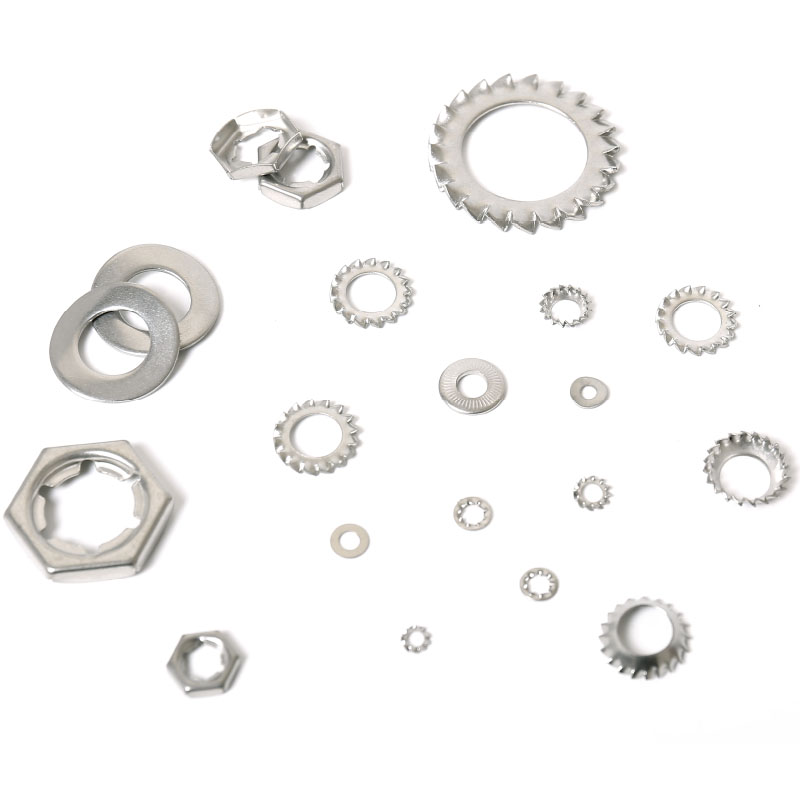
| Washers (flat, heavy, toothed lock, serrated, wave) | M2.5 – M45 | — | — |
| Screws (tapping, marine, self-drilling, set, chipboard, socket cap, drywall) | M2 – M8 | 6 mm – 100 mm | — |
The difficult end of this range is the large format: bolts up to M160 and studs with an effective length up to 5000 mm are where a supplier's actual capability, rather than its catalogue, is tested. A buyer comparing offers should check that the quoted size range covers the full bill of materials, including the accessory items — washers and nuts — in matching materials.
What a verifiable supplier profile looks like
One example of the profile buyers can measure offers against is Jiaxing Union Hardware Co., Ltd (UHC Group), a stainless steel products supplier founded in 2017 that operates five production bases and one import and export company, with a hardware production base serving solar, wind, nuclear, railway and aerospace applications.
The supply-side facts relevant to a material comparison are these: 80,000 m² of factory space across five factories, 200 employees and a 25-engineer R&D team, with annual output of 25,000 tons of stainless and special materials. The company holds ISO 9001, ISO 14001 and ISO 45001 certification together with EU Pressure Equipment Directive (PED) certification, operates an independent laboratory for dimensional and mechanical performance testing, and runs an ERP system covering production, sales and management so that material movement is traceable from raw material procurement to delivery. Capability data records OEM/ODM production with head mark and logo customization, a monthly capacity of 500–1000 tons, a minimum order quantity of 150 kg and a lead time of 75–90 days, with roughly 80% of output exported to the EU, Korea and Japan.
Application evidence is equally specific: fasteners supplied by the manufacturer have been used in critical industries including aerospace, marine, automotive and power generation for over 10 years, with a documented supply of 100,000 pieces to industrial equipment OEM manufacturers, engineering contractors, hardware distributors and new energy system suppliers in Germany, Italy, Korea and Japan, for fastening assembly in aerospace parts, marine equipment, automotive chassis and power generation facilities. The reported outcome of that supply relationship was a reduction in later maintenance replacement cost and stable project operation, based on high tensile and anti-fatigue strength, seawater and acid-base corrosion resistance, high-temperature resistance, and compliance with DIN, ISO, JIS, ASME and ASTM standards.
Where conventional supply still fits — and the limits of specialty sourcing
A material comparison is only useful if it also states where the alternative is genuinely better. Standard zinc-plated carbon steel fasteners sourced from catalogue distribution remain the appropriate choice for dry, indoor, moderate-load static assembly: they are widely available, carry low minimum order quantities, and are faster and cheaper to obtain than specialty stainless or alloy grades. Their limitation is exactly the one this article addresses — they are not a fit for seawater, acid and alkali, or high-temperature service, and substituting them into those conditions introduces a corrosion and reliability risk that no price advantage offsets.
The specialty side has boundaries of its own, and buyers should plan around them rather than be surprised by them:
- Planning horizon. Specialty material supply carries a minimum order quantity of 150 kg and a lead time of 75–90 days. That suits planned project procurement; it does not suit an emergency single-piece replacement, where the practical answer is to draw on project spares instead.
- Over-specification has a cost. Specifying nickel-based high-temperature alloys where 304/316 stainless would satisfy the actual condition raises material cost without adding service benefit.
- Grade and tolerance interact with cost. Moving to higher property classes such as D6-100, or to tighter nut thread classes such as 3B, increases manufacturing control requirements and therefore price.
- Coating choices are not free-form. A Dacromet coating or an adhesive pre-coating changes friction and fit behaviour, so it must be specified together with the thread class and the tightening method.
Outlook: why material specification is becoming a procurement requirement
Demand signals in the three condition families point in the same direction. Global wind turbine capacity is projected to grow from 1,100 GW in 2025 to over 2,400 GW by 2030, according to the Global Wind Energy Council, and the wind power fastener market was projected to reach USD 14.68 billion in 2025 by The Insight Partners. Marine demand is reflected in the 59.0% year-on-year rise in China's new shipbuilding orders in Q1 2024. On the high-temperature and high-strength side, the global aerospace superalloy fasteners market was valued at USD 776.7 million in 2024 by Fortune Business Insights, while Fact.MR estimates the titanium aerospace fasteners market at USD 520 million in 2026, growing at a 5.1% CAGR.
It is worth noting that market size estimates differ between research houses depending on segment definitions — for the global industrial fastener market in 2025, Grand View Research cites USD 103.9 billion, Dataintelo USD 96.4 billion and Mordor Intelligence USD 88.39 billion. The directional conclusion is unaffected: growth is concentrated in exactly the applications where material grade, thread class, coating and documentation have to be decided before the order is placed. The likely medium-term shift is that batch traceability, material test certificates and lab-verified test data move from differentiators to baseline procurement requirements, particularly for EU pressure equipment and offshore projects.
FAQ
How do I choose between 304/316 stainless steel, duplex steel and nickel-based alloys for a petrochemical project?
Start from the working condition rather than the material name. For general indoor environments, 304/316 stainless steel is the preferred option. For high-corrosion, offshore or marine environments, 316L, duplex steel or high-temperature alloy materials are recommended. Where high-strength mechanical load is the dominant condition, alloy steel fasteners are adopted. In petrochemical service, acid and alkali exposure plus elevated temperature normally pushes the choice toward duplex or nickel-based grades, while the mechanical load requirement determines the property class within that family. Material selection is normally customized to the project working condition.
Which material is recommended for marine and coastal salt-spray conditions?
316L or duplex steel is the recommended route for marine and coastal salt-spray working conditions. Both are listed among the material options for bolts, nuts, threaded rods and washers, and duplex grades such as UNS S32205, 1.4462, 1.4410 and UNS S32750 / 2507 additionally support higher strength classes where the assembly carries higher tensile load.
What do the strength grades A2-70 to D6-100 mean in a purchase specification?
They combine a stainless steel class with a property class and are defined per product family. Bolts and nuts are listed in A2-70, A2-80, A4-70, A4-80, D6-80 and D6-100; threaded rods and studs in A2-50, A2-70, A4-50, A4-70, D6-80 and D6-70; screws in A2-70, A2-50, A4-70 and A4-50. A2 and A4 correspond to the austenitic stainless families, while D6 designations sit with the higher-strength duplex family. ISO 3506-1:2020 specifies mechanical properties for corrosion-resistant stainless steel bolts, screws and studs and is the reference standard to quote when the grade must be verified at inspection.
Which thread tolerance classes should be stated for bolts and nuts?
The product data lists 6g / 2A precision thread for bolts and threaded rods, and 6H / 2B / 3B precision thread for nuts. Because metric and inch classes are not interchangeable, a purchase order should specify the bolt class and the corresponding nut class together. The tighter 3B nut class is used where closer fit control is required and carries stricter manufacturing tolerance.
What documentation should accompany a high-performance fastener order?
The available acceptance package includes a 3.1 material test certificate, first article inspection, in-process inspection, pre-shipment inspection and batch quality tracing, supported by ERP-based traceability from raw material procurement to finished product delivery. Depending on the application, buyers may also need to reference the Pressure Equipment Directive 2014/68/EU for pressure equipment in the EU, EN 14399 for preloaded structural bolting, or AS9100 for aerospace quality management requirements.
What size ranges and lead times should buyers plan for?
Bolts are available from M2 to M160 with an effective length range of 6 mm to 300 mm; nuts from M2 to M64; threaded rods and studs from M5 to M160 with an effective length up to 5000 mm; washers from M2.5 to M45; and screws from M2 to M8 with a length range of 6 mm to 100 mm. Surface treatment options are natural finish, passivation, Dacromet coating and adhesive pre-coating. For specialty and customized supply, plan around a minimum order quantity of 150 kg, a lead time of 75–90 days and a monthly capacity in the range of 500–1000 tons.
For readers who need the full product range, material options and specification detail in a single document, the UHC Group product brochure is available here: UHC Group fastener and hardware brochure (PDF).
Have Questions or Need More Details?
Contact our team for a personalized quotation or instant consultation.
Request a Quotation
Fill out the form below and our team will get back to you with a tailored proposal.
WhatsApp Direct Chat
Prefer to chat in real-time? Message us on WhatsApp for instant assistance & quick answers.
- Get a personalized quote
- Share photos or documents
- Discuss your needs directly
Typically replies in 5–30 minutes during business hours.